NIGHT MOVES

By Marc S. Sanders

As soon as composer Michael Small’s easy listening disco themes kick in and you see Gene Hackman make a u-turn in his green Ford Mustang convertible, I had vibes that Night Moves was going to operate like an episode of The Rockford Files.  I was alert and energized.  I liked where this was going.  A new, undiscovered gritty 70s movie to sink my teeth in.

Gene Hackman is Harry Moseby, a perfect name for a private detective.  Arthur Penn is the director in his second of three collaborations with the actor.  The film starts off well for Harry.  He’s giddily promiscuous and happily married to Ellen (Susan Clark), and he’s ready to take on a new case. 

A Hollywood has been actress needs Harry to find and bring back her sixteen year old, runaway daughter named Delly (Melanie Griffith, in her debut role).  Through a lead in the form of a young, punk kid (James Woods, in an early role), Harry flies out to the Florida Keys where Delly might have taken up with her step father.  

Seems easy enough, but before he departs Harry does some personal investigating on the side and discovers that Ellen is having an affair with a guy named Marty (Harris Yulin).  Harry’s carefree exterior is shattered.  Quickly, he becomes bitter towards all he cared about, from his wife and his profession which serves a purpose of lifting the veil on sins and secrets.  

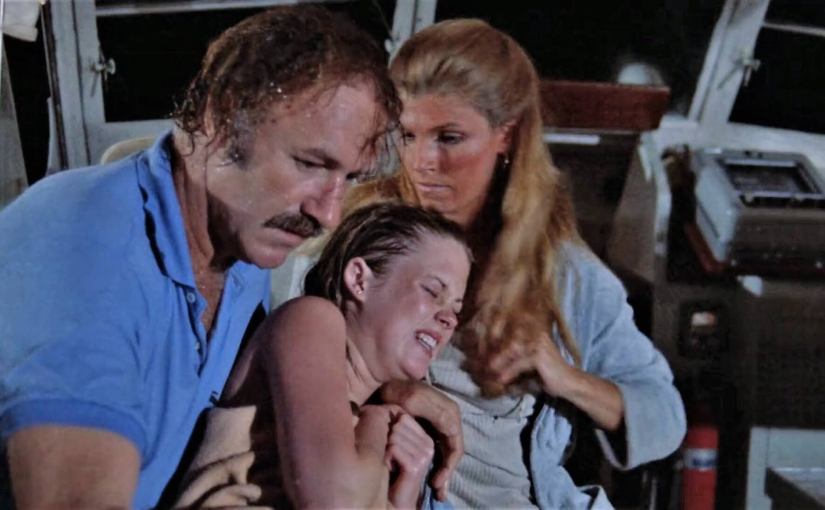
Night Moves performs with unpredictable directions and tempos.  When Harry finds Delly with her step father Tom (John Crawford) and his younger girlfriend Paula (Jennifer Warren), the rundown boat dock where they reside seems relaxing and tranquil.  Paula tends to a dolphin pen.  There’s a plane that Tom uses for shipment trips.  Drugs?  Harry is not all that concerned.  He’s only here to pick up Delly.  A boat is there for fishing and swimming off of too.  Delly feels welcome and independent here.  Though as a teen she’s resistant to Harry’s obligation to return her to her mother in Los Angeles.  

It’s only after he wraps up the case that unexpected twists occur and now he’s got to backtrack to find out what is really going among the ranks of these folks.  In parallel succession, Harry and Ellen have to wade through their own sordid conflicts.  

Watching the Criterion issue of Night Moves was really interesting.  After seeing the film, I watched two different interviews with director Arthur Penn.  There are lots of discoveries to find in the film all the way down the very last frame of the picture.  However, the revelations of the mysteries are not told but rather shown.  Dialogue hardly spells out this story.  It’s what Arthur Penn allows you to see.  He described it as explaining through a lens or view from a window, for example.  As Penn speaks, Criterion edits in quick moments where mirrors and windows that were woven into the final cut of the film provide new information and answers.  It’s a very clever strategy.

The sinister happenings of Night Moves are undetectable until Harry gets wise.  It made me think of what Jake Gittes experiences in Chinatown.  The new assignment seems so easy.  An open and shut case until the complexities surface from under water or even high above.  

What separates Night Moves from the Mickey Spillane gumshoe stories or Chinatown and The Maltese Falcon for example, is that Harry Moseby’s personal hell interferes with an occupation where he’s meant to serve from outside of all of the sordidness.  Harry won’t slack on his case, but he still has to grapple with a sudden broken marriage that he is so capable of uncovering from his wife and her bumbling lover.  He’s not a loner like Sam Spade, Jake Gittes or Mike Hammer.  He’s opted to open his own private practice and dig into others personal conflicts and misgivings.  On the side, he wants a happy home life.  Problem is he is just too damn good at what he does.  So, he’ll get hurt.  It’s the cost of his talents.

This is a great performance from Gene Hackman.  He seems like a put together Jim Rockford in the form of James Garner.  Yet, when the film steers into the tsunami of its conflicts, this character splinters apart.  Hackman has always been good at evoking strength and confidence in the romances and adventures his characters get into as well as with their various occupations.  He’s also a dynamo at showing how his characters crack and become undone (Crimson Tide, The Conversation, The French Connection).  

The supporting cast of lesser known but familiar character actors are collectively stellar as well.  Sharing scenes with Hackman only makes them look more engaging and natural in either their privileged Hollywood, California habitats or the earthy locales of Florida islands.  Arthur Penn assembles this whole cast in great footage and sequences.

Whether it’s a trip to Florida or back to California, a late night personal stake out and break-in at an ocean beach house, a visit to a film set, or a moonlit boating venture in the Keys, Alan Sharp’s script never foreshadows what’s too come.  Thus, Night Moves offers a verity of the sinister and complex.  Just when you think you don’t need to carry much thought with the picture, it suddenly begins to challenge you.

Night Moves will have you believe it gets its title from how Harry plays the strategies of two celebrated chess champions against one another.  He explains to Paula, that while it may seem that the players are three moves ahead of each other, they’re really not.  Instead, there’s play going on beyond a standard trap of check or checkmate.  When everything is laid out to the very last second, it all makes sense even if Harry never had the instinct to think of any likely scenario before.  

Was I a little vague with you just now?  

Good.  

That’s how Night Moves serves its audience best. A stunning, unpredictable thriller.

THE VERDICT

By Marc S. Sanders

Sidney Lumet is a master filmmaker at shooting predominantly talkie films. In The Verdict by David Mamet, his best special effect is, at least, the just as legendary Paul Newman as washed-up alcoholic attorney Frank Galvin. Lumet opts to shoot Newman for the screen talent he is. Occasionally, his camera points up at Newman, who looks as if he will fall over. Lumet also makes Newman look great as he runs down a hallway, or with a stare of his familiar blue eyes. The chemistry of camera and performance are blended rhythmically.

Alcoholism has been depicted countless times, but Newman’s interpretation ranks at the top of the list. He can’t function without his drink whether it’s gaining a high score on pinball, flirting, reading a brief or even getting a fast protein fix by dropping an egg yolk in a beer. Paul Newman makes you wonder if Frank Galvin is going to pass out or fall asleep even while he’s barely practicing legal brilliance. He toes the line beautifully between coming undone and barely squeaking by. This is one of his best roles ever.

Frank is given a chance to salvage himself as goes up against the Boston Archdiocese and the hospital it owns in a case of medical negligence, who are represented by a conniving antagonist in the form of James Mason with his limitless resources, power, strategies and army of lawyers. If this were a silent film, I’d buy it with Mason twisting a handlebar mustache. He’s absolutely a man you love to hate.

The dialogue crackles against simply the inflection of vocals from Newman, Mason, an unexpected Charlotte Rampling as Galvin’s sudden love interest, a difficult judge played by Milo O’Shea, and Frank’s assistant played Jack Warden. The delivery of lines, the twisty double crosses, and conflicts play to the precision of great Shakespeare. So much so that when on the rare occasion these characters curse or the ominous cue of music steps in, it’s all shocking and applauded.

The settings are great for atmosphere too. Worn in leather chairs, polished cherrywood tables and courtrooms with their squeaky floors. This is a well-worn Massachusetts backdrop of legal reputation and intimidation.

Every member of the filmmaking team from Lumet to the cast, to the composer,Johnny Mandel, and David Mamet’s fantastic script have been thought out and measured to completion.

Some will say this film is dated (rotary phones, ladies’ hairstyles, wardrobe; year of release was 1982). I say its themes are still significant. Power is something that must always be overcome by a weak, flawed protagonist. Whether or not Frank Galvin can do it, matters not. It’s the struggle that’s important to follow in a film like The Verdict.

NORTH BY NORTHWEST

By Marc S. Sanders

A story of mistaken identity becomes one of the grandest adventures on film with Alfred Hitchcock’s North By Northwest. The movie plays at such a fast pace, moving from one locale to the next and it all feels convincingly possible.

Before James Bond, there was the dashing Cary Grant in his sharp, fitted light grey suit (the best suit to ever be shown on film) portraying advertising executive Roger Thornhill who simply raises his hand in the air while meeting some colleagues at The Plaza Hotel in New York and is suddenly mistaken for a man named George Kaplan. Soon he’s forced into a car by two men and driven to an estate property belonging to someone named Townsend (James Mason) who implores “Mr. Kaplan” to cooperate or else. Suddenly, Thornhill who continues to insist he’s not Kaplan is on a cross country journey while escaping the authorities who want him for murder while he tries to prove his true identity and exonerate himself.

Cary Grant is dashingly fun with Hitchcock’s camera. It’s refreshing for a change to watch an innocent protagonist not lay on the heavy drama and panic so much. Hitchcock with Grant were going for a sweeping story of cat and mouse play.

What Alfred Hitchcock does best is put the viewer right in position of Thornhill. For the most part (definitely through the first forty minutes) the viewer only knows what Thornhill knows. We know he’s been mistaken for someone else and we are only given the opportunity to put a few names with faces and get a hold of a crumpled photograph. That’s all we and Thornhill have to go on.

Later on, it’s only fortunate that Thornhill comes upon one of Hitchcock’s celebrated blond actresses he was always reputed to cast. This time it is the incredibly striking Eva Marie Saint as Eve Kendall who becomes a willingly helpful train companion for Thornhill. Cary Grant and Eva Marie Saint make for a spectacular on screen couple. Their chemistry is so natural together.

Not much else should be said about the story of North By Northwest. The entertainment comes from what each new scene reveals. Hitchcock incorporates all the expected twists and makes sure to use a MacGuffin, of course. This time it involves a statue and microfilm. What’s on it? That does not so much matter really. It’s the need to pursue it that’s important. The pursuit is what drives the picture from New York City to the United Nations, all the way to a curious auction house for fine art and then on to the four famous faces of Mount Rushmore in South Dakota.

Naturally, Hitchcock is the master once again as he points his camera up close on Grant, Mason and Saint and then quickly will cut to one of their points of view to lengthen the suspense. Running after or away from something in the moment is where Hitchcock is very strong as a storyteller. It keeps you alert as a viewer. Very alert!!!

James Mason makes for a terrific villain as Townsend, or could he be someone else? He’s got that sneaky inflection in his voice and short build that makes for a great antagonist against Cary Grant’s tall stature. Mason’s sidekick, Leonard (a mysterious looking Martin Landau) is also a spooky guy to keep your distance from.

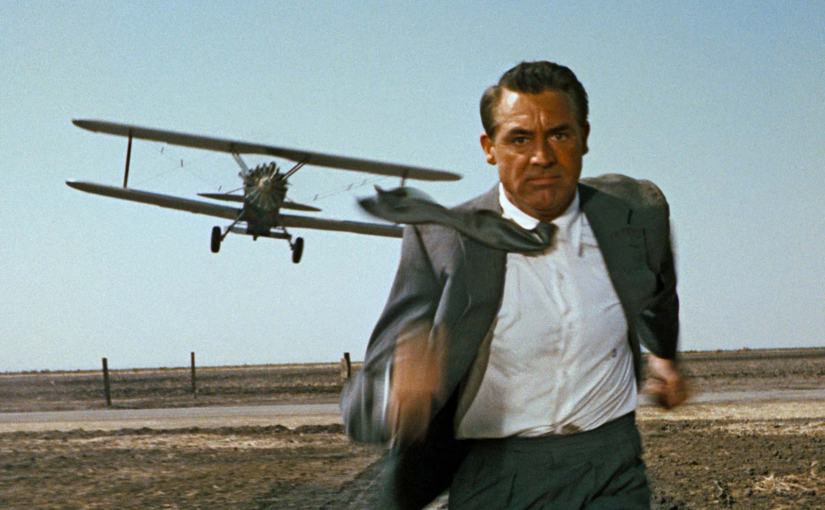
The most celebrated scene probably also contains one of the best captions caught in film. I speak of the very surprising crop duster chase. As Roger Thornhill finds himself in a quiet, Midwestern dirt road intersection, an airplane crop duster turns into a frightening menace. The best shot occurs as Grant runs quickly towards Hitchcock’s camera and the plane flies overhead rapidly getting closer in the upper left side of the screen. As Grant runs and runs, he fills more of the screen, but so does the crop duster. The editing alone is spectacular, as an oil rig eventually comes into play with Grant about to get run over. Story wise, I adore this scene as somehow the life of a man who routinely gets in taxicabs and hob nobs through New York City on a daily basis suddenly has found himself in a dusty field running for his life. What was never expected is suddenly all that matters to this ordinary man.

Hitchcock plays with what’s around to play with. Other than a quick gag in Superman II, l don’t recall many films incorporating Mount Rushmore as such an important element to its picture. Every crevice or ledge or finger hold is important to the edits of the climax in North By Northwest. When Eva Marie Saint is holding on for life, I truly believed she could actually fall. [SPOILER ALERT] Actually, Hitchcock wanted you to believe that as the very last scene doesn’t even truly reveal the solution to her predicament. I like his method of editing this way. Hitchcock seemingly offers no option for survival as Grant and Saint’s hands barely hold on to one another. The editing is just so damn good here.

I’d be remiss if I also didn’t recognize one of the greatest orchestral scores in film. Bernard Hermann’s stirring, fast paced rhythms keep the running man theme in play. The movie seems to play by the beats of Hermann’s conduction. Action films of the future seemed to adopt some measures from he did with this film.

North By Northwest will always remain as one Alfred Hitchcock’s best films. There is not one error in the picture. Every shot is done with deliberate intent to sustain the mystery of suspense. Humor is included even at times on a risqué and subtle measure. Alfred Hitchcock again invites the simplicity of storytelling to introduce the complexity of fear and mystery and outstanding suspense. Not many films compare to North By Northwest.

12 ANGRY MEN

By Marc S. Sanders

This film lives up to its reputation.

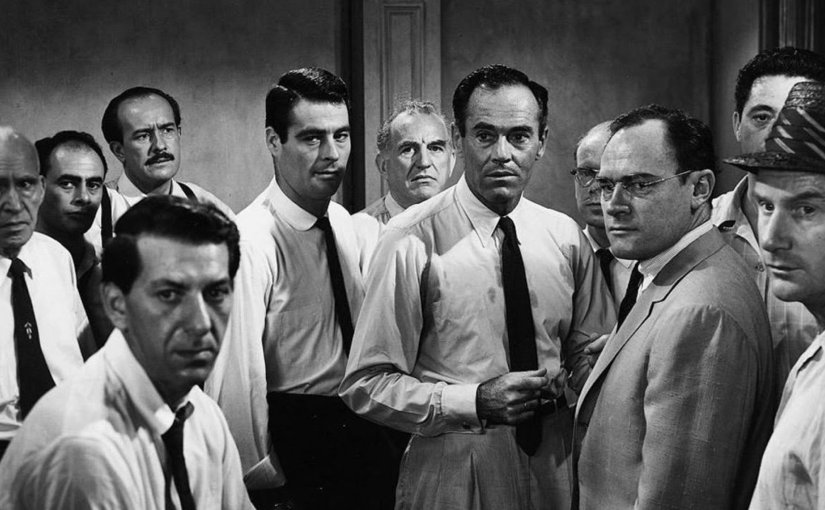
This was the great Sidney Lumet’s first theatrical film, and for a project limited mostly to only a claustrophobic and hot room, it boasts a lot of talent; Henry Fonda, Martin Balsam, Lee J Cobb, Jack Klugman, Jack Warden, EG Marshall.

For a black and white picture Lumet and his crew are effective at showing tiny details like sweat on brows and shirt stains, a broken ceiling fan, and the mental exhaustion of limited breathing space as twelve citizens debate over the guilt or innocence of a young man on trial for killing his father by stabbing. Lumet’s camera (just like when I watched The Verdict) is constantly traveling, even if it’s in a tiny confined space. He zooms in when he needs to and he changes angles to get the most of 12 different perspectives. Lumet keeps it interesting by changing up his use of lens. As the afternoon proceeds into early evening, the camera navigates more closely to the table they sit at. The men are uncomfortable, frustrated with each other, more impatient and more concerned with their consciences about sending a man to death. The actors do well with translating these factors, but Lumet sends the message home.

What I found most interesting is the different variations of how each juror eventually comes to changing his mind. Almost all of them arrive at that point in a new or different way. Credit goes to screenwriter Reginald Rose for that. Additional credit for the different variations of how the jurors repeatedly cast a vote; raising hands, notes, anonymously, not anonymously and so on. Rose changes it up each time to keep the viewers’ attention.

Rose’s script will only tell you so much. The attorneys don’t appear in the film, deliberations are done, we only get a close up of the defendant but there’s not enough material for a viewer to cast judgment. The film opens with the judge giving a boring routine instruction as to how the jury should proceed. He might as well be telling them how to complete an SAT exam.

Yet what we are treated to are the faults and overcomings of the human spirit. Ed Begley is a juror who gives a brilliant monologue that stereotypes the defendant’s ethnic background, though we never know what race or ethnicity he is. As he continues to rant, every other juror steps away from the table. Begley seems to get more ashamed of his thought process as he carries on, but he doesn’t stop until he’s ordered to by another juror. Amazing!!! In 1957, when Jim Crow and McCarthyism were on the horizon or rampant, this film was not having it. It’s the best scene in the film.

Henry Fonda is great as the one who only asks for sensibility. He adds weight to the case they are deliberating over that the others are sadly failing to recognize. A man’s life is in their hands.

I’d argue that the facts of the case and evidence presented carry very little complexity to what a real murder trial might offer. I’d also argue that what serves as a fulcrum to sway each vote is maybe a little too convenient (presuming the time it takes for one witness to walk or whether a witness wore glasses), but that doesn’t matter. What’s most important is whether each of these men can live up to the demand of recognizing reasonable doubt; the necessary requirement for a trial by jury. In that sense, 12 Angry Men succeeds.

PATTON

By Marc S. Sanders

You may find this hard to believe but as I was watching the epic Best Picture winner of 1970, Patton, I was actually thinking of a dreadful film I had seen the day before called Under The Cherry Moon, featuring and directed by Prince.  How in the hell could that be?  Well, both films are laced with the vanity of their films’ main characters to the umpteenth degree.  However, I’ll save Prince’s piece for another column, when maybe I’m out of excuses to avoid death or a root canal.  The point is both films never tire of the close ups of its featured player to enhance the pride, ego and conceit they do not hesitate to thrive off of.  The difference is that director Franklin J Schaffner knew that to really show what motivated General George S Patton you had to drill for the American warrior’s drive, and Patton’s motivation was truly his own self-worth.  (Prince just wanted one more close up on top of one more close up as a means of self service.  Sorry but that’s not enough of a reason for a character to live.)

Patton is portrayed by George C Scott in an Academy Award winning performance.  No one else could have played this role.  No one else should ever play this role again.  Scott and Patton are symbiont in a camera’s lens.  One can not be imagined without the other.  Schaffner’s film opens in front an American flag that fills the entire screen.  Patton steps up in front.   Somehow, his figure seems like a bigger, more prominent figure than the large backdrop of the stars and stripes.  He delivers a monologue that was aimed at the troops fighting in the second World War, but this is really an introduction to the audience of what to expect for close to the next three hours.  He reminds us that the blood and guts of the Nazis will be used to grease down the tread of our tanks and he will be proud to lead his men on any battlefield that calls for the bloodshed of Hitler’s regime.  In the film’s first five minutes, you know that this biographical character will never sway from what he stands for.

The theme of the film tests the egotism of General Patton.  We see him get dressed in his military uniform before heading in to battle.  His subordinates put his military jacket on.  Another one places his helmet upon the great battalion leader’s head, but it is done with great detail.  This helmet will never fall off.  I can promise you that.  Early in the film, the two star general takes it upon himself to decorate his shirt collar with three stars.  He’s reminded that President Eisenhower has not made his promotion official yet.  Patton proudly dismisses that detail.  None of this has to do with the strategist Patton became known for on the battleground.  George C Scott demonstrates that the General knew when to bestow himself with another honor in his proud military career.  No one else, not even the Commander in Chief, would determine when the General was worthy of another star.

In the heat of battle, Patton happily volunteers historical facts about the regions he is fighting on.  He even insists that he knows for sure what happened before.  He, General George S Patton, was there.  He’s not kidding.  He truly believes that.  History did not deliver General George S Patton.  Rather, General Patton delivered history. 

All throughout the film, Patton is seen in moments of great pride.  He’ll be standing as his jeep caravans his military forces through conflicts in Tunisia and war torn Europe.  General Patton loved to lead, but his leadership was specific to sending a battalion into one conflict after another and what was most important was earning the glory for himself.  The British couldn’t have the accolades.  Certainly, his fellow generals couldn’t either.  Patton is who the Nazis feared.  Patton is the towering six foot tall man who must be seen walking off the bow of a ship into battle when the US back home gets film updates. 

Scott’s character is tested however as Ike loses confidence in the great general.  Patton’s mentality on war does not mesh well with the propaganda of the United States with the other allied countries, particularly Russia.  Patton is not interested in making friends with Russia as he is more concerned with anticipating an eventual disagreement with them and thus, we must be prepared for war.

More significantly, Patton only cared for the bravery of his men.  Early on in the film, Patton arrives at the camp site of a US battalion to take over its leadership.  George C Scott’s presence is all that needs to be said as he visits the mess hall followed by an office and then an infirmary.  Men will no longer show up late for breakfast.  If other men are going to sleep, well then that’s fine as long as it is a means to end with an advantage towards military victory.  Doctors will don their helmets even if it means drilling holes in them to continue properly using stethoscopes, and any man who is being treated for self-inflicted gun shot wounds will not be entitled to a bed for healing.  Get those cowards out immediately.  Hospitals are for those soldiers who proudly shed their blood in the name of the United States of America. 

This last detail is further echoed at a pivotal point in the film.  Patton chastises a crying soldier who is simply terrified of the shelling of war.  No man who dons a military uniform should ever be crying in fear.  Following slapping the boy around, Patton orders that the soldier be sent to the front lines.  My question is how useful is this kid going to be on the front line if he is crippled by his own fears.  Patton would have then slapped me around, most likely.  The front line will certainly wake this kid up and load his weapon to spill some enemy blood. 

The other interesting dynamic to the film falls upon the role of General Omar Bradley played with contradictory delicateness by Karl Malden.  The script by Francis Ford Coppola and Edmund H North display Bradley as a man who came up through the ranks of General Patton.  Yet, because of Patton’s controversial nature as a proud war hero and not a politician representing the ideals of Ike’s administration, Bradley is eventually put in charge of the United States’ positions in the War.  By the time this arrives, the film is only approaching the beginning of its second hour and I could only imagine how Patton is going to take this. He’s advised by his friend Bradley to calm his nature and maybe even question his motivations for battle.  Yet, Patton can only see that his apprentice has taken over and he has been grounded or meant to serve as a decoy to Hitler’s armies.  This is a complete misuse of his skills and his pride as an American symbol.  Patton is relegated to delivering speeches to gracious European women.  This is beneath him.  Adding insult to injury, the dog he proudly walks by his side is a fraidy cat when confronted with a woman’s little yappy pup.  The great general’s ego has been terribly bruised.

General Patton might have been controversial but the film serves as a means to show his imperfections ahead of his historical conquests.  When Patton is questioned as to how he can overthrow Hitler’s positions in various parts of Europe within two days of heavy snowfall, Patton is proud to say that he alone has trained his men to overcome any ordeal they are faced with.  His men are killers; killers of Nazis.  The doubt of other military leaders is proven wrong thanks to the General’s insistence.  Sure, the old general might have been a pain in the ass for the United States, but how would the war have really ended for the Nazis if they hadn’t have had to deal with the great leader?  Periodically, during the course of the film we see how the Nazis try to gage what Patton will do next.  It makes no difference how the United States are censoring their general.  The Nazis stare at a proud photograph of him, knowing he is still out there.  Where is Patton leading his forces to, and how will they ever explain it to their Fuhrer? 

George C Scott is truly a great presence here. Schaffner’s work with the camera must also be recognized.  The film is epic because of its scale.  Years before the age of CGI and a great war film like Steven Spielberg’s Saving Private Ryan, this film from 1970 showed vast settings populated with tons of extras and infinite tanks and vehicles, as well bomber planes.  It’s astounding.  How was this all accomplished?  Other films like …Ryan or The Thin Red Line would show more intimate fights among the opposing forces.  Shootouts and one on one grappling.  Patton shows the enormous battles.  Tanks are overturned, bombs are dropped right in the middle of a sea of extras.  The film was also awarded for its art direction and its hard to question why.  It’s unbelievably impressive.

As the film directly says, Patton lives for the love of war.  Therefore, the ending is a little sad.  The war ended.  The Nazis fell to the triumph of Patton, the United States and their allies.  Schaffner simply offers a wide shot of Scott walking alone into a field of no significance.  Other biographical films would resort to a death bed moment.  That’s too easy an escape sometimes.  In a way, the film could be a tear jerker.  Mind you, I didn’t cry at the end of Patton.  However, any film must have a certain sense of sorrow when a character no longer serves any meaningful purpose in life.  The heart might continue to tick, but the soul no longer has anything left to accomplish.  Coppola and North knew that, as well as Schaffner, and George C Scott knew so as well.  Once the war had ended, a proud (very, very proud) man was put out to pasture.  That has to be more meaningful than any physical passing.