KLUTE

By Marc S. Sanders

Perhaps Klute, directed by Alan J Pakula, was one of the earliest erotic thrillers to hit the cinema.  In 1971, with Jane Fonda portraying a call girl who briefly goes topless on screen, the daringness of the picture likely garnered a lot of attention.  I bet it was perceived as controversial and elevated the common murder mystery to a grittier more forthright and sleazier height.  Even John Klute, the investigator, played by Donald Sutherland, did not possess the theatrical disposition of a Sam Spade like Bogart or even a Jake Gittes that was just a few years away.  The case at hand in Klute felt real and disturbing.  The actions of the characters were unmentionable and unfathomable.

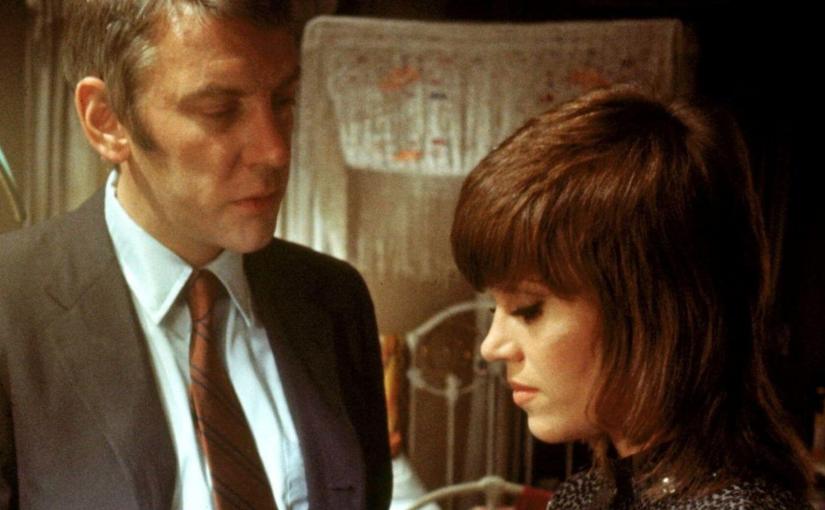
A highly respected married man named Tom Grunerman turns up missing.  The most unusual clue into his disappearance are letters found in his desk that were written to a New York City prostitute named Bree Daniels (Jane Fonda).  According to his wife and the CEO of his company, the letters seem out of character for a man like Tom.  Six months go by and there is still no sign of the man.  So, John Klute voluntarily goes to New York to investigate for himself while becoming acquainted with Bree.  

Bree is a very high-priced call girl who estimates she does between five hundred and six hundred calls each year.  She’s trying her best to step away from this lifestyle and work as a professional actress and model.  Yet, to uphold her means of living and to make up for the various rejects at auditions, she can’t help but return to what she’s best at.  Occasional visits to a therapist help her justify why she maintains this seedy occupation.  Various recordings of Bree’s observations and conversations with her Johns are about her regard for the profession. She claims that she is capable of catering to any particular vice a man might have. Most impressive is that she does not get turned on by the trysts she shares with these men. She also does not cast much judgment on whatever niche her various clients are into.  She’s positively cold to the demands of her job. Tom does not sound familiar to her, but he might have been the guy who beat her up a year earlier.  

I like the slow burn wait of this story.  A picture like Sea Of Love with Al Pacino works this way.  That’s a better movie though.

Donald Sutherland has significantly less dialogue than Jane Fonda.  He’s got a disturbing expression with large eyes and closed lips, not to mention a tall stature, that allows him to seem alert as an observer and a listener, particularly to Fonda’s character who is protective of herself even if she has much to say.  So, while the two get to know one another with Bree offering some possible leads for Klute to follow, there is an eerie and deliberately meandering pace to the story.  I knew I had to keep up my patience with Klute because an unexpected payoff would eventually arrive.

What bothered me though is that the twist of the mystery is revealed midway through the movie.  You brought me my steak before I had time to finish my salad.  Now, for the rest of the story I’m smarter than the characters and I’m only watching everything unfold. That left me feeling unchallenged through the whole second half of the film. Klute became boring and less inviting.

In 1971, this was a bold kind of picture though, not a common 1990’s erotic thriller like Basic Instinct or Color of Night.  It was seedy, unheard of and therefore fascinating.  At the time, the intrigue for a picture like this must have been off the charts.  Pakula even shows off how novel a tiny tape recorder was in 1971. Imagine what this recorder is capable of!

Had Klute been released today, I’m certain many would take issue with its final edit of story development.  I would also argue that a young Jane Fonda would never be accepted in a role like this.  Frankly, twelve years after this film, Jamie Lee Curtis was more convincing to me as a call girl in Trading Places.  Fonda’s inflection and voice of maturity just did not work for me in this role.  I did not find her alluring in the part, and I think she was too organized and educated to be Bree the call girl.  I was surprised to read afterwards that Jane Fonda won the Oscar for Best Actress for this film because I considered her miscast. Fonda’s voice always sounded overly patronizing to me.  I read later that the actress’s moments with the therapist were primarily improvised by Fonda, shot after the bulk of the picture was completed. Pakula honored her wish to shoot the therapist scenes later because Fonda wanted to have more of a grasp on this call girl character. The therapist scenes definitely look unpolished, particularly for the woman portraying Bree’s counselor. I could detect the improv going on before I knew that it was so. I was watching Jane Fonda, the actress, making a case for the research she collected to prepare for this role.  I wasn’t convinced Jane Fonda was playing the role, though.

The film provides moments where Bree is catering to a couple of clients.  Pakula is honest with his staging.  One client breathes heavily with nervousness about the trouble he’s about to indulge in and then there is the awkward business agreement between Bree and the man followed by the necessary construction of turning the hotel sofa into a bed. It’s weird and unromantic. All this business interrupting this guy’s ultimate fantasy. Very good direction by Alan J Pakula.

Another client hires Bree to pose like a woman from a pre-World War I era where she simply narrates a scenic moment from his past. He does not touch her. He does not undress. This old man from the city’s fabric district simply takes it all in, allowing Bree to do the heavy lifting while he remains stoic in his chair surrounded by the darkness provided by famed cinematographer Gordon Willis (The Godfather).  Still, Fonda seems out of place in these episodes.  Even her fear of a possible killer on her trail left me unsatisfied.  This woman always looks like she has it altogether. She arrives on John Klute’s doorstep in the middle of the night because she’s apparently haunted by what he’s pursuing and also, she’s getting prank calls at odd hours. Nevertheless, I’m still not convinced that Jane Fonda as Bree the call girl is truly shaken by any of this. Jane Fonda is just too put together and hardly evokes any convincing weakness.  

It is ironic the film is named after Sutherland’s character, Klute.  The story begins with his perspective.  I liked his detective.  Almost like the guy could’ve branched off into other stories, like Sherlock Holmes or Sam Spade or Mike Hammer.  The fact that the picture is called Klute leaves me wondering if a series of mysteries would have been paved for this character.  To my knowledge, I do not believe that ever came to be.  I’m sorry the trajectory of the movie veers off into Fonda’s character primarily when she enters the story.  Little is revealed about John Klute.  I only know his experience as a detective is limited, and he’s actually never visited New York City before.  Some interesting challenges for this guy, but none of this hardly becomes obstacles or factors for the rest of the film.  Much is learned about Bree Daniels, but hardly anything is absorbed about the title character, John Klute.

Klute starts off with a lot of promise.  I was excited to tag along with a new kind of brooding investigator who is impervious to influence and looks like he could not get easily overwhelmed. The mystery to uncover why a man went missing but not murdered is very intriguing.  My curiosity was there from the start.  Unfortunately, my interest dwindled as the picture carried on.  Jane Fonda talks a lot with not much to say and when the real culprit is unmasked at the midway point, my attention span is no longer demanded by the film.

Klute was likely a risky, pioneering kind of picture at the time of its release.  A sexy thriller.  Nowadays, it’s like any Saturday night midnight kill thrill of the week where the tempos are foreseen several minutes before they come to life.  Klute just loses its lust–ahem–sorry luster.

M*A*S*H

By Marc S. Sanders

Forgive me.  I’m not sure my position on Robert Altman’s film will be fair.  All my life, I think I deliberately eluded seeing the motion picture of M*A*S*H as I have been so accustomed to the classic television show that ran for eleven seasons on CBS.  As I expected the two properties couldn’t be further apart from one another.

Altman’s movie still carries a zippy kind of perspective to the horrors of war.  With their hands and surgical scrubs in the thick of gory, blood red surgery, the characters are so much more apathetic to the turnaround of wounded that arrive at the 4077th American mobile army hospital, located three miles from the explosive front lines of the bloody Korean War.  The well-known characters were first given live action roles here following the published novel by Richard Hooker.  

Most surprising is near the end of the film when two doctors realize they are being sent home. One surgeon who is in the midst of operating on a head injury actually instructs a colleague to take over.  This guy has his hands covered in brains and blood and chooses not to finish saving his patient’s life.  Alan Alda of the television show, as a writer, director or while portraying Hawkeye Pierce, would never respond in such a manner. Yet, this is the approach that Robert Altman chose to follow, having infamously always despised the TV series that eclipsed his film in popularity.

Altman’s movie is a slap in the face to the famed oxymoron called “military intelligence.” In 1970, we say bravo for finally saying something frank and honest while a Vietnam War has carried on far too long for not necessarily any of the right reasons.  It’s not so simple to declare war is hell.  It’s much more complicated and horrifying than that.

The film’s opening bylines are quotes by celebrated military leaders of the time, like MacArthur and Eisenhower.  However, these championed commanders are lampooned as we watch shlubby Hawkeye Pierce (Donald Sutherland) arriving in Korea.  He heads directly towards a General’s jeep and steals it, plain as day.  From there on, M*A*S*H operates like a precursor to Animal House with a series of hijinks and a lack of care for military leadership or the U.S.’s purpose in this conflict.  

About the only time, there is any care or forthright anger from anyone is when the jerky Major Frank Burns (Robert Duvall) chastises an underling.  Trapper (Elliot Gould) and Hawkeye punch his lights out and the schmuck ends up in a straightjacket.  Nonetheless, these guys could care less about criticizing and exposing the truth about the institution they have been drafted to serve.  Their purpose is not to make an ironic statement like a Doonesbury comic strip.  They just punch the commanding officer in the face and drink.  The TV show was at its strongest when it relied on the wit and delivery.  Trapper and Hawkeye never use irony or intelligence to belittle a buffoon.  They punch, or they embarrass an authority who’s taking a shower. Regretfully, it’s the dialogue that’s lacking. Robert Altman encouraged much improv on the set and overlayered conversations within his scenes. He found nothing organized or neat and pretty about war, including daily functioning. Chaos did not only reign on a battlefield.

The pace of M*A*S*H moves episodically, and it is likely what led to the idea of a half hour TV show that dominated the airwaves for the better part of eleven years.  A character called Painless contemplates suicide and so a Last Supper reenactment before he sends himself off is inserted. It’s a funny caption from these halfwits, but a storyline focused on deliberately ending a life does not connect with me in a humorous way here. Burt Reynolds, the dark comedy Heathers, and even more recently Tom Hanks toed the line of humor to be found in death by suicide. I think it worked better in those examples. With the somber, well known theme song of “Suicide Is Painless” that is forever linked with M*A*S*H, I just could not muster the laughs for this bit.

There’s also time to build comedy against another regular army brat like Major “Hot Lips” Houlihan (Sally Kellerman, also the best and most memorable of the cast).  The iterations of shower hijinks has been duplicated so often since the release of this picture. Therefore, this gag is dried up. It does not hold its impact fifty years later after dozens Porky’s movies. As well, there’s golfing off the helicopter pad, heavy drinking and a long, drawn-out final act of an overstayed football competition which leads to one of the first times the F-word was used in a mainstream American film.  

In 1970, Robert Altman delivered a bold, risky and daring film to counteract against a losing Vietnam War and the heroism of John Wayne’s bravado in war pictures.  The chutzpah to lash out against American politics likely felt relatable to many who saw different and more realistic images when they understood their young sons and daughters were not coming home and were thus forever changed.  Richard Hooker’s properties and stories lent an understanding to the animosity of those who forced the war on America’s children and loved ones.  War has never been consistent with the short film propaganda asking you to buy war bonds. M*A*S*H negated the heroism of Hollywood sensationalism found in machine gun fare and overtaking a hill while draped in green fatigues with shiny bronze ammunition hanging off their shoulders. These soldiers of war deserve our country’s utmost respect, but they did so much more than what John Wayne demonstrated. They offered up parts of themselves they would never get back.

M*A*S*H deliberately left out the heroes.  However, seeing the film for the first time, over fifty years later, I wish that at least we could follow the escapades of doctors who also directed a bed side manner to the pawns who were dying while upholding their leaders’ cause.  The doctors of Robert Altman’s interpretation hardly emulate a reason to care. 

The film interpretation of M*A*S*H is outdated of its time of release and the period in which it takes place.  I like to think we live more humanely than not just how our military leaders functioned.  I wished these physicians used their scalpels with a much less obtuse absence of empathy.  Hate the puppet masters, yes. Yet would it kill these guys to still care about the puppets? 

KELLY’S HEROES

By Marc S. Sanders

There’s gold in them thar Nazi castle.  Hence the plot is set in motion for a World War II romp called Kelly’s Heroes.  It’s easy to get acclimated to the lightheartedness of this comedic war picture from director Brian G Hutton (Where Eagles Dare). 

The movie opens during a dark and rainy evening within a German occupied France. The on-screen credits pop up revealing an all-star cast of tough guy actors who are also quite funny.  Clint Eastwood is the title character who sits behind the wheel of a jeep. When the Nazis take notice, he hits the gas, makes a sharp left through the muddy road, and zooms away while avoiding shell fragments coming down on him. The film’s catchy theme song marches in – “Burning Bridges” performed by the Mike Curb Congregation.  The chorus of singers speak as a soldier who does not even care about authority or the rules of war.  The lyrics are rather simple to understand, and you want to just join in on the revolutionary merriment.  The song enters the film again and again over the next two and a half hours, reminding you to just enjoy the ride against this tragic capsule of time from the first half of twentieth century history.  Hawkeye Pierce couldn’t have said it better.

In his capture, Kelly has brought back a Nazi commandant and when he sees a fourteen-karat gold bar in the German’s possession, it’s easy to surmise that there must be more where this came from.  Turns out there is a stash worth roughly sixteen million dollars crated in a bank vault in the center of a stopover town, located across enemy lines in war torn France.  Kelly and his squad, led by Big Joe (Telly Savalas), are under heavy fire and forced to retreat for safety, but that isn’t going to stop him from making a snatch and grab.

Joe has been given orders to get the unit to safety and allow them a three-day reprieve of R & R.  However, he’s just as enticed as Kelly and gradually a small team of men assemble to pull off the heist.  First, they’ll need tanks to fight off the nearly indestructible Nazi Panzer machines they expect to encounter.  Fortunately, Crapgame (a scene stealing Don Rickles) and Kelly come across the hippie loving Oddball (another scene stealer – Donald Sutherland) who can supply the tanks they need and fend off what stands in the unit’s way.  What’s also important is Oddball find a bridge for the squad to cross before the allies destroy it.  That’s not so easy.  Sutherland is somewhat of a spaz; maybe an ancestor of Cosmo Kramer.

Meanwhile, a blood and guts two-star General Colt (Carroll O’Connor) is screaming for results from his subordinates.  When he intercepts the guys’ communications, he can’t help but be impressed with their progress and strategies of attack.  He’s ready to go into the field with a handful of medals for every American soldier that’s giving a damn. 

The looniness of Kelly’s Heroes is hilarious. Eastwood carries his signature quietness about him.  So, he’s the straight man leaving the loudmouth material for Savalas, Rickles, and a bevy of supporting actors.  Plus, there’s O’Connor in his own side story.  Sutherland is another kind of comedy – the free spirit who appears to have taken one too many shells to the noggin. 

It’s not a slapstick kind of movie.  It operates like the doctors from M*A*S*H.  These draftees have no loyalty to a cause.  They look out for each other.  They know how to survive the battles and they know that some will not make it.  Brian Hutton does not forget the frightening impact of war.  A memorable scene occurs when the unit realizes they are dead center in a mine field, offering up the life and death factor blended in both the comedy and drama that comes with a heroic war picture. 

There are some inconsistencies to Kelly’s Heroes.  Often, it feels like some scenes that would connect certain dots must have been edited out of the final print.  As the men come close to the to the bank where the gold is stashed, two of the soldiers are already in the overlooking bird’s nest tower giving a low down of the area to Kelly and Big Joe.  Yet, how did those guys ever get up there?  It’s not a terrible violation.  There are sequences like this that make the movie feel a little uneven. Clint Eastwood even went on record expressing his disappointment with the film as there were excised moments that drew more out of Rickles and Sutherland’s characters, and a few of the other supporting characters played by Gavin MacLeod (The Love Boat, The Mary Tyler Moore Show), Stuart Margolin (a very underrated character actor who had memorable episodes on the M*A*S*H tv series) and a young Harry Dean Stanton (here credited only as Dean Stanton). 

This film was shot in Yugoslavia simply because the country still had possession of many tanks and vehicles from the story’s time period.  The art design and battlegrounds are very impressive.  Before CGI, Brian G Hutton and his team were reenacting a lot of these loud, bombastic battle scenes complete with big fireballs of explosions along with the aftermath wreckage left behind of rubble and blasted out walls and craters.  Hutton positions his cameras either on top or right behind the cannons and guns mounted on the tanks.  So, you are actually getting a first person view of these massive war machines driving across the plains while shooting off their firepower.  The filmmakers did not hold back on making World War II look authentic in its battle wear.  I’ll be bold enough to say the settings are comparable to what Spielberg accomplished with Saving Private Ryan, and what Eastwood depicted in Letters From Iwo Jima.  The lens is just not as serious as those films.

The cast is a magnificent fraternity of brazenly funny tough guys, in the same vain as The Dirty Dozen, though much more lighthearted.  They’re a motley sort who all stand out among their similar appearances in green army fatigues and netted helmets. 

Kelly’s Heroes is a lighthearted comedic adventure where the heist is what you come to see against a historical backdrop when nothing was ever sensationalized fun.  History offers up a cruel world of pain and suffering, but who says we can’t enjoy ourselves through all the blood, guts and misery as our heroes ride off into a ravishing orange sunset?

Go for the gold and catch up with Kelly’s Heroes.

MAX DUGAN RETURNS

By Marc S. Sanders

Max Dugan Returns is one of those delightful films where the smile never leaves your face.  It’s a cozy, rainy Saturday afternoon with your favorite pillow and throw blanket.  The characters are whimsical, and they simply feel like good, good friends you would love to have in your life.

Nora McPhee (Marsha Mason) is an overworked, underpaid high school English teacher who is drowning in debt with a broken refrigerator and a car that is as ugly as it sounds on the road.  Her fifteen-year-old son Michael (Matthew Broderick, in a sensational on-screen debut performance) is a good kid, but she’s worried he’s getting too involved with the drug dealers that roam his school.

After her jalopy of a car gets stolen, the only positive that comes upon her is in the form of Donald Sutherland as a cop named Brian.  After he lends her his motorcycle to get around, there’s an immediate attraction, but it could not happen at a worse time.

Nora’s father, Max Dugan (Jason Robards), who abandoned her at age 9 arrives on her doorstep in the middle of a rainy night with a business proposition.  Now that his doctors have informed him he has six months to live, he would like to provide Nora and Michael with the six hundred thousand dollars he’s towed with him in an attaché case.  In exchange, he only wants to spend time with his grandson.  Beyond the animosity she’s held for Max, what alarms Nora is that her father stole this money from a Vegas casino.  He claims the mob stole the money from him first.  She doesn’t want the money; not with Brian the police officer in her life and she does not want to be affiliated with Max’ criminal past or associations.  Not to mention there would no way to explain this sudden windfall based on her minimal teacher’s salary.  Max won’t go away so easily, though.

Thus, the theme of Max Dugan Returns is one scene after another where a hoard of luxurious items arrive on the McPhee’s doorstep.  New appliances, new jewelry, new furnishings, fresh groceries, electronics for Michael, a Mercedes, and a thoroughbred dog named Pluto – I’m sorry.  Plato!

It’s impossible not to love this movie.  It is one of the few films that Neil Simon wrote directly for the screen.  It is so much fun though, that I think it would work marvelously as a stage play.  The story may not be grounded in reality, but Simon’s dialogue is so quick and sharp and a better cast could not be found to deliver Neil Simon’s wit.

Mason, Robards, Broderick and Sutherland have pitch perfect chemistry with one another.  These actors are so absorbed in their characters, and it makes sense.  Matthew Broderick was personally selected by Neil Simon to do his biographical play, Brighton Beach Memoirs.  Marsha Mason did five of Simon’s adapted films while she was married to him.  (They divorced shortly after the release of this picture in 1983.)  Jason Robards has an affectionate gravel to his voice – one of the best voices in film next to James Earl Jones. Robards is just so appealing as he playfully conflicts with Mason on screen while connecting with Broderick’s character under a different identity.  It’s important Max maintains a low profile.  Donald Sutherland is the straightest character in the picture.  He has a relaxed manner to him that’s found often in Neil Simon’s scripts (unless you’re a Nora McPhee or a Felix Unger).  In another actor’s hands, this would be just a walk on role, but with Sutherland on screen, you are satisfied to watch another winning performance from this actor with a relaxed stature and a genteel way about him, as his detective suits and ties hang loose on his shoulders.

Max Dugan Returns is an enchanting fantasy without the overt fantasy.  It never needed unicorns or lovable elves to deliver its magic and whimsy.  I did notice a collection of rainbows –  easter eggs hiding in plain sight, however.  Are pots of gold to be uncovered? The film asks what would happen if your long-lost father showed up on your doorstep with a suitcase full of money and a treasure trove of gifts to bestow upon you. 

Hey, it could only happen in the movies.

JFK – DIRECTOR’S CUT

By Marc S. Sanders

Oliver Stone’s JFK is told through perspective, not necessarily history.  It’s not a biography and I do not believe Stone would ever claim it to be so.  It’s a thinking person’s picture that gives viewers entitlement to question what occurred, how it occurred and why it occurred.  It might guide you not to trust what anyone says, sees or hears, but let’s face it.  Probably the day Kennedy was shot, November 22, 1963, could we ever completely trust anyone ever again? 

(Forgive my cynicism.  I must backtrack a little.  I still trust my wife and daughter.)

Oliver Stone works through the eyes of New Orleans Prosecutor Jim Garrison (Kevin Costner, in what may have been his most challenging role to date at the time).  Garrison sees a little too easily that there are circumstances out of place, or maybe too neatly in place to satisfy the ultimate resolution that a known American defector to the Soviet Union, like Lee Harvey Oswald (Gary Oldman), acted alone in the assassination of the President.  Stone wrote the script for JFK with Jim Marrs and used Garrison’s input from his own novel. Nearly every scene builds into another possibility of how that fateful day came to be.  Stone even questions if a famous photo of Oswald on the cover of Life Magazine is real.   Too many cover ups with a building list of body count witnesses and too many coincidences keep Garrison up at night.  So, he assembles a crack team of investigators and fellow attorneys to reopen the case and question the official Earl Warren Commission.

Firstly, JFK is magnificent entertainment with a hair raising and unusual original score from famed film composer John Williams.  His notes on percussion with dings and harpsichord strings cue in at just the right moments when Stone introduces another one of many scenes that point out what seems cagy and suspect. The music of JFK works as a narrator.  This narrative keeps you alert.  Maybe you should look in each corner of the screen at times for some subtle clues.

It was also wise of Stone to go with a well-known cast of actors.  The Oscar winning editing from Joe Hutshing and Pietro Scalia moves at a breakneck pace.  Yet, because I recognize fine performers like Ed Asner, Jack Lemmon, Kevin Bacon, Tommy Lee Jones, Brian Doyle-Murray (Bill’s brother), John Candy and Joe Pesci it is easy to piece together who is playing who and what significance they lend to the many theories Garrison and Stone question next.  

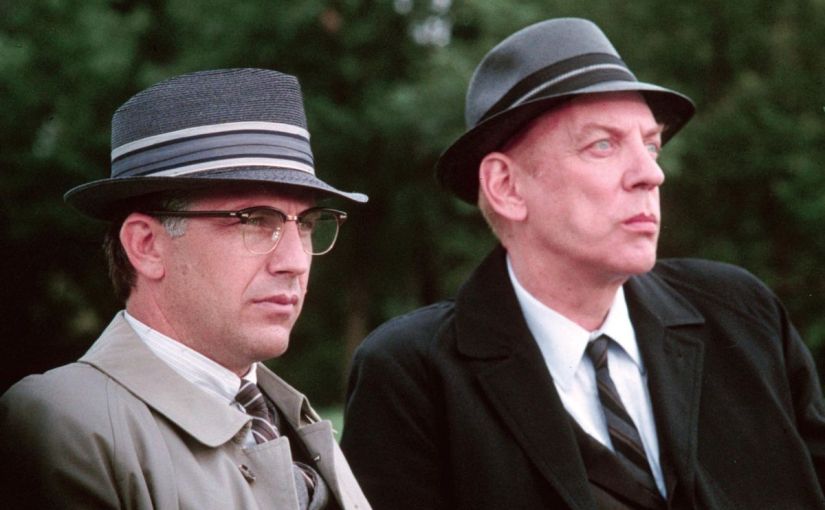
My admiration for the casting continues with the Garrison team that performs with Costner – Michael Rooker, Laurie Metcalf (especially impressive), Wayne Knight, and Jay O. Sanders.  There’s also a clandestine trench coat guy named X portrayed by Donald Sutherland.  Who even knows if this guy ever existed?  He’s more secretive than Deep Throat, but Mr. X has a hell of a lot of information to justify Jim Garrison’s suspicions.  That is an especially marvelous sequence between two men strolling through Washington D.C., eventually concluding a disturbing realization on a park bench.

Sissy Spacek brings out another dimension to the Jim Garrison character.  She’s his wife and the mother of five who suffers the loss of her husband’s attention which is entirely focused on this compounding investigation.  I like Costner’s take on the Garrison character.  Early on he politely asks one of his associates to stop cursing.  He does not like that kind of talk.  Later, it is Garrison who is dropping a number of eff bombs in front of his wife and young children.  This conundrum of a case, a very puzzling detective story, is unraveling the investigator. 

JFK was instrumental for further Congressional consideration following its release.  Files were reopened.  Additional research was executed, and soon many of those secret documents pertaining to the assassination will be revealed in 2029.  Back in 1991, of course that appeared to be a lifetime away.  It’s time we know everything, though.  Arguably, most of who were involved in this incident are dead by now.  Let us know our history.  Still, Garrison was bold enough to point skepticism at not just the adversarial relationship Kennedy may have had with Castro, the Cubans and their Communist allies, but also the people within the CIA and the FBI.  Lyndon Johnson is not even free from scrutiny after he’s sworn in.  Some on Garrison’s team went so far as to factor in culpability from the mafia.  Garrison was not so keen on that theory, actually. 

The construction of Oliver Stone’s film is unparalleled.  I think it’s his best film to date and I can find few others that even compare to how he assembled the picture.  It begins with the voiceover of Martin Sheen laying out many news cycles that were occurring ahead of Kennedy’s murder such as the Bay Of Pigs and the President’s supposed efforts to withdraw from Vietnam.  Sheen’s narrative comes at you very fast with Stone incorporating real life home movies of Kennedy along with his brother Bobby, as well as Castro, and television news footage from Vietnam and anywhere else events were happening.  By the end of the roughly five-minute opening, your head might be spinning. 

Thereafter, though, Stone goes through Garrison’s day on November 22, 1963, watching the outcome following the momentous event and the writer/director works his way into the drama beginning with Asner and Lemmon as two drunk old guys walking through the rain and getting into an argument. 

Three years pass by and so begins Jim Garrison’s motivations to follow multiple trails of breadcrumbs that lead to a lot of different places, all unlike what Earl Warren surmised. 

The scenes work quickly from that point on, and cuts of theoretical reenactments occur.  Who knows if any of these scenes are factual?  Stone and Garrison want you to at least consider their reasonable likelihood.  Moments happen where Joe Pesci and Tommy Lee Jones’ characters appear to be lying about even knowing one another while Stone will depict a sexual role play encounter between them which also includes Kevin Bacon as someone with no more reason to lie. 

Episodes are deeply focused on Lee Harvey Oswald depicted as an infamous and suspected patsy in association with others who may have a reason to want Kennedy dead.  Gary Oldman hides so well in the role.  Oliver Stone even lends focus to how different witnesses describe Oswald.  In some scenes it is Oldman, but then there are other times where a shorter, more overweight man may have been the real Oswald. Later, there’s an Oswald who is taller and more slender. 

A few years ago, I was visiting Dallas, and I was able to spend a some time walking around the crossroads where Kennedy was shot in the convertible while seated next to his wife Jackie.  Watching JFK again lent more clarity to all of the locales such as where Oswald was supposedly shooting from the top floor of the corner book depository.  Kevin Costner and Jay O. Sanders go through the motions of Oswald firing the three shots from his rifle in the short amount of time span.  The script also questions why Kennedy was taken out by Oswald after the turn off the corner of Elm and Houston. There appears to be a better wide-open clear shot long before the turn with the car only going ten miles per hour.  The men question if it was Oswald, then why didn’t he take advantage of the clearer shot.

I know.  I could go on and on.  I have to stop myself.  There’s a ton – A TON – of information in JFK.  It becomes addicting to watch.  You don’t even want to pause the long film for a bathroom break.  I watched the extended Director’s Cut by the way. 

Many common critiques of JFK lean towards how many of these scenes did not even happen.  People are happy to point out there’s no evidence to truly say any of Oliver Stone’s enactments occurred.  I agree, but that’s not the point of this director’s piece.  This is primarily told through the eyes of Jim Garrison.  Kevin Costner is great as the listener, the observer and especially at the conclusion, the describer.  Watch him physically respond to anyone he shares a scene with.  There’s a memorable twitch he offers while at the scene of the assassination that works perfectly with a jarring echo of a gunshot edited into the film.  He’s also great at turning his head down as the thinker while Mr. X lays out an enormous amount of information that comes from several different directions.  Because the film comes from Garrison’s perspective, it does not have to be true.  It only has to be what the investigating prosecutor reasonably believes, and what he absorbs from suspects, witnesses, and his devoted team. 

A final speech of Garrison’s is told at the trial of suspect Clay Bertram, aka Clay Shaw (Tommy Lee Jones), who was the only man tried by Garrison for Kennedy’s murder.  First, it’s important to note that during this fifteen-minute sequence, when Stone cuts back to Garrison in the courtroom, Costner is wearing different suits.  So, while it is assembled as an ongoing rundown, it is not meant to all be in one instance.  Garrison lays claim to an endless amount of possibilities and circumstances that at times have no correlation with each other but could possibly all merge together towards November 22, 1963.  Critics argued this speech of Garrison’s never took place.  That’s correct.  However, this is a movie and for the efficiency of information to come out, a funnel must be opened up to learn what is being pursued and what has been uncovered.  This is the strategy that the script for JFK adopts and it works, leaving you thinking and rightfully doubting what our governing bodies and history books have told us.  Most famous of all of these nonsensical happenings delivered by Garrison is the “Magic Bullet Theory” made extra famous by Jerry Seinfeld with Wayne Knight on the comedian’s sitcom.  It’s silly but it is also a response to the impact that came from JFK.

JFK has a very glossy appearance from the Oscar winning cinematography.  Reflections and natural glares come off of Jim Garrison’s glasses.  The exasperation, along with the shiny persperation of John Candy’s sleazy lawyer character is undeniably noticed as his integrity is being questioned.  Staged reenactments are shown in black and white, clear color or grainy distressed output (such as recreations of the known Zapruder Film).  Nothing is clear about what led to Kennedy’s murder.  So, Oliver Stone’s filmmaking team will ensure that nothing should look consistent.  There are no straight answers; only endless amounts of reasons to ask another question after another.

Oliver Stone does not make JFK as complex as some will have you believe.  It’s quite easy to piece together who represents what in this story.  Many theories are offered at lightning speed, but they hardly ever intersect with each other until a probability is completely laid out on the table and then the film moves on to the next one.

JFK may have a long running time and a large cast with a lot to say and ask, but it’s an exhilarating thrill to behold.  Who knows what is true?  The importance of Oliver Stone’s masterpiece demonstrates that much of what we were told as truth may not consist of the entirety of facts. 

Again, question your governing bodies and ask the hows and whys and whos.  Oliver Stone reminds us that we have that right as the citizens of America. 

What really happened to our President, and who was really responsible?

THE HUNGER GAMES: THE BALLAD OF SONGBIRDS AND SNAKES

By Marc S. Sanders

The Hunger Games: The Ballad Of Songbirds And Snakes is a stellar prequel to Suzanne Collins’ well-known franchise approach to reality television within a barbaric dystopian setting.  Francis Lawerence returns to direct this characterization of the would-be antagonist Coriolanus Snow played by unknown Tom Blyth in a blazing performance of innocence eventually corrupted by a warped environment of law.

The story takes place just over sixty years before Collins’ first trilogy that centered on the heroine archer Katniss Everdeen.  A vicious annual tournament known as “The Hunger Games” has reached its tenth year and interest in the programming has waned.  Rebellion throughout the twelve districts of Panem is getting stronger and the idea of selecting children to compete in a battle royale to the death is frowned upon. 

The elite students, which include Coriolanus and his best friend Sejanus Plinth (Josh Andrés Rivera), have been assigned to a new development in the Games.  They are to serve as mentors to the selected contestants.  Sejanus, who is the son of one of Panem’s wealthiest entrepreneurs, protests the games altogether.  He’s outspoken and determined in his efforts to put an end to the event.  Yet, his father’s wealth always bails him out.  Coriolanus does not seem to have an opinion on the matter.  He’s more curious about the showmanship of the contestant that he’s been assigned from District 12, a wildcat by the name of Lucy Gray (Rachel Zegler, giving a magnificent presence to her role).

Lucy Gray is a free-thinking troublemaker wearing a wardrobe of colors and design.  She is a bursting talent with a guitar as well and an attitude to boot.  While the other contestants appear malnourished, poor, sad and legitimately pitiful, Lucy has a guise of confidence and independence.  She certainly stands apart from her competition when they are all locked up in a zoo cage for the public and press to look upon as hype ahead of the grand tournament.  Lucy is not a skilled fighter, but even without Coriolanus’ guidance she knows how to develop a following.

Elsewhere, there are the puppet masters.  There’s Dean Casca Highbottom (Peter Dinklage), the inventor of the games, and teacher to the mentors.  He stresses a promising future for the best mentor performance, but there is to be absolutely no cheating.  As well, Viola Davis plays a devil of a villain as a Dr. Volumnia Gaul.  Think of her as the equivalent to the Nazis’ Dr. Mengele who experiments with new inventions of hideous creatures and process.  Her towering canister of colorful snakes is chilling anytime it appears on screen.

The Ballad Of Songbirds And Snakes has a long running time for a science fiction piece catered for young adults.  However, it confirms the error that was made with Collins’ film adaptation of her third novel, Mockingjay, which was split it into two films for the sake of greedy revenue commercialization to line Lionsgate’s pockets.  Because this prequel is contained as one piece, Tom Blyth is invited to perform a thrilling character arc of a poor, but intuitive, and good-natured young man who is eventually transformed into an evil personification. 

Lawrence’s film has multiple opportunities to end and roll the credits.  However, it carries on and becomes a journey for its principal characters, Lucy Gray and Coriolanus Snow are much like in the same vein as Vito and Michael Corleone in The Godfather.  Novels often have the luxury of spanning a wide berth of time to inch their way towards a protagonist’s destiny.  Movies tend to want to hurry things along.  With Francis Lawrence’s film we are granted the time to see how Lucy Gray performs during the leadup to the games as a character of confidence that a public is willing to follow and bet on, but most importantly care about.  Accompanying her is Lucy’s mentor, Coriolanus Snow, who is curious and concerned for Lucy’s wellbeing.  While being separated from one another for large portions of time, the two characters convincingly fall in love. 

The second act of the film is the sport in an arena, far from the technologically sophisticated nature found in the other films.  In this prequel chapter, it is simply an in the round stone coliseum of wreckage following a rebellion strike with barbaric weapons left in the center to grasp for advantage. 

The third act, which in another director’s hands might have been saved for a churned-out sequel, follows the aftermath of where the characters go from here.  Coriolanus becomes an infantryman in District 12 along with Sejanus.  A whole new design is introduced late into the film, and it is as if we’ve begun a brand-new episode of a franchise series.  What keeps The Hunger Games installments feeling fresh is that we are granted both the events preceding the games as well as what’s occurring thereafter. 

The cast is outstanding.  Viola Davis and Peter Dinklage have those jaded and unusual appearances suitable for this disturbing setting.  Davis especially absorbs the scenery whenever she is on screen.  Her costume wear, hair and makeup only enhance her chilling performance.  Jason Schwartzman does a superb interpretation of Lucky Flickerman, an ancestor of Stanley Tucci’s flamboyant character from the other films, and the MC for the games.

Rachel Zegler lends her talents for song and guitar to the film, and I loved every second of it.  I know she is currently not favorable in the public eye based on comments she has made.  However, if she continues to follow a course of picking smart roles and playing them as well as she does here, and like she did in Spielberg’s West Side Story, then she is destined to becoming an elite leading actor in the likes of Julia Roberts and then later Anne Hathaway.  I loved every song she performed in the film as well.  She lends a twang to her vocals that blend beautifully with her guitar strings.

Tom Blyth is so trusting with his boyish complexion and bleach blond curly mop top.  He fits well into the destitute role of the son of a dead would have been tyrant.  His wardrobes are described as hand made at home, even with small bathroom tile pieces serving as fashionable buttons on his dress shirt.  Blyth, while humble, wears everything with confidence, remaining the exact opposite of the President Snow we knew from Donald Sutherland’s performance in earlier films.  This Coriolanus is someone I can trust.  Someone I do not question.  Yet, when the end of the film arrives, I’m left surprised by the outcome of the character even though I know what’s expected of him.  It’s a positively inventive characterization from Suzanne Collins, interpreted with a subtle balance between protagonist and antagonist from Tom Blyth.  This guy might have been a better casting choice for Anakin Skywalker in the Star Wars prequel films. 

I’m angry at myself for not having yet read The Ballad Of Songbirds And Snakes.  I imagine it’s a crackling good read.  The film concludes with doors open for questions that leave me curiously thinking, four days after having seen the picture.  I can only hope there are additional films to come that explore even more deeply into Suzanne Collins’ rich tapestry of dystopia and the complex characters that occupy it.

The Hunger Games: The Ballad Of Songbirds And Snakes is one of the best pictures of the year.

THE HUNGER GAMES

By Marc S. Sanders

Some of the worst atrocities in history have often spawned some of the greatest stories.  I’d expect it would at least leave us feeling melancholy, but I hope it shapes a future that learns from humanity’s worst offenses.  That’s what came to mind as I watched the film adaptation of Suzanne Collins’ dystopian best-selling novel The Hunger Games.

In what was once a supposed North America, the continent is now called Panem and it is divided into twelve districts, with each specializing in some means of living.  Districts 1 and 2 are the upper-class wealthy.  Districts 11 and 12 are the starving destitute.  To maintain a semblance of order, President Snow (a chillingly older Donald Sutherland) oversees the nation’s Annual Hunger Games where a boy and a girl from each district is selected to compete in a dangerous competition of being the last one to outlive their competitors.  May The Odds Be Ever In Your Favor!  In the 74th edition, expert hunting archer Katniss Everdeen (Jennifer Lawrence in her most celebrated role) volunteers herself from District 12 to spare her younger sister from danger and selection.  She is paired up with the District 12 boy, Peeta Malark (Josh Hutcherson). 

Like any sporting competition, Collins’ story takes time to hype up the event.  The youths are fashioned up in the most glamourous adornments and interviewed for television by Caesar Flickerman portrayed by a delicious, yet unsung Stanley Tucci in bright blue hair and sparkly suits, doing his best Griffin, Carson, Letterman, Leno, and O’Brien.  With every white molar revealed in Tucci’s broad smile, he appears even more sinister in the purpose he serves for the Games, Panem, and President Snow.

Jennifer Lawrence gives a faithful portrayal to the Katniss character found in the pages of Collins’ series of young adult novels.  A new hero has been conceived – the rebel who stands along other well knowns like Luke Skywalker, Robin Hood and Harry Potter.  Katniss is not looking to be a savior but with influence from a prior Hunger Games champion (Woody Harrelson, doing his drunken best) and a calm, but humble fashion designer (Lenny Kravitz) she finds herself elevated towards a promising future.  Katniss Everdeen inherits the moniker known as “The Girl On Fire” with a three finger salute and a somber three note battle cry harmony.

I’ve likened the setting of The Hunger Games to the Holocaust and the early twentieth century European Nazi occupation.  (It seems more apparent in the next film, Catching Fire.)  If I had to compare the real-life period to this fictional one, then they are not anywhere close.  Yet, Suzanne Collins and director Gary Ross’ film depict hardship and oppression from a ruling upper class gleefully using their young for savage sport entertainment, while being forced to dwell in concentration camps with no permission to escape or run free, lest they suffer terrible punishments for themselves or those they care most about.

The Hunger Games values the themes of sacrifice while some characters inadvertently become heroes for a people against a domineering force.  It’s fantasy.  It’s adventurous.  It’s sprinkled with romanticism for Katniss and the triangle she’s pitted within for her care of Peeta but also her loving affections for another District 12 resident named Gale (Liam Hemsworth).   Frankly, the romance angle is a little weak in the films and books.  Ultimately though, it is harsh for the young characters in the story, which is why my wife refuses to invest her time.  I empathize with her position.  However, I find the story inspiring.  It’s also a hell of a thriller.

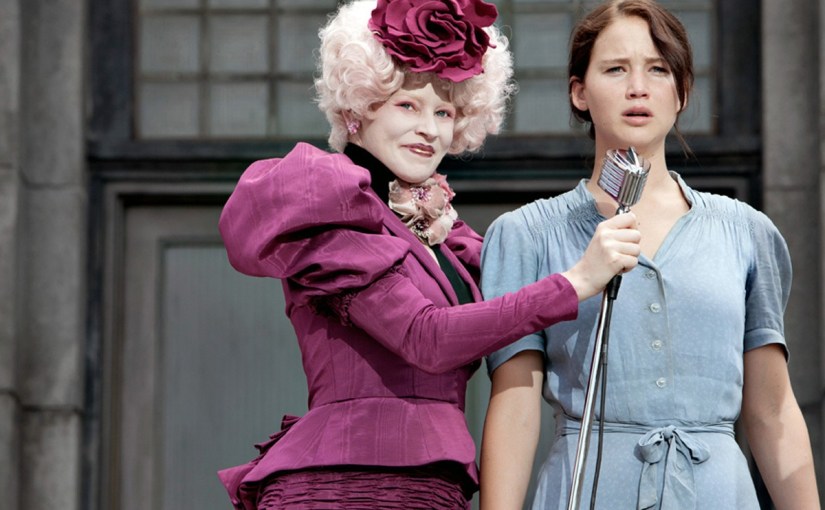
As a film, Gary Ross assembled a strong and alive production of gaudy, bright colors within the capital against morose grays found in District 12.  The clash of the two settings is no more apparent than when squeaky Effie Trinkett in her garishly loud facial makeup and wardrobes arrives in District 12 to host the Reaping, also known as the selection of the child contestants.  So many actors in this cast are memorable.  An unrecognizable Elizabeth Banks is no exception.  As Effie, her personality that publicly represents a hesitant Katniss and Peeta is deliberately inappropriate and further demonstrates how demonically twisted the mentality of The Hunger Games truly is. 

When it is time to finally arrive at the manufactured arena where the contestants will do battle to the death, Gary Ross effectively incorporates the inventive surprises offered by Collins’ source material.  Some competitors are brutal in their combative skills, but environmentally speaking the forest like jungle is dangerous as well.  Especially notable is a hive of stinging tracker jackers that’ll leave the viewers shaken. 

Suzanne Collins’ first installment of her series persists in leaving its ending completely questionable.  Will all these children, some of them who are noble and good, actually die?  Could a good soul like Katniss follow through with what the Games demand of her like killing Peeta for example?  I appreciate the imagination that went into the ending, leaving a subsequent tale to be told beyond this film.  

My one complaint is common in action films.  Gary Ross does really well with the edits and filming of his movie.  However, one of the last scenes develops into a hand-to-hand combat moment taking place in darkness with very shaky camera work and uneven grunts, punches, and kicks.  I abhor when filmmakers go this route.  It’s lazy work.  I can’t tell who is hitting who or where.  I’m just supposed to accept the final struggle that the hero is having with the bad guy and feel a sense of urgency and suspense as they supposedly cast a harsh blow to their enemy and fall over. I might as well close my eyes during moments like this because it’s all just blurry streaks in midnight blackness with sound editing filtered into the sequence.  This tiring approach happens so often in movies, and it becomes a let down for me time and again.   I love a well-made, thought-provoking thriller but the filmmaker hacks it all up near the end and it looks like he’s got to meet a deadline for the final print to get out to the theaters.

There’s much to discuss and think about in The Hunger Games.  Suzanne Collins’ idea stemmed from how television viewers soaked up the drama found in reality tv shows like Survivor and Big Brother.  It’s not so much the fate of the contestants that we care about, but how do they serve the producer’s crafted storylines.  Even American Idol steers the drama of the kids who get their shot at Hollywood fame.  The Super Bowl will position a star player like Tom Brady as a focus with questions of whether this is his final season, and how the championship games affect his marriage and family.  Does he get along with his coach?  None of this has anything to do with the points on the board.  Is all of this about the games, or is it about those tasked with playing the games, and for whose benefit of control, wealth, and power?  In this fantasy film, do the people of Panem cry at the drama spurned from the horrifying death of a child they got to know from Caesar’s colorful interviews, or are they in despair at the loss of another young life?  Whether it is real or fictional, is the drama of these gladiator games and competitions focused in the right direction?

The cast and production team under Gary Ross have put together an effective dystopian and bleak future reliant upon what the world focuses on more than anything beyond who they truly love or what they stand for.  The Hunger Games might seem inconceivable, but it is frighteningly relatable. 

DON’T LOOK NOW (United Kingdom, 1973)

by Miguel E. Rodriguez

DIRECTOR: Nicolas Roeg
CAST: Julie Christie, Donald Sutherland, Hilary Mason, Clelia Matania
MY RATING: 8/10
ROTTEN TOMATOMETER: 94% Certified Fresh

PLOT: In Venice, a married couple grieving the recent death of their young daughter encounter two elderly sisters, one of whom is psychic and brings a warning from beyond.


I’ve only seen two films from director Nicolas Roeg.  The first was Walkabout, which I’ve now seen three times in an effort to “get” it.  While I admire Walkabout’s visual strategy, that film has always left me cold and frustrated, and I do not imagine that will ever change.

However, Don’t Look Now, Roeg’s adaptation of a Daphne Du Maurier short story, is about as expertly made as any supernatural thriller could be.  While the story may feel a little thin when all is said and done, this is yet another case of a movie not being what it’s about, but how it’s about it.  The entire film utilizes an editing and cinematographic strategy to convey an aura of dreamy dread and paranoia.  Of course, the performances from the two leads, Julie Christie and Donald Sutherland, are exceptional, but the direction, editing, and cinematography are really what make Don’t Look Now so disturbing and compelling.

Christie and Sutherland play married couple Laura and John Baxter who are grieving the death of their daughter, Christine, who drowned in the pond behind their cottage.  The scene of her death which opens the film showcases the visual and editing strategy that will come into play so heavily later in the film.

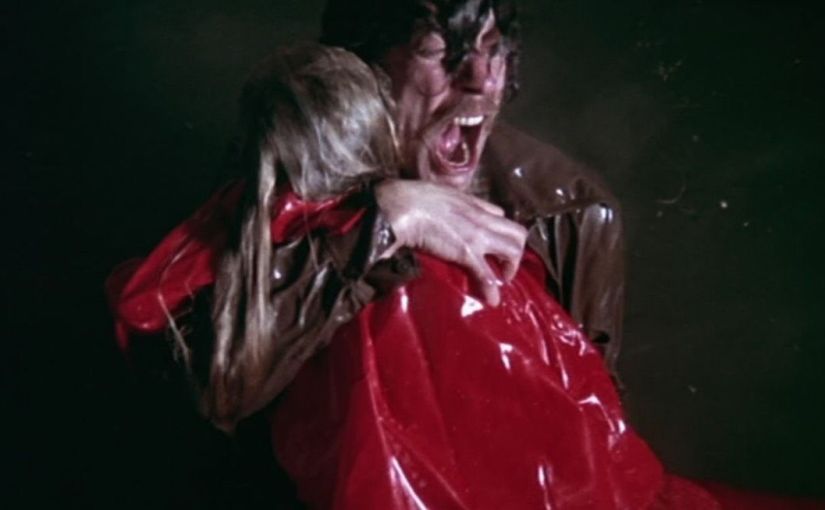
They relocate to Venice, leaving their other child, a son, behind in England in a boarding school.  In Venice, John works on restoring an old church while Laura…well, it’s not clear what Laura does to pass the time in Venice.  One day she bumps into two old women in a café restroom, one of whom is a blind psychic.  The psychic abruptly tells Laura that she’s seen Christine, happy and laughing, and wearing the red raincoat in which she drowned, information the psychic could not possibly have known beforehand.

Later, as John wanders the Venetian streets at night, he gets a brief glimpse of a small figure darting among the buildings ahead…wearing a red raincoat.  When Laura visits the psychic again, the psychic warns Laura that she and her husband are in danger and must leave Venice as soon as possible.  Meanwhile, a body is discovered in the canal near their hotel…

Because the film’s effectiveness relies so heavily on its visual style and editing, I’m finding it difficult how to convey how strongly I recommend searching this movie out, while simultaneously acknowledging the story itself is not as “meaty” as, say, a thriller from David Fincher or Alfred Hitchcock.  I was actually reminded more of the films of Brian De Palma and David Lynch, two directors whose visual and storytelling styles were clearly influenced in one way or another by Don’t Look Now, which was itself clearly influenced by the early films of Dario Argento (The Bird with the Crystal Plumage, Suspiria), though without quite so much bloodshed.

Making a movie like this is tricky.  Use too much cross-cutting and non-sequitur edits, and you risk simply confusing the audience.  One plot point involves John putting Laura on a plane back to England, but hours later he clearly sees her on a funereal gondola in Venice.  Convinced the two elderly women are somehow behind it, he tracks down their apartment, only to find it abandoned.  Quick cut to the sisters in another hotel somewhere…laughing.  Are they involved in some kind of sinister plot?  Or is he having a breakdown?  Is this the director just yanking the audience’s chain simply because he can?  One could make the argument, but the process and style of the storytelling kept me intrigued rather than confused.

All sorts of small details become ominous.  A single glove abandoned on a windowsill.  A child’s plastic baby doll left on the steps leading down to a canal.  Old family portraits on a table.  The lingering glance of a stranger in a police station or a café.  In one scene, John visits the police, convinced the two sisters have kidnapped his wife.  IMDb trivia reveals that the Italian actor playing the captain had no knowledge whatsoever of the English language, so he simply read the lines phonetically without understanding what any of it meant.  As a result, his dialogue with John sounds oddly stilted and detached, almost menacing.  Is he part of some kind of conspiracy?  During their conversation, he actually sees the two sisters walking outside his window but fails to mention this fact to John.  Is he in on the conspiracy?  Or does he simply not recognize the two women?

After a few more plot developments and a couple more sightings of the small figure in the red raincoat in the distance and the discovery of yet another murder victim, everything finally gets wrapped up in a way that I found satisfying even though it didn’t exactly bring the kind of closure I was hoping for.  However, it does bring all the story threads together, including the possibility that John himself might be psychic without realizing it.  Don’t Look Now doesn’t pack quite the punch of Psycho or Mulholland Drive, but it is exquisitely well-made, well-acted, and well-directed.  Watch closely, and you can see how many other filmmakers have been influenced by this movie decades later.

SIX DEGREES OF SEPARATION

By Marc S. Sanders

John Guare adapted his celebrated Broadway play Six Degrees Of Separation into a screenplay directed by Fred Schepisi.  Having never seen a stage production of the show, I can still see how well it would work in live theater.  It’s a talking piece with colorful dialogue and fast paced monologues revealing the true nature of people whether they are telling the truth, exaggerating, or simply being lied to.  Can a piece of writing succeed at showing the phoniness of people while at the same time displaying the authentic nature of a con man and a liar? 

In a very early career performance, Will Smith plays a young man named Paul.  One night, he stumbles upon the Park Avenue apartment of Ouisa and Flan Kitteridge (Stockard Channing, Donald Sutherland), wealthy art dealers ready to make a multi-million-dollar deal with a South African guest, named Geoffrey (Ian McKellan).  Paul is a handsome black man in a navy blazer and college tie, with a knife wound in his side.  He has just been mugged while on his way to pay the Kitteridges a surprise visit.  They welcome him inside, clean his injury and loan him a freshly clean pink dress shirt from their son’s closet. 

Talking and interaction take effect.  Paul describes how he intimately knows the couple’s children away at college.  He segues into an insightful literary evaluation of Holden Caulfied from Catcher In The Rye, and he eventually makes his way into the kitchen where he impresses the high society people with his exquisite dinner preparation and his immense background of being the son of celebrated actor Sidney Poitier. 

By the end of the evening, Geoffrey is ready to sign the deal and the Kitteridges are over the moon with the dumbfound luck of meeting this young man, who is now going to arrange for them to be extras in the film adaptation of the musical Cats, soon to be directed by Sidney, himself.  It’s all too good to be true.  The next morning, after insisting that Paul stay over for the night, surprises abound and perhaps Ouisa and Flan don’t know everything they should have known about Paul.

The couple meets up for lunch with Larkin and Kitty, another high society couple (Bruce Dern, Mary Beth Hurt) who can’t wait to share an unbelievable story with them.  Only their anecdote is eerily similar to the experience they had with Paul.  Could these people have been duped?  The only option is to go to the police, and yet was there really a crime ever committed?  Fifty dollars was leant to Paul to get back to school, and he made off with the pink shirt, but that’s it.  All of their prized artwork and collectibles remained.  No one was physically harmed.  Nothing was stolen.  Still, the four people are insistent on uncovering the mystery of this man. 

Ouisa, Flan, Larkin and Kitty eventually catch up with their children to see how they had come to meet Paul.  The kids have no idea what their parents are talking about and are downright resentful of mom and dad.  Ouisa and Flan’s son (Jeff Abrams, as in eventual director JJ Abrams) is especially hurt they gave Paul his pink dress shirt.  The horror!  Their daughter describes them as ignorant and uncaring simply because of their wealth.

While I can’t describe the structure of the play, Schpisi’s film does a back and forth of Ouisa and Flan gleefully telling their tall tale to anyone who will listen.  While guests at a wedding reception, the crowd of listeners seem to grow around the pair, eventually to the point that the bride and groom are even listening.  Their story spreads at a funeral and dinner parties and on and on.

Later, a young couple (Heather Graham, Erik Thal) enter the frame to share their encounter with Paul after meeting him in Central Park.  Their tale is not as similar as the others, but there is enough to determine that they met the same “Paul” in their experience.

Paul’s existence seems to grow and grow, but not necessarily because of Paul.  Rather, it is because of how widespread his various intrusions become.  While making efforts to pursue the mystery, Ouisa and Flan get interviewed for the paper.  Even more people within New York City (revered for having eight million stories) reveal their own encounters. More people, especially their peers, become even more fascinated by the outrageous anecdote, and it becomes the centerpiece of dinner conversations and social gatherings.  People can’t get enough of the night Ouisa and Flan met Paul and what happened afterwards.

Guare’s script is focused not so much on dimension and character change, as it is in demonstrating what can happen when one story blossoms into a multitude of others.  The title follows the idea that every person on the planet can somehow be connected within six different people of one another.  What I took from the film is how inauthentic the ones who were duped actually are.  Flan wants nothing ever more to do with Paul, repeatedly declaring a fear that he may come back and “slash their throats.” Yet, he can’t resist sharing the story and what happened after that and then after that.  Ouisa follows along, until perhaps the end of the picture.

Stockard Channing plays the most dynamic of all the characters thanks to moments offered in the script where Ouisa begins to contemplate how fascinating it is how many people have come in contact with Paul and thus lending credence to the film’s title.  A memorable monologue towards the end earned her Oscar nomination for the film. 

Will Smith is the con man at the center of the script.  It’s an extraordinary performance and it’s an insightful character as well.  Paul is a con man.  That is the one sure thing that viewers assuredly walk away with from the movie.  It may be the only genuine fact in the film.  The people he seduces are eventually revealed to be fake for the sake of laying impressions upon their peers or for exacting aggravation, as the spoiled college age children seem to do.  Nothing that Ouisa, Flan, Larkin, Kitty or any of their high society friends and children come off with genuine affection and care for one another.  Their tales are told simply to impress and uphold relevance.  Only as the credits roll, does Ouisa perhaps have a revelation of how she behaves with her friends, and her children, particularly when in company with her husband, Flan.

Film Critic Roger Ebert didn’t care for this film as he asked what are we supposed to gain from this picture; that everyone in the world is a phony?  Maybe so.  The irony for me however, is that Paul is nothing but a con.  He never deviates from that pattern during the course of the picture all the way to his final scene when he’s alone on the street speaking with Ouisa on a pay phone. He still insists on being Paul Poitier, son of Sidney.  Therefore, let’s at least admire Paul’s consistent behavior of lying, while turning our backs as we realize how artificial the well to do folks really are.  Irony is thought provoking, and I think John Guare’s script at least succeeds in that respect. 

NATIONAL LAMPOON’S ANIMAL HOUSE

By Marc S. Sanders

When a film opens with two students walking across a college campus as the classical horn music of proud alumni accompany them, and then one of the students stops to pull up his fly, you know you are probably in for a contrast of ideals.

Animal House set a new standard in comedy featuring a John Belushi whose expressions and improvisations appeared too fast for the camera to catch everything he’s doing. The script never gave him much dialogue because his routines of smashing beer bottles, smashing guitars, smashing beer cans and just getting smashed merited no dialogue. He might have looked like a dirty slob, but he was a craftsman of facial expressions.

Every scene of Animal House plays like an episode of an ongoing sitcom; a raunchy one at that. A dead horse, a pledge ceremony, a toga party, a sabotaged parade, and a food fight. Each topic is the title of a sitcom’s various episodes.

John Landis directed the snobs vs slobs script co-written by Harold Ramis, and 40 years later the material still holds up. Then again, 40 years later, I wonder if this film would even get made. I’d rather not dwell on that.

What I do know is that this movie is still funny. Outrageously funny.