
By Marc S. Sanders
Tom Calloway’s A Time For Sunset is a well-crafted film with shadowy, haunting cinematography and some decent edits. Unfortunately, it travels towards its conclusion on a repetitive Groundhog Day trajectory. Regrettably, the deliberate slow burn does not work.
A cell phone rings. It’s answered. A few lines are exchanged and then there is the hang up. Five seconds later, the phone rings again and the same routine occurs, between the same two people. This pattern occupies the ninety-minute running time of this film. Sometimes the same questions are asked. The conversations seem similar to what I’ve already encountered, and I asked myself if we’ve covered this already. Out of nowhere someone gets shot right between the eyes, but I am so numb to this lethargic routine that I can’t even become alert to see what could happen next. After all, the phone is going to ring again for a couple of lines to be said before the next hang up, followed by another call.
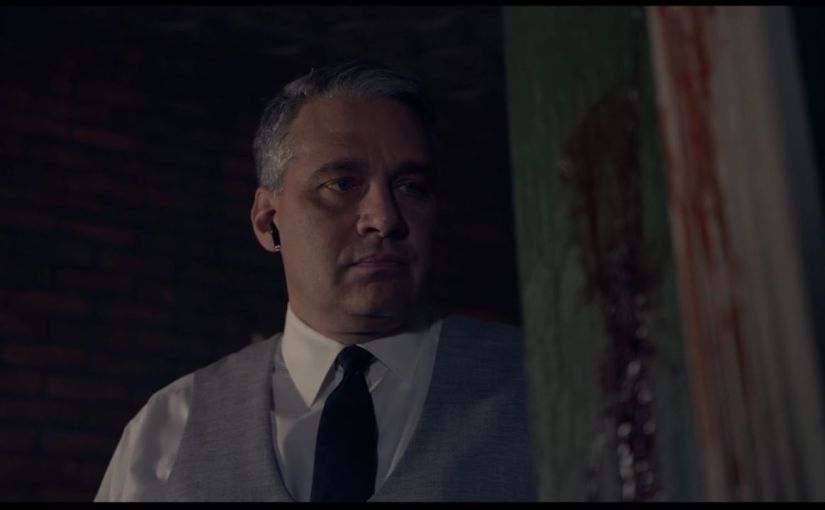
Don Worley is John, a seasoned assassin, who checks into a downtown hotel room with a set of golf clubs. He calls his wife and daughter to say hello while he begins to assemble his sniper rifle. Just after he disconnects with them, “No Caller ID” (Nicholaus Weindel) rings and John realizes that while he awaits his assigned target to appear on the street below, John has also become a target. Each time this caller phones, he seems to share more information about John’s current circumstance thereby putting him in danger along with his wife and daughter. Now it’s one assassin against another, but John is clearly at a disadvantage because he is unable to pinpoint from where this caller is watching him.
With Thomas L Callaway directing, A Time For Sunset monopolizes its camera work on actor Don Worley who is up for the one-man challenge. Intermittently, other figures on the hotel floor disrupt the phone conversation to lend to John’s contained paranoia such as a bellhop, a couple of rowdy kids, a manager and an angry mother. One person arrives to up the stakes with a cleverly rigged bomb and my mind immediately went to the third act of Jan DeBont’s Speed. These all feel like brief episodes though with not enough oomph to break the monotony.
The pace of the film moves very slowly because it focuses too often on a guy talking into his cell phone or the accompanying earpiece. So, the thrill of this thriller is mostly absent. Don Worley might be portraying this expert assassin with a measure of calm and cool sensibility during a high-pressure circumstance. However, his tone hardly changes as the stakes are getting higher. I never saw the desperation unfold, even as the film was wrapping up. John hardly breaks a sweat. Joel Schumacher’s Phone Booth was another picture that came to mind. Colin Farrell’s everyday man seemed to respond to the fear that is sorely lacking in Callaway’s film.
I liked the idea of this bottled up storyline. It has the potential to be compelling. A lot can be generated when someone must work against an unknown entity within a small setting. The original Saw, for example. Yet, even with a ticking time bomb front and center, plus the intrusion of a red pointer beam from a sniper scope, the direction does not build any suspense here.
Despite what the introductory scene appears to spell out for John’s fate, I really didn’t care what would become of the poor fellow.
 2 UNPAID MOVIE CRITICS!!!!