
KELLY’S HEROES

By Marc S. Sanders

There’s gold in them thar Nazi castle.  Hence the plot is set in motion for a World War II romp called Kelly’s Heroes.  It’s easy to get acclimated to the lightheartedness of this comedic war picture from director Brian G Hutton (Where Eagles Dare). 

The movie opens during a dark and rainy evening within a German occupied France. The on-screen credits pop up revealing an all-star cast of tough guy actors who are also quite funny.  Clint Eastwood is the title character who sits behind the wheel of a jeep. When the Nazis take notice, he hits the gas, makes a sharp left through the muddy road, and zooms away while avoiding shell fragments coming down on him. The film’s catchy theme song marches in – “Burning Bridges” performed by the Mike Curb Congregation.  The chorus of singers speak as a soldier who does not even care about authority or the rules of war.  The lyrics are rather simple to understand, and you want to just join in on the revolutionary merriment.  The song enters the film again and again over the next two and a half hours, reminding you to just enjoy the ride against this tragic capsule of time from the first half of twentieth century history.  Hawkeye Pierce couldn’t have said it better.

In his capture, Kelly has brought back a Nazi commandant and when he sees a fourteen-karat gold bar in the German’s possession, it’s easy to surmise that there must be more where this came from.  Turns out there is a stash worth roughly sixteen million dollars crated in a bank vault in the center of a stopover town, located across enemy lines in war torn France.  Kelly and his squad, led by Big Joe (Telly Savalas), are under heavy fire and forced to retreat for safety, but that isn’t going to stop him from making a snatch and grab.

Joe has been given orders to get the unit to safety and allow them a three-day reprieve of R & R.  However, he’s just as enticed as Kelly and gradually a small team of men assemble to pull off the heist.  First, they’ll need tanks to fight off the nearly indestructible Nazi Panzer machines they expect to encounter.  Fortunately, Crapgame (a scene stealing Don Rickles) and Kelly come across the hippie loving Oddball (another scene stealer – Donald Sutherland) who can supply the tanks they need and fend off what stands in the unit’s way.  What’s also important is Oddball find a bridge for the squad to cross before the allies destroy it.  That’s not so easy.  Sutherland is somewhat of a spaz; maybe an ancestor of Cosmo Kramer.

Meanwhile, a blood and guts two-star General Colt (Carroll O’Connor) is screaming for results from his subordinates.  When he intercepts the guys’ communications, he can’t help but be impressed with their progress and strategies of attack.  He’s ready to go into the field with a handful of medals for every American soldier that’s giving a damn. 

The looniness of Kelly’s Heroes is hilarious. Eastwood carries his signature quietness about him.  So, he’s the straight man leaving the loudmouth material for Savalas, Rickles, and a bevy of supporting actors.  Plus, there’s O’Connor in his own side story.  Sutherland is another kind of comedy – the free spirit who appears to have taken one too many shells to the noggin. 

It’s not a slapstick kind of movie.  It operates like the doctors from M*A*S*H.  These draftees have no loyalty to a cause.  They look out for each other.  They know how to survive the battles and they know that some will not make it.  Brian Hutton does not forget the frightening impact of war.  A memorable scene occurs when the unit realizes they are dead center in a mine field, offering up the life and death factor blended in both the comedy and drama that comes with a heroic war picture. 

There are some inconsistencies to Kelly’s Heroes.  Often, it feels like some scenes that would connect certain dots must have been edited out of the final print.  As the men come close to the to the bank where the gold is stashed, two of the soldiers are already in the overlooking bird’s nest tower giving a low down of the area to Kelly and Big Joe.  Yet, how did those guys ever get up there?  It’s not a terrible violation.  There are sequences like this that make the movie feel a little uneven. Clint Eastwood even went on record expressing his disappointment with the film as there were excised moments that drew more out of Rickles and Sutherland’s characters, and a few of the other supporting characters played by Gavin MacLeod (The Love Boat, The Mary Tyler Moore Show), Stuart Margolin (a very underrated character actor who had memorable episodes on the M*A*S*H tv series) and a young Harry Dean Stanton (here credited only as Dean Stanton). 

This film was shot in Yugoslavia simply because the country still had possession of many tanks and vehicles from the story’s time period.  The art design and battlegrounds are very impressive.  Before CGI, Brian G Hutton and his team were reenacting a lot of these loud, bombastic battle scenes complete with big fireballs of explosions along with the aftermath wreckage left behind of rubble and blasted out walls and craters.  Hutton positions his cameras either on top or right behind the cannons and guns mounted on the tanks.  So, you are actually getting a first person view of these massive war machines driving across the plains while shooting off their firepower.  The filmmakers did not hold back on making World War II look authentic in its battle wear.  I’ll be bold enough to say the settings are comparable to what Spielberg accomplished with Saving Private Ryan, and what Eastwood depicted in Letters From Iwo Jima.  The lens is just not as serious as those films.

The cast is a magnificent fraternity of brazenly funny tough guys, in the same vain as The Dirty Dozen, though much more lighthearted.  They’re a motley sort who all stand out among their similar appearances in green army fatigues and netted helmets. 

Kelly’s Heroes is a lighthearted comedic adventure where the heist is what you come to see against a historical backdrop when nothing was ever sensationalized fun.  History offers up a cruel world of pain and suffering, but who says we can’t enjoy ourselves through all the blood, guts and misery as our heroes ride off into a ravishing orange sunset?

Go for the gold and catch up with Kelly’s Heroes.
CASINO

By Marc S. Sanders

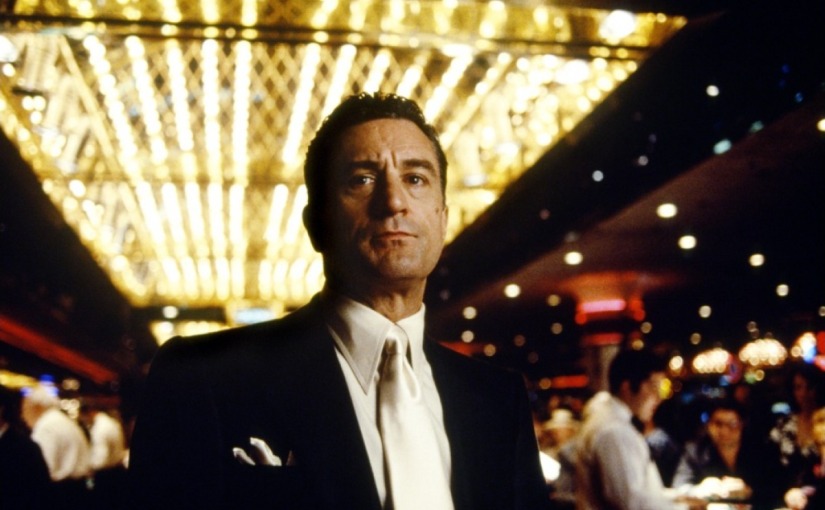
When a movie is set in Las Vegas, doesn’t it feel like it should be overly exaggerated, maybe a little loud, and quite bombastic?  That’s how I feel about Martin Scorsese’s three-hour opus, Casino.  The film opens with a car bomb exploding our primary narrator, Sam “Ace” Rothstein into the skies where he then makes his descent into the expansive signs that light up sin city in the desert.

Ace (Robert DeNiro) runs The Tangiers Casino.  He was especially picked by the mid-west Mafia back home (St. Louis, Mo.) to oversee everything that happens at the casino.  He’s looking for cheaters.  He’s making sure blueberry muffins live up to their name.  He’s dodging the FBI and their hidden bugs.  Most importantly, he’s making sure hefty suitcases are walked out of the casino and delivered on a monthly basis to the wise guys he has to answer to, and those deliveries better not come up light.  These guys treasure Ace because he never loses a bet.  Not one.  He can predict the outcome of any sports contest.  He can beat the odds on any table.  Ace is the best at his job because he also works eighteen hours out of every day, and he makes a lot of money for his superiors.

Everything should go smoothly.  However, the mob has also allowed Ace’s childhood friend, Nicky Santoro (Joe Pesci) to move out to Vegas.  Nicky is a heavy.  It’s not wise to upset or anger Nicky, because it’ll likely be the last time you ever do.  He’ll kick you when you’re down on the ground, but he’ll also stab you with a pen an endless number of times.  Don’t get your head caught in a vice when you are around Nicky.  This bull might have been sent out as a toughie to protect Ace and his work, but he’s not subtle about his methods.  When law enforcement gets involved, it only causes interference for Nicky and his crew to get back in the casinos or even in to Vegas.  Because Nicky won’t settle for that, it’s only going to make things harder, and especially challenging for Ace.

Ace’s other problem focuses on the one bet he did lose in life, and that was marrying Ginger (Sharon Stone in an Oscar nominated performance).  She’s a high-class hooker that Ace quickly becomes infatuated with, and the worst mistake he could have ever made was that he trusted her.  He trusted Ginger way too much.  Ginger may have quickly had a child and married Ace, but she never gave up on her loyalty to her scuzzy pimp, Lester (James Woods), and just wait until she starts carelessly confiding in Nicky.  Early on, everyone in the room, like even those in the comfort of their own homes, scream out loud why Ace would entrust a safe deposit box containing millions in cash with only Ginger’s name.  Ace can’t even get into the box if he wanted to.  He arranged it so that only Ginger could have access.  Keep the cash out of his name and the Feds can’t make a case.  As well, is Ace hiding his own interests from his own people?  Yet, that’s what he did.  He trusted his hooker wife way too much, way too often.

I’ve seen Casino a few times and I always leave it with the exact same problem.  I don’t think the film lives up to its title enough.  The first half of the film, while a similar blueprint to Goodfellas and later The Wolf Of Wall Street, is incredibly sweeping with Scorsese’s signature steady cams and voiceover work from DeNiro and Pesci.  You can travel from one end of the gambling hall, and then through clandestine back rooms and into secure areas all within sixty seconds.  Scorsese with a script from Nicholas Pileggi gives you a very fast education on how Ace operates a tight ship and keeps his mob superiors invested. 

Later, however, the film loses its way with an abundance of material on the Ginger character and how she is undoing Ace.  Stone gives an incredible performance as a constant drug and alcohol fueled spoiled brat of a trophy wife/former hooker.  She has wild outbursts that continuously threaten Ace and who he works for and with.  Minutes later, the film cuts to where the drugs have worn off and she comes back to her husband with her chinchilla coat draped over her shoulders.  The energy that Stone puts into this role must have exhausted her.  As a viewer, I get wiped out just watching her.  Yet, as engrossed the actress is in the part, what does it really have to do with life in a mob run casino? 

It’s not crazy to say that Las Vegas is city of at least 8 million stories.  It’s not called sin city for nothing.  In three hours’ time, much attention is given to how Ace’s casino funnels out monies to the mob.  Focus is also given to how they deceive the gaming commission and how Ace dodges the need to have a gaming license if he is to work at the casino.  There’s a great scene where he demonstrates what happens to cheaters who rip off the joint.  He also has to contend with the governing good ol’ boys who staked their claim in Nevada long before it became the gaming capital of the world.  If a dumb nephew is fired for not properly handling the slot machines, Ace is going to have to answer to someone with a big shot title.  Pileggi’s script is best in scenarios like this.  So, I can’t understand why he diverts his story into a domestic squabble of screaming and shoving between a husband and wife. 

The Ace/Ginger storyline populates over one third of the movie and then not much is talked about with the casino.  There are broken glasses and screaming and crying and drug fueled rages and opportunities to beat up Lester and now the film has become a personal picture, rather than Las Vegas mob cycle we were invited to observe.

Ironically, what I always hoped to gain from Casino is only a tease at the end, when Ace narrates how Las Vegas segued from mob rule and sold out to corporate America, even comparing it to Disney Land.  A wise shot is provided showing the senior citizens entering the doors of the casinos en masse, dressed in their sweat pants and polyester outfits ready to take a chance on the slots, not the more sophisticated gaming tables where the fat cats would lay down ten grand a hand.  Why couldn’t Nicholas Pileggi and Martin Scorsese devote time to this transition?  This seems like the bigger bet that Ace wouldn’t win out on.  Tons of married couples lose out and get married for the wrong reasons.  We’ve seen that kind of material before.  The real undoing of Ace Rothstein was likely the blue-chip organizations who pounced on what the mafia pioneered.  Hardly any of that is shown, only left to be implied.  I’m sorry, but Casino concludes on a missed opportunity.