
by Miguel E. Rodriguez
Director: Lone Scherfig
Cast: Peter Sarsgaard, Alfred Molina, Rosamund Pike, Dominic Cooper, Olivia Williams, Emma Thompson, Carey Mulligan
My Rating: 9/10
Rotten Tomatometer: 93% Certified Fresh
PLOT: A coming-of-age story about a teenage girl in 1960s suburban London, and how her life changes with the arrival of a playboy nearly twice her age.
Lone Scherfig’s An Education, written by famed British author/screenwriter Nick Hornby, is yet another example of how my preconceived notions of a film are often very wrong. Based on the plot description above, I assumed I was in for what I call a “spinach movie”: something that’s good for you, but not a lot of fun to eat. I thought the film would be dark and deep, delving into unsavory territory involving a predatory older man putting the make on an underage girl. Lessons would be learned, but it would be an uncomfortable watch.
For about the first half of the film, I felt I was mostly right. It’s 1962 in England, and Jenny (Carey Mulligan in her first major role) is a sixteen-year-old student who is studying hard to pass her A-levels – I think I got that right – with flying colors, which she hopes will give a favorable impression to the admissions board at Oxford. Her father (Alfred Molina) supports her plans…or rather, he supports HIS plans for her. He gives several impassioned speeches about the importance of getting a higher education, making sacrifices, dropping her cello hobby, etcetera, all in the service of getting those Oxford-level grades.
One day, Jenny gets caught in the rain and is rescued by David (Peter Sarsgaard), a charming older man driving an irresistible maroon sportscar. He isn’t just charming, he’s effortlessly charming, turning the exact right phrases to put Jenny at ease. The morning after he drives her home, he leaves a bouquet of flowers at her doorstep. He bumps into her again quite by accident, or “accident”, and asks her on a date for dinner and a concert. For this, he must convince Jenny’s very suspicious father…which he does with silver-tongued ease.
Jenny is caught up in this whirlwind of attention from a much older man who is clearly well off with sophisticated friends, Danny and Helen (Dominic Cooper and Rosamund Pike). Jenny’s father, Jack (Alfred Molina), is torn between his protective instincts and the idea that Jenny might have met a man who could make her dreams of Oxford…moot. Why worry about the expense of university when a rich husband can keep his daughter well cared for?
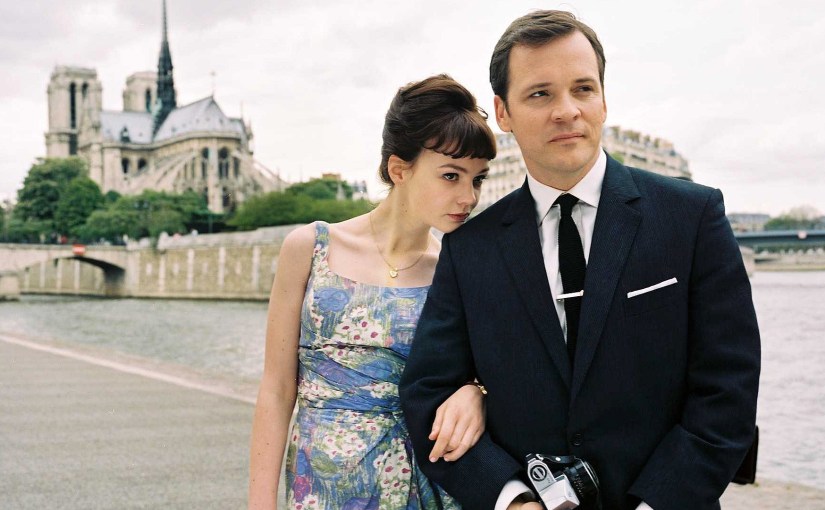
Despite the father’s (and my own) forebodings, Jenny is genuinely enjoying herself. She loves music, so David takes her to a concert. She loves art, so David takes her to an art auction. She loves learning and speaking French, so David takes her to Paris. His method of getting Jenny’s father to agree to this overnight trip is simultaneously simple and diabolical. Jenny is having fun for what seems to be the first time in her life.
She’s having so much fun that, for a while, I wasn’t quite sure what the movie was advocating. Is it supporting this relationship? She has a very frank conversation with David regarding her wish to remain a virgin until her seventeenth birthday. David agrees…then, in one of the ballsiest (and creepiest) moves I’ve ever seen from a guy in a movie, he asks her to give him a “peek.” What is going on?!? This guy is clearly a cad. But he’s so nice to her…and she’s having fun…!
Put it this way: I was prepared to throw something at the television by this point.
Around the midway point, though, the movie finally makes its true purpose known. It’s not about judging Jenny, which is too easy to do, or even judging David, which is ridiculously easy to do. The film is based on a memoir by a British journalist named Lynn Barber, which made some of the revelations about David’s past and how he makes a living easier to swallow, knowing that it’s based at least partially on fact. It also made all the “icky” parts in the first half of the film a little more palatable. When you realize that someone really went through this, it puts everything in a different light. I had the same epiphany during Schindler’s List; the concept that this all actually happened brought a deeper level to the viewing experience that I hadn’t expected. (It’s also what made Fargo so much more entertaining than your average crime film, but that’s another story…)
Anyway, this happens and that happens, and before you know it, Jenny has made the kinds of decisions that would make grown men and women tremble with anxiety. The movie’s title takes on a whole new meaning. It’s not just about Oxford anymore. It’s about studying at the University of Life, where the only way to know if you passed your test is if you’re still willing to take the next one, and the next, and the next. Even David learns a thing or two. Maybe. It’s a little inconclusive when it comes to that guy. What a jackass.
So…is it any good? Yes, it is. It’s got brilliant performances working from a Nick Hornby script that switches easily among pathos and embarrassment humor (witness the predicament of Jenny’s other suitor at her 17th birthday party) and even a little suspense. I tend to think of Hornby as Britain’s answer to Cameron Crowe. Hornby’s books and screenplays walk that same tightrope time after time (About a Boy, High Fidelity, the original Fever Pitch – soccer, not baseball), just like Crowe’s best work (Jerry Maguire, Say Anything, Almost Famous, which I don’t particularly love, but I do acknowledge its craftsmanship). By the time I got to the end of An Education, the double- or triple-meaning of the title is fully realized. Everyone has learned something. Not all of it has been good. It doesn’t all tickle. But, except possibly for David, everyone has taken what they’ve learned, good or bad, and put it to good use. That’s a satisfying ending.
[Side note: after this movie was over, I found myself thinking of Licorice Pizza and its plot regarding an underage boy and an adult woman. I can imagine my friend and partner-in-crime reading my favorable review above and asking me, “If you like this movie, how can you not like Licorice Pizza?” (He really loved Licorice Pizza.) The difference is that, by the time An Education is over, the characters have EVOLVED. Discuss.]

 2 UNPAID MOVIE CRITICS!!!!