
YOUNG GUNS

By Marc S. Sanders

In the late 1980s a novel idea hit the screens.  An MTV interpretation of the Old West with a rock anthem soundtrack of electric guitars and drums. A far separation from Ennio Morricone’s unbeatable spaghetti western approach.  

The film was Young Guns, featuring handsome stars like Emilio Estevez, Kiefer Sutherland, and Lou Diamond Phillips.  They were each different kind of gunslingers in their own right while delivering stand out personalities.  The film has some problems in editing, and some sequences do not work.  Yet, it remains stylish with impressive set designs, props, costume wear, and an especially appealing array of performances from the whole cast.  

Billy The Kid aka William H Bonney is one of the most notorious outlaws in American history.  Emilio Estevez brilliantly turns the gunslinger into a quick draw joker with an addictive cackle and an adorable smile.  William is taken in by the mentoring John Tunstall (Terence Stamp) who already oversees a collection of orphaned young men.  He’s teaching them to bear responsibility on his farm while they learn proper manners at the dinner table and how to read.

A neighboring industrial enemy, L.G. Murphy (Jack Palance) commissions his men to gun down Tunstall.  Billy and the rest of the gang are then deputized by the local Sheriff to issue warrants for the arrest of the killers.  However, Billy repeatedly exercises his own form of justice by killing one guy after another with his pair of six shooters.  Soon after, the boys are on the run by horseback while creating a whole bunch of mayhem.

I never considered Young Guns to be a perfect film, but I like it a whole heck of a lot.

There are moments that serve no purpose, like when the men get high on peyote, introduced by the Navajo, Chavez Y Chavez (Lou Diamond Phillips).  It’s not amusing.  It’s not quotable and the scene runs too long as we watch the cast walk and talk while in daze.  Frankly, most movie scenes of just watching people get high are boring.  Often, they go nowhere and I’m not sure how to respond. It’s like I’m the designated driver fiddling with my car keys at a drunken binge fest. This is no different.

As well, there seem to be gaps within the body of the story. I know it is inspired by the Lincoln County War, but it’s never entirely clear why Tunstall and Murphy are at odds with each other.  We just have to accept that the two elderly men of equal proportions are against one another.  Still, Palance versus Stamp is a very inviting conflict to look at. (Supposedly, the real John Tunstall was only in his mid-20s.)

Young Guns has a very cool polish.  These cowboys are downright attractive, sexy like Hollywood movies tend to offer, and I love how they handle each other, their horses and their pistols.  Every time a six shooter whips out of a holster and clicks, the movie becomes more alive.  The guys look well-worn within this environment, close to the Mexican border of the 1870s.  The image is just as effective as Clint Eastwood appears in his various assortment of westerns.  

Billy The Kid, over this film and its sequel, is Emilio Estevez’ best role of his career.  The actor has such a cocky, nervy way about him and his over-the-top laugh is impossible to forget.  A favorite scene in all of movies emerges when Billy toys with a bounty hunter in a saloon.  Estevez delivers much fun before gunning the guy down. I never tire of watching that moment.

Kiefer Sutherland is second in line with a graceful sensitivity as the educated and poetically romantic Doc Scurlock.  You worry about him and his courting affair with a young Chinese concubine that is owned by Murphy.  Lou Diamond Phillips specializes in knife throwing as Chavez, the token Navajo.  His presence belongs here as an unpredictable sidekick.  

The best surprise is delivered by Casey Siemaszko as the virginal, boyish illiterate Charlie.  Some gunslingers were afraid to ever become outlaws.  Charlie is ugly and dirty, bumbling and sweet, reminiscent of Fredo in The Godfather films.  Siemaszko never became as established as the others in the cast, but he’s a good performer who delivers panicked fear and brings the glamour of Young Guns down to a semblance of reality.  

Young Guns is a style over substance product.  It has potential for a stronger storyline, but the dialogue works and the cast is stellar, which also includes Dermot Mulroney, Terry O’Quinn and Charlie Sheen.  The sequel is actually better as it commits closer to the intrigue of Billy The Kid.  

Not perfect, but this is a fun escapist western experience.
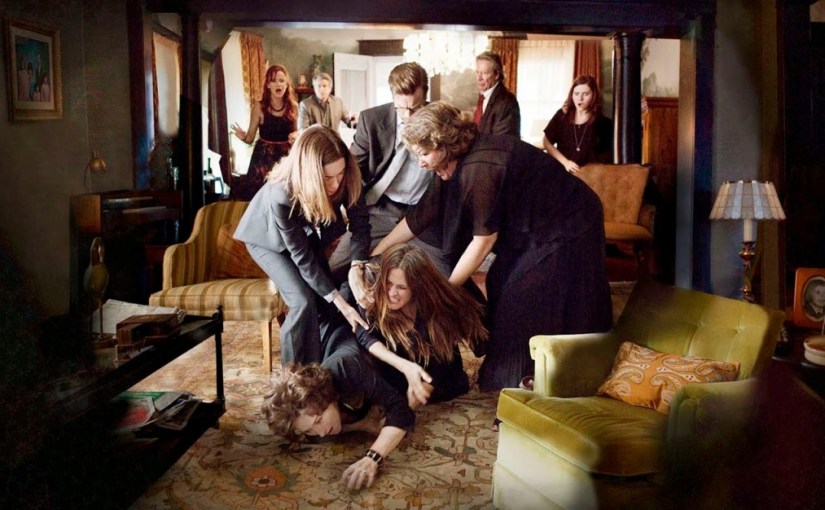
AUGUST: OSAGE COUNTY

By Marc S. Sanders

Once the dead are buried, the secrets come out.  Some mourn the loss.  Others mourn the reality of what existed.  Tracy Letts’ Pulitzer Prize winning play August: Osage County was adapted into a very well-cast film in 2013.  Letts’ screenplay is just as biting as his original source. Perhaps that is because of the performances of not just Meryl Streep and Julia Roberts, but also the entire collection of actors.

Dysfunctional is not a strong enough word for the Weston family of the sleepy, lifeless area of Osage County, Oklahoma.  The patriarch, Beverly (Sam Shepard) hires Johnna (Misty Upham) a Native American housekeeper/helper, for his pill popping, cigarette smoking wife Violet (Streep) who is also stricken with cancer of the mouth.  Shortly after, Beverly disappears.  The family comes home to the dusty shelves of books and old black and white family photographs and learns that Beverly has committed suicide.  The opportunities flood in for Violet (or Vi) to unleash every ugly, harsh truth that her three daughters Barbara, Ivy and Karen (Roberts, Julianne Nicholson and Juliette Lewis) have encountered along with their partners.  There’s also Vi’s sister Fannie Mae (Margo Martindale), her husband Charlie (Chris Cooper) and their son Little Charlie (Benedict Cumberbatch) to revisit the revelations of the Weston family.  Barbara’s estranged husband Bill (Ewan MacGregor) and her daughter Jean (Abigail Breslin) have their own drama to contend with as well.

It’s best not to spoil too much of what is revealed in the movie directed by John Wells.  The centerpiece of the picture is the afternoon family meal following the funeral service.  This must be one of the most intense and captivating dinner scenes caught on film in recent years.  Wells positions his cameras perfectly, so you know where every family member is seated at the table and the trading of barbs that go back and forth between the different combinations of arguments.  I would say the scene lasts at least twenty minutes and Wells manages to seat the viewer next to or right in front of every person at the table.  At one end of the table is Charlie.  Chris Cooper is a reluctant fill in to the void left by Beverly, the original patriarch.  The instigator is Vi. Meryl Streep is placed at the other head of the table where her drug addled eye contact can be had with anyone seated in her presence.  I’d love to have seen Meryl Streep while shooting this scene because even when the camera is not on her for a close up, I can still see that she is there in the dining room.  I’d argue she never turned off this persona during the making of this film. 

The most agonizing relationship is clearly between Vi and oldest daughter Barbara.  The first pairing on screen for Meryl Streep and Julia Roberts.  Why didn’t it happen sooner?  Moreover, why hasn’t it happened again since this film?  Perhaps because it is rare to find material of this dramatic weight to justify what can come from these two incredible actors.

The dinner scene is left discomforting to say the least, but the timing and delivery of Tracy Letts’ dialogue is functioning with high energy.  At age fourteen, Jean is the youngest member at the table, and she is questioned as to why she doesn’t eat meat.  According to her, you are consuming an “animal’s fear.”  The Westons are only adoring when they are cruel to one another.  One of the rare times that the rest of the family will unite with the antagonizing Vi is when they can mock and chortle at young Jean’s philosophy for “claiming” to be vegan, which is also undone by her parents when they reveal what she eats back home in Colorado. 

A hip middle aged Florida man named Steve (Dermot Mulroney) in a Ferrari has accompanied Karen to Osage.  Karen is the flighty one with her head in the clouds.  Steve has been married three times and takes a liking to teenage Jean’s curiosity to try pot.  Vi expresses disdain for the jerk with another welcome facial expression from Streep, but Tracy Letts does not have his character lash out or protest Karen’s choice to marry the guy.  For Violet Weston, it is better that Karen does marry this letch.  It gives Vi more purpose to criticize and belabor upon one more poor decision made by another daughter.  Violet thrives on bellowing out the shortcomings of her children, her dead poet/author husband, her sister, and anyone else within her presence.  It’s how she lives and overcomes her cancer while an unkempt wig conceals her chemo remaining grey hairs.

On the side, a relationship is brewing between first cousins Little Charlie and Vi’s middle daughter Ivy.  They know it’s wrong, but they can’t help hiding their affections much longer.  Cumberbatch goes against type here as a nervous, insecure young man who has not matured from his boyhood nature.  Julianne Nicholson appears to be the most held together of the three daughters as she has never ventured out of Osage while living with her parents.  She is now ready to give up that lifestyle, and she’s leaving it in Barbara’s lap to figure what’s to come of Vi. 

Barbara is the most unhinged.  She is married to sweet natured but boring Bill and it’s likely that the past demons she clung to from her upbringing left Osage with her when she relocated to Colorado with her husband and daughter.  Bill might be having a tryst with one of his college students but is he the worst one in the marriage?  Barbara Weston might be Julia Roberts’ best role since her early career film introduction in Steel Magnolias and her Oscar winning turn in Erin Brockovich.  In films like these, Julia Roberts doesn’t look like the starlet she once was in the 1990s.  In August: Osage County she has downed her appearance with no makeup, unwashed hair, and wrinkled clothes while carrying an emotionally exhausted physique.  However, she’s perfect to play the eldest daughter who somehow must be the one responsible for picking up the shattered pieces of dishware that hit the floor on numerous occasions and fractured connections left behind in the family dynamic.  This is a commanding performance by Julia Roberts; one that needs to be seen.  Incidentally, she never does clean up the broken plates.  I only assume it would be her who must do so.  However, the quiet Johnna is around somewhere. She will make everything disappear.

Memorably, a physical altercation ends the dinner.  The day passes into the next mid afternoon and more secrets are uncovered.  Some are quite horrifying, considering the circumstances that some members of the family have themselves in.  Just when you think that this script is ending with a debate of which daughter will look after mother now that daddy is gone, there’s more troubling truth to grapple with as well.

August: Osage County is a movie hinged on the acting chops of its cast with a smart, unforgiving script for the damaged characters depicted.  It falls in the same category as David Mamet’s Glengarry Glen Ross or Sam Shepard’s True West.  We may be witnessing the abnormalities and sins of these people, but it would be more unusual had these folks possessed genuine happiness and solid affection for one another.  The quietly muted Native American Johnna enters the household of people who replaced her own people, who occupied this land long before the early generations of Westons ever arrived.  It’s telling that Tracy Letts demonstrates the original occupants still survive in peace while the ones that took over can’t find a way to live happily among themselves.  Watch the film or see the play.  Then come back and tell me if the white folks of the Weston family truly belong in the once occupied Native American Osage County, Oklahoma.