
TRAINING DAY

By Marc S. Sanders

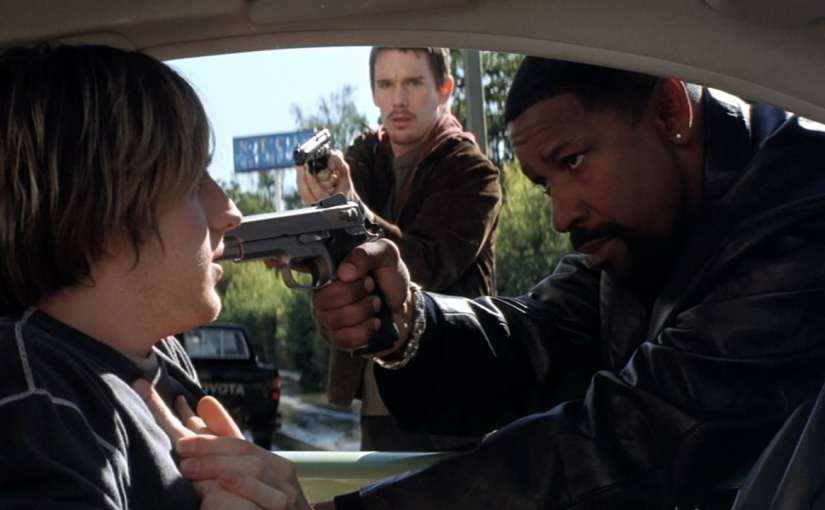
When I first saw Antoine Fuqua’s Training Day in theaters, I found it difficult to watch. The violence or the induced police brutality is very strong. There’s no humor and there’s no thrill. Just an in your face pull over excuse for a cop to exercise his strong arm with his two strapped nickel played Barettas.

Jump to the present and it’s even harder to look at because what the film perpetuates is quite parallel to how many parties view law enforcement and people of color today. Training Day isn’t pretty, nor is it assuring. It’s more or less glamorized evil with a good-looking Denzel Washington driving a gorgeous looking pimped out black Chevy Monte Carlo.

Washington gives an Oscar winning turn (though I’ve seen him in more deserving and nuanced roles; Hello? Malcolm X, anyone?) as narcotics detective Alonzo Harris. He begins his day taking on a new partner named Jake Hoyt (Oscar nominee Ethan Hawke), a boy scout looking cop fresh out of his uniform and into street clothes eager to advance his career and eventually get the kind of big house that other high salary detectives reside in.

Alonzo knows the streets of Los Angeles so well that he can literally stop his car in the middle of an intersection and every other driver will circumvent around him with no protest. Alonzo is here to show Hoyt how to learn the streets for himself and earn the respect of the various gangs and pushers that will lead to the big busts. Only thing is that Alonzo Harris is not a good man. This is a cop who uses his badge as a way of power and intimidation. In this one day, with each passing moment, Hoyt questions his own training and considers if crossing line after line is how you get ahead. Does Alonzo truly know what it means to be a cop making a difference? Does Alonzo care? Does Hoyt care, or does he only concern himself with his career aspirations?

There’s no question that Fuqua’s film is very well made. His dirty, criminally ridden Los Angeles is very convincing and the command that Washington has with his corrupt cop role is all the more intimidating. However, I didn’t feel good with the film after it ended. I didn’t learn anything about race or social classes in America. I didn’t learn that a cop can be a hero. After all, Jake Hoyt doesn’t exactly take the noble approach to surviving his first day in the new job.

There’s a lot of preaching monologues from Alonzo Harris, who is a pretty frightening guy. He’ll his gun at his apprentice’s head, as a means to convince him to smoke some street PCP, because it’s a first step in knowing these streets. Hoyt gives in to the pressure. Still, none of this tells me anything.

Harris goes from one questionable incident to another and Hoyt gives merely dubious expressions but not much else. Eventually, as things boil over between the two men, Hoyt takes the law into his own hands rather than following procedures.

Training Day dictates who is the good guy and who is the bad guy. In the film, however, the good guy more or less becomes the bad guy by the end. That simply didn’t sit right with me. All the necessary ingredients are here for a good cop/bad cop thriller, but I didn’t feel quite good about myself when the film closed out. There really is no one who comes up triumphant. There’s nothing to question about my own view of the world we live in, and there’s too much edge to allow for any kind of suspense. Alonzo Harris is just a bad, bad guy and John Hoyt is never really a good guy. He’s a wimp succumbing to an evil brainwash.

So, then what’s left is to wonder exactly what is there to truly appreciate in Training Day, and the answer is practically nothing except the construction of the film and Washington’s performance. Otherwise, the film is a harsh fiction never concerned with conveying a message within a real problem area of the United States. I would’ve appreciated a response to a harsh reality.
THE TRAGEDY OF MACBETH (2021)

by Miguel E. Rodriguez

Director: Joel Coen
Cast: Denzel Washington, Frances McDormand, Alex Hassell, Brendan Gleeson, Corey Hawkins, Stephen Root
My Rating: 8/10
Rotten Tomatometer: 93% Certified Fresh

PLOT: William Shakespeare’s tragic tale of murder and guilt gets a stylistic re-telling with moody direction from Joel Coen and powerhouse performances from its two leads.


I am of two minds when thinking about Joel Coen’s take on William Shakespeare’s Macbeth.

First, I must admit I am no Shakespeare scholar. I can count on one hand (maybe two) the number of filmed Shakespeare adaptations I have seen, and I can count on one finger how many theatrical productions I’ve seen. I’ve only read two of the Bard’s plays beginning to end: Othello and Julius Caesar. I have acted in a production of the popular Shakespeare parody The Compleat Workes of William Shakespeare (Abridged), but I doubt anyone would find that an acceptable credential.

So I must be honest and say that, when it comes to the nitty gritty specifics of the dialogue in The Tragedy of Macbeth, I was lost for, oh, 50-60% of the time. Like, “out to sea” lost. I am moderately familiar with the story, so in those times I was lost, I was able to glean what was going on or what was being said in context. I know who Banquo and Macduff and poor Duncan are, and so was able to follow their various comings and goings as revealed in the frequent chunks of expositional dialogue.

[Full disclosure: If the name of the Ross character is ever actually mentioned in the film, I must have missed it…for the duration, I wondered what his name was, and he is a vital character in certain scenes.]

But I have to say, whatever I missed in the dialogue was more than compensated for by the sensational visual language of the film, and by the stunning performances from the two leads.

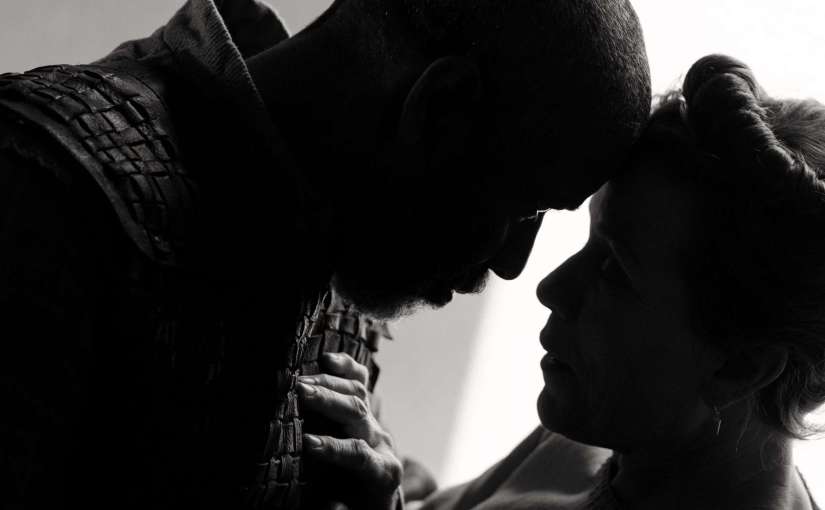
First, it was shot in glorious black-and-white, and it was all shot on soundstages, giving the director (Joel Coen, working for the first time without his brother Ethan) and cinematographer (Bruno Delbonnel [Amélie, Across the Universe]) absolute control over the lighting and shadows. The resulting visuals look like something out of the early silent films of Fritz Lang and, especially, F.W. Murnau, with compositions that must have taken hours and hours to set up, with high-contrast shadows creating elaborate framing devices on walls and floors. When Macbeth famously sees a dagger before him, it’s accomplished by shining a reflective light on a highly polished door handle. In the few shots that take place outside the castle, more often than not shadows are moving slightly in the frame, as if the sun or the clouds were in constant motion. Those shadows always seem to be sliding down over the characters, perhaps mirroring Macbeth and his lady’s constant downward spiral towards their fate.

Another factor in the visual look of the film was the decision to frame it in the standard 1:33 ratio, sometimes known as the “Academy” ratio. Basically, instead of watching the film on a rectangle-shaped viewing area, you’re watching it on a square set in the middle of the screen. One might think that doing so would limit the possibilities of visual expression, but not so. For me, it had the effect of making everything a little more claustrophobic, which I think is important in cementing the state of mind of our two main characters. As the guilt over their evil deeds threatens to overwhelm them both, the smaller screen is a constant, subtle reminder that their options are limited, and becoming fewer as time goes on.

All in all, a visual feast, in a nutshell.

But what makes The Tragedy of Macbeth even more delightful to watch are the performances. To be sure, everyone involved acquits themselves incredibly well. (Keep your eyes open for a young man named Harry Melling, aka “Dudley Vernon” from the Harry Potter film franchise.) But the two that shine brightest are Denzel Washington as Macbeth and Frances McDormand as Lady Macbeth.

Lady Macbeth is as quietly vicious and malicious as they come, and it helps that her attitudes are quite at odds with McDormand’s kind, open features. It is a little startling to see the face of good-hearted Marge Gunderson fiercely exhorting Macbeth to commit regicide in sharp, clipped tones, her whispers piercing the air between them like poison darts. Her despair at her husband’s inability to calmly deal with the guilt is clearly evident; when he reveals he went above and beyond what was originally planned, her shocked “are-you-kidding-me” looks are worth pages and pages of dialogue. And, of course, in the late stages of the story, when madness finally overtakes her, when no amount of washing will wipe the blood from her hands, her animalistic howls of anguish are almost worth the price of admission.

But the highlight of the whole venture (for me, anyway) was watching Denzel Washington demolish the screen as Macbeth himself. Words fail me. I haven’t seen a performance this amazing and praiseworthy since Daniel Day Lewis in There Will Be Blood. I may not be a Shakespeare scholar, but I know enough to understand that making it flow as easily as normal speech takes a great deal of research and rehearsal and collaboration. What I would not GIVE to see him reprise this role on stage somewhere! He navigates the twists and turns of Shakespeare’s tortured syntax as easily as if he was telling a story about his day at work. As with any great performance, there are peaks and valleys, and his teeth-clenching, fist-pumping outbursts are used as periodic punctuation marks, not entire sentences. There is a brief scene where he angrily berates a messenger, and his seventeenth-century taunts and name-callings are as surgical and cutting as anything from Mamet. It’s a miraculous performance, and I would not be surprised in the least if he gets another Oscar nomination. (The same goes for Frances McDormand…what a duo!)

(I would be remiss if I did not also mention the performance by a little-known actress, Kathryn Hunter, as the famous Witches. Her voice and face open the film, and if there’s any justice, it will go down as one of the great opening sequences of the movies. There are portions of her performance that must have taken great courage and trust in director Coen, to make sure she did not come off as simply a kook. She does not. She is one of the most ineffably creepy individuals in a movie in quite some time. I dare not say more without ruining the effect. But she was breathtakingly successful.)

When I walked out of The Tragedy of Macbeth, I can clearly remember thinking, “Well, great movie, but one that I wouldn’t purchase for my home video library, because how can it possibly equal the experience of seeing these precise visuals married to these insane performances, on a big screen?” But the more I think about it, the more I think I will pick up a copy when it becomes available, for a couple of reasons. First, a little extra culture never hurt anyone, and second, it will be worth the purchase price just to see Washington and McDormand tear up the screen as the Macbeths again, not to mention those stunning visuals, AND those creepy witches. This movie is really growing on me.

PHILADELPHIA

By Marc S. Sanders

Tom Hanks most certainly deserved the first of his two Oscars for his portrayal of Andrew Beckett, one of the first protagonists to be an AIDS victim on screen in Jonathan Demme’s 1993 film, Philadelphia. Its a good film but not a great film.

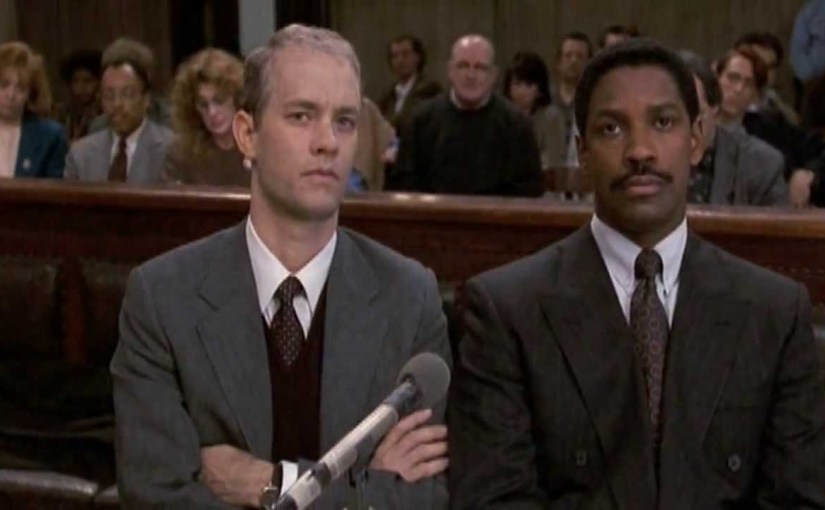
I recall seeing Philadelphia when it was originally released. Seeing it today, my opinion hasn’t changed. I don’t believe the film takes enough risks and the script from Ron Nyswaner is too cookie cutter and simple. Beckett hires Joe Miller (Denzel Washington) to represent him when he proceeds to sue the law firm who wrongfully fired him for having AIDS, and most likely being gay as well. The argument hinges on proving that having AIDS is a handicap that never interfered with Andrew’s work performance. Andrew is clearly made out to be the firm’s best of the young attorneys when he’s assigned their biggest client. Nine days later he’s sabotaged, and soon after he’s fired for an attitude problem and carelessness. Eventually, Andrew and Joe assemble, despite Joe’s prejudices against homosexuals.

The trial, Andrew’s struggle of living with AIDS, and Joe’s own inner debate with associating and defending a homosexual, AIDS victim are the three main storylines.

The first storyline is the best. Demme does a masterful job of showing the evolution of the disease. Andrew could be looking at papers on a desk and when he turns his head, a lesion appears on his neck. Makeup artists Carl Fullerton and Alan D’Angerio deservedly were Oscar nominated as Hanks’ appearance seems to change from one scene to another and another. He’s thinner in one moment with very fine ash gray hair. In another scene, he’s got a full head of hair with an energetic way about him. I cried for Andrew’s deterioration. Hanks and Demme carry that aspect very, very well. The actor does great work of changing his voice when he’s fighting a cold with a terrible cough or evoking massive weakness. As the film progresses and Andrew gets sicker, he’s incredibly pale with a droopy eye. The makeup artists tell the story with Hanks’ performance and Demme’s direction.

The 2nd and 3rd storylines don’t offer much of a challenge. The law firm primarily represented by head partner Jason Robards is too easily “evil.” There’s no subtlety here. Robards gets right in the face of the film – “Andrew brought AIDS into our office.” A better script would wait for the bad guys’ momentous third act Freudian Slip. This case was unchallenging really. It was too easy to win. Especially true considering this great and powerful law firm hires Mary Steenburgen as defense counsel. Steenburgen plays her part very mousy and unaggressive though. This case is too lopsided and uneven and I just couldn’t get past that.

Joe’s own reservations are too apparent as well. He’s meant to represent those that simply never understood the mentality of gay love, nor the scientific evidence of the AIDS virus. He rushes to his doctor following an initial meeting with Andrew. Demme does an extreme close up of this doctor to teach the audience the basics of AIDS. This guy is right in your face with his dialogue. I didn’t care for moments like this. Too patronizing.

A side story attempts to show the intimate relationship of Andrew with his boyfriend Miguel (Antonio Banderas). I still feel the same about this part. The script holds back. Hanks and Banderas give each other “bro hugs” and kisses are done on the bottom cheek. Back in’93, filmmakers were not prepared to go all the way with depicting the true nature of homosexuality. I found it insulting. You finally want to make a film that shows AIDS and homosexuals at the forefront but you stop short at the finish line.

Ironically, Joe has a repetitive line “Explain this to me like I’m a 4 year old…” Demme adopts that method throughout the film with major “in your face” close ups to glaringly make the beliefs of what any character values or has to say as obvious as possible. I felt as an audience member that Demme didn’t have to take it this far. I get it. You don’t have to be THAT FORTHRIGHT.

Washington is a great actor as always. He’s likable even if he’s tripped by the fault of misunderstanding. His “TV GUY” ambulance chasing lawyer is comic relief at times within a film of very heavy subject matter.

Demme’s filmmaking does make some wise choices despite some of my issues. The opening credits offers a lot of footage of the city with people carrying on their daily lives while waving to the camera, selling fish at the market, street dancing, etc, all accompanied by Bruce Springsteen’s sweet, yet haunting theme “Streets Of Philadelphia.” I like this opening as it shows what we see on the surface of the people we live with does not necessarily reveal the struggle any one of us might be enduring. This is a moment where the script is not so easy to grasp. There’s a challenge to accepting Demme’s footage blended with Springsteen’s overture.

Jonathan Demme is a good director, who is sadly no longer with us. I appreciate Philadelphia for showing the illness but not much else. It’s a film that should be seen. I’d argue most would embrace more of the movie than I did. I just felt the envelope could have been, actually should’ve been, pushed further. It was too careful with its subject matter.

A great observation though was recognizing the many faces that appear in the film from Demme’s other film, The Silence Of The Lambs. As well as naming Joe’s baby daughter “Clarice.” I also recognized an identical tracking shot that Demme offers. When Joe goes to visit Andrew in the hospital, it is a shot for shot remake of the tracking movement when Clarice goes to visit Jack Crawford in his office, at the beginning of Lambs. This might not be original, but I had fun recognizing it, nonetheless.

THE TAKING OF PELHAM 1 2 3 (2009)

By Marc S. Sanders

While the remake of The Taking Of Pelham 123 is not the best of the Tony Scott directed/Denzel Washington headlining thrillers, it’s still a good time. I’m a sucker actually for most of their films, though as of this writing I’ve yet to see Man On Fire. Washington and Scott made several action pictures together. You depend on Scott to work in all the fast cuts to wake up your pulse and allow Washington to form a variety of characters. Denzel Washington didn’t have to appear like the macho tough guy with the ripped muscles. In Pelham, it could not be more evident.

Washington plays Walter Garber (first name salute to Walter Matthau of the original film), a dispatch operator for the New York City subway line with years of experience in all facets of operation and management. However, he’s been demoted due to an ongoing investigation that he has accepted bribes. Now let me say that I like this angle. He’s not a typical alcoholic or drug addict that we might have seen a Bruce Willis guy do one too many times. This is something different and unexpected. Washington also appears with a pot belly, glasses and no fashion sense. He’s not a decorated war veteran. This is not an action hero. Screenwriter Brian Helgeland got it just right, with this character at least.

John Travolta is your bad guy known as Ryder, and I’m afraid he’s cut from similar cloths of his other career bad guys. He screams in the same way. He has the psycho meltdown attempts at hilarity. So he’s more of the same really.

Ryder and his crew hijack one car off the subway line that comes out of Pelham Bay, NY. Garber answers the call from Ryder with his demands for money within the hour or a hostage will get killed minute by minute after the deadline.

Now Helgeland and Scott are very aware of the absurdity going on here. When the apathetic Mayor (a welcome James Gandolfini) agrees to pay the cash, it has to be transported all the way from the bank reserve in Brooklyn. This requires Scott’s signature moves of racing police cars and bikes through congested New York City to get it to Ryder before the deadline. Only midway through this long sequence which gobbles up tons of the film’s running time, does someone ask why they just didn’t use the helicopter. Cue my colleague Miguel E Rodriguez: “Then there wouldn’t be a movie!!!!”

As much as I like the action shots, because I’m a guilty pleasure sucker for that stuff, I have to insist that there still could’ve been a movie; a better movie. Helgeland’s script wasn’t imaginative enough, or the producers insisted on more car crashes and things blowing up real good. The original with Walter Matthau and Robert Shaw maintained tension for its two hour running time. This remake could have learned a little more from its ancestor. Two great actors are at your disposal, and you might have gotten some good dialogue like that of Clarice & Hannibal, perhaps.

Still, the conversations between Washington and Travolta are serviceable on at least one side with most credit going to Washington. Surprises into the Garber character keep the film interesting. Travolta? Well, I saw this guy in Face/Off and Broken Arrow and Swordfish and on and on.

The Taking Of Pelham 123 always had my attention. Yet, I wish it showed me even more new things than just its unlikely hero. Denzel Washington shouldn’t have to be the only one putting in overtime.