
By Marc S. Sanders
As Clint Eastwood’s Absolute Power was unfolding I started to think this plays like one of those hardcover bestseller political thrillers from the 90s that my dad would scoop up off of the neatly designed stack at the front of Barnes & Noble. You know with the glossy book jacket that has the blood stain and a dead girl’s nail polished hand next to a bloody letter opener. The graphics are elevated to feel the crime scene with your fingertips. The intrigue is summed up on the inside tab. You turn to the back of the book to see the picture of the author. Then you buy it with your membership card. Go figure! William Goldman adapted the screenplay from a novel by renowned author David Baldacci. Absolute Power has an engaging set up, a who’s who of a cast, it’s directed, produced and starring Eastwood. Still, it evolves into utter eye-rolling preposterousness.
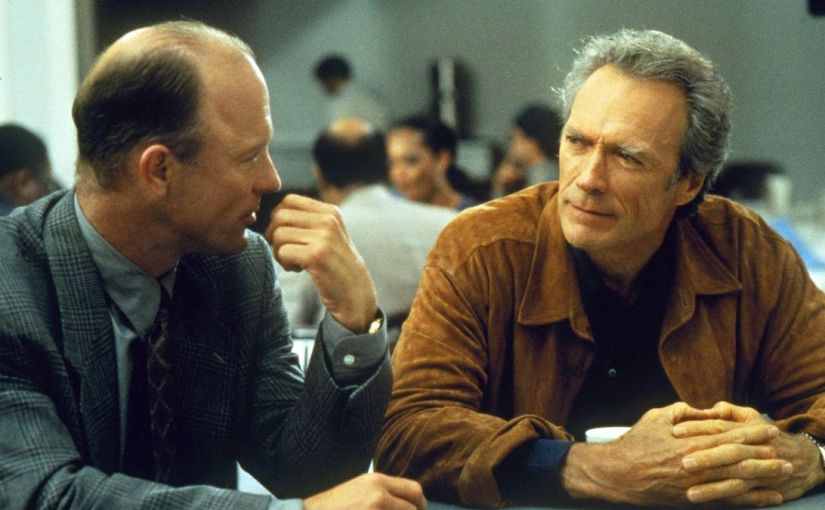
Eastwood directs his own portrayal Luther Whitney, an expert jewel thief. He might be getting up there in age but he scopes out the mansion of a billionaire tycoon (E.G Marshall, in his final on-screen role) and locates the vault hidden behind a large two-way mirror. Everything is going to plan as Luther bags up the valuables and a lot of cash but then a drunken couple enter with Luther hidden behind the mirror to watch their tryst turn deadly. The President of the United States (Gene Hackman) avoids being stabbed to death by the young lady (Melora Hardin) when his secret service detail (Scott Gleen and Dennis Haysbert) enter to shoot the girl dead. The President’s Chief of Staff (Judy Davis) arrives soon after. Luther observes the four as they rush the Commander In Chief out of the house and alter the crime scene. They get careless and just as Luther makes a quick exit, he retrieves evidence that will hopefully work to his advantage. Now he’s in danger of the President and the other three as they work to permanently contain the situation.
Elsewhere is Ed Harris as the detective out to solve the murder and uncover everything we already know. When he realizes a thief must have been at the scene of the crime, he actually approaches Luther for some guidance as to who could have been there. Later, he will use Laura Linney, playing Luther’s daughter, for assistance as her father seems to be the prime suspect.
The tycoon, the President’s biggest supporter, also wants to resolve his personal vendetta by hiring his own sniper (Richard Jenkins) to take out Luther.
Absolute Power has all of these players, with recognizable actors in the roles, and yet cannot work the magic necessary to fix this outrageous conundrum. I can believe that a President could get in more trouble than he needs with a one-night stand and a dead girl on the floor. I can believe members of his staff will work to tie off all the loose ends, even if it means more murder and mayhem must occur.
What is hard to swallow is how neatly the story wraps up literally within one afternoon leading into an evening. It’s fortunate that window washers are present to throw off a couple of snipers with an inconvenient glare at the most inopportune time. Otherwise, there will be no more movie. It helps that a character with remorse happens to take his own life, thus exposing the conspiracy, just as Eastwood’s character is steering his own way to exoneration. All in the same night!!!!
To ramp up the suspense, the bad guys go after Linney’s character, the one person Luther cares for the most. She ends up in a hospital. Message has been sent. Luther better surrender himself along with what he knows to the President’s squad. Yet, they try one more time to permanently eliminate her and I asked why. What purpose does that serve to kill her now? If you kill her, then Luther has nothing to protect or care about anymore. He can just reveal the entire breakdown of what really happened complete with evidence and so on.
A few years earlier, Eastwood starred in In The Line Of Fire where John Malkovich played a master of disguise assassin. Luther is also a craftsman at hiding in plain sight. However, there’s no way I can believe that. We are looking at Clint Eastwood here. He’s got his own unique and very tall and square stature. Put a white mustache and a pair of glasses on the guy, and it is still Clint Eastwood. Put a hat and beard on him and it is still Clint Eastwood. Wrap him up in a trench coat and have him walk the city streets in broad daylight where fifty cops are awaiting his arrival and you’ll be able to see the one and only Clint Eastwood. It just can’t work. James Bond can hide in disguise. John Malkovich can hide in disguise. Go anywhere in the world and Shaquille O’Neal and Clint Eastwood would never be hidden in plain sight.
William Goldman (The Princess Bride, Butch Cassidy And The Sundance Kid) is one of Hollywood’s most celebrated screenwriters. He did not think this story all the way through. You may believe Gene Hackman (second billing behind Eastwood) would have had more of a presence in this picture but oddly enough he’s hardly there. The real bad guy roles belong to Judy Davis and Scott Glenn who are not nearly as exciting as what Hackman could have delivered.
There was a potential for a good conspiracy thriller. The problem is the audience knows too much following the first fifteen minutes of the film. We know everything that happened and therefore I could care less about the progress that Ed Harris’ detective makes. Absolute Power likely would have performed better had it opened after the crime had occurred. Run the opening credits over the dead girl in the room and open the two-way mirror for Luther to enter the frame. He makes a run for it and then the film can gradually reveal what precisely happened. A mystery for the characters and the audiences who are watching them only works if the questions are offered before the answers are revealed.
Absolute Power offered a lot of promise with a lot of talent but it’s devoid of both.

 2 UNPAID MOVIE CRITICS!!!!