TRADING PLACES

By Marc S. Sanders

Dan Aykroyd and Eddie Murphy are the unaware invitees of a Prince And The Pauper R-rated, yet whimsical, scenario in John Landis’ Trading Places.  They are one of the best on screen pairings in film, and this is one of the best comedies to come out of the 1980s.

Randolph and Mortimer Duke (Ralph Bellamy, Don Ameche – another brilliant on-screen duo) are the filthy rich misers who live to make more and more money and use their wealth to cheat and make even more monies or to perhaps use those that are at their behest to test certain social experiments.  Namely, Randoph believes that regardless of a man’s environmental upbringing, anyone can become a success based on their merits.  Mortimer believes otherwise.  It’s in the blood, he claims.  Who you spawn from is how you are destined to become.  To settle this debate, they make a modest bet of switching out their protégé investment representative, Louis Winthorpe (Aykroyd), with homeless bum/con artist Billy Ray Valentine (Murphy).  Deplete Louis of all his possessions and wealth along with his sparkling reputation, his lovely fiancée, his friends and even his faithful butler, Coleman (Denholm Elliot).  At the same time, establish Billy Ray as an up and comer in the WASP Hoi Polloi and award him all of Louis’ assets, along with assistance from Coleman.  Then they will see what shakes out and who wins the bet.  A plot like this was staged in a few Three Stooges shorts during a post Great Depression phase.

The premise for Trading Places allows for a lot of gags that consistently serve the story set mostly in Philadelphia around Christmas and New Year’s.  The holidays lend an atmosphere to the picture.  The brutal cold seems to only make it downright worse for poor Louis, the suddenly accused drug dealer and petty thief.  It only looks worse for him when he’s dressed in a dirty Santa Claus suit and getting peed on by a dog just before the cold rain arrives.  For Billy Ray, the warm comforts of Louis’ home seem like a welcome respite from the chilly, damp streets he likely has slept upon night after night.  If not on the street, then in a jail cell. 

The characterizations are perfect.  I get a kick of Dan Aykroyd’s performance of Louis, the contemptible snob with not one hair out of place and the arrogant tone of his line delivery.  Eddie Murphy is basically doing his routine from all of his early work like Saturday Night Live and 48 Hrs or Beverly Hills Cop.  Yet, I have no complaints.  He’s just funny as hell and the dialogue lends to his basic schtick.  This is the Eddie Murphy I miss from most of his modern film releases.  Denholm Elliott is great at often breaking his regal character to refer to someone as a scumbag.  Bellamy and Ameche are equivalent to wicked stepsisters from a fantasy story.  They are scheming and dreadful with glee.  Paul Gleeson is that “seen that guy somewhere before” henchman working in line with the Dukes.  He’s a great jerk who gets Louis and Billy Ray into their unexpected predicament.  Jamie Lee Curtis is unforgettable as a hooker with a heart of gold, convinced to help out a poor down on his luck Louis when there’s nothing else available to his assist.  She portrays Ophelia whose got the street smarts and sometimes the Judy Holliday squeak in her voice to lend to the spoof comedy this film relies upon.  It’s hard to believe this is the same actor who was a scream queen in a couple of slasher flicks a few years before this film’s release. Never a glamourous actor, but Jamie Lee Curtis has such an amazing range that still surprises in newer films of today (see her Oscar winning performance in Everything, Everywhere, All At Once).

The imagination into this film’s story has to be admired.  When Louis and Billy Ray become aware of the ruse pulled against them, it’s suggested not to kill the villains in cold blood. Rather do unto them what they already committed. Thus, a wonderfully energetic third act is welcomed on the floor of the New York Commodities Exchange that hinges on insider trading and realistic mass hysteria for a silly, yet highly valuable commodity such as Frozen Concentrated Orange Juice.

John Landis incorporates so many side gags into Trading Places.  Imagine Billy Ray intruding upon the wealthy’s exclusive club of snobs and you get a memorable caption of ten police officers pointing their guns in his face.  Poor Louis being subjected to a strip search conducted by nerdy Frank Oz.  Randoph and Mortimer explaining how commodities trading functions to Billy Ray thereby inviting Eddie Murphy to break the fourth wall for a moment.  Even one of my favorite actors of today, Giancarlo Esposito, makes a blink and miss it appearance as Billy Ray tells a tall tale of how he got arrested after using the “Quart of Blood Technique” on ten cops at one time while two hilarious jail cell thugs listen in to his BS.  A train ride to set the victims’ plot of revenge in motion is great involving silly disguises, a New Year’s Eve costume party attended by James Belushi, and a live gorilla.  Even Bo Diddley gets a scene with Louis trying to sell his expensive wristwatch while wearing the ugliest sports jacket and tie combination.

I yearn for another comedy that reunites Aykroyd and Murphy.  We were treated to a little sampling of Bellamy and Ameche in Murphy’s later film, Coming To America.  Oh, how I wish those guys could have capitalized on that small scene.  They pair just as well as Jack Lemmon and Walter Matthau did. 

Trading Places is always a perfect holiday movie to watch in December.  It’s funny, charming, and very smart.  It remains one of the best comedies ever offered by any of the cast members listed in this film.

Looking good Billy Ray!

Feeling good Louis!
A BRIDGE TOO FAR (1977)

by Miguel E. Rodriguez

DIRECTOR: Richard Attenborough
CAST: Sean Connery, Ryan O’Neal, Gene Hackman, Michael Caine, Anthony Hopkins, James Caan, Maximilian Schell, Elliott Gould, Denholm Elliott, Laurence Olivier, Robert Redford, and MANY others
MY RATING: 7/10
ROTTEN TOMATOMETER: 63% Fresh
Everyone’s a Critic Category: “A Movie Set During an Historic War”

PLOT: A detailed account of an overly ambitious Allied forces operation intended to end the war by Christmas of 1944.


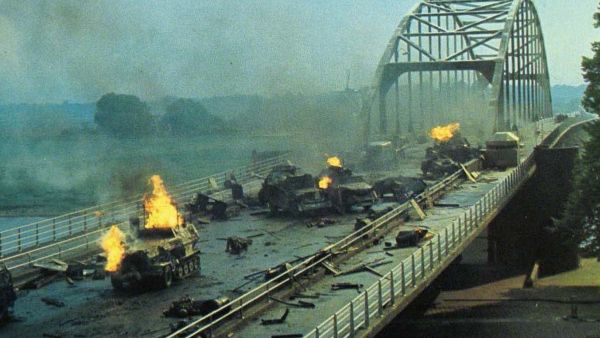
In September of 1944, in an attempt to land a finishing blow to Germany following D-Day, Allied forces launched Operation Market Garden, a bold offensive that would drop over 30,000 soldiers behind enemy lines.  The objective was to capture and hold three strategic bridges in the Netherlands, over which a massive column of British tanks would then roll straight into the Ruhr, the heart of Germany’s industrial complex.  Neutralize the Ruhr, and taking Berlin would be inevitable.  However, as with so many other simple plans in history, multiple factors led to the operation getting bogged down at the third bridge, and after massive Allied casualties, the offensive was abandoned.

Based on a bestselling novel by Cornelius Ryan (who also wrote the novel The Longest Day), the movie of A Bridge Too Far resembles the actual Operation Market Garden, not just in appearances, but also in its ambition, scope, and ultimate failure to achieve its goal.  However, as a pure combat movie, I give it credit where it’s due.

First off, look at this cast.  There had not been an assemblage of so many of Hollywood’s leading men since 1962’s The Longest Day (“42 International Stars”, that movie’s posters proclaimed).  Naturally, most of the actors are pitch perfect in their roles, with one glaring exception.  Whoever thought Gene Hackman was just the right guy to play a Polish general was either desperate or foolhardy, or both.  Hackman is a talented actor, without question, but his attempt at a Polish accent is a MAJOR distraction from whatever he’s saying.  Every once in a while, it even pulls a disappearing act, not that it matters.

ANYHOO.  The all-star cast.  To offset the lengthy running time, the story is told in semi-episodic fashion, which makes me wonder if someone hasn’t thought about rebooting this movie as a Netflix/HBO/streaming miniseries.  I’d watch it.  Within each of these episodes, it helps if we remember right away that Michael Caine is the leader of the tank column, Sean Connery is heading up one of the ground units, Anthony Hopkins is holding the bridge at Arnhem, and Elliot Gould is the cigar-chewing American trying to get a temporary bridge put together, and so on.  It’s a rather brilliant way of using visual shorthand to keep the audience oriented during its nearly three-hour running time (including an intermission at some screenings).

There is one “episode” featuring James Caan that has literally – LITERALLY – nothing to do with the plot.  He plays an Army grunt who has promised his young captain not to let him die.  After a grueling ground battle, Caan finds his captain’s lifeless body and, after improbably running a German blockade, holds an Army medic at gunpoint, forcing him to examine his dead captain for signs of life.  I read that, unlikely thought it may seem, this incident really did happen as presented in the film (more or less).  All well and good.  But what does it have to do with capturing bridges?  I’m sure the story is in the novel, but the movie takes a good 10-to-15-minute detour from the plot to follow this bizarre story.  Did director Richard Attenborough think we needed comic relief or something?  I remember liking that story as a kid, but watching it now…is it necessary?  Discuss amongst yourselves, I’ll expect a summary of your answer at tomorrow’s class.

I want to mention the combat scenes in A Bridge Too Far.  First off, I never served in the armed forces.  Well, never in combat.  I was in the Air Force for about a week.  (Well, Air Force boot camp in Oklahoma for about a week…LONG story.)  So, my observations of the combat scenes are less about historical accuracy and more about how they compare to other films.  While some of the combat portrayed is rightfully horrific in its own way – the river crossing in those ridiculous canvas boats, the slaughter of the paratroopers, the seemingly endless holdout at Arnhem – a lot of the combat, particularly the tank shelling and the skirmishes at Arnhem, is…I have to say, it’s kind of fun to watch.  There’s something, I don’t know, charming about it all.  It reminded me of how I used to play with my army men and Star Wars figures, or how I used to run around with neighborhood friends wearing plastic helmets and pretending we were “good-guys-and-bad-guys” while throwing dirt clods at each other and making fake explosion noises.  It was movies like A Bridge Too Far that shaped my young impressions of what wartime combat was like, and whether it was realistic or not was irrelevant.

Anyway, enough nostalgia.  Here’s the sad truth: A Bridge Too Far, despite its thrilling combat and all-star cast, falls short of delivering a truly meaningful war film.  There are half-hearted attempts to drum up some dramatic impact with scenes in a makeshift field hospital and a speech in Dutch from Liv Ullman wearing her best “isn’t-war-awful” expression, but for some reason those scenes fall flat.  (I did like the “war-is-futile” scene with that one soldier who runs out to retrieve the air-dropped canister, only to discover…well, I won’t spoil it, but it’s a good scene.)

After writing almost 1,000 words, I’m no closer to explaining why A Bridge Too Far falls short.  It’s still an entertaining watch, but I’ve really got to be in the mood for it.  It’s rather like reading a historical novel that isn’t particularly thrilling like a Crichton or a Clancy, but it does deliver some eyebrow-raising information.  It doesn’t hit me in the heart, but it does feed my brain.  Maybe that’s not such a bad thing in the long run, but if movies are about stirring emotions, I must say: A Bridge Too Far is no Saving Private Ryan.

(Sure, I probably could have just said that instead of writing this long-ass review, but where’s the fun in that?)


QUESTIONS FROM EVERYONE’S A CRITIC

Best line or memorable quote:
“Remember what the general said: we’re the cavalry. It would be bad form to arrive in advance of schedule. In the nick of time would do nicely.”

Would you recommend this film?  Why or why not?
Ultimately, I would recommend it to film buffs who have not yet seen it.  If nothing else, it’s an interesting time capsule movie.  This would be the last time for a VERY long time that anyone would attempt to make an epic film with a truly all-star cast.  …come to think of it, I can’t think of a major, epic drama since A Bridge Too Far with an actual A-list cast.  Can you?

INDIANA JONES AND THE LAST CRUSADE

By Marc S. Sanders

Steven Spielberg is great when he takes advantage of a silhouette. His best example of this is with Indiana Jones. He’ll hide the character in deep sun so you only make out the recognizable shadow of his famous fedora hat and bullwhip by his side. I treasure a moment like this as Indiana Jones And The Last Crusade approaches it’s closing credits and he rides off into the sunset along with his father and their trusty companions. (Other great silhouettes happen in Raiders Of The Lost Ark – when he first meets Marion, or when he’s traversing through the South American jungle or when he’s digging towards the Well Of The Souls. I love it every time I see it.)

The Last Crusade no longer offers the mystery of the famed archeologist. Unlike Raiders where Indy only says what is necessary and his past experiences remain unknown, this story offers a background. How does Indy first dabble into the world of rare antiquities and what did he miss out on as a child followed by an adventurous transition into adulthood? How about that scar on his chin? There are some answers here.

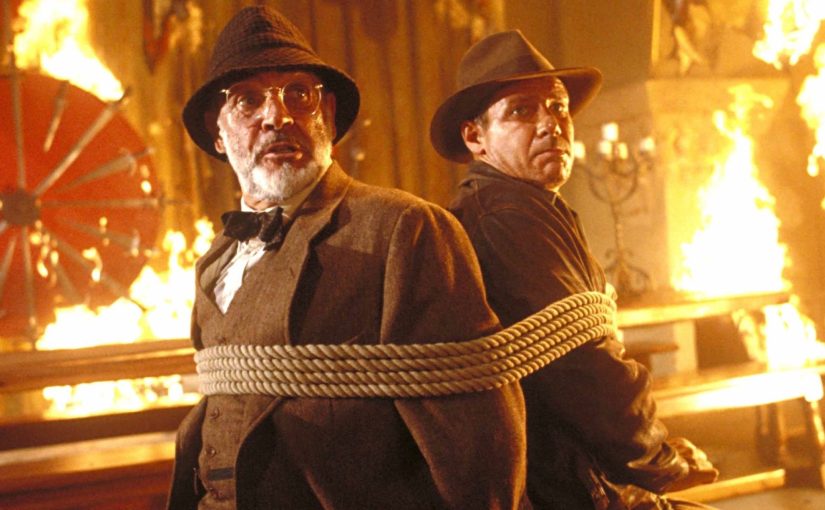
Harrison Ford keeps Indy stoic and only amusingly frustrated when interfered with by pesky Nazis and a wonderfully naive and innocent Sean Connery as his father, Henry Jones. Their pursuit of the Holy Grail, the cup that belonged to Christ at The Last Supper, is a similar narrative sequence of events to Indy’s first adventure. However, what sets it apart here is the relationship between father and son. I imagine it’s a similar connection between a lot of dads and their sons, and therefore I have a nice affection for the film.

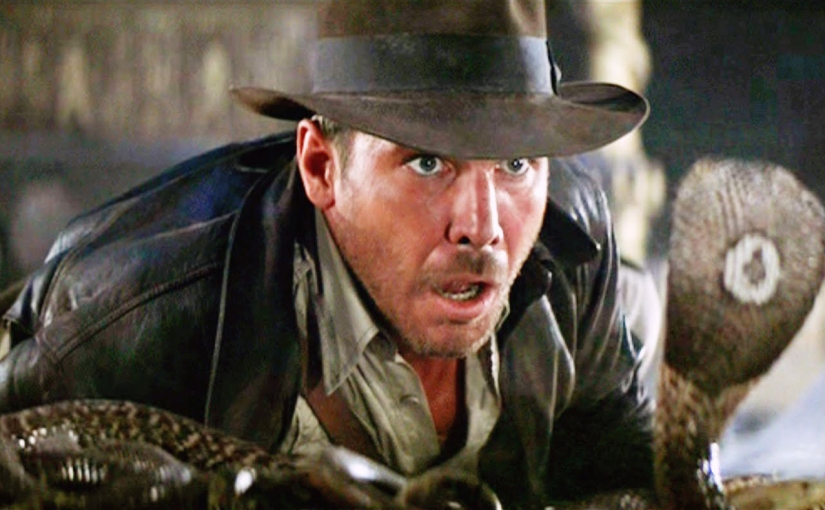
Spielberg continues to be great with his action moments by keeping it light and fun. River Phoenix echoes a young Indy as Ford would have played it as a pre teen. It’s a convenient short story to show how the character earns the hat, the jacket, the whip and even his infamous fear of snakes.

Boat chases, underground relics, rats and fist fights atop a tank are well edited and clearly shot.

The 3rd of four wonderful adventures (soon to be five) is still fun to watch and offers enjoyment that many of today’s blockbusters have simply forgotten.

It’s always exciting to ride alongside Indiana Jones.

RAIDERS OF THE LOST ARK

By Marc S. Sanders

Raiders Of The Lost Ark remains as one of the greatest films of all time. There’s nothing not to like about it and the accolades go to Steven Spielberg, George Lucas, Harrison Ford, Lawrence Kasdan and John Williams, along with a sensational cast of still unknown actors that owned their roles with absolute authenticity.

Ford became a great action film star due to Indiana Jones and Han Solo. This film is an example of his best work. He’s the best at facial expression during high action moments. Watch the truck chase during the second half of the film. As he is careening a truck through the sand streets of Cairo, he winces in pain, evokes anger and dons a toothy grin as he shakes Nazis off the vehicle, and throws them through windshields.

He’s got the perfect delivery of lines as he love/hate banters with Karen Allen as tough broad Marion Ravenwood (Jones’ best gal pal of the series). Their chemistry is great because they are two loudmouths who work off insulting and shouting at one another. They are one of my favorite on screen couples; like two Oscar Madisons who belong together.

Recently Ford said no one else can play the role; the role dies with him. He couldn’t be more right. Indiana Jones is not an interchangeable part like James Bond or Batman. Those roles change with the times and technology. Jones remains in history with a trusty whip, a sign of the times fedora hat and a drive to uncover the great unknown. None of these films work unless Harrison Ford is Indiana Jones.

John Williams also needs recognition. Who isn’t familiar with the famous build up horns calling for adventure? His composition just puts a smile on your face. Dialogue isn’t at play much during one of Spielberg’s well orchestrated action scenes. So we rely on the march of Williams’ efforts to relish in the fun of a foot chase through a Cairo marketplace or to thrill at a fast rolling boulder chasing the famed archeologist after he snatches his prized booty.

Spielberg and Lucas always get praise for their brilliant imagination. I venture to guess how many people were aware of the occupation of archeologist before the film’s original release in 1981. Sure, this isn’t what the job realistically entails, but the film opens your mind to what is out there and what we can learn more about from our past.

A great moment in cinematic exposition is when Jones explains the power of the famed biblical Ark of the Covenant. The dialogue works great here, thanks to a winning script from the great Lawrence Kasdan, and it has the audacity to convince an audience that some MaGuffin we read about in Sunday school could actually make Hitler’s Nazi regime invincible. Seriously? What?!?!? When you blend Spielberg and Lucas’ bravado, Williams’ eerily quiet thinking music, and Ford’s professor obsessed role with Kasdan’s efficiency for description all in one scene…yeah…you believe this could be a very, very real threat.

Every scene is different. Snakes, truck chases, spiders, foot chases, bottomless pits, bar shootouts, Nazis, the power of God, and a wide variety of antagonists all used to build the structure of two of the best hours in a film. It’s all brilliantly weaved together with transitioning red lines across a traveling map on screen. This is great editing, people.

Nothing has ever come close to Raiders Of The Lost Ark. Nothing ever will. It is a perfect film.

“Trust me.”