AIR FORCE ONE

By Marc S. Sanders

On the day I write this article, July 12, 2024, the new trailer for Captain America: New World Order premiered and Harrison Ford (whose birthday is tomorrow; Happy Tiding Dr. Kimble, Dr. Jones, Captain Solo, Mr. President, Dr. Ryan) is back in the Oval Office playing the President of the United States.  Don’t know what kind of Commander In Chief he’ll be this time around.  He might be as heroic as James Marshall from Air Force One. Then again he could be a challenge of hulk like proportions.  However, let’s at least fantasize that we have Mr. Marshall running for the top job this year against both the criminal buffoonery and geriatric disqualifications we are left to choose from.  Just look at James Marshall’s qualifications. 

Following an American Special Ops capture of a Russian radical, Marshall is bestowed an honor from the Soviet government. His acceptance speech insists his administration will never negotiate with terrorists.  Now that the line has been drawn, away he goes with his staff, his wife (Wendy Crewson) and pre-teen daughter aboard the most protected and safest plane in the world, Air Force One.  Yet, an element of careful process does not go according to plan and Gary Oldman’s team of Russian radicals hijack the plane with demands to free their leader from captivity.  Oldman’s screaming hysterical character, Ivan Korshunov, won’t have it so easy though because his team of men failed to capture the President.  As well, it requires the Vice President (Glenn Close) and Secretary of Defense (Dean Stockwell) who are on the ground to coordinate with Russia to free the prisoner.  Oldman’s response is to kill a hostage every half hour and if that does not work, then just blow up the plane.

This is not good.  BUT WAIT!!!!!  Is that…?  Could it be???  Is the President alive, sneaking around the bowels of the plane while taking out one terrorist at a time?  Raise your fist for Harrison Ford!!!!

‘Murica!!!!!!

There are two narratives going on with Air Force One.  One is the standard Die Hard formula action onboard the plane.  Then there is the endless debates of authority between the Vice President, the Secretary of Defense and the military leaders about if the President is in a proper state of mind to lead and act upon his aggression with a high level of threat to the country at stake, and more personally his wife and daughter in harm’s way?   None of this is nothing new.  It’s all familiar from the likes of many late 80’s and 90’s action pictures.  The politics are much more simplified than what you’d find in a Tom Clancy novel.  There’s even time for a which color wire to cut scene.  Yet, the movie is entertaining.

Director Wolfgang Peterson is best at showing the real star of the picture and that is Air Force One itself.  He’s got long shots down endless corridors and aisles. Within the underbelly, as well as the hollowed-out cockpit, there’s more for us to explore amidst the gunfire.  We see where the weapons are stored as well as the luggage and food supply.  We get to watch the football game in the President’s office too.  Heck, before the terrorists reveal themselves they are given a tour of the massive plane as their guide boasts that it is even impervious to a nuclear blast.  Color me impressed in Patriotic Red, White and Blue.

I think some of the acting is a little overdone at times. Not by Ford, but by almost everyone else.  Watching the debates within the government conference room, I’m seeing a little too much melodrama around the table.  A little too much hand clasping, pacing around the room, whispering,  and deep sighing.  On the plane, Oldman goes over the top but he’s one of our best character actors and its expected from him.  He’s the evil villain after all.  On the ground though, Dean Stockwell has done better work elsewhere, with much more complicated material. 

I like the idea of including political debates and a response to an unfathomable crisis like this, but a lot of the dialogue from guys like Stockwell, Phillip Baker Hall and Bill Smitrovitch comes off as textbook boring.  Same goes for Close, but she fits the role perfectly.  Let her be Ford’s running mate and they got my vote.  The only thing that upholds these scenes are due to Peterson’s hyper Steadicam.  So, when one more person in a suit makes a mad dash into the room, the director sweeps his camera right over there to get the latest news. 

Harrison Ford is doing his standard everyman/tough guy routine, always knowing how to stay one step ahead of the bad guys. President Marshall is much more capable than his entire trained Secret Service Squad and it’s fortunate that he gets the convenient shard of broken glass to cut the tape that binds his hands.  How often do we see that in movies?  The film definitely belongs to Ford, but it’s also nice to see some familiar faces participating like Xander Berkley, William H Macy and Paul Guilfoyle. 

The most unforgiving moment of the film occurs in the final minutes.  I don’t spoil everything by saying the plane nosedives into the sea, but this crash has to land at the top of some of the worst CGI ever assembled.  Yes, I know this was back in 1997, two years before what George Lucas accomplished with, at the time, pioneering effects on his return to Star Wars.  However, the final climax to Air Force One looks so obscurely animated and unfinished, it begs for the screenplay to find another way to wrap up its simplistic story.  It is downright terrible.  I recall it looking terrible on the big screen.  It looks just as bad on a 65” flat screen.  A toy plane crashing into a bathtub would look more convincing.

Air Force One is solid action.  Nothing more.  It’s not a thinking picture or one needing deep concentration and analysis. It does make you yearn for Harrison Ford to at least consider a run for the Oval Office, though.  He’d still be better than what will be on the ballot this year.
THE LEGEND OF BILLIE JEAN

By Marc S. Sanders

Growing up as a teenager, in the dog days of summer, and living in a new town with few friends at the time allowed a lot of binge watching of movies on Showtime.  Top Gun must have been shown twelve times a day.  So was Back To School.  The other movie on constant repeat was The Legend Of Billie Jean – a movie of few merits and yet the heroic sweep of the fugitive rebel on the run with her trailer park gal pals and her little brother was addicting.  It’s a brisk ninety-minute film, but each time I’d watch the movie it felt like the title character raised even more awareness and support for her cause than the last time I watched, which was likely four hours earlier in the day, during breakfast.

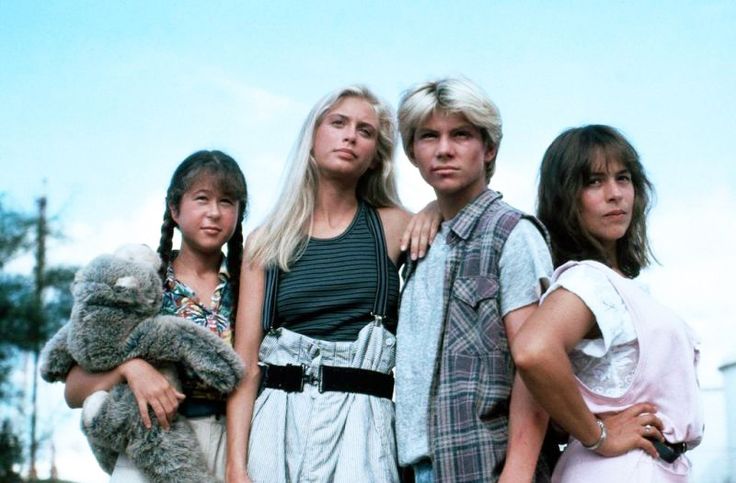
Helen Slater is Billie Jean.  Her younger brother is Binx played by Christian Slater, in his first film.  NO RELATION!!!! 

Under a hot sun-drenched setting in Corpus Christie, Texas, the siblings are bullied by Hubie (Barry Tubb).  Binx gets beat up.  Even worse, his shiny maroon motor scooter is stolen and trashed.  When Billie Jean approaches the bully’s father, Mr. Pyatt (Richard Bradford), to collect the six hundred dollars for the cost of the bike, she narrowly escapes a rape after Binx shoots the scumbag in the shoulder.  Now the kids are on the run with Ophelia and Putter (Martha Gehman and Yeardley Smith – eventual voice of Lisa Simpson).

A firestorm starts to spread with a loyal underground following for Billie Jean and her band, and they receive assistance from the District Attorney’s (Dean Stockwell) son Lloyd, played by Keith Gordon.  The cop on their trail is played by Peter Coyote.  Wait!  I’m not being fair.  This cop is never on their trail.  Somehow every kid in the state of Texas can find and help Billie Jean, except the cops.  Even with the DA’s son in tow, these fugitives cannot be located by one single, solitary police cruiser.  Yet, the kids on the playgrounds make no effort to find Billie Jean, Binx and the others.  Yes.  You shake your head at the whole thing.  When you are age fourteen though, you get caught up with Helen Slater, one of your first celebrity crushes, and the accompanying soundtrack of Pat Benatar’s rebellious anthem “Invincible.”

The Legend Of Billie Jean is a stupid movie.  I don’t think anyone can argue with me.  I mean think about this for a second.  Peter Coyote’s cop finds their getaway car with Putter and Ophelia.  Still, he doesn’t choose to search the vehicle for a significant clue to the hero’s whereabouts until the next day.  Isn’t this sloppy investigative fieldwork?  As well, during the climax a brushfire is started by Billie Jean and no one runs or calls for a firetruck.  The DA, the cops, the kids – they all just stand there watching in deep thought like they were directed.  I can only imagine the director with his megaphone yelling out the command to stare straight ahead at the growing flames.  Mind you, this isn’t a control burn firepit.  This is a BRUSH FIRE with hay and wood and clothes as accelerants.

Nevertheless, the movie is an only slightly embarrassing guilty pleasure.  It’s not as hokey as it looks on the surface.  The acting isn’t terrible because the young cast is embracing the absurdity of the whole situation.  It stands, albeit wobbly, on the same plotline of an eventual and exceedingly better film called Thelma & Louise.  More importantly, Helen Slater makes for a good lead role and heroine.  When she tells Mr. Pyatt “No,” and cries her anthem of “Fair is fair” you root for her.  Slater’s performance is far grander than the script she is working with. 

The Legend Of Billie Jean performs like an afterschool special without dubbing out the cursing. The cause of these kids’ plight enhances as the film progresses.  What starts out as a simple bullying story and a demand for monetary damages of only six hundred dollars turns into a fight for respect and honor from the adult males within a small, southern local community.  However, there is little to feel inspired by, and I’m afraid Billie Jean’s supposed legend unfolds into only a slightly miniscule smidgen of Legendary

TO LIVE AND DIE IN L.A.

By Marc S. Sanders

William Friedkin is the director of one of the greatest automobile chases ever put on film with the 1971 Best Picture The French Connection. In 1985, he tried to up his game with the counterfeit caper called To Live And Die In L.A. He just about tops himself.

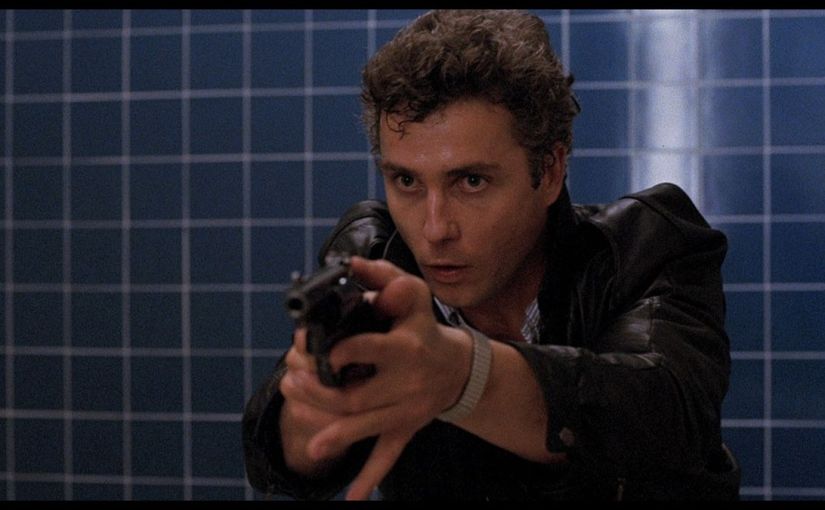
It is a dated flick with a Wang Chung soundtrack, popped up shirt collars, black leather jackets, and skinny ties. Friedkin goes Miami Vice and it more or less works but his lead player, William Peterson, is no Don Johnson. He’s more like a contestant on the dating show Love Connection.

Peterson plays a Secret Service agent with the last name of Chance; Richard Chance to be more precise. Kind of apprapo as he seems to always test his fate like bungee jumping off bridges (long before bungee jumping was ever a thing) and taking his tactics over lines that should not be crossed.

Chance is on the trail of nabbing counterfeiter, Rick Masters (Willem Dafoe), who killed Chance’s partner with only three days left until retirement. The cop who gets killed early on always seems to have three days left until retirement. To get at Masters will require Chance to…well…take some chances. He’ll blackmail a prostitute informant. He’ll also pressure his new partner (John Pankow) into circumventing policy. As well, like any movie cop or agent, he’ll go against the instructions of his supervisor. Chance might even rip off a diamond dealing exchange.

The acting is nothing special here. Peterson looks more athletic than fierce or driven. He’d never be Gene Hackman. Dafoe’s weirdly youthful appearance with his Benneton ‘80s outfits look…just that…well…weird! He’s an artist (like with actual paintings) while also printing fake money.

Friedkin’s film carries on its longevity through the years with an effective car chase; one of the best on film. From what I can tell he mounted a camera on the hood of the car. The camera can pivot 360 degrees. So we can see Peterson driving the car and then the camera can swoosh and turn to give a point of view as to where the car is driving. So now the viewer can see where the cars are careening and turning and speeding towards. It gets especially hairy when the car goes the wrong way up the freeway exit ramp into rush hour traffic. No CGI work here. This is in your face material.

To Live And Die In L.A. is worth the watch. A surprise moment towards the end also gets your attention by going against the typical cops and robbers formula film. The shoestring budget is apparent here with quite dull, very dull, cinematography and no big stars at the time (Peterson, Dafoe, Pankow, John Turturro, Dean Stockwell). However, William Friedkin does his best to make every moment worth it, and I can’t deny it, this 80s raised kid thinks the Wang Chung soundtrack is so friggin’ cool.

THE RAINMAKER

By Marc S. Sanders

Francis Ford Coppola didn’t just call his film The Rainmaker. He called it John Grisham’s The Rainmaker. I understand the significance as a large portion of the film relies on voiceover narration from its main character, Rudy Baylor (played very well by Matt Damon).

The film focuses on much of the underpinnings of the legal system within the state of Tennessee. Rudy gives insight into his position of ethical practice – he’s fresh out of law school but doesn’t have a license yet – versus the large giant sell out attorneys (a towering, sharp dressed and slick Jon Voight) that represent goliath parties like big time insurance companies. Grisham’s novel, along with Coppola’s screenplay, also leave room in the beginning of the film for the sleaze of the law practice with Rudy’s first employer who goes by the moniker “Bruiser,” played by an oily Mickey Rourke.

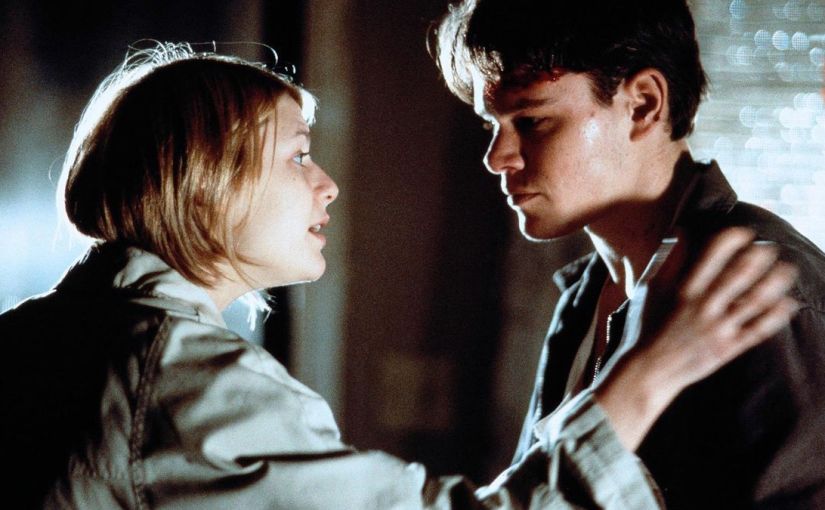
Rudy has not even passed the bar exam at the start of the film but he’s already got three cases in progress. He has agreed to completing a will for a kind old lady (Teresa Wright) who is adamant about leaving her estate to a television evangelist. He also volunteers himself to protecting a young woman named Kelly (Claire Danes) from an abusive husband. His biggest case is going after a million dollar insurance company for wrongfully denying a claim filed by one of it’s ill insured. Rudy knows the insured is justified to sue and it could be a huge and necessary windfall for him and his unlicensed, corner cutting partner (Danny DeVito), but it’s only him against a grand army of legal gods lead by the great Leo F. Drummond, Esq. (Voight).

Grisham and Coppola wanted to depict a drive for doing right by the law and the people it’s meant to protect. Damon’s portrayal of Rudy represents that ideal. His father hated lawyers and he grew up in a home life that never responded favorably to the merits of officers of the court. Rudy defies what his father frowned upon. Despite his inexperience in a courtroom and his ability to respond with objections and cited legal rules, he knows he’ll be a good lawyer simply because he can distinguish between right and wrong. He doesn’t need to sink as low as Drummond’s cronies by bugging the opposition’s office. Will Rudy’s righteousness be enough though? He’s so dang honorable in his profession that it might just be the ultimate means of his defeat.

Same can be said for Rudy’s will to protect Kelly, the young, abused wife. Precedents of law keep her husband on the streets no matter how bruised and bloody she gets time and again. This man is a monster, but no higher power is looking upon this victimized wife to legally protect her, and this man will continue to beat her until one day she’s dead. Rudy wears his heart on his sleeve for this woman and again can only serve as an honorable servant of the court. When he steps out of that line a little by risking his life to save this woman, he’s testing his own sworn code that he’s respected while others have dismissed it.

John Grisham’s The Rainmaker is one of those under the radar films not celebrated enough. I recall it being shown in limited theatre capacity, and it hardly did well at the box office, but it’s really a remarkable piece as it shows an unconventional and honorable attorney, reminiscent of Harper Lee’s Atticus Finch but set in modern day. Nearly everyone around Rudy, from his own father, that he describes to the students he attended law school with, to even the even the fool of a judge (Dean Stockwell) who swears him in as well as his own partner (DeVito in a hilarious, quick solving, underhanded role), are beyond any moral compass and yet Damon ensures Rudy Baylor sticks to his convictions.

Coppola’s film is not a legal thriller. It’s an observation of how the established perceive the law and the one fish who treads water above the bottom feeders, allegorically shown in Bruiser’s fish tank, seek out big rewards. For Rudy, the client matters. For everyone else, only the money matters.

BEVERLY HILLS COP II

By Marc S. Sanders

I know. I know. I SHOULDN’T like this movie, but I do.

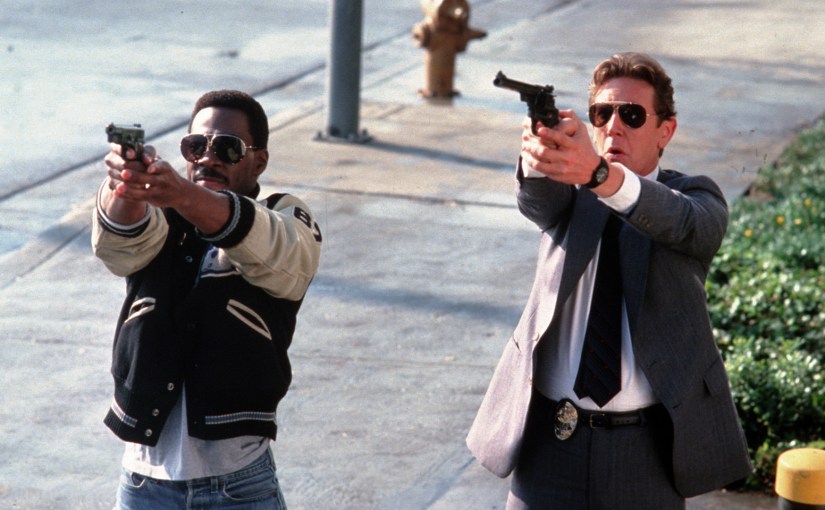
Beverly Hills Cop II is a sequel that is really an opportunity to see a wide variety of close ups of an Eddie Murphy who was well in his ‘80s prime, releasing one #1 movie after another. Here the viewer is treated to Murphy’s Axel Foley blowing a kiss to himself in the mirror, laughing to himself, tucking his crotch in his tailor made suit, flipping sunglasses on and off, driving a Ferrari, and shamelessly plugging the Detroit Lions all while trying to stop an “Alphabet Bandit” criminal in Beverly Hills, CA.

So there’s really not much here when all the vanity is on Murphy. Well, then what’s to like?

Considering I’m a fan of director Tony Scott, who uses great cinematography in all of his films with quick, tension filled editing, it’s hard to resist.  Most especially here Scott’s film is accompanied with an exceedingly cool and dangerous soundtrack from Harold Faltermeyer. Just the opening scene alone (without Murphy in it) belongs in a better movie. A robbery at a City Deposit bank and then later at a horse track are so well edited that you might tuck your knees into your chest and chew on your thumbnail. Great stuff from Tony Scott that would eventually carry over in films like Crimson Tide, Enemy Of The State, and one of my very favorites True Romance.

There are other good moments in Beverly Hills Cop II, especially a great scene with Gilbert Gottfried, and a few with Paul Reiser as well as a smirk inducing scene with Hugh Hefner.

I shouldn’t like this movie but sue me. It’s a guilty pleasure for me. However, watch the far superior first installment over this one any day of the week.