
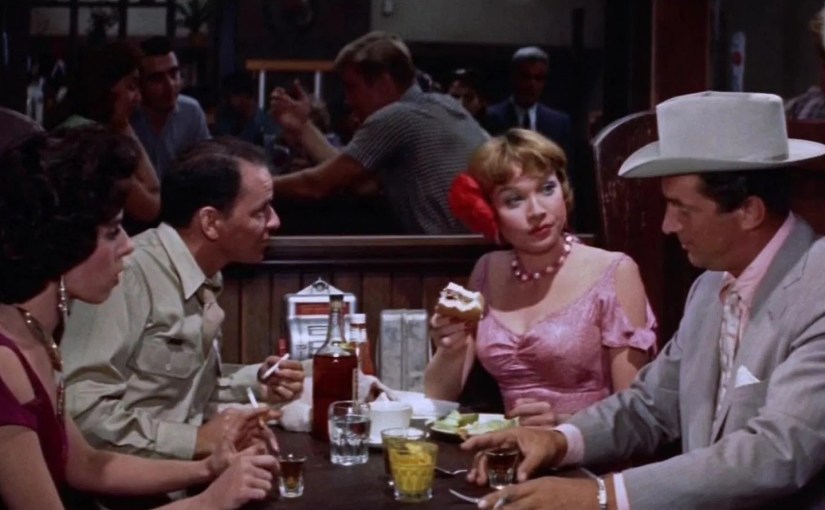
SOME CAME RUNNING (1958)

by Miguel E. Rodriguez

DIRECTOR: Vincente Minnelli
CAST: Frank Sinatra, Dean Martin, Shirley MacLaine, Arthur Kennedy
MY RATING: 7/10
ROTTEN TOMATOMETER: 78% Fresh

PLOT: A war veteran returns home to deal with family secrets and small-town scandals in his small Indiana hometown.


Before getting into the nuts and bolts of Some Came Running, let’s just take a second to admire its pedigree.  It’s based on a novel by James Jones, author of the novel From Here to Eternity; that film adaptation won eight Oscars in 1953.  It was helmed by acclaimed director Vincente Minnelli, whose prior credits included The Bad and the Beautiful, The Band Wagon, An American in Paris, and Meet Me in St. Louis, among many others.  In fact, his film Gigi, released the same year as Some Came Running, would go on to win an astonishing NINE Oscars.

It stars Frank Sinatra and Dean Martin, two of Hollywood’s most bankable stars of the day, along with an adorable 21-year-old Shirley MacLaine as a pixie-faced gamine, among the first in a long string of memorable roles and Oscar nominations.  The supporting cast is headed by 5-time-Oscar-nominee Arthur Kennedy, who may be unfamiliar to the casual moviegoer, but whom I recognize from memorable turns in Lawrence of Arabia and Elmer Gantry.

With all of that going for it, Some Came Running looks like it should hit a home run in all categories.  The story is edgy, the characters are not all totally lovable (no, not even Shirley MacLaine’s), and the ending definitely does NOT cave in to sentimentality…which is all very appealing to me when done right.  However, while I am definitely not calling it a failure, I have to say that I was not moved by the plight of these characters.  The fact that it dares to show the hypocrisy of polite small-town society in the ‘40s and ‘50s was interesting to me, but I never got into a lather over it.  (By contrast, a movie like The Big City from India, with a no-name cast and a modest budget, also centering on a family’s plight, made me genuinely care about the characters.)  But I must acknowledge the daring nature of the film’s story, some of its uncompromising language (to a degree), and its chutzpah to cast Dean Martin as a lovable, comic character who nevertheless refers to women as “pigs.”

The story does take a little while to get rolling.  It’s 1948.  Dave Hirsh (Sinatra) is a military vet who arrives by bus to his small hometown of Parkman, Indiana.  He’s astonished when Ginnie Moorehead (MacLaine) gets out with him, wearing too much makeup, a disheveled pink dress, and a purse made out of a stuffed dog doll.  She has followed him from Chicago based on a drunken invitation, but he wants nothing to do with her, so he gives her $50 and sends her on her way.

That’s not chump change, equivalent to over $650 in today’s money…what’s a military vet doing splashing out that kind of cash?  Turns out Dave is also a published author, but he’s given up writing at the moment.  He’s come home because…well, we never get a real answer to that question.  Maybe he has nowhere else to go.  But he doesn’t exactly get a hero’s welcome.  His brother, Frank (Kennedy), runs a jewelry store and is also on the board of a local bank.  When he learns that Dave has deposited $5,500 in a COMPETITOR’S bank, that raises eyebrows around town and earns Dave a mild reprimand.  Frank’s wife, Agnes, vows not to be home if Dave visits because of something he wrote in one of his books.

Despite the small-town hominess of Parkman, the only place that welcomes Dave with open arms is the local bar, Smitty’s.  It’s here that Dave meets Bama Dillert (Martin), a slick talker in a cowboy hat, a loose-fitting suit, and a tumbler seemingly permanently attached to his hand.  The chemistry between Sinatra and Martin is instant, fueled by the fact they were fast friends offscreen, and their friendship drives some of the major plot developments later on.

The rest of the movie does an excellent job of deconstructing the mythology of small-town life.  Dave meets an underage cad who tries to get him to buy a bottle of liquor for him.  We later learn he’s dating Frank’s daughter, Dawn, and no one seems to be aware of his fondness for liquor.  Agnes relents and agrees to host a dinner for Dave, but does nothing but snipe about him behind his back.  Dave meets Gwen French, a schoolteacher who has read his books, but who rebuffs his romantic advances until a peculiar later scene where she seems to turn on a dime because she simply lets her hair down.  When Dave gets in a scrap with a drunk outside of Smitty’s, the incident is reported in the small-town paper, and Agnes worries about what that will do to her reputation at the country club…not to mention that Dave has been spotted with Ginnie hanging on his arm, a woman who looks anything but reputable…

I think you get the idea.  Some Came Running does for small-town Americana what American Beauty and Blue Velvet did for white suburbia, perhaps not as intensely, but still pulling no punches.  I was also reminded of Rebel Without a Cause, and it occurred to me that they might make an interesting double feature, since there are more than a few scenes in Some Came Running featuring gaggles of teenagers in the background loitering on street corners, or even “parking” on a remote dirt road.  The feeling I got was that these problems exist, whether you paint over them with a centennial celebration or not.

I just wish it had grabbed me by the collar more than it did.  I never got tired of watching Shirley MacLaine’s performance – she outguns everyone, even Sinatra, in my opinion.  Dean Martin’s acting looks deceptively simple – just Martin being himself – until a plot twist late in the film gives it a deeper dimension.  But the movie, as a whole, never achieved liftoff.  Or, maybe it achieved liftoff, but never got into orbit before splashing down.  Some Came Running has an enviable pedigree, but it’s an example of how even the most sensational casting and directing isn’t enough to carry a movie all by themselves.  Whatever the “X” factor is, I didn’t find it in Some Came Running.

AIRPORT

By Marc S. Sanders

Burt Lancaster described his participation in what would become the first of a batch of 1970s all-star disaster epics as the worst picture he’s ever done.  He declared it “the worst piece of junk ever made.”  Perhaps because of this assessment we were eventually blessed with the Airplane! spoofs a decade later.  

Airport is a sudsy soap opera drama from novelist Arthur Hailey.  It’s an indiscreet invitation to make fun of it, but I doubt it was meant to be regarded that way in 1970.  Then, Airport was likely celebrated as that new kind of picture like The Godfather, Jaws and Star Wars would pioneer in their own rights.   

The film was a box office smash for Universal Pictures, garnering an acting Oscar for kindly old Helen Hayes along with nominations for Best Picture, Cinematography and Screenplay.  It spawned three more films following its success.  Yet, it’s terribly cornball, drowning in floods of cheese, and coated in the thickest of sap.  You better swallow that Maalox now.  This airport is all backed up!

Lincoln International Airport is getting blanketed in one of the treacherous, most blinding snowstorms imaginable.  So naturally it’s the right time to launch passenger airlines into the night sky while also welcoming jets to land.  Were harsh weather conditions not so alarming fifty years ago for air travel?

Well, this blizzard is going to be the first of several problems starting with a plane stuck in the snow right in the middle of the airport’s major runway.  Burt Lancaster is Mel Bakersfield, Lincoln’s Controller, who once again puts aside his family and his troubled marriage to oversee the matter.  He recruits the grizzled, cigar chomping Joe Petroni (George Kennedy) to clear that runway.  Mel firmly believes Joe is the only man who knows what the hell to do.  (Best I could tell is that Joe picks up a shovel like everyone else.) Mel’s other issue is that his pesky wife is disrupting his happy affair with Tanya Livingston (Jean Seberg), the no nonsense, yet perky appearing, blond airline executive with the mini uniform dress hemline.

Further upholding the proud chauvinism of this picture is everyone’s favorite lounge singing lizard Dean Martin as Vern Demerest.  These names!!!! If this movie wasn’t taking place at an airport, I’d swear it was a news station.  Vern also has an inconvenient marriage now that he’s learned his cutie stewardess Gwen Meighen (Jacqueline Bisset) is pregnant.  Cue the squeaky violin music as Vern offers to cover the abortion.  Shocking!!!! Gwen might want to have the child, but she’s gracious enough not to make it an obligation for Vern.  She’s gonna let her dreamboat wonder of a man be, so he remains a doting husband on the side.

So we got melodrama for the airport staff, the pilot, the stewardess… Hmmm…Oh yeah!  The passengers!!!!

A mentally ill, down on his luck man (Van Heflin) spends six dollars cash on a life insurance plan for his wife Inez (Maureen Stapleton) before boarding Vern & Gwen’s plane with a dynamite bomb in his briefcase.  Can Inez warn Mel, Tonya and everyone in time before the plane takes off?

Of course, this kind of stressful tension requires some adoring comic relief, and Helen Hayes as kindly old Mrs. Ada Quonsett delivers an Oscar winning performance.  She takes pleasure in being a habitual stowaway on one flight after another.  Gosh darn it if Tonya is going to make sure to put a stop to this lady’s shenanigans.  

The Cinemaniacs (Miguel, Thomas, Anthony and I) watched this together and Mig pointed out the cinematography first.  It’s dull like straight out of a Sunday night TV movie.  Thomas reminded us that this was in the same vein as most of Arthur Hailey’s material, like Hotel – the book that became a movie that became a TV series.  The soap opera occupies the first two thirds of the picture.  Then a potential threat of disaster occurs, and you work to guess who lives and who dies.  

Directors George Seaton (also screenwriter) and Henry Hathaway work to get the audience invested in these people first while trying to educate us on the most up to date operations in a fully functioning airport.  If George Kennedy’s character is not shoveling snow on a runway and giving it all he’s got in the stuck plane’s cockpit, he’s telling the others what to expect from a potential bomb explosion aboard a jet.  And Look!!! There’s telephones in Mel and Vern’s cars.  Push button ones too.  All over the airport are red phones next to white phones.  There’s luggage.  There’s blankets and pillows for everyone on board the plane. There are also unsuspecting women wearing minks and smuggling jewelry into the country, but the seasoned custom security guard has got a good eye. He can see everything, except for the guy with the bomb. And there’s snow.  Lots and lots of snow but the cabs make it to the airport in the nick of time.  There’s also a message about the need for updating construction on our country’s airports with the most sophisticated traffic controls and operations imaginable.  Should the money be spent?  On top of all this, how are Mel and Vern’s wives and families holding up?

Maybe it’s unfair.  It’s hard to embrace Airport when I have already grown up watching the ZAZ team brilliantly spoof the picture with the Airplane! films.  Yet, I’m confident that had I seen Airport upon its initial release, I likely would not hail the romances of Lancaster, Seberg, Martin and Bisset as the next iterations of Rick and Ilsa.  The dialogue and scenarios are eye rolling at best.  The chemistry sputters as soon as we see the characters for the first time.  The men are twenty five years older than the women, but the love is supposedly passionate?

The extras who are granted snippets of dialogue look like they are reading cue cards and the major players truly look bored.  Watch the cast when the bomb goes off on the plane (like you didn’t think it wouldn’t happen).  There’s no adrenaline from Dean Martin.  He looks lost without his signature scotch and cigarette. The passenger extras never got the memo that they are supposed to be on board a plane with a gaping hole in the rear lavatory.  The priest on board slaps the guy next to him, but I need more convincing of the panic that is supposed to persist.

Fifty years later, the legacy of Airport hinges on only one purpose and that is to give it the ol’ Mystery Science Theater 3000 treatment.  More importantly, once you finish watching it, about all you want to do next is watch Airplane! 

“The cockpit!  What is it?”

“It’s the little room at the front of the plane where the pilots sit, but that’s not important right now.”