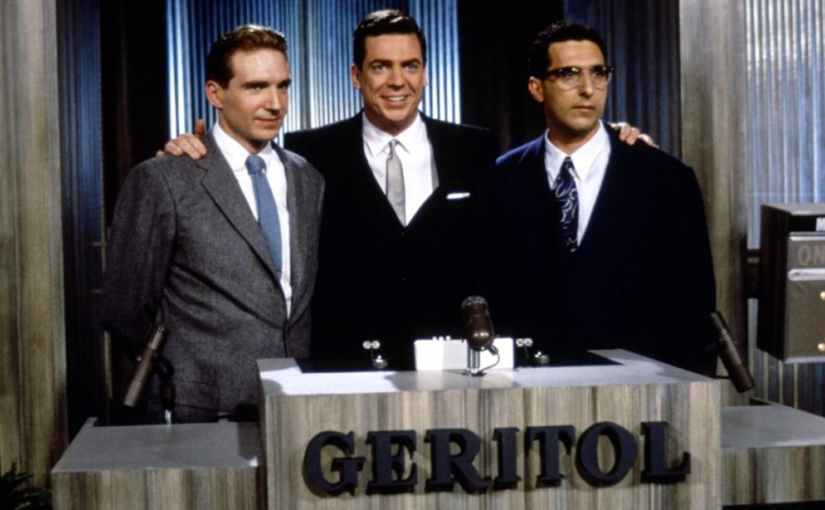
QUIZ SHOW (1994)

by Miguel E. Rodriguez

DIRECTOR: Robert Redford
CAST: John Turturro, Rob Morrow, Ralph Fiennes, Paul Scofield, David Paymer, Hank Azaria, Christopher McDonald, Mira Sorvino
MY RATING: 7/10
ROTTEN TOMATOMETER: 97% Certified Fresh

PLOT: In the late 1950s, a popular TV quiz show, along with its current champion, falls under federal investigation following allegations of rigging.


I imagine there will be no shortage of people more than willing to tell me how wrong I am, but while Robert Redford’s Quiz Show was well-directed, well-written, and well-acted, I never fell completely under its spell.  For that matter, it never felt like it had the director’s stamp on the material; a lot of it felt like a Ron Howard film.  No doubt the story captured a lot of attention when it happened in the late ‘50s, but it failed to grab mine, at least to that same degree.  It’s too well-made for me to skewer it mercilessly, but neither do I consider it a masterpiece.  It’s…okay.

It’s 1957, and Sputnik captures the world’s attention at (or at least near) the height of the Cold War.  To distract themselves from Sputnik’s implications, Americans tune their TV sets to the most popular game show on the air: Twenty-One, in which competing contestants are asked random trivia questions while isolated from each other.  These questions are something else.  One multi-part question includes: “Who rode with Paul Revere?  Who lent him his horse?  Was it a mare or a stallion?  And what was the horse’s name?”  I mean, really?  The current champion, Herbie Stempel (John Turturro), knows these answers and many others and has become something of a local hero, but he’s not terribly photogenic, with his oversized shoulders, those nerd goggles, and that one rotten bicuspid that you can’t take your eyes off.

Twenty-One’s showrunners decide Stempel’s run has come to an end and hatch a plan to throw the next episode to handsome young Charles van Doren (Ralph Fiennes), a Harvard professor who in real life did not look quite as handsome as Ralph Fiennes, but whatever, this isn’t a documentary.  Both Van Doren and Stempel comply with this plan, but the scenes in which they make their decisions felt contrived, or false, or something.  I was never convinced of their motivations.  Stempel needed the money but was supposedly swayed by the possibility of being awarded his own “panel show.”  Van Doren clearly didn’t need the money and even turns the offer down at first, but then he changes his mind because…I guess he needed a way to live up to his Pulitzer-Prize-winning father?  All the pieces are there, but it’s never fully explained until his final speech in front of a Congressional committee.

The story engine involves a young DC lawyer named Dick Goodwin (Rob Morrow) who gets a whiff of potential scandal and, eager to make a name for himself – as a possible parallel to Van Doren himself – does some independent investigating.  His digging leads inevitably to Stempel, who is more than happy to name names, but whose irascible personality makes him a less than ideal witness.  Things get interesting when he interviews Van Doren.  He is clearly suspicious, but no hard evidence appears…until he watches an old clip of a previous Twenty-One contestant who appears to give an answer the host was not expecting…

I don’t know how relevant this is, but I feel compelled to observe that director Redford seems to have phoned in a lot of favors when it came to casting Quiz Show.  In addition to the fine performances from the leads (Rob Morrow is outgunned by Turturro and Fiennes, but he holds his own), the supporting cast reads like a Woody Allen picture: David Paymer, Hank Azaria, Christopher McDonald (perfectly cast as the smarmy, superficial host of Twenty-One), Mira Sorvino, Martin freaking Scorsese, and walk-ons by Timothy Busfield, Ernie Sabella, Barry Levinson, Mario Cantone, Illeana Douglas, Calista Flockhart, and a blink-and-you’ll-miss-him Ethan Hawke.  Redford clearly wanted to make sure his canvas was deep and well-drawn, and not just with the impeccable period production design.

But to what end?  I went into Quiz Show thinking it would involve a much deeper conspiracy than just two showrunners who, following orders from corporate, simply bribed several contestants to follow a scripted playbook.  About halfway through the movie, I realized there was not going to be much more to that part of the story, and we were going to follow the lawyer on his quest to uncover the truth, and I was like, “…that’s it?”  Does that make me guilty of criticizing the movie that I wanted it to be, instead of criticizing the movie itself?  I’m not sure.  Rightly or wrongly, I felt the movie wanted me to empathize or sympathize, or one of the -izes, with Van Doren.  But I was not moved to goosebumps by Van Doren’s final speech at the end of the film.  I found myself siding more with the committee member who says, “I don’t think an adult of your intelligence ought to be commended for simply, at long last, telling the truth.”

(I suppose a case could be made that the whole film is a parable for Watergate, still several years in the future; Nixon is name-dropped a few times.  The end credits inform us that NBC and Twenty-One’s sponsor, Geritol, were never indicted because their underlings claimed full responsibility for their actions, much like Haldeman, Ehrlichman, and the rest.  Does the buried subtext of America’s lost innocence make Quiz Show a better film?  Maybe a little, but only when you stand back from it, not while you’re watching it.)

SEARCHING FOR BOBBY FISCHER

By Marc S. Sanders

In a game of chess, if your queen is taken, it might mean a permanent loss of what was thought to be a god given talent. Seven year old Joshua Waitzkin does not realize that, and thus it allowed him to become the greatest chess champion in the country.

Josh (Max Pomeranc) is not a chess player. Josh is a boy who plays chess, as well as baseball. He also builds Legos, plays Clue and does just about anything else including fishing with his dad. He knows this about himself. The problem is the adults in his life only see chess, and nothing else. Writer/Director Steve Zaillian assembles a film that turns the world’s most historic board game into a means of recognizing self-worth and the limits of talent with its correlation to identity.

Josh gains influence from a cutthroat formal chess instructor named Bruce (Ben Kingsley) who doesn’t just teach chess but also offers guidance in manners of contempt and dislike for your opponent. It helps that he recognizes Josh’s talent but is Bruce coaching with the best intentions?

Contrary to Bruce is a city park speed player named Vinnie (Laurence Fishburne) who reminds Josh to always play on offense. Play the board, not the opponent. Josh’s father (Joe Mantegna) only sees victory through beautiful trophies. When Josh loses interest in champion accomplishment, his father only sees nothing but failure. His mother (Joan Allen) sees the boy losing his boyhood.

These are all good people and necessary for Josh. The conflict lies in the clash of their different ideals. I love that. There isn’t a villain here. There’s a debate.

Zaillain devotes time to footage of renowned champion Bobby Fischer who eventually went into seclusion probably due to the lack of any worthy challenger beyond himself. The worry of the film lies in whether Josh will end up with the same sad fate of Fischer. Everyone is on the hunt for the next Bobby Fischer. Does everyone want to be the cruel, cold and isolated Bobby Fischer, though; a man with talent yet also hates his talent?

Zallian films very effectively in a majority of close ups, hardly showing the surroundings of the settings. He wants his camera to maintain a tunnel vision to only allow Josh, and those that discover and observe him, per se, to see what’s directly in front of him. Nothing else. Nothing but the chess pieces on a board and how many moves until check mate arrives are all that matters.

The film edits beautifully in sound as the speed play pounds the chess pieces in an aggressive music accompaniment. Pieces are KNOCKED onto the board, and when a queen is taken it is SLAMMED on to the table. A person has ultimately been disabled and weakened. When check mate eventually comes, the king piece weakly drops over.

Josh is not proud of his ability to conquer. He’s proud of his ability to play.

QUIZ SHOW

By Marc S. Sanders

Robert Redford’s 1994 masterpiece deserves much more recognition than it ever got.

Here, he produced and directed a stellar cast that showed how America was always in it for the competition and for the glory and for the fame and naturally for the money.

Redford opens his film with a car salesman describing the regal elegance and perfection of a 1957 Chrysler convertible. It’s a gorgeous car. Then the potential buyer turns on the radio. The car isn’t so fascinating anymore as a news announcement reveals that Russia beat the United States into space with its launch of Sputnik. All America has now is just a car.

Opening credits roll and the next American sensation is presented, “21,” the most popular show displayed on the greatest invention, a home television set. However, the show is all a lie, and yet by the end it’ll survive along with its network, NBC, and its wealthy sponsors.

Quiz Show foreshadows the cost of fame and attention. It’s a wonderful sensation until it’s stripped away in personal disgrace. John Turturro (how did he not get an Oscar nomination?) is Herb Stemple, the champion, nerdy schlub who is growing tiresome among producers and audiences. He is forced to take a dive and be replaced by the handsome Charles Van Doren played Ralph Fiennes, a member of one of the country’s most intellectually gifted families. The difference in appearance is obvious. So is the desire for a change in programming. What’s obvious is how the two men are exploited as pawns for gain in corporate America. Cheat, but if you call it television, what harm is there really?

The harm falls in public perception. Disgrace comes to these men, and worse, to their families. It mirrors modern stories like Harvey Weinstein, Joe Paterno, Bill Cosby, Kevin Spacey and Matt Lauer.

It’s a very calm film that debates the ethics of these men and necessities to uncover the truths and reveal the falsehoods.

Redford only gets aggressive in his period settings and I’m thankful for it. Nothing looks out of place, including the large enthusiastic grins of a 1950s American viewing audience dressed elegantly and innocent. Even nuns and pajama clad children are invested in “21.” This clean cut appearance will soon fade , however, after the quiz show scandal dies down.

Ugly lies and denials were committed against Redford’s beautiful backdrops. Therein lies the necessary conflict of another fascinating story.

Was this country ever innocent?

DRAG ME TO HELL (2009)

by Miguel E. Rodriguez

Director: Sam Raimi
Cast: Alison Lohman, Justin Long, Dileep Rao, David Paymer
My Rating: 8/10
Rotten Tomatometer: 92% Certified Fresh

PLOT: Christine Brown has a good job, a great boyfriend, and a bright future. But in three days, she’s going to hell.


Re-read that plot description above.  That’s pretty much the movie in a nutshell.  And it was directed by Sam Raimi getting back into his grindhouse-y horror zone after five years of hobnobbing with Columbia Pictures and their Spider-Man franchise.

In other words, it’s a movie showcasing a director getting back to what he does best.  And it is nothing if not effective.

Christine Brown (Alison Lohman), a loan officer at a bank, tries to impress her boss by refusing to extend the home loan of an elderly woman, Sylvia Ganush, who is facing eviction.  Later that night, Mrs. Ganush accosts Christine in a parking garage (one of the movie’s many exceptionally effective scare sequences).  As revenge for rejecting her loan extension, Mrs. Ganush bestows a curse upon Christine: in three days, a demonic spirit will come for Christine’s soul, and there’s nothing she can do to stop it.

(We have already received a glimpse of what potentially awaits Christine during a horrifying prologue…and it is not good.  Helpful Tip for a Longer Life: Never piss off an old woman with a glass eye.)

Drag Me to Hell is not really trying to be “great”.  It’s a D-list story filmed by an A-list director.  It’s not concerned with the thematic dichotomy of good versus evil, or anything like that.  It is simply a delivery device for scares intended to jolt people out of their chairs every 5 or 10 minutes.

And, MAN, does it deliver.  There are sequences of poor Christine alone in her house, while something sinister prowls around outside, and eventually gets into the house…and I haven’t been that scared since I saw John Carpenter’s Halloween on VHS for the very first time.

There’s a creepy scene involving a single fly buzzing around Christine’s head while she sleeps, and then it alights on her face and crawls INSIDE HER NOSTRIL and then OUT THE OTHER ONE.  <shudder>  But then it moves towards her lips and starts to force its way INTO HER MOUTH…and it just makes your skin crawl in a way that’s hard to describe.  Accomplished with no blood or gore, just…eeyuck.

Mrs. Ganush herself makes a few encore appearances, just to keep things interesting, and then there’s a climactic séance at the house of a celebrated medium who once battled this particular evil spirit before.  This will certainly go down in movie history as one of the scariest/most gonzo séances EVER.  Without going into too many details, let me just say this: I could tell you the scene involves, at one point, a talking goat, and you might laugh, because what’s funnier than a talking goat, and it IS funny for the first couple of seconds…but that laughter will fade as soon as you see what happens next.  The word “bizarre” was invented for the séance in Drag Me to Hell.

That right there sort of encapsulates the general mood of this movie.  In all of his horror films, Sam Raimi’s sense of humor was always evident, most especially in Evil Dead 2 [1987] and Army of Darkness [1992].  In returning to the genre that started his career, he retains that gleeful, mischievous tone.  As horrifying as Drag Me to Hell is, it’s also pretty damn funny, even while we’re getting the bejeebers scared out of us.  (It’s hard to explain without getting into spoilers, but you’ll see what I mean when you watch it.)

So there you go.  It’s a horror movie that will make you laugh and shriek at the same time.  I thoroughly enjoyed it.

…but I would advise checking your doors are locked before starting it. Just saying.