
THE HURT LOCKER

By Marc S. Sanders

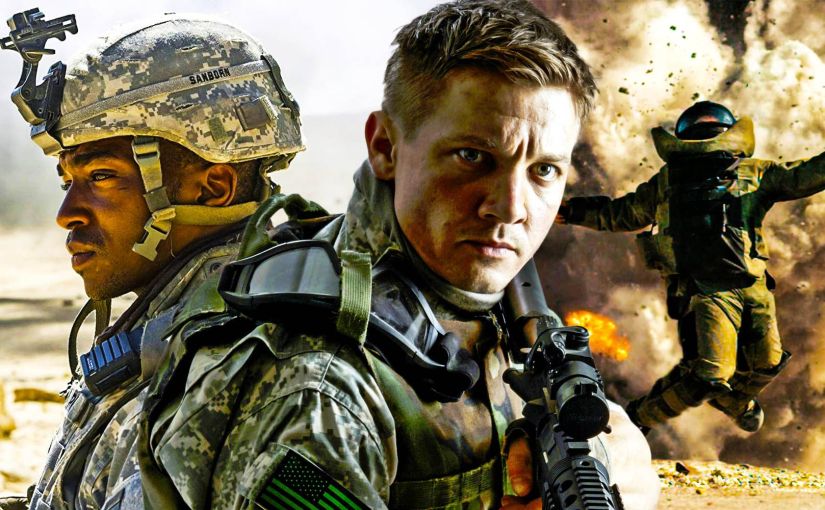
Often the most effective war movies hardly focus on the enemy.  It’s the environment that keeps us on our toes.  Like Oliver Stone’s Platoon, Kathryn Bigelow’s The Hurt Locker is a widely acclaimed depiction of the Iraq War, centrally located in Baghdad in 2004. Her film follows a frighteningly tense perspective of three members of Bravo company – a bomb disposal team.  

After their leader perishes in a surprise attack, Sergeant J. T. Sanborn and Specialist Owen Eldridge (Anthony Mackie, Brian Geraghty) welcome Sergeant First Class William James (Jeremy Renner) to the squad for the remaining thirty-eight days of their rotation. Beyond evading suicide bombers and questionable Iraqi civilians who observe from the sidelines, Sanborn and Eldridge fear they’ll have to survive James’ maverick approach to deactivating sophisticated bombs that hide in the scorching hot desert area. William James claims to be responsible for shutting down eight hundred and seventy-three explosives in his young career.  He’s good at what he does but he disregards the best interests and care for others within his vicinity.

The art direction for The Hurt Locker is most impressive.  The expected sand rubble and distressed tenement buildings are convincing as Jordan stands in place for the film’s Baghdad. Bigelow’s team goes to great lengths with sophisticated explosives.  An early moment has James gently tugging on a red cord that eventually leads to other cords and then what comes out of the desert sand is six identical underground bombs surrounding him from all sides.  With her camera positioned overhead, pointing down, this feels like a monster movie with tentacles springing out in a circumference around the hero.

Another early scene has James recklessly undressing from his bulky, anti-bomb suit, and disassembling an abandoned car to look for the suspected device that’s hidden inside.  With Eldridge and Sanborn remotely demanding updates, the wild man chooses to toss his headset away to focus on his dire circumstance, solo.  

Ahead of the film’s thrilling opening, a quote from someone named Chris Hedges appears: “The rush of battle is often a potent and lethal addiction, for war is a drug.”  A more appropriate phrase would not describe Jeremy Renner’s character any better.  There’s no denying this guy is an expert and the best of the absolute best.  However, he’s positively the worst at accounting for his team or the environment around him.

Kathryn Bigelow is an outstanding director who gets better with each passing film.  The Hurt Locker elevates her finished products that began with cops and robbers fare like Blue Steel and Point Break.  Bigelow is not aiming for laughs or Hollywood shootouts.  With Mark Boal’s Oscar winning script, the filmmaker zeroes in on how someone so proficient with dangerous work pushes beyond limits of caution.  The three characters covered within this tiny sliver of a larger war find themselves tested with each passing day.  

There’s a routine to these guys as they respond to other desert platoons as the sun rises. They are summoned to come upon bombs and mines and people strapped to bombs and mines.  They load up in their Humvee, drive to the next site and do what is expected of themselves like firefighters would in any neighborhood. The conflict is these guys just do not work in sync with each other.  At night, they return to base following a full day’s work to play shoot ’em up video games, drink, and roughhouse with each other as a means to grasp who is the dominant one of the trio.  

Psychologically, James, Sanborn and Eldridge are not on similar planes.  Eldridge is the frightened one who confides in a Colonel with an empathetic, bedside manner.  Sanborn is the sensible levelheaded one.  James seems to lack priority for anyone including his on again/off again girlfriend back home (Evangeline Lilly) and the child they share together.  He’s bent on conquering the next sophisticated, wired device.  It only gets personal for him when one of the few kids in the area meets a gruesome demise and James goes lone wolf at night, within the towns, even though he’s not covert ops. His risks are too great for this war, his squad, and maybe himself.

Kathryn Bigelow effectively sets up environments that’ll rattle your nervous system.  Using handheld cameras, this film often works like documentary footage with quick cuts to citizens of Baghdad who may be staring at what this squad is doing, or maybe they are waiting for their cue to detonate something nearby and trap them.  A local butcher with a cell phone in his hand feels like the worst kind of threat.  A kid with a soccer ball seems untrustworthy.  A guy in a suit pleading for desperate help at the other end of the street is a person I wouldn’t want to stand next to.  There’s an abundance of desert citizen extras to look for and hypothesize about.  Is it that guy with the trigger or maybe it’s that kid or that woman?  Most of these people do not even speak.  Their glazed, war torn and dusty expressions say so little while the powerful machine guns held by the Americans will not do much to prevent a horrifying possibility.

The extensive footage of explosions is very impressive.  I read that Bigelow wanted to display what a real detonation would look like, and not with Hollywood fireball extravagance.  Accompanied with Oscar winning sound editing and mixing, the bombs in this movie lift the dirt and dust particles off the ground, building and automobile surfaces and then plume into mushroom clouds that expand beyond the limits of city blocks. The Bravo Company men even predict how the blasts will take off and where exactly the shrapnel and debris will reach and descend. They think they have this down to a science. This material is entirely different than what other action or war pictures typically show.  

Sniper fire comes at unexpected moments.  An open desert plain actually has an enemy concealed somewhere and quick pierces of sound drops a someone who you might think controls the scene. Then the next someone. The shock of how quickly it’s edited together plays with your senses. Bob Murawski and Chris Innis are the award-winning film editors of this piece. They complete their job to the fullest. This all looks so real and not a product of art.

The Hurt Locker is term to describe where a militant solder will go to when living with internal pain and conflict.  The soldier goes to his hurt locker. This war puts each of these three guys in their own kind of hurt locker, but perhaps they force their situations upon themselves and each other. Mark Boal and Kathryn Bigelow’s film do not just devote time to the three characters who are most at play, but also to devices of war and destruction that drastically change these men.

The Hurt Locker is one of Kathryn Bigelow’s best films.
12 MONKEYS

By Marc S. Sanders

Bruce Willis is a time traveler from an ugly dystopian future in 12 Monkeys.  His name is James Cole and his mission is to uncover why all but one percent of the world’s human population perished from a mysterious virus in the year 1996. 

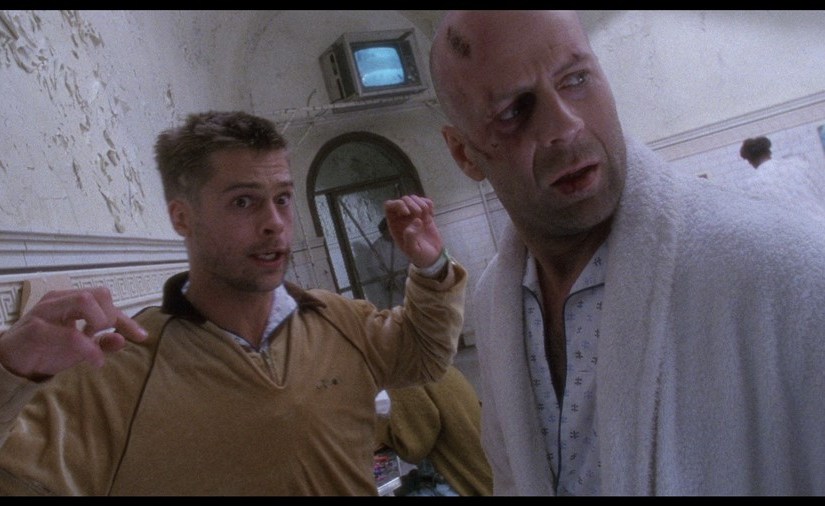
Director Terry Gilliam specializes in disorienting his films.  No shot or closeup is well defined.  He’ll position his camera on a slant or he’ll turn it on an uneven axis so that nothing appears completely clear.  In 12 Monkeys, the viewer is as confused as the protagonist, James Cole, along with a psychiatrist he periodically encounters named Kathryn Railly (Madeleine Stowe).  Beyond the camera trickery, the script of the film offers up oddball characters in both Cole’s present time period (the “future”) and in his past.  Jeffrey Goines (Brad Pitt, in his first Oscar nominated role) is one particular weirdo, residing in a mental institution that Cole is entered into when he time traveled back to Baltimore, Maryland in the year 1990.  During his stay in the loony bin, Cole is talking gibberish to Dr. Railly and her team.  Jeffrey has his own language of nonsense.

Cole’s dreams of himself as a child are intermittently weaved into the final edit of the film.  There’s a woman running after a man, a rapid beep, beep, beep and a gunshot.  Later returns to this dream will provide more clues fleshing out its significance.

It would be easy to have a five-minute conversation and spell out what occurs in 12 Monkeys, but that would be defeating the cleverness of the film.  The achievement of its story relies on the sum of its parts.  Terry Gilliam strategically lays out breadcrumbs with fractional pieces of dialogue, words and pictures that quickly flash in front of you.  It may even hinge on a news story or memorable pieces of music playing on a radio. Still, he also unnerves the characters and the viewer with uncomfortable and sometimes grotesque imagery. 

The first time you watch the film your attention may turn to the long stream of bloody drool hanging from Bruce Willis’ mouth when he shares his first scene with Madeleine Stowe.  Repeat viewings, which I believe only enhance the picture, will have you focus on the nonsensical dialogue that James Cole is continuously uttering.  Other characters are seemingly disruptive to your concentration, particularly the herky jerky behavior of Brad Pitt’s character, but their purpose is essential to a mystery that has left the world of the future in a tailspin where the last of the human race lives underground while animal wildlife roam the cities above.  Furthermore, who or what can explain the enigma behind a team of people perhaps known as The Army Of The 12 Monkeys?

12 Monkeys is a very weird and very unusual kind of science fiction film and that is its crowning achievement.  I have spoken before of how sometimes a movie can not be determined as a success until it reaches its climax, say the last five minutes of its running time.  Terry Gilliam’s picture is one such example.  Gilliam has a keen sense of foreshadowing with tactical layering of complexity.  He is wise with how everything neatly unravels at just the right moment. The answers to the mysteries that James Cole pursues eventually rise to the surface, reminding us that everything was right under our nose the whole time. 

I recall the elation I had the first time I saw the film in theaters.  On repeat viewings, I grin at how the movie is assembled.  Quick references that seem like blink and you miss it moments add up to a satisfying conclusion in Terry Gilliam’s film.  My colleague, Miguel, and I both agree on the time travel motif in 12 Monkeys.  It is one of those rare occasions where the science built within the story’s fiction seems to make sense.  Too often time travel movies paint themselves into a corner and can’t escape the gaping plot holes they leave behind.  Yet the different time settings of 12 Monkeys cooperate with themselves.  Because the film doesn’t color outside of its lines, its worth applauding how ingenious the picture truly is from beginning to end.

12 Monkeys may require your patience the first time you watch it.  It’s not a comfortable journey.  However, you’ll be glad you stayed with it as the story answers its own questions.

16 BLOCKS (2006)

By Miguel E. Rodriguez

Director: Richard Donner
Cast: Bruce Willis, Mos Def (a.k.a. Yasiin Bey), David Morse
My Rating: 7/10
Rotten Tomatometer: 56%

PLOT: An aging alcoholic cop (Willis) is assigned the task of escorting a witness (Mos Def) from police custody to a courthouse 16 blocks away. However, chaotic forces are at work to prevent them from making it in one piece.


“Genre film.”  To some people, these may be considered dirty words.  They conjure up painful memories of poor-to-middling films like Red Heat, Beastmaster, Con Air, Deep Impact, Cliffhanger, ad infinitum.

However, let us not forget that people who were just trying to make a simple genre film also gave us Star Wars and Jaws and Casablanca.

With 16 Blocks, veteran director Richard Donner (Lethal Weapon, Superman) takes a familiar story – gently re-using elements from 3:10 to Yuma, if you ask me – and delivers a respectable genre film: solid, if somewhat predictable, entertainment.  Call it a compromise between Casablanca and Commando.

If Bruce Willis had not been cast, this movie would probably not have been made.  With genre films, you want archetypes, actors who embody the characters without having to say a word if they don’t have to.  That’s our Bruce.  When you first see him on screen, nursing a hangover, eyes half-closed, trudging wearily step by step, you don’t need a lot of plot exposition.  We’re there.

Where this movie mildly elevates its formula is in the casting of Mos Def as Eddie Bunker, the federal witness whom Willis is tasked with protecting.  I’m speculating here, but I’m guessing that Mos Def was probably no one’s first choice for the role.  On the page, the script is crying out for a comedian: Chris Rock, maybe even Eddie Murphy, or Dave Chappelle.  Instead, the producers went with the “hot hand”, Mos Def, a former hip-hop artist, riding high on high-profile roles in several recent hits.  Despite his modest popularity, he is still not the obvious choice.

But make no mistake: Mos Def is what makes this movie work.  His Eddie Bunker character has this amazing, indescribable accent, somewhere between the nasal whining of a Beastie boy and Billy Ray Valentine from Trading Places.  His job is to be as annoying as possible to his minder, and he succeeds.  But he is also somehow able to make Eddie likable and even relatable.  He claims he’s in prison by mistake (of course), but he has plans to open a bakery when he gets out…because he learned to bake in prison.  I love that, I don’t know why.

The film hurls this odd couple from one situation to the next as it unspools almost in real time.  In the course of all this hurling, they encounter that most reliable of screen clichés: bad guys who can’t shoot straight while the good guys are nearly perfect marksmen.  Predictable.  Not to mention the bad guy who monologues just a LITTLE too long, the ability for the good guy to somehow out-think the bad guys even with a monster hangover, the good guy who (gasp!) turns out to be a bad guy…most movie clichés are out in full force here.

But it works.  It’s not Heat, but it’s not The Golden Child either.  It’s fun, a not-quite-guilty pleasure that hits all the buttons on time and on target.  Predictable, yes.  But fun.