HAUNTED MANSION (2023)

by Miguel E. Rodriguez

DIRECTOR: Justin Simien
CAST: LaKeith Stanfield, Rosario Dawson, Owen Wilson, Tiffany Haddish, Danny DeVito, Jamie Lee Curtis, Jared Leto
MY RATING: 6/10
ROTTEN TOMATOMETER: 40%

PLOT: A single mom in New Orleans hires a grieving tour guide, a dubious psychic, a shady priest, and an unhinged historian to help exorcise her newly bought mansion after discovering it is inhabited by ghosts.


Writing even a mildly negative review of Disney’s Haunted Mansion feels a little like hitting “dislike” on a picture of a 3-legged puppy.  The puppy is just being a puppy.  It doesn’t know or care that it’s missing a leg.  It just is what it is.

So it goes with this new attempt at a movie based on a popular Disney ride.  It’s chock-a-block full of inside jokes and references to the ride, some in plain sight, some tucked away in the corners of the screen.  As a fan of the ride at the Magic Kingdom in Orlando (I’ve never been to the Disney parks in Anaheim), I enjoyed these little Easter eggs.  Truthfully…I enjoyed them a lot.  I especially liked the chair shaped like a Doom Buggy, and the room that stretches, and the hitchhiking ghosts, and on and on.  This movie is basically Ready Player One revolving around just one IP instead of hundreds of them.  (That’s “Intellectual Property” for all you non-nerds out there.)

But aside from all the cool references, there’s not much else to recommend, especially not for those few poor souls who are not as thoroughly familiar with the Disney ride as I and many others are.  For those people, I would imagine Haunted Mansion plays a little bit like a de-fanged version of the original Jumanji [1995] or Jon Favreau’s criminally under-appreciated Zathura [2005].  There’s a heart-tugging sub-plot about the grieving tour guide, Ben, played by LaKeith Stanfield.  (Stanfield deserves recognition for playing the absurd material absolutely straight, even pulling out the emotional stops for a touching moment as he describes his late wife, in a scene that features an absolute scene-stealing button from Danny DeVito.)  Travis, son of single mom Gabbie (Rosario Dawson), has problems with bullies at school, even when he isn’t troubled by the ghosts who have latched onto him like lice.  Then there’s the issue of who all the resident ghosts are REALLY afraid of, a big-bad known only as the hatbox ghost (Jared Leto).

(I was reminded here of Peter Jackson’s The Frighteners [1996] in which a host of ghosts were terrified of a being that can actually kill a ghost.)

The movie has all the requisite creepy hallways and creaking doors and one or two jump-scares, but everything is done so tongue-and-cheek that it’s never truly horrifying…which was, I’m sure, the aim of the filmmakers.  Certainly you don’t want to make a film, based on a theme park ride, as scary as The Exorcist.  So, to that end, the filmmakers succeeded.  The movie is harmless, even a little fun at times, Owen Wilson gets to deliver some of his trademark dry observations, and DeVito gets to play some notes that I haven’t seen him play in a very long time.  If pressed, I would be forced to conclude that, for non-fans of the ride, this movie would most likely be a bit of a slog.

…but it is cute, despite missing that one leg.

BATMAN RETURNS

By Marc S. Sanders

I’ve always been a little hot and cold with Tim Burton’s films.  They are beautifully constructed in set and costume design, always well cast with exceptional talent and composer Danny Elfman’s music accompanies perfectly with Burton’s wide collection of social misfits and altogether celebrated weird material.  Still, more often than not, I leave Burton’s movies feeling less fulfilled than I want. Tim Burton’s one sequel film to date, Batman Returns, is one such example. 

To commemorate the annual Batman Day, I opted to watch Burton’s return to the murkiest of comic book locales, Gotham City, where Michael Keaton reprised the role of billionaire Bruce Wayne who dons the costume of The Dark Knight.  This time the villains of the week are the grotesque Penguin (Danny DeVito) and the sexy, dominatrix like Catwoman (Michelle Pfeiffer). 

Penguin resurfaces from the sewers of Gotham 33 years after his parents abandoned him as an infant, depositing him into the city reservoir in a bassinet to be raised by…you guessed it…penguins.  (Schools of penguins reside in the city sewers???? I guess it’s better than rats.)  Nerdy and mousy Selina Kyle is raised from the dead by the gnawing and licking of random alley cats to take on a warrior persona for Catwoman.  How exactly a feline resurrection works in either myth or science is never explored.  I guess I just have to go with it.  The manipulator behind these villains’ actions is a wealthy industrialist named Max Shreck, portrayed by Christopher Walken.  I was never sure of his stake here.  I’m only supposed to understand that he’s unlikable on the surface and he is not good for Gotham. 

I love all these actors.  I love them in these roles.  I do not love the script doled out for them though, which serves none of them well.

Batman Returns is best when the Batmobile or the Bat Glider is on screen.  They are awesome pieces of hardware to see in action as much as any tripped-up James Bond vehicle.  However, these are props.  They don’t speak, or laugh, or cry, or get angry.  Therefore, they don’t drive or develop a story.  When Luke Skywalker pilots an X-Wing Fighter, I care about the pilot.  The pilot speaks for the vehicle.  Batman doesn’t speak for the Batmobile. 

It’s ironic that the title character has only one sentence of dialogue in the first 30 minutes of this two-hour film.  There’s no dynamic to Batman or Bruce Wayne.  Keaton looks great sitting by his fireplace in deep thought or watching his television as the bat signal beams upon him.  He stands, and then when we see him next, he’s sitting in his bat car in full horned head regalia.  Otherwise, the Batman character is a prop to be used for scapegoat tactics by Penguin, Schreck and Catwoman, or he’s present to hurl a bat gadget, or throw a stiff-arm punch.  He doesn’t even do much of that stuff, anyway.  In Batman Returns, I learn nothing new about Batman or Bruce Wayne or his crusade to protect Gotham City.

Keaton shares one good scene in the film with Michelle Pfeiffer. It may be the one scene with a story to it as the two are dressed down from their comic book evening wear to dance slowly at a masquerade Christmas ball where they gradually realize who they are when they are not with one another.  Of course, we know this should be so obvious, yet a rule of thumb for comic book literature is not to realize what’s right under your nose.  A nice touch to this scene is having Keaton and Pfeiffer be the only guests not wearing a mask while everyone else is.  Batman and Catwoman have in fact dressed up as someone else for the costume party.  Very ironic and almost clever.

Too much material is given to Walken as the conniving Max Shreck.  Walken performs well, but just like his Bond bad guy in A View To A Kill, he belongs in a different movie.  The Schreck character lends nothing to this Batman adventure.  Who’s interested in this guy?  McDonalds and the other merchandising companies could even see how unattractive this character is.  So, why couldn’t Tim Burton or his writers and producers?  I’ll pay you a gazillion dollars for your rare, never manufactured Max Schreck action figure.  Yet, the bland script from Daniel Waters and Sam Hamm arguably provides the most dialogue to this guy.  You’ve got Batman, Penguin, Catwoman, even Alfred the butler and Commissioner Gordon, and yet this grey-haired guy with a wolf like pompadour in a bland, black business suit is hijacking a Batman movie.  Makes no sense.  Much of Batman Returns is made with cutting room floor material taped together featuring an unwanted Christopher Walken.

Who else is better to play The Penguin than Danny DeVito?  No one!  So, it is disappointing when the squat actor has nothing to do.  A seemingly inspired storyline from the campy Adam West TV series, and maybe a handful of comics, have him running for Mayor of Gotham.  A good start, but then the script does nothing remotely interesting with it, even though this stuff sells itself.  Where’s the political jokes to parallel the campaign? Where’s the ridiculous podium debates?  Imagine Penguin kissing little old ladies and holding babies while on a campaign trail.  None of that happens here.  You have outstanding talent from DeVito and yet all he’s left to do is ride around in a duck boat, spit out black and green sludge goo, and scream frustrations in a groggy, ear-piercing bellow on more than a couple of occasions. Unlike Jack Nicholson before him, DeVito is abandoned to play scenes with no dialogue while he chomps on raw fish or screams for the sake of screaming. 

An error in judgement was layering the actor in ugly makeup and unattractive costume wear.  Usually, DeVito is seen wearing a stained and damp white footy pajama suit with black dental pieces and very black eyeshadow on a whited out facial texture with a giant hook nose.  This is Danny DeVito.  He already looks like The Penguin.  If it ain’t broke, don’t fix it!  The only charming accessories are his top hat and his collection of umbrellas (shooting fire or bullets or flicking out knives) that serve as exclamation points on dialogue when a jokey punchline could not be considered with even just a smidgen of effort from the writers.  The umbrellas were more expressive than the guy operating them, and yet even they were hardly used in any action scenes.

Batman Returns has some sloppy scene cuts as well.  A scene will appear with Catwoman skipping through a store, then it’ll jump to Batman punching out a few circus clowns, then the two meeting up on a rooftop somehow.  Why, where and how did this all happen?  The math doesn’t add up.  Penguin will somehow appear within this stitchery too.  For what reason?  Three movies are happening here and none of them are communicating with one another.

Films like the original Batman, or Edward Scissorhands or even Pee Wee’s Big Adventure carry the weirdo trademark of Tim Burton.  I know what I’m getting when I turn on almost any one of his films.  (Ed Wood being the surprising, and pleasing biographical exception.)  These are gorgeous, macabre films to look at, whether they are dimly lit or staged in deliberately bright and gaudy rainbow colors.  Yet, there are often scenes or moments that lack that hook that carries you from the exposition to the acclimation I normally get from the universe on screen before my eyes.  Batman Returns especially lacks that transition. 

Because the film looks so good, it is not the worst of the Dark Knight’s many films.  Yet, it is an uninspired and disappointing piece.  Any film with such storied and legendary characters as these is going to be a big letdown if they are given nothing to do.  Why, oh why, did they give almost all of the lines to the boring guy in the business suit?  If I wanted to entertain myself with an accountant, all I needed to do was sit in the lobby of an H & R Block.

ROMANCING THE STONE

By Marc S. Sanders

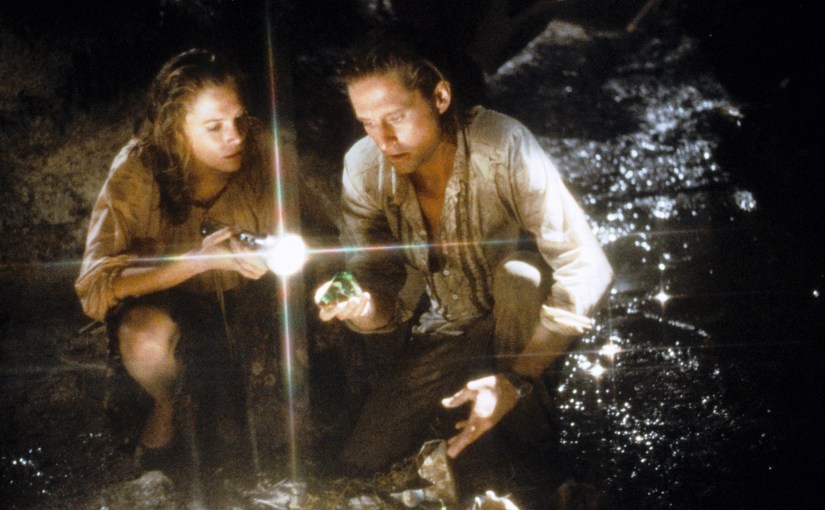
Robert Zemekis’ Romancing The Stone is one of those perfect Saturday afternoon rainy day movies. Since it focuses on best-selling author Joan Wilder (Kathleen Turner), it seems apropos that the movie feels like curling up with a good book.

Upon discovering that her New York apartment has been ransacked, Joan gets a call from her terrified sister who has been kidnapped in Columbia. Joan is instructed to deliver a treasure map in exchange for her sister’s safe return. However, Joan is not as romanticized or adventurous as the characters in her novels. So, her three-piece suit and heels won’t serve well in the wet jungles in which she ends up completely lost. Fortunately, she meets a heroic, handsome guy in the form of Jack T. Colton (Michael Douglas). Together, they flee from the parties interested in the map, while trying to find the titled priceless gem.

Zemekis might have been taking an Indiana Jones route with this picture, but it finds its own identity, nonetheless. The fun comes with how Joan adapts to the outdoor elements and escapes the safe and lonely concrete jungles of city life. Turner is great as the one with no clue for travel or the instinct to stay out of a bad situation. It’s amusing to see her encounter and respond to one approaching cliffhanger after another.

There are great scenes here with mud slides, vine swinging, shoot outs and car chases. The best adventures never rely on CGI. A favorite sequence involves a meet up with a Columbian drug runner who helps the pair evade the bad guys in his 4 x 4 truck. That’s one of the many unexpected and wild moments offered here.

A third star is Danny DeVito fast on the trail of Joan and Jack. He’s here as the stooge more or less but he’s added comedy.

The one sad thing about Romancing The Stone is that it’s screenwriter Diane Thomas passed away shortly after her script was sold. Imagine what she could have done based on the promise of this film. This script has focus, fun and outstanding action sequences.

Romancing The Stone is just great escapism.

THE RAINMAKER

By Marc S. Sanders

Francis Ford Coppola didn’t just call his film The Rainmaker. He called it John Grisham’s The Rainmaker. I understand the significance as a large portion of the film relies on voiceover narration from its main character, Rudy Baylor (played very well by Matt Damon).

The film focuses on much of the underpinnings of the legal system within the state of Tennessee. Rudy gives insight into his position of ethical practice – he’s fresh out of law school but doesn’t have a license yet – versus the large giant sell out attorneys (a towering, sharp dressed and slick Jon Voight) that represent goliath parties like big time insurance companies. Grisham’s novel, along with Coppola’s screenplay, also leave room in the beginning of the film for the sleaze of the law practice with Rudy’s first employer who goes by the moniker “Bruiser,” played by an oily Mickey Rourke.

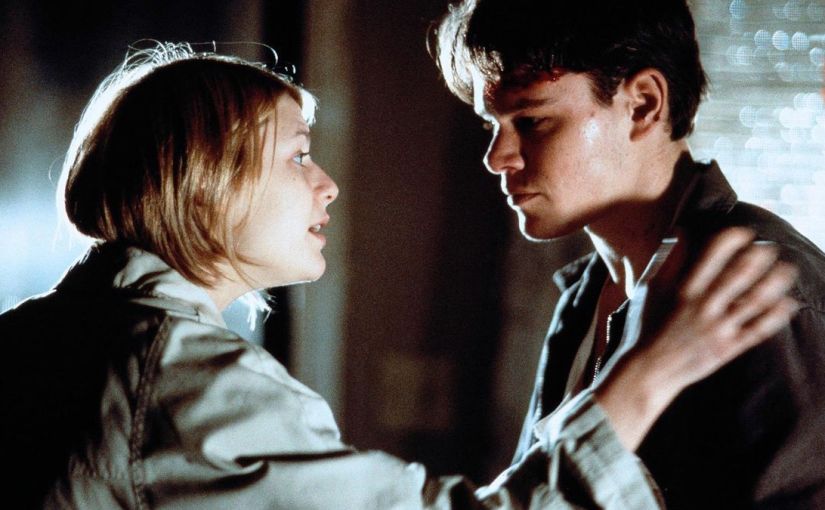
Rudy has not even passed the bar exam at the start of the film but he’s already got three cases in progress. He has agreed to completing a will for a kind old lady (Teresa Wright) who is adamant about leaving her estate to a television evangelist. He also volunteers himself to protecting a young woman named Kelly (Claire Danes) from an abusive husband. His biggest case is going after a million dollar insurance company for wrongfully denying a claim filed by one of it’s ill insured. Rudy knows the insured is justified to sue and it could be a huge and necessary windfall for him and his unlicensed, corner cutting partner (Danny DeVito), but it’s only him against a grand army of legal gods lead by the great Leo F. Drummond, Esq. (Voight).

Grisham and Coppola wanted to depict a drive for doing right by the law and the people it’s meant to protect. Damon’s portrayal of Rudy represents that ideal. His father hated lawyers and he grew up in a home life that never responded favorably to the merits of officers of the court. Rudy defies what his father frowned upon. Despite his inexperience in a courtroom and his ability to respond with objections and cited legal rules, he knows he’ll be a good lawyer simply because he can distinguish between right and wrong. He doesn’t need to sink as low as Drummond’s cronies by bugging the opposition’s office. Will Rudy’s righteousness be enough though? He’s so dang honorable in his profession that it might just be the ultimate means of his defeat.

Same can be said for Rudy’s will to protect Kelly, the young, abused wife. Precedents of law keep her husband on the streets no matter how bruised and bloody she gets time and again. This man is a monster, but no higher power is looking upon this victimized wife to legally protect her, and this man will continue to beat her until one day she’s dead. Rudy wears his heart on his sleeve for this woman and again can only serve as an honorable servant of the court. When he steps out of that line a little by risking his life to save this woman, he’s testing his own sworn code that he’s respected while others have dismissed it.

John Grisham’s The Rainmaker is one of those under the radar films not celebrated enough. I recall it being shown in limited theatre capacity, and it hardly did well at the box office, but it’s really a remarkable piece as it shows an unconventional and honorable attorney, reminiscent of Harper Lee’s Atticus Finch but set in modern day. Nearly everyone around Rudy, from his own father, that he describes to the students he attended law school with, to even the even the fool of a judge (Dean Stockwell) who swears him in as well as his own partner (DeVito in a hilarious, quick solving, underhanded role), are beyond any moral compass and yet Damon ensures Rudy Baylor sticks to his convictions.

Coppola’s film is not a legal thriller. It’s an observation of how the established perceive the law and the one fish who treads water above the bottom feeders, allegorically shown in Bruiser’s fish tank, seek out big rewards. For Rudy, the client matters. For everyone else, only the money matters.

ONE FLEW OVER THE CUCKOO’S NEST

By Marc S. Sanders

After watching One Flew Over The Cuckoo’s Nest for the first time in many years, I recognized a political dual taking place on the battleground of an insane asylum. Director Milos Foreman sets the stage for one patient to win over the community from the Head Nurse in charge.

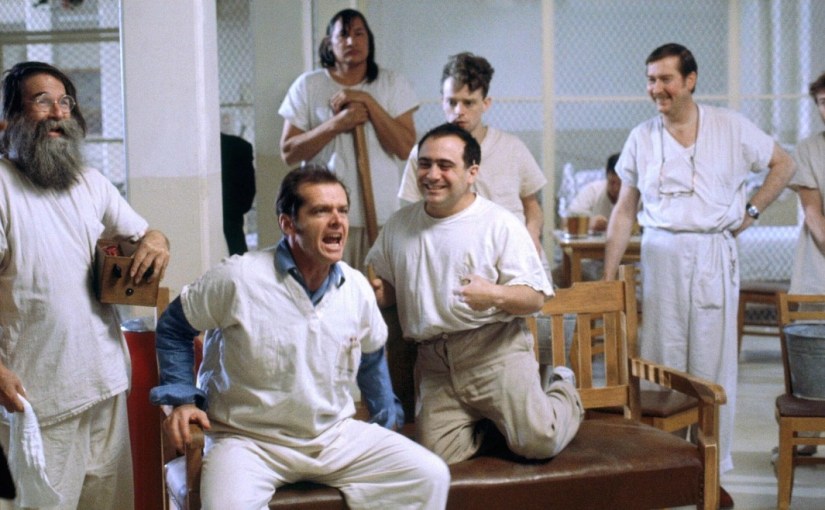
Jack Nicholson is Randall P McMurphy, a criminal who is transferred to the asylum for examination even though there are likely suspicions he’s faking his current condition as a means to escape prison life work detail. Louise Fletcher is his opponent as Nurse Ratched who has maintained an organized control over the floor of 19 men with an assortment of mentally unwell behavior.

McMurphy is a cut up as soon as he joins the gang. At first he appears observant during Ratched’s daily sessions where she asks the men to contribute to the discussion but at the same time she couldn’t be less encouraging. She’s happy to welcome ideas with open arms but don’t disrupt the process. There will also be “Medication Times” and there will be samples of classical and childlike music to subdue the patients as well. McMurphy may request the volume be lowered, but that’s not a simple request that Nurse Ratched will honor.

McMurphy’s experience outside the realm of insanity works as a wake up call for some of the men which consist of introductory performances from great character actors like Christopher Lloyd, Danny DeVito and Vincent Schiavelli. The stand out is Brad Dourif as Billy Bibbit, the stuttering suicidal young man with the baby face who fears his mother’s judgment as Nurse Ratched methodically continues to imply.

McMurphy wins over the crowd eventually. A fascinating scene is when Ratched challenges McMurphy to obtain enough votes among the men in order to watch the World Series. The count of raised hands appears to tie, but then Ratched reminds him that he needs one more vote to win. Before he can get to that point, the session is ended by Ratched. The call for election is lost due to a technicality by the governing control. An election won’t silence the voice of the people as McMurphy quickly encourages the masses to watch a blank television screen imagining his own interpretation of the game. Ratched can only domineer to a certain degree. Here’s the flaw in the Ratched character. At last a breakthrough among these ill men is established as they’ve learned to vote for themselves. They want to watch a baseball game. Ratched won’t stand for progress though.

Questions arise in One Flew Over The Cuckoo’s Nest. Is McMurphy truly faking his mental condition? Is Ratched so drunk on control to disregard doctors’ opinions for his release and keep him institutionalized? If he’s not insane, then why would she want him there? Is it all about Ratched’s obsession with winning?

Ken Kesey wrote the original novel the film is based on. He hated Foreman’s approach particularly with disregarding telling his story from the perspective of the deaf/mute six foot five Native American that McMurphy regards as “Chief” (Will Sampson). Chief seems to be the quiet one who does not take sides until McMurphy demonstrates the ease of obtaining freedom such as when the Chief helps him escape over a barb wire fence and then takes the men on a boating joy ride. I can’t side with Kesey’s insistence that the film be done from the perspective of the silent, yet memorable Chief. Film is a different medium than what’s read on a page. You can’t watch people’s thoughts. What I do find interesting is that Kesey opted for a Native American as McMurphy’s best sidekick. This is a man whose ancestors historically lost their land. McMurphy attempts to rob the rule of the asylum from Nurse Ratched. The political undertones just seem so apparent. The government control, however, is hard pressed to surrender even after McMurphy arranges for his own party of celebration complete with booze and alcohol. Ultimately, and sadly, the fate of McMurphy shows that he eventually becomes a product of his own environment. The Chief however, acknowledges his independence though.

One Flew Over The Cuckoo’s Nest is the second of three films to win the five main Academy Awards (Best Picture, Director, Actor, Actress, and Screenplay). It deserved it, and because of the film’s unsettling and messy nature it’s almost surprising that it was so well received. It’s not a glamorous film. It can show the ugliness of men drowning in their own consciousness.

At the same time, the film shows the subtle yet brutal control of those living fulfilling lives at the expense of the constituents they oversee. Sure, let’s have an open minded community of provoking thoughts, but only if it’s confined to the restrictions that remain in place. Step outside those lines and a more permanent technique will be applied so you adapt to what’s mandated…unless you can bodily lift a concrete water fountain and smash it through a cage bar enclosed window to freedom.

TERMS OF ENDEARMENT

By Marc S. Sanders

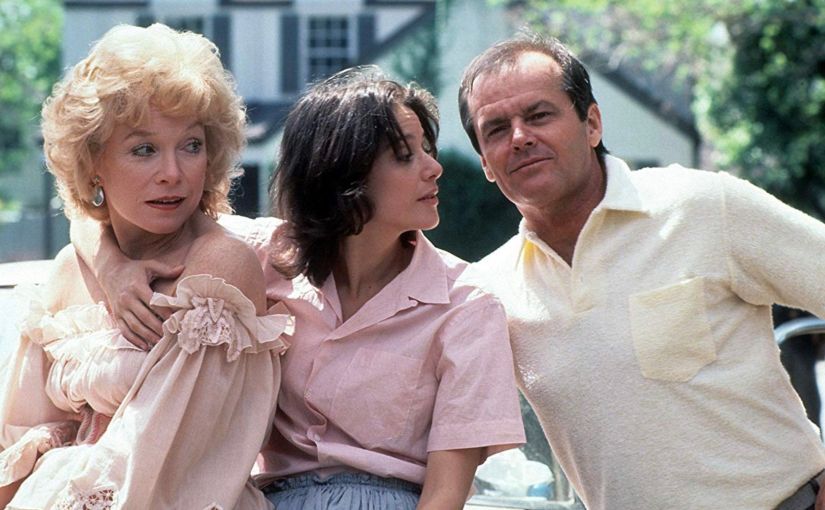
Acclaimed television writer James L Brooks’ first feature film was the 1983 Best Picture Winner Terms of Endearment.  The movie succeeds in more ways than one because of its varied relationships among the characters.  You have Aurora Greenway (Shirley MacLaine) and her daughter Emma Greenway-Horton (Debra Winger).  There’s Emma and her husband Flap Horton (Jeff Daniels).  There’s Aurora and Flap, and then there is Aurora and her neighbor Garrett Breedlove (Jack Nicholson).  Sounds like a lot to take in for a two hour picture, and yet Brooks manages to adapt a script from Larry McMurtry’s novel that smoothly covers realistic depth and dimension among these characters, and how they connect with one another.  Brooks is at least an incredibly efficient writer/director.  Honestly, I’m not complimenting him nearly enough.

Shirley MacLaine provides one of the best female performances to ever grace the silver screen.  She doesn’t have to utter a word of dialogue to say so much about how Aurora feels.  One of her greatest facial expressions is when she is addressed by her grandson as “Grandma!”  This moment is so utterly hilarious that the studio selected it to close out the original theatrical trailer.  If anything is going to get you in the seat at the theatre it’s this moment.  Aurora is a widow who can be difficult to please, judgmental and always conscious of her part in the world-even while she is hosting multiple gentlemen suitors in her Houston, Texas home.  This character is so powerful that it is hard to understand why Hollywood really never followed suit with presenting more films focused on the middle age woman or man.  There are still interesting things to be found in being a widow and dealing with ageism, motherhood and a resurrection of sexuality.  Think about The Golden Girls which dominated television sets on Saturday nights for most of the decade.

Aurora disapproves of Emma marrying Flap.  Flap has no imagination or drive and is as devoid of affection as his name suggests.  Best he can do for Emma and their three children is find whatever college professor job he can muster and uproot his family from one mid-western state to another.  Emma knows of her mother’s disdain for Flap, and can’t disagree with her.  She knows Flap is a loser, but if it means aggravating her mother then it is worth it at least to marry him.  Early in the film it amuses Emma to frustrate her mother a little more and a little more.  Contrary to Aurora’s instincts, Emma is naively unaware that life settles in soon enough and the happy nuptials fade away.

Still, Aurora and Emma have a strong mother/daughter relationship where numerous phone calls each day happen between them.  These conversations consist of Emma reluctantly telling her mother that she may be pregnant, yet again, or that Aurora is proud to let her guard down and approach the boorish, drinking next door neighbor astronaut, Garrett, played with a devil may care seductiveness from Jack Nicholson.  Aurora’s serene peacefulness in her beautiful backyard garden and home is always disrupted by Garrett’s loud bellow before diving into his swimming pool.  Still, she can’t help but be attracted to him while putting on a façade of disapproval in his presence.  The first lunch date that Aurora and Garrett share must be one of the best dates ever depicted on film.  The scene might have been written and staged by Brooks, but it is thankfully hijacked by Nicholson and MacLaine.  One of the funniest moments to ever come out of 1980s cinema for sure.  There’s much reason that MacLaine won Best Actress and Nicholson won Best Supporting Actor.  These actors easily stage a scene of realistic comedic chemistry while later expressing deep rooted drama and affection with one another.  Not easy to do all in one film.

Brooks masterfully writes these characters with such authenticity that you find yourself legitimately laughing at a scene or a piece of dialogue, while the person sitting next to you might embrace the dramatic element of the very same moment.  Both responses to random moments in Terms Of Endearment allow varied reactions like that.  When Emma suspects Flap of committing adultery, pay attention to the dialogue and the performance from Winger and Daniels.  Emma allows Flap to dodge a lie he’s about to tell by warning him that he may have just lost his senses, but if he continues down a wrong path, then he will end up worth less than he already is.  He doesn’t fight her on that observation.  Hard to explain here but listen to the vocabulary Brooks applies to Emma’s dialogue and watch how Winger traps Daniels.  You may nod with a smirk, or you may feel frightened for Emma and her marriage. 

I always say Terms Of Endearment is a comedy first and a drama second.  The film steers towards a frightening fate for the Aurora and Emma.  However, before that third act sequence there is so much to treasure, love and laugh at in the film.  When a cloud of imminent loss feels like it may approach, that is when the dramatic elements step forward.  To truly feel loss, you had to treasure wonderful moments with a loved one or a friend.  You had to value something important in your heart and soul to feel so terribly frightened and mad and hysterical when days might seemingly appear numbered.  James L Brooks and Larry McMurtry remind us of that.  Every person on the planet is destined for this feeling at one point or another.  What happens when the inevitable arrives is what sustains Terms Of Endearment to it’s satisfying end.  A character may appear on a hotel staircase to reconnect with support.  A hug goes a little longer than expected, and for the first time the one who normally lets go first actually tries to keep the moment frozen in time.  A gift from long ago is recovered to touch someone emotionally.  Brooks includes all of these moments in his film and that’s what I embrace most importantly.  Cinematically speaking, these points in the film are heightened by a memorable soundtrack of quirkiness and passage of life from composer Michael Gore.  His music is so effective that it has been used countless times over to enhance trailers for other films marketed at audiences that this picture was catered for.

Yes, after numerous viewings, Terms Of Endearment never fails to me put me in tears.  Like ugly crying!  I prefer to watch it alone actually, because I connect with the characters differently than most people I know, including my wife.  It’s a very personal film for me.  It reminds me of loss that I have felt and experienced.  More importantly though, it reminds me of all I’ve had, and all I continue to hold on to.  Terms Of Endearment is one of my favorite films.