WAKE UP DEAD MAN

By Marc S. Sanders

Benoit Blanc is back with a new mystery to solve in Wake Up Dead Man.  With three films, all directed by Rian Johnson (Knives Out, Glass Onion), Daniel Craig’s eccentric detective now belongs in the ranks of Sherlock Holmes and Hercule Poirot.  He’s a pleasure to watch with a smirk on your face.  Ironically, he doesn’t make his entrance until at least a third of the picture is complete.

Josh O’Connor is Father Jud Duplenticy who first reveals a wide berth of exposition ahead of the murder mystery that awaits us.  He’s a catholic priest who works hard to contain his temper that might resort to raising his fists.  He’s been assigned as the assistant minister to a church in a small New England town where everyone knows one another, especially repulsive Monsignor Jefferson Wicks (Josh Brolin).

Whodunit mysteries should never be spoiled.  I certainly wouldn’t imply how this film wraps up.  I also do not want to reveal who the victim(s) is/are.  I urge you to see Wake Up The Dead Man because this puzzler of a story is as gleeful as the title itself.

Like the Agatha Christie film adaptations from the 1970s, Rian Johnson does his best to provide a lineup of suspects with celebrity familiarity including Brolin, O’Connor, Mila Kunis, Kerry Washington, Thomas Hayden Church, Cailee Spaeny, Jeremy Renner and a standout performance from Glenn Close who steals much of the film away from the rest of the cast.  After seven nominations spanning over forty years, give her the Oscar already.  She’s eerie and needling, spooky and fun.  As Detective Blanc continues his investigation, a character tells him this all seems like something straight out of Scooby Doo.  Glenn Close, donned in black with an elderly bleached facade certainly feels like she’d come in contact with the animated pup and those meddling kids.

Rian Johnson writes with that classic narrative that Agatha Christie or Arthur Conan Doyle adopted, only it’s modernized.  The director of The Last Jedi even throws in a Star Wars reference and the joke soars.  The writer/director crafted this script as an invitation for hair raising merriment with his design.  If you can’t be a part of a mystery dinner theater party, he ensures that you can participate in this one.

An old church, priests who curse, habitually pleasure themselves and confess to an abundance of sins, a gothic tomb, a dark basement with a repulsive bathtub, a bar with a photograph of clues, startling entrances, unconventional dialogue and a quizzical murder weapon function like page turning literature.  Even better is to understand how impossible the first murder can be under the limitations of a locked door mystery.  How can someone be killed right in front of our eyes when no one else is in room?  The answers await and thankfully the revelations are not far-fetched.

Wake Up Dead Man is a fun time at the movies.  It’s coming to Netflix on December 12, 2025.  Nevertheless, I encourage you to go your local cinema.  The crowd we saw it with was responding consistently with us, and that only enhances the experience.

SPECTRE

By Marc S. Sanders

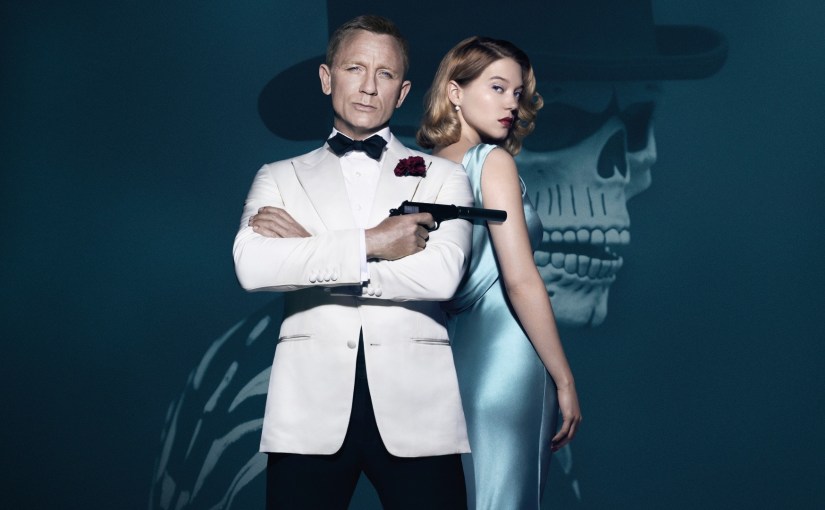
It’s fortunate that the success of Mike Myers’ Austin Powers franchise did not wash out the best features of the James Bond series. Had it done so, we wouldn’t have been treated to the outstanding production of Daniel Craig’s film, Spectre, with an opportunity to face off against a reinvented Ernst Stavro Blofeld played perfectly by Christoph Waltz. One of my few complaints however, is that we didn’t get enough material for the two-time Oscar winner.

Director Sam Mendes returns following Skyfall to reinvigorate the original traditions and blueprints that attracted audiences to 007 in 1962 with Dr. No. Blofeld lays in wait in his secret fortress of a lair housed within a desert crater (an upgrade from the volcano in You Only Live Twice), ready to offer exquisite hospitality to Bond and his love interest before providing an unrequested guided tour of his technology and hideous plots. No, he never had to show Bond anything. Yet Blofeld was never bashful, with or without his cat. Waltz is the right choice for this 21st century iteration of the staple villain. Gone is most of the camp presented in the character during the later Connery films. Most of the camp actually. He does still have the white cat after all.

Craig remains a great 007. The role is not a mimic of past Bonds. Craig is everything of the “blunt instrument” that author Ian Fleming described. Thanks to his physique and some great fight choreography, a marvelous fisticuffs scene occurs between him and brutish Dave Bautista aboard a moving train. Craig always looking great in the white dinner jacket tux, even while he’s getting pushed around.

Lea Seydoux is serviceable as the Bond girl, Madeline Swann, daughter of an old enemy of Bond with information necessary in the pursuit. Seydoux is not the best Bond girl. Others have offered more intellect beyond the beauty. Still, that might only be due to the limits of the script. She’s a good actor nonetheless.

Ben Whishaw and Naomie Harris are great as Q and Moneypenny. The roles have stepped up in frankness and skills that stretch out more than a traditional one scene cameo. Whishaw as Q is more of a know it all and Harris as Moneypenny reminds the audience that she has a life outside the office.

Ralph Fiennes is good too as M. Though I do wish his storyline was better here where he is dealing with an over abundant policy in complete government surveillance. The antagonist against Fiennes is nothing special and as quick as this storyline started, you knew how it was going to end. Still, I like watching Fiennes in the role.

Spectre has great scenes, most especially the signature opening taking place on the Day of the Dead in Mexico City that culminates in the destruction of a city block before Bond disables two bad guys aboard a spiraling helicopter. Steady cam and very clear edits make this a knockout.

I also appreciate the gag that not all things work accordingly for Bond. He orders his signature Vodka Martini, shaken not stirred, and is denied as he is at a bar located in an isolated strict health retreat. As well, his Aston Martin is not as reliable thanks to empty hidden machine guns hidden behind the logo in the trunk. Not everything comes as easy for Craig’s Bond, and that allows for some tongue in cheek humor.

I liked Spectre more on a repeat viewing. Mendes shot a gorgeous looking globetrotting picture of Mexico City, Rome, Austria, Tangiers and clear evening London.

Considering the next installment is likely to be Craig’s last film is disheartening. With Spectre, a summation of all the prior Craig films is assembled leading to what has been a great miniseries within the storied franchise. I’ve liked following this James Bond. There are revelations about the character including his orphan history, his faults and his coldness that only serves to protect the Queen’s country. The Daniel Craig Bond is the best following the very different albeit wry interpretation of Sean Connery.

Still, I’ll take what I can get, and once again happily look down the target scope aimed right for 007 before the blood comes pouring down.

SKYFALL

By Marc S. Sanders

Skyfall is a great James Bond film. One of the best. However, …it has one major shortcoming that always gnaws at me. Regrettably, it has a contrived middle section that steals some of the magic away from the film. Yes, for a moment, my suspension of disbelief is robbed from me.

Daniel Craig’s third outing as 007 has become a favorite among fans and movie goers. Craig is magnificent in a primarily dramatic turn in the part. Following a fantastic action packed opening where Bond pursues an assassin through the streets of Istanbul, Turkey (widely known as a favorite locale of Ian Fleming), the chase involves cars, motorcycles, rooftops, fruit stands and trains for well edited shootouts and fist fights. Alas, the assassin gets away and Bond is left for dead.

Following an attempt on the life of M (Judi Dench in her absolute best portrayal in the role), Bond returns for active duty. However, he’s not what he used to be. His aim is off and his body is worn. The question remains if Bond is ready to be back in the field.

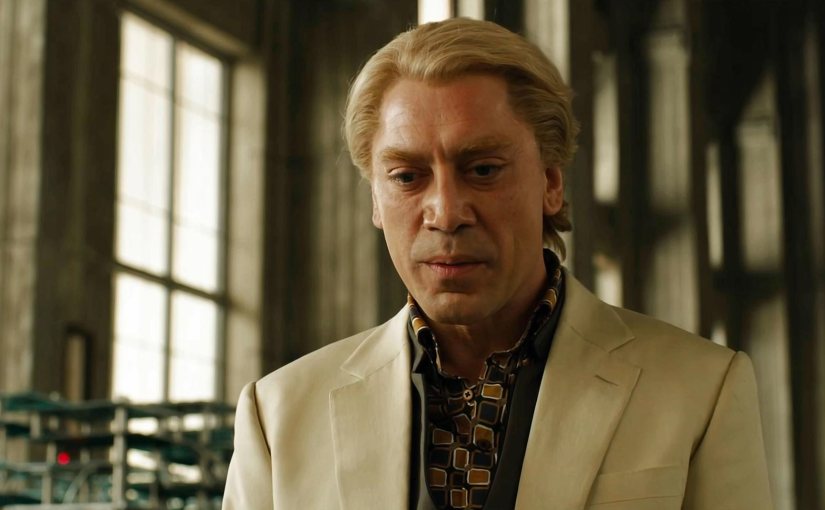
The plot centers on a bitter former MI6 agent named Silva (Javier Bardem in a potentially Oscar worthy performance) out to seek revenge on M for the sins he believes she’s committed.

It’s funny. The Austin Powers films, and even film critic Roger Ebert, would always draw attention to the fact the villain would just longingly speechify when they have all the time in the world to just shoot Bond dead and move on with their devious plot. Silva is a response to that issue. He has a mutual respect for Bond, and you can see he’d rather keep him alive for the time being to allow the game to keep running. It’s not said outright, mind you. Yet that’s what I took away from the character. A superbly written monologue to introduce Silva at the midway point of the film compares him and Bond to the last of two rats surviving a trap. Which rat will win out?

It’s also quite special that Bardem shapes his villainous role with a homosexual tendency. Silva is fashionable and proudly dons a bleach blonde hairstyle. He gleefully rubs Bond’s legs and opens his shirt to examine his scarred chest, pronouncing that Bond must ponder his “training” at the moment. Silva is beyond the typical femme fatale. It’s different and it’s time the Bond franchise acknowledges the differences in people. A welcome trait for a major character.

The plot set up of Skyfall‘s devices are ingenious in simplicity with a basic revenge tale but also with broadening the legacy and responsibilities of the M character. What Casino Royale did for a story arc for James Bond, Skyfall does for M, and with Dench in the role it works beautifully. She must answer to superiors, like a very welcome Ralph Fiennes, for the death of several agents and a bombing of MI6 headquarters. She must resist the pressure of early retirement. This is the most that M has ever had to contend with personally, and it’s here at last.

My one reservation with the film occurs just after the midway point. Silva somehow arranged to get apprehended and then managed to escape, don a police uniform, travel through London’s tube, and time an explosion on a runaway train ready to crash into James Bond who is on his trail. Thereafter, he’s able to locate the interrogation session where M is making a public statement in her defense and try to kill her. There are way too many factors at play that work too conveniently to Silva’s advantage. It’s a tension filled sequence. It looks great. It has great action and effects, but it’s overly contrived. I wish the script from Neal Purvis, Robert Wade and John Logan made this middle section a little more believable.

Sam Mendes (American Beauty) directs a terrific, action-packed film filled with more drama and minimal tongue in cheek that the series is primarily known for. I was grateful for the more serious Bond. Like the other Craig installments as well as the Dalton films, Skyfall offers a different and fresher approach.

Granted the ending plays more like an Arnold Schwarzenegger action piece from the 1980/90s, but it’s highly entertaining, well edited and well shot, nonetheless.

I highly recommend Skyfall for its outstanding cast that also includes Ben Whishaw as a nerdy variation of Q, the gadget man, and Naomie Harris in a secret role that has a satisfying payoff. As well, the standard revenge story works quite well here when you have Bardem, Fiennes, Craig and most especially Dench doing some really top notch acting with terrific dialogue. Mendes is a stage director first, and it shows quite admirably here.

Again, Skyfall is not the best Bond film but it’s at least one of the best.

QUANTUM OF SOLACE

By Marc S. Sanders

A writer’s strike never bodes well for a film. So the 22nd installment in the James Bond franchise, Quantum Of Solace, suffered because of it. Daniel Craig returns in his second film as Bond which begins as a direct sequel to my favorite film in the series, Casino Royale. Marc Forster (Finding Neverland) directs, but not very well.

Much of the action scenes are very shaky and choppy. Forster seems to have adopted Paul Greengrass’ technique that works so effectively in the Jason Bourne films and United 93. However, Forster does not make clear what is occurring. You can’t recreate Picasso with crayons.

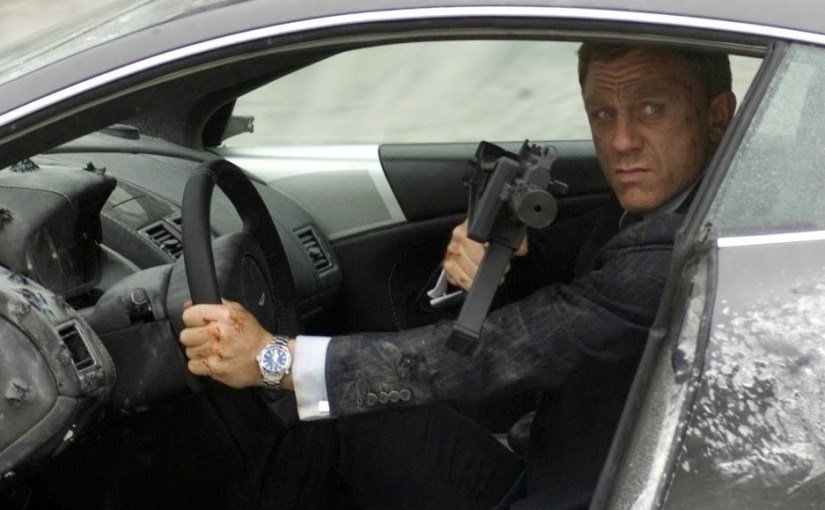
The opening is a rush job of a car chase as Bond races away from enemies in his Aston Martin. Machine guns and heavy traffic and construction sites make way for his car to gradually fall apart but it’s hard to really see how the car becomes damaged in the first place. Just when exactly did the driver’s side door come off? There’s lots of spinning out of control and dirt flying with bombastic gun fire and engine revving. It’s all sensory overload to hide the preciseness in the high speed chase.

Later, Bond is attempting to rescue the girl Camille (boring name, boring girl) played by Olga Kurylenko when she’s held captive on a boat. He jumps into a motor boat and the chase is on. Bond fends off the bad guy by tossing a rope with a hook on it. Just tossing it up. Suddenly the bad guy’s boat flips over. What exactly happened here? How did the rope take out that boat? I didn’t see the connection. Film is visual. So show me the fundamentals from A to Z, please.

The story involves Dominic Greene (Mathieu Almaric) who appears to be an environmentalist with interest in a pipeline in Bolivia. (Bolivia????) At first Bond is under the impression this pipeline must be for oil. Later, it’s realized that Greene intends to charge the country enormous prices as he takes over the water supply. (Roman Polanski’s Chinatown did this all much, much better.). In exchange, Greene will assist a tyrannical Bolivian General in becoming President. This General raped and murdered Camille’s family. Naturally, she wants revenge. As Bond pursues Greene, he comes to learn that Greene is a member of a secret organization called Quantum. Hence the strange title.

Bond follows through with this assignment while trying to determine why his past love (Vesper Lynd from Casino Royale) was murdered, and after MI6 is infiltrated.

The story is kind of all over the place. It has a lot of interesting threads like Bond’s need for revenge, Camille’s need for revenge and a secret organization that MI6, nor the CIA, were ever aware of. Threads remain hanging as threads though if a writer’s strike interferes.

The story for Quantum Of Solace hardly gets fleshed out. We learn nothing of the organization, Quantum. When Bond finishes his mission with Camille, she just gets out of the car and walks away into the middle of nowhere. Where is she going exactly? The climactic battle takes place in a luxury hotel located in the middle of the desert. Unless this is Las Vegas, who goes to a hotel in the middle of the desert? I mean like ever?????

The film is a tremendous disappointment after the creatively artistic success of Casino Royale. Often sequels do not live up to their predecessors, but Quantum really goes off the rails. This film was a make-up as you go.

Craig is fine in the role of Bond; consistent with his first film. Almaric is okay as the villain, but never given much to do. A second woman comes into play, named Fields played by Gemma Arterton, assigned by M to bring Bond out of service. She seems to have a personality that the Camille character lacks, but she’s hardly given much screen time, save for a nightcap with Bond and later an image that harkens back to Goldfinger.

Jeffrey Wright (a great Felix Leighter, that I have not talked about yet) is belabored to share scenes with an obnoxious CIA partner played David Harbour. These two guys seem to be acting in a different movie.

Marc Forster was given a toolbox but didn’t know which end of the hammer to hold with Quantum Of Solace. There are too many things wrong with this film to justify any merits it may have.

Maybe the most interesting moment happens in the epilogue scene as we learn more about Vesper’s past. The scene has next to no relevance with much of the main story beforehand. Still, why couldn’t this film simply stay on this trajectory from the beginning? This is a thread worth pulling on and then tying off.

In other words, Vesper Lynd is far more interesting than the water supply in…ahem…Bolivia. 

CASINO ROYALE

By Marc S. Sanders

Casino Royale from 2006 is the one film in the entire James Bond series that gives the MI6 agent a complete character arc, and for that reason alone, it is also the best film to date in the franchise, and another of my most favorite movies.

Bond becomes a different person, and a different agent by the end of this film. It’s a pleasing and unexpected surprise.

Following the misfire of Pierce Brosnan’s Die Another Day, the franchise was wisely reinvented, going back to the origins of 007 and how he earned his well-known license to kill. Fans immediately protested the casting of a blonde-haired Bond with relatively unknown Daniel Craig. Yet, as soon as the film was released, tensions were overall subdued.

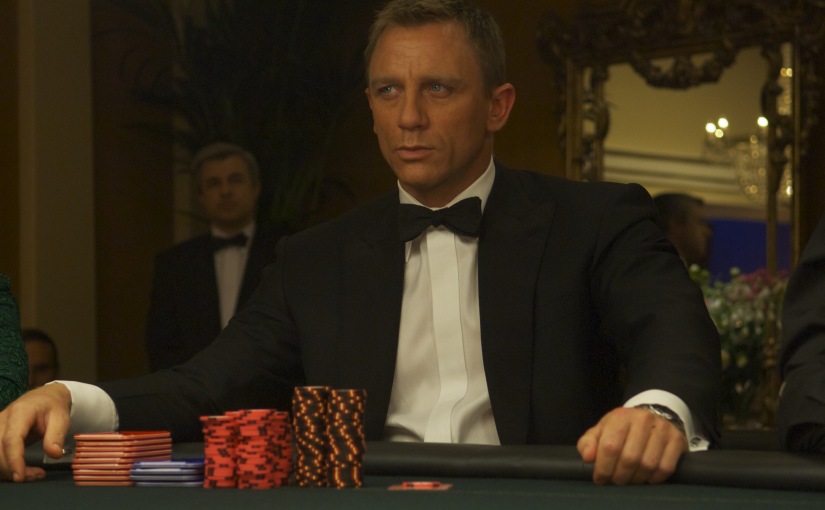
Martin Campbell (Goldeneye) returns to direct the EON Production’s adaptation of Ian Fleming’s very first Bond novel. The super spy quickly completes the necessary requirement of two kills to earn his 007 status and is assigned by M (Judi Dench, still so good in her role) to pursue LeChiffre (Mads Mikkelsen), a mathematic genius and money launderer for high priced terrorists. Bond engages in a high stakes’ poker game at the renowned Casino Royale where he must beat LeChiffre’s bluff or monies from his Majesty’s government will have directly funded terrorism. Along the way, Bond falls in love with the treasury agent, Vesper Lynd (Eva Green), who is assigned to fund his poker buy in.

This film offers a James Bond with faults and mistakes to learn from. He’s never completely perfect and he is subject to losing a bluff in more ways than one, albeit at the poker table or in the face of love. As well, Bond doesn’t necessarily think far enough ahead, as his kill ratio continues to rack up. To M’s displeasure, she wishes he’d have some reservations so that they can question who he comes in contact with. Bond doesn’t seem to consider that.

Daniel Craig gives a brilliant performance of a man who believes he is even wiser than the reputation moviegoers have been accustomed to for over 40 years prior. By the time the film reaches its climax in an action paced shootout within a floating building along an Italian strait, Bond’s steely armor is donned against affection or distraction. James Bond becomes humbled by personal betrayal. I never would have imagined. Death will never affect him again. Love won’t either. This James Bond makes mistakes, but never will he make the same mistake twice.

Mikkelsen is a great villain as the bad guy who gets in over his head. He is not trying to dominate the world. He’s only interested in a profitable return from his dealings with terrorists. James Bond can’t interfere. LeChiffre is a new brand of villain, but still written with a trademark deformity of weeping blood uncontrollably, plus a case of asthma. A far cry from metal teeth and hooks for hands. Mikkelsen plays LeChiffre as cold and terrifying, almost like a vampire with a winning hand.

Eva Green is the best Bond girl of the series. There’s a mystery and a dimension to her performance. Something is driving her and it may play against Bond ever succeeding. Green portrays Vesper as lovely, graceful and suave like her partner, but she is incredibly smart too. She is evenly matched with Craig’s Bond. A great moment occurs when James & Vesper first meet for dinner on a train and size each other up. Eva Green is precise in monologue delivery. She is assured and confident. This woman is able to read Bond before Bond is given the opportunity to seduce her.

Campbell puts together real looking and tangible action sequences where 007 pursues a bomber specializing in parkour, a sport of climbing and leaping on and off of objects within a construction area. There’s also a well choreographed fight scene in a hotel staircase.

The best moments are reserved for the poker match however. Campbell amps up the tension with these ridiculous hands the players have in a fierce match of Texas hold ‘em. Bond gets sidetracked with sword wielding killers and poisonous drinks, but still manages to return to the table time and again with his tuxedo neatly pressed. The interplay at the table with or without dialogue is mesmerizing.

Daniel Craig went entirely different with his James Bond. The wit is there, but the tongue in cheek is not missed. This James Bond doesn’t give a damn if his vodka martini is shaken or stirred. Most of the prior Bond films had the super-agent without any scruples or demons in his closet. World domination, death and casual sex were just all in a day’s work. This 007, however, comes with a heavy background. Craig is great with his silent, seemingly guilty regard for killing someone whether it be by drowning a thug in a flooded bathroom sink or stabbing another one to death amid a museum crowd.

Screenwriters Paul Haggis with Neal Purvis and Robert Wade write a dramatically induced James Bond story. A tale not easily forgotten. It was time to reinvigorate the franchise that was going off into the absurdity of invisible cars and over the top gadgets. The puns are still here, but they serve more as a cover of a necessary internal pain for Bond, rather than disregard for his actions.

Casino Royale is one of the best films ever made. No qualms about me saying that. It’s hard to find great relationships among characters with huge risks at play, and magnificent chemistry for one another, as well as the story that serves them.

Casino Royale is an absolute winning hand at any table.

QUANTUM OF SOLACE (2008)

by Miguel E. Rodriguez

Director: Marc Forster
Cast: Daniel Craig, Olga Kurylenko, Mathieu Amalric, Judy Dench, Gemma Arterton, Jeffrey Wright, David Harbour
My Rating: 5/10
Rotten Tomatometer: 65%

PLOT: Super-spy James Bond investigates a mysterious organization that seems intent on cornering Bolivia’s water supply.  Yes, you read that right.


The trivia on IMDb for Quantum of Solace (Bond #22, for those keeping track) contains this revealing nugget:  “Editing this movie was so stressful that co-editor Richard Pearson was brought in to assist Matt Chesse, to speed up editing. Director Marc Forster only had five weeks to edit the entire movie. In his previous movies, Forster would take an average of fourteen weeks to edit.”

Right there.  That’s the biggest problem with Quantum of Solace, the reason it’s ranked among my least favorite Bond films.  The stunts are there, the wordplay is there, the Bond girls are there…I was going to add “good villain” to the list, but more on him later.

Anyway, most of the important elements are there, but the movie never really makes us CARE about what’s going on.  We do get the barest bones of a connection to Casino Royale from two years earlier, but that’s still not enough to bring this up to the level I’ve grown accustomed to with Bond films.  This film feels more like one of Vin Diesel’s old XxX movies.

One of the biggest problems is the aforementioned editing issue.  In Casino Royale, the fight scenes were clearly defined and visually exciting.  (Remember that fight in the stairwell?  BRILLIANT.)  In Quantum of Solace, the fight scenes are cut so rapidly I’d swear they were from a Michael Bay movie.  Rather than make the scenes more exciting, this had the effect of making the scenes feel like the trailer for the movie, rather than the movie itself.  It was distracting, and lessened the tension for me.

Another problem that kept me from caring what happened is the plot.  Dominic Greene (Mathieu Amalric) is the villain this time around, and I’m sorry, but he does not exactly come across as a dangerous fellow.  He’s a little on the shorter side, he doesn’t dress impeccably (except when attending the opera), and his hair looks…greasy.  This is not a villain; this is a sidekick looking for a villain.

And his evil plot?  Using an environmental advocate organization as a front to…corner the Bolivian water supply.

The water.  In Bolivia.  After decades of James Bond stopping villains who wanted to do everything from steal nuclear submarines to kill literally every human on Earth, it seems to me this particular mission could have been left to the varsity squad.

There are other elements that were distracting.  David Harbour makes an appearance as a CIA agent whose character serves no real purpose other than to be the stereotypically obnoxious American.  One scene takes place during a beautifully staged outdoor production of Tosca that looked so amazing, I almost wished I could have left the movie just to finish watching the opera.  Gemma Arterton plays Agent Fields (first name Strawberry…get it?), another in a very long line of female characters in Bond films whose sole purpose is to sleep with Bond and/or get killed…or both.  Usually both.  (In an interesting first for the franchise, Bond actually does NOT sleep with the main Bond girl…go figure.)

The movie’s showdown takes place in a location that looked very real, but was ALSO distracting.  What is a four-star hotel doing in the very middle of the Bolivian desert?  We get a clumsy exposition line about the hotel running on “fuel cells” that are apparently poorly protected indeed, given the building’s incendiary tendencies during the climax.

I’m making the movie sound like a BAD movie.  It’s not truly BAD, but it just feels so slipshod in comparison to its predecessor, Casino Royale.

So what happened here?  Well, another tidbit on IMDb quotes Daniel Craig as saying this is the last time he’d work on a Bond movie without a finished script.  I guess THAT’S what happened here.  Shooting a movie without a finished script can sometimes end well, but not usually.  It’s like building a 30-story skyscraper using plans that only go up to the 15th floor, with couriers bringing new blueprints for the floors already under construction as well as the unbuilt floors.

But…BUT.  There is one overwhelmingly bright spot in the film: the THEME SONG.  Performed by Jack White and Alicia Keys, it marked the first (and, so far, only) Bond song to be performed by a duet.  It’s called “Another Way to Die”, and it is a SCORCHER.  Words fail me.  It’s down, dirty, mean, and growling, complete with the occasional staccato brass flourishes so evocative of John Barry’s score from earlier Bond films.

Too bad the rest of the movie is unable to live up to the promise of its title song.  Alas.

NO TIME TO DIE

By Marc S. Sanders

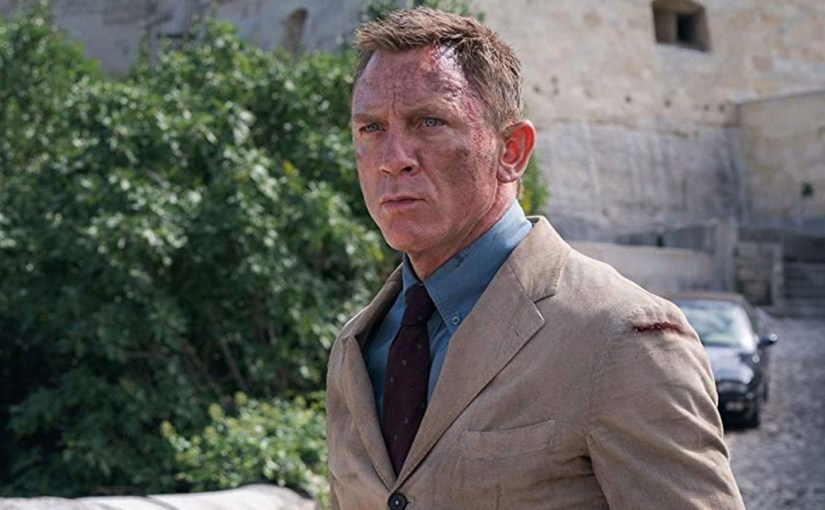
Any die-hard James Bond fan should absolutely love Daniel Craig’s final outing in No Time To Die.  Not only does the film work as a salute to the more serious aspects of past Bond films (not just Craig’s installments), but it is working with its tongue placed firmly in its cheek.  That is not to say that I still did take issue with a few narrative choices the film steers into.

Years have gone by for Craig’s interpretation of the famed secret agent.  He’s comfortably in love with Madeleine Swann (Lea Seydoux) from the prior film Spectre, and known daughter of Mr. White, one of Bond’s prior adversaries.  Suddenly though, Spectre seems to be back with a vengeance.  The imprisoned Blofeld (Christoph Waltz) somehow seems to be involved and 007 puts his guard back on opting not to trust Madeleine or anyone ever again.  The story jumps to five years later and Bond’s CIA friend, Felix Leiter (Jeffrey Wright) has convinced him to come out of seclusion and assist with recovering a kidnapped scientist who holds the formula to a deadly nanobot virus manufactured through plant life.  Bond travels to Jamaica to complete the mission.  From there, the story gets more complicated and more interesting.  Though I dare not spoil what comes next.  This film has a lot to tell in the near three hour running time.

Daniel Craig always had some sort of challenge with the general public while playing James Bond.  First, how dare he be blond?  James Bond is not blond.  He survived that ordeal to continue to make more films.  His second film suffered in storytelling due to a writer’s strike.  During press junkets for his fourth film, Craig was quoted out of context noting that he’d rather “slit his wrists” than play the character again.  As well, his films broke convention in the long running EON Production series, as each film served as a continuing story with much more serious, dramatic and sorrowful undertones than was ever presented before.  None of these challenges seemed fair to me.  After 25 films, you gotta stir the pot a little bit on a character that has been on screen for nearly 60 years.  It’s not enough that his gadgets change with the times of technology. 

I divert into this observation because No Time To Die offers some shocking developments for the Bond character, but when you return back to Craig’s first film, Casino Royale, you really start to understand why this latest picture goes in this wildly off direction.  In other words, the four films Craig performed in prior to this 2021 installment seemingly spell out the inevitable conclusion of his tenure as James Bond.  So, reader, when you go to see this last film from arguably the most controversial actor to play 007 to date, give some thought to what has already been covered before and maybe you’ll agree it beautifully makes a lot of sense.

As an action film, No Time To Die works solidly.  There’s amazing stunts and vehicles with car chases galore and nail biting shootouts.  I think this film has the longest pre-credit sequence of all the films and it’s amazing where one of the feature attractions is the famed Aston Martin DB5 against a slew of Range Rovers and motorcycles.

Rami Malek fills in as the lead villain eerily known as Safin, complete with the signature facial deformity, a shattered kabuki mask and a hell bent determination to destroy the world by means of turning people’s DNA against themselves.  Just go with it.  There’s not much weight to this dastardly mission.  It’s Malek’s performance that works. 

A new agent is also in the works and what’s this?  She is identified as 007????  Again, the newer films bravely go against convention to keep it interesting. Lashana Lynch plays Nomi.  This character was angled extensively in trailers and press junkets but honestly doesn’t live up to the hype enough.  The actor is fine.  She’s just not given much to make any kind of impact.  Ana de Armas is the actor who really makes a splash in a brief moment dressed in a gorgeous evening gown while giving high kicks to bad guys and armed with an adorable naivety about her and a killer machine gun.  Her character is reminiscent of the Bond girls who elevated the tongue and cheek elements of the series.  In a three hour film, more room should have been left for de Armas to play.

Moneypenny (Naomie Harris), Q (Ben Whishaw), Tanner (Rory Kinnear) and M (Ralph Fiennes) all return making for a solid support team for Bond.  It needs to be noted how well cast the Craig films always remained. During the five film series, each one of the characters had their memorable moments for sure.

The regrettable ingredients in No Time To Die lie in the lacking treatments of Lashana Lynch and Ana de Armas for sure.  Forgivable for the most part however.  Still, the story steers into one angle that I wish it didn’t when a young child is brought into the fold.  Children in serious peril was never part of the Bond formula.  So, while this is another new convention for the long running series, I think it was a poor choice.  I see the necessity of the young character to the story, but was it ever really necessary to put a child amid massive gun play, car wrecks and explosions.  There was something a little unsettling about that aspect of the film and the imminent danger to the girl really isn’t needed to heighten any kind of suspense.  Rather than play dramatically, it moves a little too disturbing.  Early on in the film, another child is placed in disturbing peril as well.  The story options here just don’t seem altogether appropriate.

No Time To Die is an appreciated conclusion to Daniel Craig’s version of the character.  There are great puns for Bond to deliver.  His interactions with Q and M are biting and fun.  His love story portrayal with Madeleine works more solidly here than in the last film they shared together, and his tete a tete with the villains, Blofeld and Safin, are equally strong.  These different relationships broaden the dimensions of Bond.  He’s no longer a cookie cutter character.  There’s a motivation to the guy. 

Having seen the film twice, I have an even further appreciation for this new film.  Hans Zimmer comes in to do the original score and particularly salutes the unexpected favorite among fans, On Her Majesty’s Secret Service with select notes and rhythms from that film.  Granted the script for No Time To Die makes obvious references as well.  I also appreciated the wink and nods to Bond’s very first adventure, Dr. No.  There was just a lot of smart, subtle honors presented here. 

Still, the best reference is left for one of the best lines in the film.  When Bond meets Felix’ partner ahead of a mission, Daniel Craig as 007 has to ask “Who’s the popular blond?”  After five hugely successful films, over a fifteen-year span, any one of us better know that the only blond that matters is “Bond.  James Bond.”

QUICK TAKE: Munich (2005)

By Miguel E. Rodriguez

Director: Steven Spielberg
Cast: Eric Bana, Daniel Craig, Ciarán Hinds
My Rating: 9/10
Rotten Tomatometer: 77% Certified Fresh

PLOT: After the terrorist group Black September kills Israeli athletes at the 1972 Olympic Games, Israel responds by sending covert hit squads after the men responsible.


Munich is an engrossing film that doesn’t pretend to have easy answers.  Anyone who comes out of the movie thinking that Spielberg has either denounced or commended Israel’s actions in the aftermath of the 1972 attack wasn’t paying attention.  The film simply portrays the aftermath in an extremely even-handed manner, presenting both sides of the argument without making a judgement call itself.  If there’s a judgement call to be made, that’s on you.

To make a movie that hinges on an attack by Arab terrorists just four years after 9/11 was a risky move.  Four years sounds like a long time, but I can assure you, it was still fresh in everyone’s minds at the time.  The film closes on an image of the New York skyline as it appeared in the ‘70s, complete with the digitally restored Twin Towers.  Aside from being an extremely effective visual statement tying the events in the film to today’s world, it was a little eerie.

Eric Bana is a mass of contradictions, a committed Israeli soldier who leads a squad of assassins, but who starts to have misgivings after a couple of close calls.  Their targets are essentially assigned via a safety deposit box.  No questions, no discussion: kill these men. But he starts asking the very questions that can’t be answered.  He wants proof that these assassinations are making a difference.  All he sees are newly vacant spots in the organization being filled by terrorists even MORE extreme than the one before.  So what’s the point?

Suffice to say, it’s one of Spielberg’s finer efforts, and it will challenge you to think critically about your deeply held views, whatever they may be.  And isn’t that a workable definition of “art?”

KNIVES OUT

By Marc S. Sanders

Rian Johnson’s new film Knives Out is an attempt to reinvent the Agatha Christie blueprint of The Who Done It? Murder Mystery. It primarily succeeds even if it is a little cookie cutter in its screenplay.

Famed best selling mystery writer Harlan Thrombley (Christopher Plummer) is discovered by his maid in his reading room to have slit his throat. All evidence points to suicide. Police follow through with simple procedural questioning of his next of kin, and yet a private detective (Daniel Craig) with an outstanding puzzle solving reputation is hired with a delivered envelope of cash from an unknown source. If it’s suicide, then why a detective, and who had reason to hire him?

Craig as Detective Benoit Blanc (great name) adopts a hilarious Kentucky southern drawl to rattle the cages of possible suspects, assuming that perhaps this wasn’t suicide. Could it have been…MURDER?

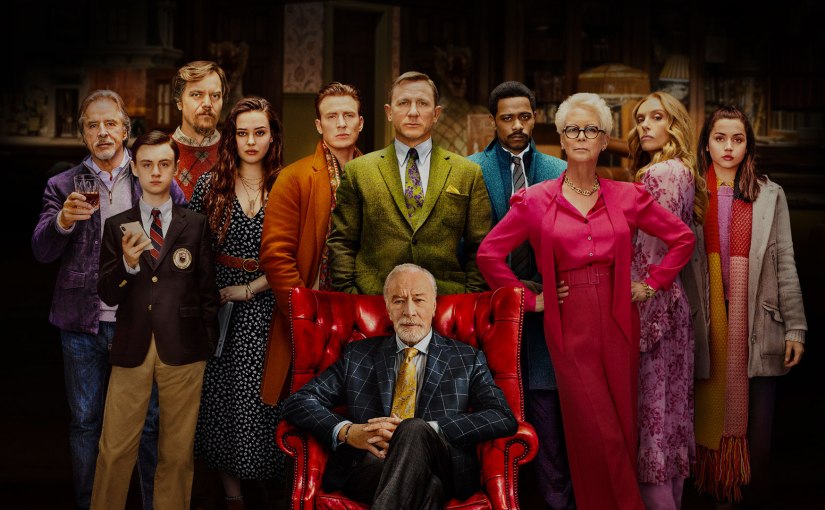
The suspects consist of family members and each is well exaggerated in their physical descriptions. Johnson wrote these connivers with possible motives to set them apart from one another-first by casting well known actors and then giving most of them a garish appearance or unusual trait. Jamie Lee Curtis as Linda with a short white as snow haircut and black circled glasses looks like no one else I can recall. Michael Shannon as Walt with a cane and exaggerated limp, not too bright but also quite discomforting. Don Johnson as Richard only with a goatee, Toni Collette as Joni putting on a bug eyed expression with ditzy delivery. Chris Evans as Ransom, with clean shaven good looks and a toothy smile in preppy, yet snobbish looking sweaters. Finally, Ana de Armas as Marta, Harlan’s nurse, who seems to be the only one devastated by what has transpired, and somehow inadvertently ends up being more involved than she ever expected. She can’t lie. If she does, she can’t help but vomit. A disadvantage perhaps but maybe a convenient advantage at times as well.

Early on, interviews are shown and it appears everyone has reason to maintain a grudge against Harlan. So if Harlan was in fact murdered, well then it’s fair to presume one of these people might have reason to commit the crime. A will is eventually read and then even more twists present themselves. Someone definitely wanted Harlan out.

Rian Johnson spells it out easily for the viewer. Each suspect has his/her own place in the film to toy around with. While I didn’t find it too challenging to predict a likely suspect that has orchestrated what’s occurred, it was more fun for me to watch how it was all pieced together. I kept asking myself what’s so important about the dogs or the baseball or the silent “Great Nana” (K Callan) who sits around the house but surely must have something to contribute.

Agatha Christie or Dashiell Hammet still hold as the much more clever writers. Still, Daniel Craig is having a blast in his role, conceived by Johnson. I’d like to see another mystery with this character. He’s funny at appearing unconcerned with new developments that could be occurring while he’s really just waiting for the inevitable fact that reveals the absolute truth.

Following leaving the scene of an arson a potential suspect makes an unexpected stop. Craig as Detective Blanc opts to wait in the car and put his ear buds on to sing show tunes. Who would do that? Yet, that’s what’s hilariously fun about this picture. A man has died but the shallowness of his surviving family and the disconnect of the detective are the entertainment factor.

Rian Johnson knows how to keep Knives Out amusingly interesting with a curiosity that does not stop.