WICKED FOR GOOD

By Marc S. Sanders

Wicked For Good is a crowning achievement in fantasy and musical wonder.  It soars across a wide expanse of never-ending settings within the wonderful world of Oz and delivers a series of messages to walk away with.  Try not to think about Wicked the next time you turn on CNN or FOX News.

Jon M Chu directs again after Wicked Part One.  Both films were actually shot as one large project but then divided.  I was suspect when I heard this was how the Broadway musical was going to be done for film.  Was there that much material, interesting enough for two full-length movies?  With a pair of new numbers drafted by original composition writer Stephen Schwartz, the answer is a profound yes.  This may be Act II of the musical but it does operate as a sequel. The new film leaps in time from when our host of characters were young students at Shiz Academy.  All are adults now with respective responsibilities and therefore they’ve grown and changed.  Sadly, but wisely, the film moves in directions that are parallel to many current events happening today. 

The wise animals of Oz are being oppressed.  The first film hinted that animals should be seen not heard.  The second part of the story executes that mantra all too realistically as they lose their power of speech and are destined not to be free but rather caged like in internment camps.  Those that have not been taken are performing mass exodus under the newly constructed yellow brick road. 

Untrue propaganda sweeps through Oz as Madame Morrible (Michelle Yeoh) uses the false influence of The Wizard (Jeff Goldblum) to unite the kingdom into believing the empathetic green skinned Elphaba (Cynthia Erivo) is the Wicked Witch of The West, on mission of terror.  Citizens of Munchkinland and the Emerald City believe the lies and live in fear of her presence.  Glinda (Ariana Grande), decked in beautiful pinks with a sparkly wand and a convenient flying bubble craft, serves as a poster girl for hope with the illusion of having enchanting powers to protect.  Elphaba’s sister Nessarose (Marissa Bode) succeeds as the governor of Oz following the death of the girls’ father.  Nessarose has grown coldhearted, particularly to her one true love Bok (Ethan Slater), who by decree must remain held captive under her authority.  He’s literally forbidden to immigrate by train. These are not the students of Shiz that we grew up with. 

I hate to use Wicked For Good as a metaphor for political purposes, but that’s exactly where my mind went to, and I’m grateful for it.  I believe there is much wrong occurring each day in the United States and throughout the world. I’m at least thankful that artistry like cinema and stage prevents us from burying our heads in the sand.  Conveniently, there’s a triggering and emotionally engaging storyline to hold on to.

Wicked was spawned off of L Frank Baum’s classic fairy tales. Part of the fun is seeing how these new stories are threaded towards his classic story of a girl from Kansas who arrives in Oz and befriends three unusual charmers while on her journey to meet The Wizard.  I’d argue that more people are familiar with the classic Warner Brothers film from 1939 than Baum’s series of books, and this Universal picture seems to adhere to the original production especially.  Elpheba delivers a new song called “There’s No Place Like Home” that’s woven beautifully into the picture.  Glinda sings about “The Girl In The Bubble” to emulate her personal conflict with how she is meant to serve.  Classic lines like “I’m off to see The Wizard” are provided.  Hints at a lion (voiced by Coleman Domingo) being fearful, along with a character’s heart becoming too small are referenced with weighty importance.  Another character is asked if he’s lost his mind.  It’s satisfying how original the Wicked properties are while being comfortably familiar.

The cast is sensational.  Cynthia Erivo is a wonderful performer who hides in her role with an American accent and her Broadway voice to belt.  She performs so convincingly that it becomes easy to look past the green skin and watch the woman who is challenged.  Michelle Yeoh and Jeff Goldblum have those unusual appearances and distinct personalities that serve a fantasy world like Oz.  Marissa Bode demonstrates tremendous strength as the disabled character who probably traverses through the biggest change of the whole cast.  Ariana Grande is a terrific actor and a lovely singer.  As I noted about the prior film, her Glinda is not my favorite, though.  The three others I saw on stage performed with a bubblier delivery and did not rely so much on Grande’s hair flip.  Jonathan Bailey is a dashing and charming hero, carved out for the prince of fantasy.  Ethan Slater’s Bok suffers through unwinnable oppression, and thus his character is more tragic this time.  It’s crushing to see, but his performance is completely relatable.

I watched the first film as a refresher ahead of seeing For Good and it occurs to me how triumphant these films are.  This whole story could have been contained in a ninety-minute Disney blueprint.  Yet, Jon M Chu, along with Stephen Schwartz want to entertain the audience through the narrative. So, it will stop where we are reading the movie, allowing us ample time to witness the world around us and what these characters of fantasy endure.  It’s odd sometimes to see the street toughs of West Side Story break into song as they are trying to knife one another in the streets.  In Wicked, it is never strange to see a witch or a munchkin or a prince break out into harmony to express their happiness, anger, sadness or wickedness.  The music and vocalizing build the vivid textures of the sets into grander designs. 

I can be told what happens next in the further adventures of Elphaba and Glinda and just move to the next chapter until they live happily ever after.  It’s better if the characters take their time to share as many thoughts and emotions as they can through song, dance, visual effects and action.  That’s what sets musicals apart from other fares of drama and comedy.

The Wicked films, and more importantly the musical, will remain timeless as much as Star Wars, Star Trek and Harry Potter.  They will never be dated.  They will only capture the hearts, laughs, tears and harmony of further generations to come decked in their favorite shades of green and pink.
THE RUNNING MAN (2025)

By Marc S. Sanders

Everything you see in the remake of The Running Man belongs.  So why doesn’t any of it work?  I think director Edgar Wright needs to have his feet held to the fire.  He made this movie with his eyes closed and his ears muffed.

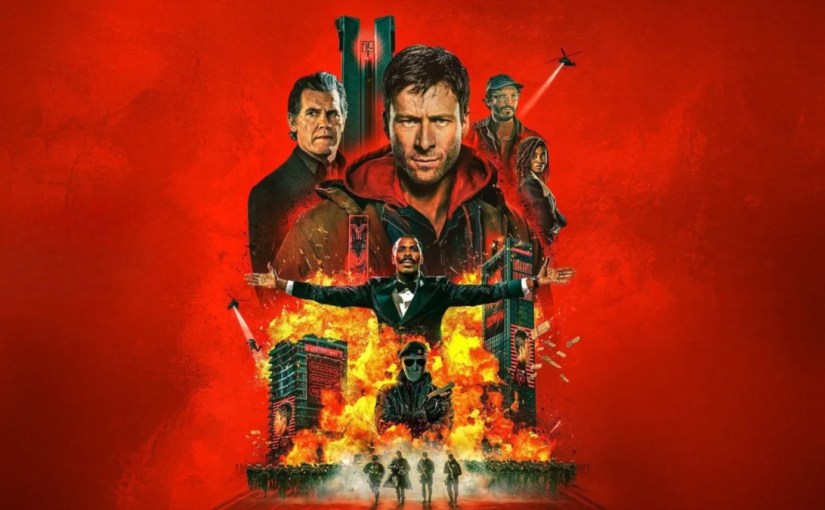
Like the Stephen King (or under his pseudonym, Richard Bachman) story and the original 1987 picture with Arnold Schwarzenegger, a violent game show called “The Running Man” occupies the airwaves in a dystopian future.  Modifications from the first film are done to separate this picture from that one.  In the last film, contestants were violent criminals on the run to win freedom from incarceration.  Here, anybody can try out to win the cash prize of a billion dollars.  I’m not sure which is more faithful to King’s novella.  

Ben Richards (a name which always gets me thinking of The Fantastic Four; Ben Grimm, Reed Richards) is played by Glen Powell with a handsome athletic build but not the muscular physique of Schwarzenegger.  Powell looks more like an Everyman who auditions for one of this future’s various twisted game shows, hoping to win cash prizes that will rescue his wife and sick baby girl from poverty.  He never intended to get thrust into the ultra-violent “Running Man” though.  The object is to outlast and survive for thirty days while sadistic headhunters attempt to find him and deliver a gruesome televised slaughter.  The producer, Dan Killian (Josh Brolin), foresees a ratings bonanza with Richards as his most wanted runner.

Glen Powell needs to enhance his career with his sudden popularity.  Between this film, Twisters and Top Gun: Maverick he is playing pick-up sticks on resurrected franchises, and he ends up being completely unmemorable and uninviting.  Other than a square chin, there’s nothing special about this guy and I never once felt empathy for his role here.  He does not convey fear or anger or humor like a Bruce Willis, a Tom Cruise or even an Arnold Schwarzenegger.  He’s boring.  Edgar Wright’s script with Michael Bacall does not help the actor either as The Running Man is neither quirky or offbeat like a dystopian action picture or a standard Edgar Wright piece (Scott Pilgrim Vs The World) should promise.

The most exciting ingredient is Coleman Domingo, one of my favorite actors working today.  He is so magnetic in anything he does that I can practically guarantee whatever pizzazz he brings as the larger-than-life game show host, Bobby T (Yes!  That’s his name!), carries no impact.  This script gives him nothing to do other than wear a purple sports jacket while belting out “WELCOME TO THE RUNNING MAN!!!”  If he was simply given all of Richard Dawson’s dialogue from the first film, Domingo could have elevated this drippy picture into something engaging and fun.

Lee Pace (The Lord Of The Rings) is fully masked until the third act and has little dialogue as he’s the hero’s main hunter.  Why waste such a charismatic actor?  He’s dressed in black with a black mask.  What’s fun about that? Josh Brolin sits behind a desk as the puppet master producer.  He plays his part like Josh Brolin on a press tour stop on The Today Show.  He’s really not acting at all.

It’s an eye-opening surprise to see Sean Hayes (Will & Grace) make an early appearance as another game show host for a different show.  This should offer magnificent promise.  Brilliant casting for an over-the-top comic performer.  I was waiting for Hayes and Domingo to get into a sparring match of egos for attention in this television world.  You know what happens, though? Sean Hayes is never seen again following his appearance ten minutes after the film begins.  Another overlooked waste of talent.

William H Macy is a good character actor for this kind of film.  Too bad he’s also given little to do other than to tell the hero to go see the guy played by Michael Cera.  Why not cut out the middle man and let Ben Richards just deal with Macy’s character? The Running Man is far from the leaner film it could have been.

Some of the action scenes in this violent tale work, and some don’t.  When Ben Richards catches up with Cera’s character, a run/hide shoot out in a two-story house plays like a video game with bannisters that come apart and rapid machine gun fire.  It’s edited quite well.  Later though, there’s a battle that occurs in the cockpit of a jumbo jet.  Gravity is disabled while gunfire and fisticuffs are at play and everything shakes and bounces so much that it’s hard to tell who gets the gun and who is shooting who.  This looks like the filmmakers were pressed against a deadline and just didn’t clean up or tighten the scene into something coherent.  I just stopped trying to focus on the film and waited for the scene to end with another escape by the dashing Ben Richards.

This screenplay feels like it was made up on the fly.  Glen Campbell is awarded several scenes to speechify melodramatic gargle.  Is there a noble cause that we are to learn about from The Running Man? Just as the third act is about to start, he hitches a ride with a young girl who we have never seen before.  Nor has she been referenced anywhere thus far.  Yet, she’s got something to say with some kind of cause on her mind as well.  This nameless sidekick takes over the movie for the next twenty minutes and then parachutes into open sky never to be seen again.  What was the point of this detour? Moreover, what the hell was she ever talking about?

This Running Man had all the ingredients to work with a stellar collection of fine actors who were up for the task of wit and satire amid ridiculous violence and totalitarianism.  With Edgar Wright at the helm, the new Running Man could have been a harkening back to Paul Verhoven’s ultra-violent tales of gonzo media silliness found in his movies like Robocop, Starship Troopers and Total Recall.

Sadly, Glen Powell is uninteresting, and the more amazing talents of the supporting cast were handed lackluster and witless material.  

The Running Man marches at a speed of sluggishness.  Better to turn off the TV and read Carrie or Misery.

SING SING

By Marc S. Sanders

Coleman Domingo is that under the radar actor who is on his way to becoming a marquee name.  Of late, I’m loving everything he’s participating in. Check out the Netflix series The Madness and the acclaimed film Rustin for which he received a well-deserved Oscar nomination. His second Oscar nominated role in another of 2024’s best films, Sing Sing, is directed by Greg Kwedar.  As soon as this film begins, you will fall in love with Domingo’s role as he completes a stage performance in A Midsummer Night’s Dream.  However, the theatre that is bursting with applause is located within the infamous Sing Sing Maximum Security Prison.  Coleman Domingo portrays a resident here as wrongly imprisoned John “Divine G” Whitfield.

Divine G is a founder and one of a handful of prisoners who cope with their caged lifestyle as members of the Rehabilitation Through The Arts program (RTA).  Every six months, the RTA prepare a play to perform for the prison population and other local benefactors.  Their director is Brent (Paul Raci), a much smaller guy than anyone in the troupe, white, tattooed and on the tail end of a hippie middle age.  Yet, the men trust their leader and he is nothing but encouraging with theatre exercises to uphold their spirits and get everyone energized. 

A new member of the group does not appear to have much promise.  Clarence Maclin (played by Clarence Maclin) stems from a hard living street life of gang culture.  While he champions the suggestion of a comedy for the next production, he is nevertheless resistant to engage and perform as Hamlet with the famed To Be Or Not To Be monologue.  Divine G works to penetrate Clarence’s stubbornness and get him to recognize how the program can be beneficial and enriching.  Consider Divine a combination of Red and Andy from The Shawshank Redemption – a well-respected realist but also a teacher.  Divine even takes it upon himself to prepare Clarence for his upcoming parole hearing, while he’s getting himself ready, following new evidence that may exonerate him.

Brent collects ideas from all of the men who are enthused to stage ancient Egyptians, cowboys, pirates, Hamlet, and even Freddy Krueger.  Rather than pick one, Brent takes the weekend to write a 148-page script that has all of these elements.  The spine of the plot?  Time travel!  Makes sense, and as Clarence originally suggested, it most certainly is a comedy.

I read that Sing Sing is collectively owned by the cast and crew.  Many people who worked on this production play characterizations of themselves and use their actual names and prison monikers in the dramatization of this film.  They produced and wrote the screenplay, designed the characters based on themselves and their experiences, having been members of the RTA.  The auditions for the play you see in the film are the actual auditions the cast did to be part of the film. So, be ready to be impressed because these rehabilitated prisoners, now actors, are outstanding. 

Coleman Domingo in the leading role only makes the whole cast look even better.  He is absorbed in this environment.  B28, his assigned prison cell, looks like a sanctuary for the plays that he writes with inspiring and researched articles taped to his walls and a typewriter to click away on.  With his wise looking gold rimmed eyeglasses, he looks like a guy who knows every corner of every room, every chip on every wall, every blade of grass within the courtyards and auditoriums.  Divine G may not belong here, but he’s all the more familiar and depended upon by the men he resides with.  Partnered with Clarence Maclin, the two actors have duet scenes that work effectively with one relaxed in the comfort of hope and promise while the other is ready to give up on any kind of prosperity or semblance of a future.

Sing Sing is about the incarcerated men who put on plays to nurture the days of punishment they are sentenced to serve.  Yet, the actual film could also operate like a live stage play.  It has more of that feel than anything traditionally cinematic. These men converse and discuss like a committee seated in a circle while determining the next best thing for the program.  They are led by Brent in exercises that allow them to reflect on past moments in their respective histories.  They do the silly walks to shed insecurities that come with urging the brave face needed to perform in front of people.

An extra reward arrives during the end credits when personal cell phone footage shows clips of the various plays that have been produced among the prison population.  Everything from their inventive stage sets to their costumes and lighting along with their blocking is extraordinary.  To bring men who once lived among a world of violence towards the escape of theatrics seems unheard of.  I mean, really, a gang member can now perform Shakespeare? 

Films have the ability to show what’s unheard of and what’s daring. They are not just run of the mill Mission: Impossible movies with the wildest stunts imaginable.  A courageous feat also comes from the theatre. Sing Sing reveals the most unlikely people to accomplish what no one could ever envision they would relate to. 

Sing Sing is an inspiringly beautiful piece of performance work from every member of its cast, in addition to Oscar nominee Coleman Domingo.

RUSTIN

By Marc S. Sanders

I’ve heard of Martin Luther King Jr.  I’ve heard of Rosa Parks.  I’ve heard of Malcom X.  I’ve heard of Medgar Evars. 

I had never heard of Bayard Rustin. 

I guess there’s just a lot of history left out of the books.

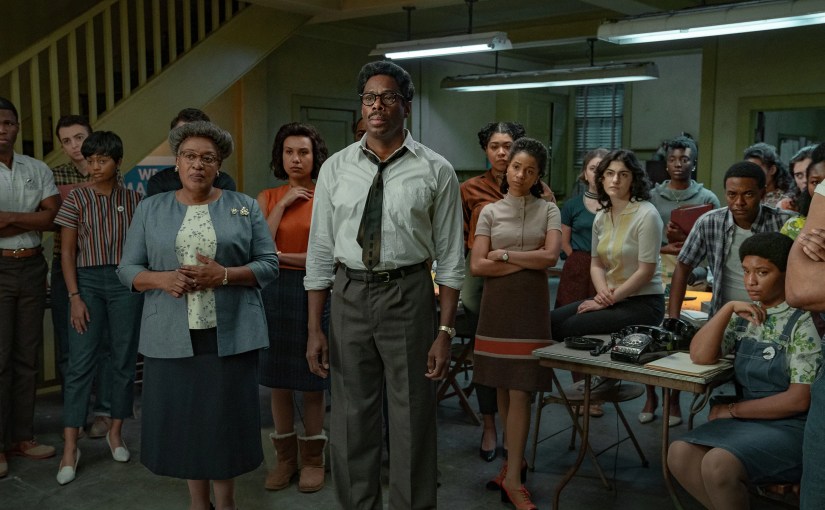
Rustin tells the story of Bayard Rustin (2023 Oscar nominee Colman Domingo) who was treated as an outcast by his friend Dr. King and the NAACP when he attempted to think of the grand possibilities of organizing the largest civil march ever to happen.  The secretly homosexual civil rights organizer eventually did see his vision come to light, however, but he had to get started with very little support or resources.  Director George C Wolfe with screenwriters Dustin Lance Black and Julian Breece use this film to depict how it all came together.

When I saw George C Wolfe’s Ma Rainey’s Black Bottom (with Oscar nominee Chadwick Boseman) my take was that it worked like a stage play on a unit set.  The sensational cast of Rustin perform in the same way, catering to what would be a live audience.  However, the unit set has been expanded to a headquarters office on the second floor, as well as Rustin’s bedroom, and the steps of the Lincoln Memorial and the National Mall in Washington D.C.  While the CGI background of the nation’s capital do not appear seamless against the cast, it is fortunate that very little of it upstages the performances from Domingo, Chris Rock, Glynn Turman, CCH Pounder, and especially Aml Ameen as Martin Luther King Jr.

Colman Domingo portrays this individual with unwavering confidence in his character.  Rustin insists on a non-violent two-day march, despite the local authorities who only grant him one day and limited resources.  One problem is that there are not enough hotels that will accommodate black guests.  Segregation might have ended in 1954, but in 1963, you would believe otherwise.  While debating with the police captain in front of Lincoln Memorial, Rustin is accused of raising his voice and yet he reminds the captain that he’s never changed the volume of his tone.  Rustin vows that this march will exceed 100,000 people from all different states.  He’s also adamant about the police authorities not carrying their service weapons to steer clear of any reason to incite violence. 

A bigger problem is bubbling within his own community of civil rights leaders.  He’s no longer associated with the NAACP which has Roy Wilkins (Chris Rock) leading the charge. Still, he needs their support. Because he does not have the respect, charm and arguably the good looks of Dr. King, Bayard’s passion falls on deaf ears and a lack of motivation from these powerful men of influence.  A large challenge comes from the arrogant Representative Adam Clayton Powell (Jeffrey Wright) who will proudly sit at the other side of the table with his long cigarette, pressed suit and pencil thin salt and pepper mustache.  With a gruff tone in Wright’s voice, this is a marvelous antagonist.

Over the radio airwaves, Senator Strom Thurmond, who was still in office at close to age 100, all the way through 2003, is building a campaign against Bayard Rustin.  Rustin has a past of suspected ties to the Communist Party, and it will also not bode well if his closeted homosexuality is revealed.  On top of that, Mr. Rustin lives with personal problems and imperfections just like anyone else.  He is trying to balance a relationship with Tom (Gus Halper) a young, white gay man and strong supporter of the cause, but Bayard is also involved with a married, closeted man as well.  None of these issues can be afforded to weigh down what Mr. Rustin and his team of youthful, optimistic volunteers are striving for.

Wolfe’s film is less than two hours, though I wish it could have been longer.  It is very engaging and certainly not difficult to follow, especially when text appears on screen to tell us who everyone is from the start.  The movie efficiently incorporates all of these dimensions into isolated episodes for Baynard Rustin to confront.  Primarily, it reflects the debates he has with the civil rights leaders and the naysayers.  There are wonderful moments shared between Colman Domingo and Aml Ameen.  Domingo also has great scenes with Gus Halper who plays Tom as someone uncompromised in the mission even if his lover is unfaithful.  Domingo is the more compelling scene partner with Chris Rock, though, who I have never considered a strong actor. A good effort is made here, but Rock is not altogether convincing as an NAACP leader. 

What I wish for, however, is some more reenacted footage of the actual historic event that famously included Martin Luther King’s “I Have A Dream” speech.  There’s a slight tease of that speech but King was so appealing in that moment that it could never be recreated so well.  It was already perfect.  What I wanted to see was some other happenings going on during this event.  We see buses arrive, chairs getting set up, people gathering, mostly black, but other races as well. What other speeches occurred on that day?  What else was said? 

I recall an episode of The Cosby Show where Theo and Cockroach had to write a school paper about the event and their parents and grandparents talked about how they drove down from New York to D.C. in buses and how hot it was that day. They described people who wore pins that said “Kiss Me I’m Black,” “Kiss Me I’m Jewish,” “Kiss Me I’m Irish,” and so on.  It might have been said to lean into Cosby’s brand of humor, but I also believe it was true.  That episode seemed much more descriptive in about ten minutes of sitcom dialogue than the film Rustin depicted. 

How was the audience on the National Mall responding?  Were people fanning themselves from the heat?  What were they saying to one another?  What songs were they singing?  Wolfe’s film only gives a tiny glimpse of this groundbreaking moment in time when 250,000 people assembled. The picture just doesn’t appear entirely painted.  Perhaps budgetary reasons were the cause of that.

Rustin is a good film and does a fine job of depicting this unsung man’s achievements despite the challenges he always faced with a smile.  Domingo is great at donning the grin with missing teeth and clumsy black framed glasses, and a loose tie with a wrinkled shirt.  He is positively absorbed in this period of time.  Still, it would have been welcome to see more of his end results. 

The picture concludes on a terrific beat before the inevitable footnote text arrives with most film biographies.  I have just observed a man who will not shut up and never tire from pursuing his seemingly impossible dream.  Baynard Rustin was likely considered a pest who would not let up.  Yet, the script closes on the fact that in spite of all I have witnessed, Bayard Rustin was likely the humblest of all of these civil rights servants.

Go learn more about our Civil Rights history and allow yourself to see one of the best performances of the 2023.