A FISTFUL OF DOLLARS

By Marc S. Sanders

Sergio Leone’s A Fistful Of Dollars is a pioneering classic. It set the standard for the spaghetti western. It made Clint Eastwood a household name and it set a trend for tension filled violence in cinema often imitated by directors like Robert Rodriguez (Desperado) and Quentin Tarantino (Kill Bill, Django Unchained), as well as even Clint Eastwood (Dirty Harry, High Plains Drifter, Unforgiven, Magnum Force) who regarded Leone as well as director Don Siegel as his inspirations and teachers in filmmaking.

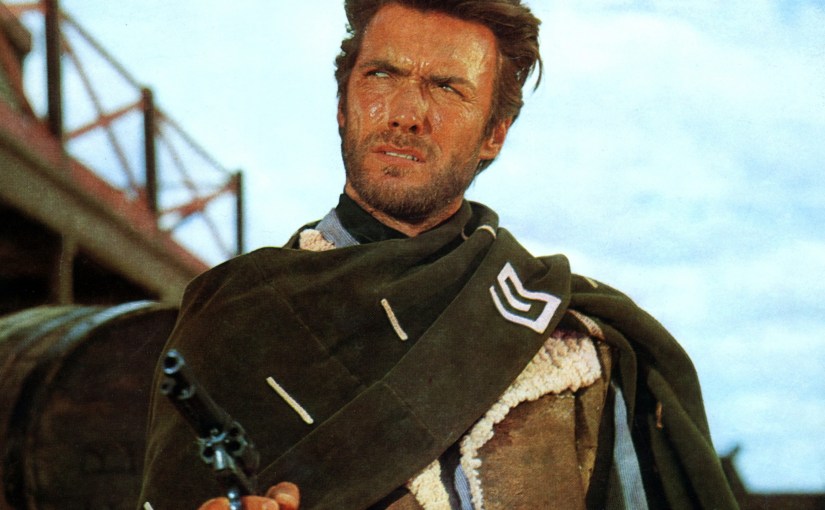
The set up is simple. A desolate town plagued by two warring factions is met by the antihero, only known as The Man With No Name (Eastwood). The Man plays the best interests of the Mexican Rojas family against the Baxter family. In the midst of it all, he continues to collect bounties from both sides.

Leone seems to have invented trademark shots that have become routine staples in films like the protagonist appearing from behind a cloud of smoke, the zoom in camera during a quick draw duel, the surprise survival against the odds, and even the memorable one liner (“Get three coffins ready”…”My mistake. Four.”).

It’s exciting entertainment and it paved the way for a different kind of western. The good guy no longer rides a horse named Trigger while dressed in white. Here he welcomes the violence because he knows he’s the only who can eliminate the threat of bloodshed.

Eastwood’s character is a man of few words to keep the viewer curious. Where does he come from? Who is he? How long has he been traveling? It’s one of the all time great movie characters that leads threads hanging and inspired future favorites like Dirty Harry, Rambo, Wolverine, Neil McCauley (Michael Mann’s Heat played by Robert DeNiro), Batman and even Boba Fett, as well as some early Han Solo.

The first of the trailblazing Dollars trilogy still holds up despite the dubbed in English of most of the players. They might be hard to understand at times. Yet the craftsmanship of Sergio Leone makes sure all the elements are easy to follow with seamless control of the camera.

A great Western.
TRUE CRIME

By Marc S. Sanders

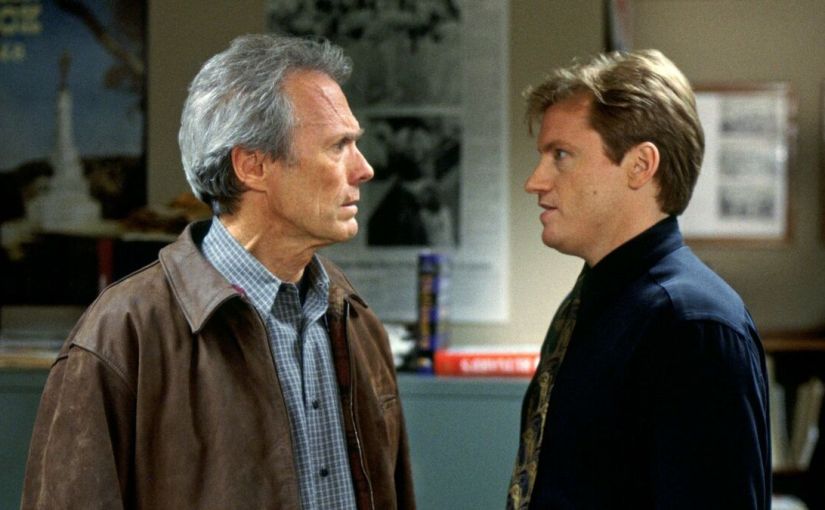
Clint Eastwood is having a pretty eventful day in the film True Crime, a picture he produces, directs and stars in. He plays Steve Everett, a womanizing journalist who is assigned at the last minute to interview Frank Beechum (Isaiah Washington) for a human interest story about the man’s last hours before he’s sentenced to death by lethal injection for shooting a young pregnant woman. Everett gets a hunch though that Beechum may be innocent and he’s quickly running out of time to prove his gut feeling. It does not help that his editor (Denis Leary) has discovered that Steve has been sleeping with his wife. It’s also inconvenient that Steve has to honor his promise to take his young daughter to the zoo.

For the simplicity in the storyline of Eastwood’s film, I still found moments that kept me engaged. Washington’s footage which begins at sunrise on his supposed last day at San Quentin penitentiary is very well detailed. I liked how the warden spells out to Beechum what to expect today ranging from requesting his last meal to ensuring direct phone lines to the governor are working properly. I got to witness how all activity of a death row inmate is strictly recorded. I found it interesting how the lethal cocktail is to be administered.

Washington has really good moments with his wife (Lisagay Hamilton) and young daughter wanting to color him one last picture of green pastures. The film doesn’t drown in sappiness or long monologues that you might expect. Like other Eastwood films he looks for the quiet moments in a person’s day; familial, but painful intimate moments of a loving family with all options exhausted.

The other storyline might be debatable for existing. Steve has to contend with his editor’s animosity towards him while also trying to balance what’s left of his family life with his current wife (Diane Venora). Opportunities are given for tough guy comebacks and insults between Eastwood and Leary along with their boss played by James Woods. There’s good timing in these lines but some might question why waste time with this material. I had no objection, however.

These are men who are not putting their lives or instincts on hold to focus just on an inmate sentenced for death. This is just routine work of the day. We don’t stop working just because we find out our spouse is a two timer. We also don’t put our personal interests in hold for a criminal we have regard except to fill a square in the news paper.

Same goes for Steve’s time sparingly spent with his daughter (Francesca Eastwood) at the zoo. Steve turns out not to be an attentive father as he also tries to stay on top of his story on Frank. My cinephile colleagues (including Miguel) took issue with most of the material that the journalist experiences. They thought it was meant for a different film other than the death row storyline. Not I, however. I found it courageous of Eastwood with a script from Larry Gross, Paul Brickman and Stephen Schiff to stay true to this portion of the film. All people have demons they live with and those setbacks don’t grant mercy in even the most desperate of times such as when a possibly innocent man has mere hours left to live. Life is never put on hold even if you’re a lousy father and husband.

True Crime stayed with me up until its last ten minutes. At that point, Eastwood takes the film in a beat the clock car chase direction. This moment is unlike anything else the film presented and I took issue with it here. I wasn’t watching an action picture before any of this. Before the end arrived, I was caught up with the different perspectives of those involved in the process of supposedly humane lethal injection. I saw the prison guards who’d make a joke out of what’s to come. I saw a self involved minister trying to egg on a confession for his own personal salvation, and I saw a warden (Bernard Hill) who actually possessed sensitivity to a prisoner’s fate; that’s something you don’t see too often in film.

Eastwood never allows the audience to empathize with his character’s personal problems. This guy made his own bed. His personal life is not wrapped up in a pretty pink bow by the film’s conclusion. Instead, True Crime told me that beyond a man’s own personal issues is the necessity to help rescue another man who is arguably in a much worse scenario. Dismiss the film’s ending, and you’ll nevertheless appreciate the structure of the rest of the picture.

UNFORGIVEN

By Marc S. Sanders

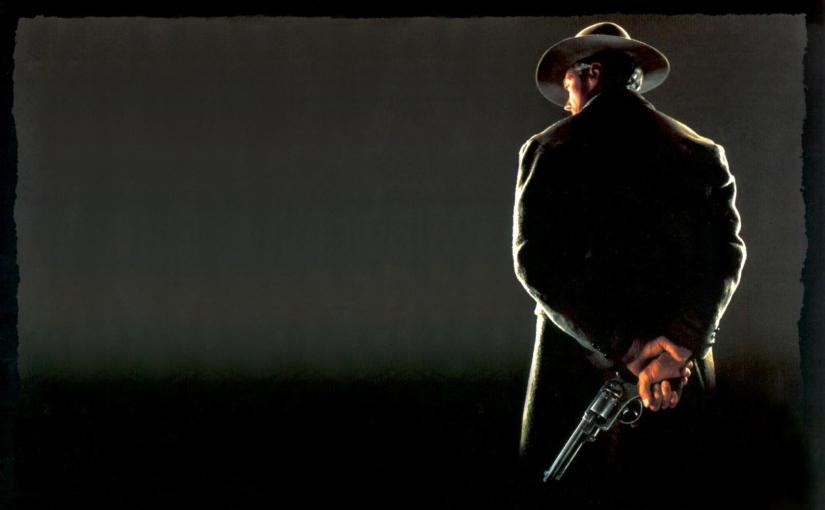
Unforgiven is a crowning achievement for director/actor/producer Clint Eastwood. It’s really a movie and screenplay from David Webb Peoples (the scribe behind Blade Runner) designed only for Clint Eastwood. After a long career of portraying quiet men with violent means, Eastwood transitions to anti-violence that would thematically dominate the next chapter of his filmography with In The Line Of Fire, A Perfect World, Mystic River, Million Dollar Baby, Gran Torino, and Letters From Iwo Jima. (WOW!!!! What a list!!!!!)

The character of William Munny is now a failing pig farmer haunted by a past of gunslinging murder and mayhem. His past returns when he’s offered a large bounty to murder two cowboys who disfigured a prostitute with a knife. He recruits his former partner Ned (another likable character for Morgan Freeman) to accompany him, and they join a kid who presumes he’s ready to kill but is really only fooling himself.

Meanwhile two other stories collide when the cruel, torturous Sheriff Little Bill Dugget (Gene Hackman in an Oscar winning role) meets with a gleeful celebrity in his own mind, gunfighter English Bob played by Richard Harris. Character actor Saul Rubinek plays Beauchamp, a reporter eager to document and dramatize these legends of the quickly expiring period of the Old West. Beauchamp will soon realize the heroes he envisions are nothing but pipe dreams.

Little Bill outlaws weapons in his town, and for the offense? A brutal beating or a painful whipping. Hackman is great at looking like his motivations make sense. Maybe they do. He sets an example and maybe it casts a preventative measure, albeit with a brutal arm of the law. Little Bill is happy to beat someone in the street, only to return happily to building his home along the river.

Unforgiven doesn’t make the violence easy for its characters. It’s harder to kill. It’s harder to listen to a dying victim beg for water. It’s just as hard to mount a horse. Most importantly, it’s hard to accept how cold blooded you can be when pushed to a point.

To watch Unforgiven almost requires at least a little experience of Eastwood’s first half of his career. The Man With No Name and Dirty Harry surmise a history for Munny where it was easy to draw the revolver, point and shoot. This film shows that defiance of scruples doesn’t last forever.

It’s a 1992 Film (Best Picture Oscar Winner) that still carries an important message responding to the questions of bearing arms and Wild West violence that recklessly surfaces in what is expected to be a more civilized society today.

Watch Unforgiven for its many moments of symbolism, changes in attitude among practically every character, and for the well executed direction of another classic from the great filmmaker, Clint Eastwood.

This is one of the best pictures of the last 30 years.

(Would love to hear commentary from others on this film. This is one worthy of extensive discussion. I also recommend you read Roger Ebert’s “Great Movie” review; here – https://www.rogerebert.com/reviews/great-movie-unforgiven-1992Ebert initially gave Unforgiven a thumbs down. This was one of those few instances where he changed his mind.) 

PALE RIDER

By Marc S. Sanders

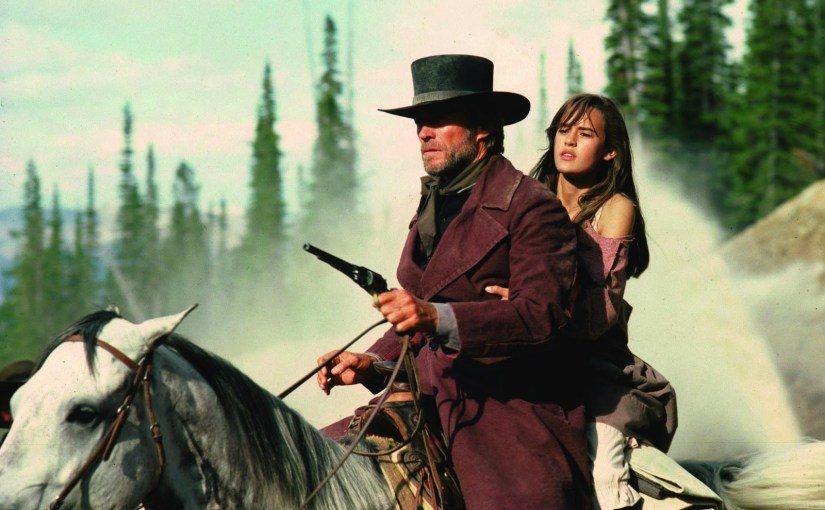
Clint Eastwood’s Pale Rider is more or less a simple western film with a storyline you’ve seen countless times before.  It’s an old west tale that has the The Magnificent Seven (or Seven Samurai) feel, but this might as well be called The Magnificent One, perhaps.

Pale Rider is nothing special in its assemblage to be another Hollywood western.  However, it’s delivery from Producer/Director Clint Eastwood is what kept me engaged.  Seeing it for the first time, nearly forty years following its theatrical release, I took great pleasure in recognizing the tough and intimidating persona that Eastwood became famous for in his spaghetti westerns and tough cop films.  The scowl and squint across his chiseled face are here along with his imposing height, with his black hat resting perfectly atop his head.  Eastwood knows how to capture himself on camera better than most any other actor/directors.  He capitalizes on his foreboding and intimidating presence.  He does it very well in Pale Rider when he points his camera at a distance down the dirt road where he’s saddled perfectly still upon his steed.  He does a shot like this as well in his Dirty Harry film, Sudden Impact, where he positions his silhouette against bright carnival lights in the background with his loaded gun held at his side.  This guy makes himself scarier than Freddy Krueger in moments like these, and in film history, the images are iconic.

Again, Pale Rider has all the trappings of what audiences used to love in Hollywood Westerns.  It has reminders of Shane and High Noon.  Yet, it’s a bit more brutal, because 1980’s cinema allowed that, and this film falls in the tradition of Eastwood’s continuous violent work at the time.  Still, that’s not why you watch an updated picture like this.  You take in Pale Rider as a Clint Eastwood vehicle.  The familiarity of Eastwood’s unnamed dangerous man that bad guys should’ve walked away from was treasured long before he thankfully segued into his anti-violent themes of films yet to come (Unforgiven, A Perfect World).  The point is that I recommend the film because…well…I’ll never tire of that scowl and squint.

ESCAPE FROM ALCATRAZ

By Marc S. Sanders


Okay.  I’m gonna give this a shot.  Granted Escape from Alcatraz came out over a decade prior to that other famous prison movie with Morgan Freeman, but how do you not avoid a comparison?

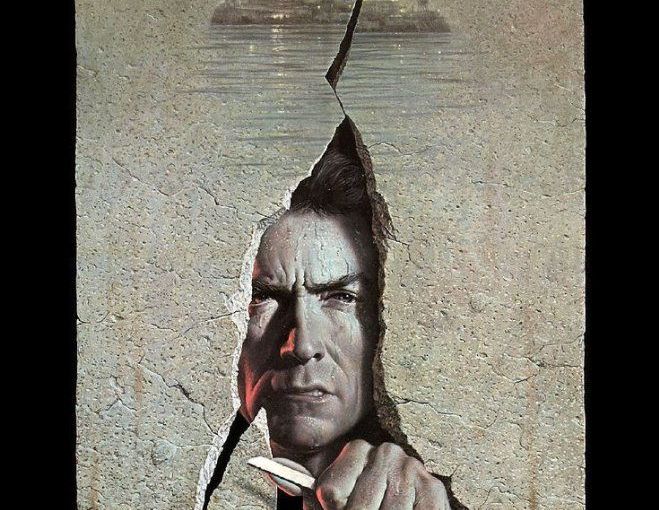
Clint Eastwood is Alcatraz inmate Frank Morris who believes he’s uncovered a way to break out of the most inescapable prison located on an island that’s at least a mile away by San Francisco Bay sea water from civilization.  The film is directed by Don Siegel (“Dirty Harry”) who depicts the true life inspired events that occur in the early 1960s.

Even before Morris begins to plot his steps to freedom with three other inmates, Siegel shows the brutal life of living in the Federal Government’s most notoriously secure prison.  The Warden assures Frank that escape is impossible.  Others who have tried were either shot or drowned in the ice cold waters of the bay.  Still, Frank Morris, who has accomplished prison escapes in the past, is certain that he’s found a way.

“Escape from Alcatraz” isn’t just about digging through walls with a makeshift tool combo of a nail file and spoon.  Siegel shows what occurs in a day in the life in the cafeteria, out in the yard and in the work shop.  Prison guards patrol with rifles.  The black prisoners have their spot on the bleachers.  An old guy paints portraits to occupy himself.  There’s even a library.  Look!!! There’s Danny Glover accepting a book from Clint. 

Actually, it comes off pretty tame all these years later when compared to many other prison films.  Frank is bullied by one bruiser, but also remember this is Clint Eastwood.  So this big guy doesn’t have a chance in a bare knuckle brawl.

The prison escape is calculated and you see step by step of how the guys climb through piping and vents and over fences and down walls.  Frankly, it looks a little too easy.  As Frank digs, all he has to do is turn off his light in his cell and the guards never catch a glimpse of what he’s up to in the dark.  Same could be said with the papier mâché dummy heads he and his cohorts make up to lie in bed.  The guards just don’t catch on.

“Escape from Alcatraz” doesn’t give me all the feels like “The Shawshank Redemption” or “The Green Mile.”  It’s simply another easy go-to watch of many of Eastwood’s 1970s tough guy flicks.  I did find it interesting, however, that this is based on a true story and when the conclusion arrives, I’m informed how in real life the result of the escape remained open and uncertain of what happened after the events of the film.  So I appreciate that the story kept me curious.  That’s saying something, and therefore I’m glad I watched the film.