SUPERMAN II

By Marc S. Sanders

It’s time for the man in the red cape and blue tights to fall in love with Lois Lane, but wouldn’t you know it?  Three Krytonian criminals possessing the same powers as our hero have arrived on Earth with a means to dominate the planet and exact revenge on the son of their jailer.  Superman II picks up where Richard Donner’s original 1978 smash left off.  It remains a fantastically fun and breathless sequel.

Richard Lester (A Hard Day’s Night) gets the directing credit on this film following one of Hollywood’s most infamous behind-the-scenes stories.  While I’m a big admirer of Donner’s body of work, I think it was a blessing that Lester finished the job.  I’ve seen what Donner was intending to do on a special Blu Ray cut, and it just does not work. The characters make odd choices that seem inconsistent with how they were perceived in the first film.  That’s all I need to say about that comparison right now, though. 

In the original theatrical release, the story expands on the relationship between Superman & Lois (Christopher Reeve, Margot Kidder) as well as Clark Kent and Lois.  Eventually, both relationships intersect with one another, and Lois realizes the man she’s been admiring and the one she hardly takes notice of are one and the same.  The problem for Superman, known by his krypton name Kal-El, son of Jor-El, is if it is acceptable to be intimate with an earthling. 

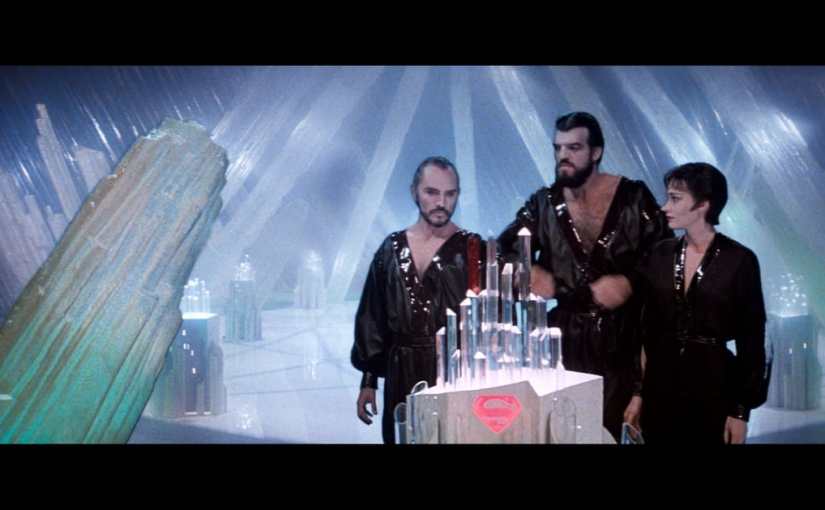
Meanwhile, Lex Luthor (Gene Hackman) has escaped prison to entice three villains from Krypton into a partnership that will allow them to take over the Earth and destroy Superman.  The trio is led by General Zod (Terence Stamp) with the wicked Ursa (Sarah Douglas) and the mindless and mute Non (Jack O’Halloran).  Following their attack on Houston, or as they call it the “Planet Huuston,” and the White House, it is on to Metropolis in search of Kal-El.

I’ve offered up quite a bit of what Superman II provides and I am not even close to sharing all it’s adventurous features and character dynamics.  This is a solid picture all the way through, and it begins with the casting.

I’ll be bold by declaring that Christopher Reeve as Clark Kent/Superman is one of the best casting decisions in film history.  Think about this for a moment.  As good as Henry Cavill was in Zach Snyder’s films, thirty years later, and how well some of the WB iterations have been, the contrary point that most people make is that none of them are Christopher Reeve.  From the smile, his handsome face, clear voice with perfect enunciation and even the signature hair curl over the forehead, no one has looked as good as a superhero come to life better than Mr. Reeve.  When he’s flying, even with outdated visual effect backgrounds, you are still convinced that Christopher Reeve knows exactly how to fly.

Following the director shake up on this picture, it is said Gene Hackman refused to shoot some scenes or do follow up edits.  You can tell when there is a double in place for him and you can hear the different vocal sound bites from Lex Luthor.  Nevertheless, what survived from Hackman’s participation is silly and twisted like you would expect from a modern-day, dastardly villain or as he declares himself to be “the greatest criminal mind of our age.” Some of these lines look hokey on paper, but Hackman invests his showmanship once again in the character.  I love it.  On all of those top ten lists, Gene Hackman as Lex Luthor is the one that everyone is regrettably forgetting about.

Margot Kidder is just as committed.  Lois Lane is best when she is the go-getter and Kidder is thoroughly convincing at not just being seen in the stunts and action but actually performing through Lois’ fears, sense of daring, and adoration for the love of her life.  Near the beginning of the film, there’s a great close up of Kidder looking up into the heights of the Eiffel Tower as Superman flies a hydrogen bomb out of danger.  No dialogue, but you can read it all over Margot Kidder’s face.  There goes my hero.  Watch him as he goes.  Few love interests in superhero films have ever matched what Margot Kidder accomplished in these pictures.

The action scenes are great set ups.  I get a chill down my spine every time I watch the showdown in Metropolis between the three baddies against the man in blue and red.  However, Richard Lester never neglects the acting throughout the whole two hours, particularly by the leads, as well as the Shakespearean maniacal performances from Stamp and Douglas.  Furthermore, the extras throughout Metropolis, Houston and even in Niagara Falls are performing very well and therefore turning the various settings into characters themselves.  Just as the fight over Metropolis is to begin, a cabbie declares “Man, this is gonna be good!”  Isn’t that guy speaking for the audience?  I remember the room applauding in the theater at that line.  When Superman rescues a child in Niagara Falls, a woman utters “What a nice man!” Clifton James, from a couple of James Bond movies, resurrects that redneck persona and it works better here as the guy who clashes with the imposing new visitors.  All of these walk on characters further shape the purpose of the visitors from space.  None of it depends on B-movie tripe like declaring “Peace!”  The personality of the folks meet the strangers from a strange land.  Sometimes it is done for means of slapstick, but it is always very entertaining.

Superman II is a perfect complement to the original film thanks especially to the cast.  Reeve gives multiple performances of Clark and Kal-El that could not be more different.  Kidder takes her character in new directions upon learning the surprises the script has in store for Lois.  Hackman is doing the same routine, but fortunately it’s welcome because I can not get enough of his antics.

This sequel really set the bar high and the next installments for Reeve came nowhere close. Though I actually have an affection for Superman III with that internal struggle depicted in the junk yard scene; one for the ages. 

The first two movies are legendary and Warner Bros/DC films realize they still have not superseded what was done over forty years ago.  The studios are not trying hard enough. However, more to the point, the filmmakers back then got it absolutely perfect, and you cannot beat Superman, nor can you beat perfection.

THE UNTOUCHABLES

By Marc S. Sanders

Brian DePalma directed the very loose cinematic adaptation of Eliot Ness’ squad of treasury agents during the 1930s prohibition era. The movie is The Untouchables, based on the famed TV show starring Robert Stack. It’s a gorgeous picture with incredible set designs, props, and Georgio Armani costume wear. It’s also bloody as hell.

Kevin Costner solidified his leading man status as the righteous Eliot Ness who swears by the law he promises to uphold, while making efforts to topple Al Capone’s (a convincing looking Robert DeNiro) massive Chicago empire that thrives on the buy and sell of illegal alcohol. Capone controls the city on all levels, from government officials down to the police force. His power is unlimited, but he has not filed his tax returns in four years. It’s crazy, but that just might bring him down.

Ness teams up with veteran beat cop Jimmy Malone played by Sean Connery, in one of the most celebrated and winning roles the Academy Awards ever bestowed. Malone knows where the underground liquor operations are located. He knows who accepts the bribes and kickbacks too. The question is how involved does he want to get. He’s the grizzled Irish mentor for Ness, and his timing is perfect for David Mamet’s script.

Memorable additions to the team also include a young and tough Andy Garcia and nerdy Charles Martin Smith as the IRS agent happy to pick up a shotgun for the cause.

DePalma’s film carries the epic look. There’s much splendor in the art direction of the film. It’s a glamorous piece of film, but it’s also just a movie.

Mamet’s script takes lots of liberties against the actual occurrences that came through historically. I do not recall hearing that The Untouchables ever took down a deal while riding horseback alongside the Canadian Mounties, for example. A villainous henchman for Capone is Frank Nitti (a happily slimy Billy Drago), always dressed in bad guy white and putting on the bad guy charm. His demise in the film never happened and most certainly not so adventurous or violently, but DePalma and Mamet clearly don’t care. This is lean entertainment for action sequences set in a gorgeous gangster period. The Untouchables is a slick looking gangster flick and nothing more.

A real star of the film is the Oscar nominated score of the film from The Maestro, himself, Ennio Morricone. His opening piece of drum beats with quick piano keys during the credits will get your pulse going. He also has great horn sections that capture the four heroes in tight shots of shining cinematography from Stephen H Burum. For me personally, this is my favorite soundtrack of Morricone’s massive career.

Costner is well cast. He has the handsome hero look to him. Garcia became a well-known and sharp looking tough guy. Smith did not move on to more celebrated material beyond this. He was remembered comedically here, just as he was in American Graffiti. He also directed since this film. As a team though, Costner, Garcia, Smith and Connery have wonderful chemistry together.

DeNiro actually took a step back from the spotlight here. His Al Capone is not so much a character as he is an every so often antagonizing appearance with a couple of well paced lines from Mamet’s famed dialogue. He’s got a memorable moment with a baseball monologue that convinces you of Capone’s strong arm, but his villain does not get too personal with the hero.

The Untouchables holds a special place in my heart. It was the last film I saw before my life changing move from New Jersey to Florida in 1987. Because the move was hard on me from a teenager’s perspective, I found great escape with this film as I memorized the lines of the enormously colorful characters along with getting absorbed by the violence and emotional variety of tones in the score. Having watched the movie many times since it was released, it’s become a kind of therapeutic experience for me. I take in the gorgeous craftsmanship of the film, the humor and the surprise moments many of the beloved characters face.

The Untouchables is not a perfect film I thought it was at age fourteen. It’s almost proud of its admitted inaccuracies, but it remains a favorite and very personal piece for me. I still love the film, all these years later.

THE MAN WITH THE GOLDEN GUN

By Marc S. Sanders

Bond. James Bond going Mano y Mano against Francisco Scaramanga, also known as The Man With The Golden Gun.

Regarded as one of the least successful films in the franchise, Roger Moore’s second outing as 007, with Guy Hamilton directing his fourth installment, is really fun and devious.

Scaramanga (Christopher Lee) is former KGB who lives on his own island where he takes pleasure in carrying out gun duels with anyone up to the challenge. Professionally though, he works independently charging a million dollars to anyone requesting an assassination by means of his golden gun with accompanying golden bullets. Though it seems now the expert marksman is reaching out to Bond as a worthy competitor.

Bond doesn’t even know what Scaramanga looks like. So, he jets off to Beirut, then Thailand, Taiwan and eventually the villain’s own private island located in the seas off the coast of China. Also, there is Scaramanga’s latest toy, consisting of unlimited solar energy, a device he could sell to world powers globally for the highest bid while also bankrupting the oil industry.

Bond has encounters with a quirky henchman again. This time it’s a deadly midget named Nick Nack (Herve Villacaize, Fantasy Island). He’s a lot of fun as he teases both Bond and his boss, Scaramanga, in a fun house obstacle course as they carry out their best efforts to survive.

Two Bond girls (Maud Adams and Britt Eckland) allow Moore to balance the ladies in a hiding game within his hotel room while trying to keep them from running into each other. It’s light farce.

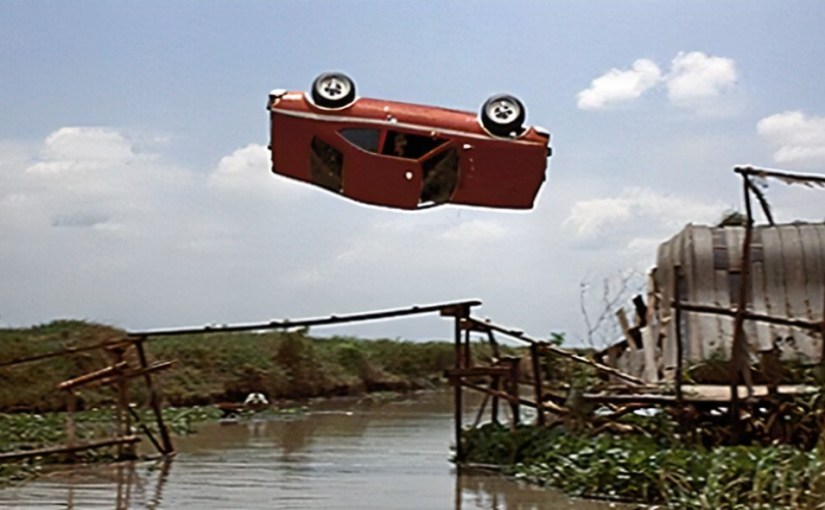
The Man With The Golden Gun also features one of the greatest automobile stunts ever captured on film, an alleyoop flip over a ravine with a broken bridge. Needs to be seen to be believed.

What keeps this film from highest of regard though is the return of Clifton James as Louisiana Sheriff J.W. Pepper for some cheap laughs that didn’t work when we saw him the first time in Live And Let Die. He’s a pest who’s contrived to show up in Taiwan of all places and coincidentally run into Bond again. Really? Seriously? There’s no reason for this annoyance to be here.

Still there’s lots of good moments including Bond vs two sumo wrestlers as well as fighting his way out of a deadly dojo with the assistance of some karate skilled school girls. Then there’s Scaramanga’s flying car which is extra cool.

007 embarks on an adventure that still holds up. Christopher Lee is loving his villainy and Roger Moore continues with the part well. He’s a sharp guy.

The Man With The Golden Gun is a film worth revisiting.

LIVE AND LET DIE

By Marc S. Sanders

I dunno. For me, the suave sophistication with the tongue in cheek persona of James Bond doesn’t mix well with the ‘70s cinematic themes of Blaxploitation and island voodoo rituals with snake bite human sacrifice. Live And Let Die was never a favorite of mine in the series. Still, it has some merits; even pioneering moments that set the standard for the next 20-25 years of 007. The gadgets are getting cooler (like a handy Rolex watch with a super magnet and buzz saw) and better, more natural looking action.

Harry Saltzman & Albert Broccoli present a film where the action scenes are the most authentic yet. A car chase with a double decker bus doesn’t feature the background film scroll seen in the rear window of an automobile, like prior films.

There’s a particularly long sequence featuring a boat chase through the Louisiana bayou. Great stunts and well edited footage here, although it features one of the most annoying characters in the whole series, redneck Sheriff GW Pepper (Clifton James, who always played the same role like in Superman II and even The A Team). This scene is an absolute blast of fun as Bond commands a speed boat while trying to evade a handful of bad guys in pursuit. Cars are wrecked. Boats are wrecked, and a bride to be wails aloud as her wedding is ruined. It’s just fun.

Roger Moore slips comfortably into the role of the Britain’s most celebrated secret agent. He’s handsome, for one thing, and his humor is dry enough that even in the face of death a pun is well delivered.

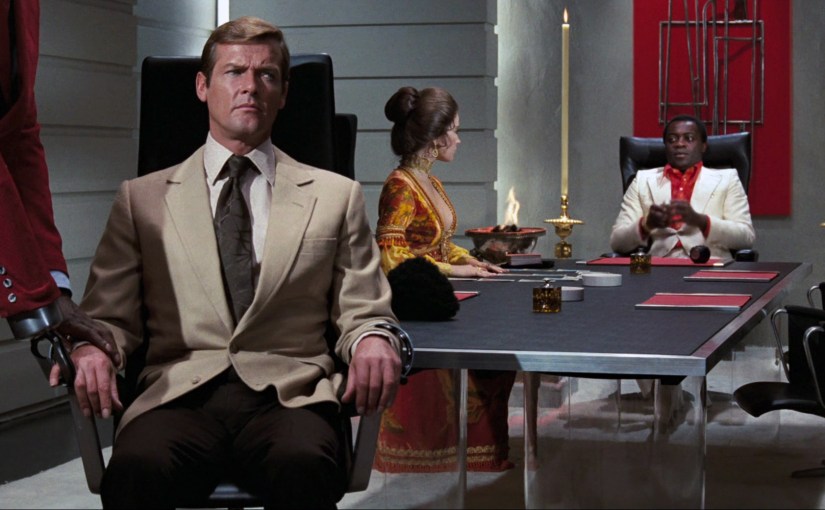
Yaphet Kotto plays Kananga, a far cry from the Cold War villains of Blofeld and Goldfinger. Turns out this guy just uses a couple of bars as a front for his heroin dealing enterprise while he dons a neighborhood crime boss image of “Mr. Big,” looking more like a villain of Shaft. He’s nevertheless good. Though he starts out the role quite subdued, he gleefully comes alive in the second half of the film when Bond intrudes on his secret lair.

Tom Mankiwietz’ script is lacking though. The pre title sequence gets me curious why three agents are inventively killed, but then the story mires itself in Kananga relying on Tarot card reading from the first virginal Bond girl, the High Priestess known as Solitaire. (Jane Seymour’s first screen role.) This offers no suspense or substance. We wait for cards to literally be turned over. Not exactly nail biting. Seymour is beautiful, but the intelligence and sex appeal of the character is flat.

There are also scarecrows and Caribbean island voodoo that are hardly threatening and belong in a horror film, not a Cold War era Bond adventure.

All of this weird material was twisting the series a little too far off course.

Live And Let Die does add a great henchman to 007’s rogue gallery; that of the imposing Tee Hee with enormous height and his steel lobster claw arm. He’s a fun bad guy that happily deserts Bond in a hungry alligator swamp.

Director Guy Hamilton’s third Bond film is not a total bust. It’s well cast in villains and Roger Moore is a perfect successor. Location shots of New Orleans and Jamaica (subbing for Kananga’s Caribbean island) are cool to see. The Harlem, New York footage really doesn’t belong here, though. It also has one of the best, most often played songs in the whole series, compliments of Paul McCartney & Wings. Again, it suffers however from a short sighted script.

Bond will be better served in missions yet to come.