
THE IRON GIANT

By Marc S. Sanders

Before he became known as a Mission: Impossible director or the guy who brought The Incredibles to the screen for Disney/Pixar, Brad Bird made the animated film The Iron Giant for Warner Bros. Animation. It’s absolutely brilliant in its visual drawings, storytelling, characterizations and period setting awareness.

The film takes place in a small town off the coast of Maine in the year 1957. The race for space has declared a winner as the Russians’ satellite, Sputnik, is the first to orbit the planet. The threat of the Cold War is no longer a secret. It’s out in the open as classrooms are exposed to danger drill warning films where children must hide under their desks in the event that a nuclear holocaust occurs. The film they watch is an absolutely hilarious sequence about what was a pretty serious subject matter at the time.

One student gleefully takes in the residual flying saucer flicks on TV, that spawned from this quagmire of paranoia occupying America at the time. His name is Hogarth Hughes, voiced by Eli Marienthal. When his TV antenna turns up missing one night, Hogarth goes off into the woods where he discovers a giant robot munching on the metal of a nearby power plant and in danger of electrocution when he gets tangled in the wires. The robot (Vin Diesel) is unfamiliar with earth and recognizably innocent, but quickly trusts Hogarth as a friend.

Young Hogarth is thrilled upon his discovery but knows his mom (Jennifer Aniston) would never approve of him keeping the robot, much less even a small pet. A government bureaucrat named Kent Manley (Christopher McDonald), complete with the fedora hat and trench coat, becomes suspicious of Hogarth. Kent’s Cold War guard drives him to uncover this 50-foot-tall robot with his own eyes. Find the threat and eliminate it at all costs. When he eventually gathers the evidence, he calls in the military to wage war right in the heart of the small Maine town.

There is much humor in The Iron Giant which truly stems from the intelligence gifted to all of the characters. Hogarth, as a kid, is first a teacher as the robot learns to pronounce basic vocabulary. The Iron Giant who has the capability to shape shift his body into a blaster kind of weapon, is not aware at first of the destruction he can leave behind until Hogarth makes him understand. Early on, Hogarth learns that the giant feeds on metal, but he must show his friend the best way to satisfy his hunger. It’s not with railroad tracks, that’s for sure.

Hogarth also matches wits with Kent. A great scene has the G-man and the kid defying each other to stay awake, rather than go off into the night in search of the giant. The clock just ticks away. Their eyes get more and more droopy. The laughs come from the animated characterizations and editing.

Hogarth’s mother, Annie, is never regarded as naive even if she’s unaware of her son’s new secret friend. A great scene has Hogarth doing his best to hide the giant’s metal hand in his bathroom. Hogarth has to do some quick but believable thinking to cover up what’s crawling around the house. Annie is a mom concerned her son might be violently ill, but trusts him when he insists he’s alright. I like that. Mom regards son as an equal. She respects his privacy but regrets it when she steps out of bounds to peek in on him in the bathroom. It’s sweet and smart, but funny too.

The Cold War is likely not a familiar subject matter for most kids, and yet there’s something to learn here. Russia and America were on the dawn of new technology. The nuclear age was upon us. The question was will they or won’t they act upon that technology. As well, will the two countries act in response to simply the threat of having such power at their fingertips? That’s what The Iron Giant of the film represents. When the giant, metal eating man is uncovered what response will it generate?

As the film progresses, kids can see why a resort to violence is truly not the answer. For how we appear might not offer an explanation on the surface. We need to familiarize ourselves with one another before truly declaring an enemy in our midst. So many movies only exist because one character just won’t speak up. Brad Bird’s film, adapted from Ted Hughes’ book The Iron Man, goes against that convention. A beatnik character by the name of Dean (Harry Connick Jr) who helps Hogarth and his new friend actually explains how the robot is not a dangerous figure who wants to destroy our planet. It then becomes a means of debate for the purposes of violence between the Army General (John Mahoney) and Kent Mansley, the government official. Do they believe the giant won’t become destructive?

I like to think a moment like this offers a subtle suggestion for the people in positions of power that are in charge to justify whether to go to war or not. It might be simplistic animation and the suspense is heightened by the time the film reaches this moment, but it’s another opportunity for viewers, especially kid viewers, to decide for themselves of what is right and wrong. Is defense or engaging in offense a more appropriate action?

Too often in family films, the kids are geniuses, maybe a little too smart or inventive, and the adults and parents are nitwits as a means for slapstick gags. Not the case here. Every character has an intelligent perspective. That’s what sets The Iron Giant ahead of other subpar family films.

Credit also has to go to the animation. There’s depth to everything seen from the main street of the town to the ocean side harbor to the woods where the giant hides. The sketches are so well defined, you want to look in the windows or sneak around the next tree. This is masterful direction. While an animated film is never shot in an actual location, Brad Bird makes sure you’ll see every corner of the New England locales that are conceived for his film.

Everything about The Iron Giant is a crowning achievement in animation. One of the best of its medium for sure.
THELMA & LOUISE

By Marc S. Sanders

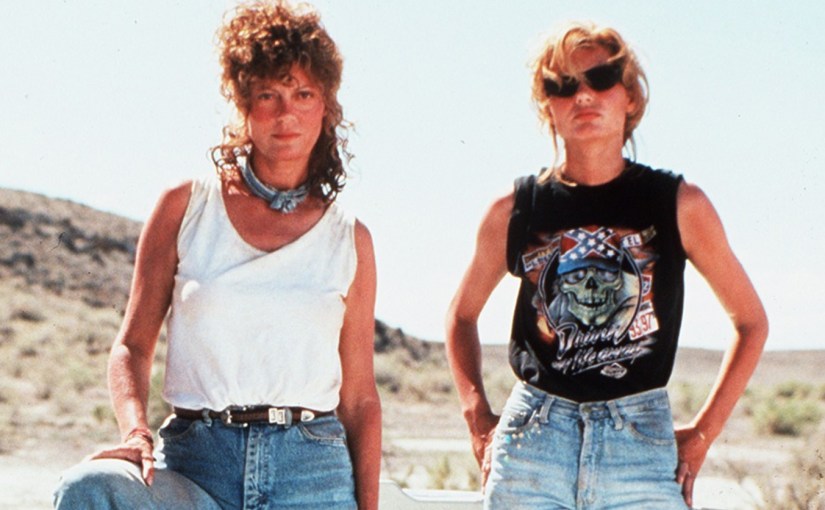
The strength of a good solid picture often depends on a strong cast from the top billing, above the title actors, to the bit supporting players who only have a few minutes of screen time.  Thelma & Louise, directed by Ridley Scott, is that film.  The opening credits of the movie come up in black and white over an out west landscape with an endless dirt road in the center of the screen.  Hans Zimmer’s harmonica and banjo, country sounds build on Scott’s camera work here.  The names of each actor are brought up: Susan Sarandon, Geena Davis, Harvey Keitel, Christopher MacDonald, Michael Madsen, Stephen Tobolowsky, and someone named Brad Pitt. The scene goes to color and then it blacks out and comes up on Louise’s (Sarandon) crowded diner where she waitresses.  Nothing is unfamiliar here.  Yet, it seems a little haunting in a way.  We are about to uncover a history to some common folk who live on the southern bend of America, and we will start in the state of Arkansas.

Louise has made arrangements with her best friend Thelma (Davis) to do a weekend cross country road trip to a cabin in the woods.  This is the southern odd couple.  Louise is always put together, clean and organized.  She’ll check herself in the mirror.  In a crowded ladies room, she’ll check her makeup and tidy her hair while intoxicated patrons are pushing around behind her.  Thelma is scatterbrained.  She’ll bite off a piece of a candy bar, put it back in the freezer and make three more stops back at the freezer for a couple of more bites.  She also will dump a dresser drawer of clothes into a suitcase, taking no time to sort through what she’s packing.

Both women have been treated unfairly by the men in their lives.  Thelma’s husband, Daryl (MacDonald) is a proud white trash carpet sales manager who treats his wife with absolute control, complete disregard and thoughtless disdain.  Louise just can’t even get a hold of her boyfriend Jimmy (Madsen), a musician who can’t commit to anything.  On the first night of their trip, the two ladies hit the road in an iconic 1966 green Ford Thunderbird convertible (one of the greatest, most memorable vehicles in film screen history), they’ll realize there may be worse men than the ones they’ve encountered.  Following an attempted rape, a shooting occurs and the ladies are hitting the road, hoping to make it to Mexico.

Thelma & Louise is at least Ridley Scott’s most sensitive film.  It was not the first or last time he used women as leads in his pictures.  Yet, the film moves symbolically along the stretches of highway and dirt roads as a means to reveal the strength and confidence a woman can have when she escapes the controlling shadow of a man.  At least that’s what I think.  The beginning of Scott’s film, with an Academy Award winning script from Callie Khouri, displays the title characters as weighed down by their past and current lives.  It is only when the two break free (with little options following an unforeseen dilemma) they understand they can be stronger than any man who’s ever dominated them before.  As the road trip moves on, they will encounter more hang ups and they will make mistakes, but by the time the third act comes along Thelma and Louise will sever any restraints that have held them back before.  It is such a gratifying story.

My father encouraged me to go see this movie with him.  It was 1991.  I was graduating high school.  I’d seen trailers for this picture and it was loaded with high energy country music.  I don’t like country music, typically.  In fact, I only can like country music when it is incorporated into a film.  Thelma & Louise is the best example of that feeling.  I hated the title.  Still kind of do.  It doesn’t have the ring of say Starskey & Hutch or Batman & Robin.  However, those are guy pairings.  Thelma & Louise are about two women, and I was never going to forget that.  Once I saw the film, I could not stop thinking about it.  I grew so accustomed to Ridley Scott’s direction and use of cinematography with Adrian Biddle.  The sun on the screen felt hot.  The dirt on the character’s faces and the Thurderbird felt gritty.  The sunburns on Sarandon and Davis felt sore and dry.  The glow of the car’s dashboard light felt bright in my vision. The settings spoke to me.  There’s a great moment where Louise seems to shed her feminine and dainty skin so to speak.  She hands over her jewelry to an old timer sitting on the side of road at an abandoned truck stop.  No words are shared between them.  This guy was born on this spot.  He’s never moved from this spot and Louise will leave her history behind with him.  Later, as the stakes grow, with the FBI and law enforcement closing in on the fugitives, there’s a moment where Thelma tells Louise, that she feels awake; like really awake and alert.  I knew what she was talking about.  I’ve already been on this hike for two hours with these characters, along with the crimes and entanglements they’ve gotten into and the movie has my full attention.  All these years later with repeated viewings, and I still feel that way.  I feel absolutely awake the moment the movie begins.

Khouri supplies her script with a variety of men.  Some are sensitive like the detective played by Keitel who knows that a murder didn’t just happen maliciously.  There’s more to the circumstances at play, and he’s hoping for the best for the ladies.  Some are just procedural like Tobolosky, who doesn’t recognize them as women, only as fugitives. Some are enlightening, yet deceptive like Brad Pitt’s hitch hiking handsome and charming loner that the ladies pick up, and some are simply cruel and vicious, like the rapist or Thelma’s husband, Daryl (MacDonald).  Maybe a trucker along the way is like that as well.  How will Thelma and Louise respond to each of these guys?  As the story contains a gamut of what all these men are, I never regard the picture as a middle finger protest to the male population.  Not at all.  There are men who will give women a chance and will treat them with respect and at least equality, within their surroundings.  Khouri’s script allows time for that.  Sadly though, thirty years later there are still men who will treat women like punching bags with no value and esteem.  It’s wrong.  It’s why the “Me Too” movement had to eventually come into play, long after the release of this picture. 

At the risk of sounding political with potential for debate and preach, watching Thelma & Louise last week, I could not help but think of recent current events that have occurred in mid year 2021.  Bill Cosby was set free from his prison sentence following a technicality that justified his release, but never exonerated him of his crimes of rape.  A former kid actor named Drake Bell was sentenced to three years’ probation for sending sexually explicit materials and texts to an underage girl.  More physical details have been implied on that relationship but Bell was never charged with anything on that topic.  Hence, no jail time.  A Disney channel actor has a warrant out for his arrest following missing a court date with similar charges as Bell.  Following the early rape scene in this film, the attacker is shot and killed in a parking lot.  The ladies consider going to the police and explaining what exactly happened, but they choose to run.  Why?  Because, they know that the police would never believe them.  They were witnessed minutes earlier drinking and partying with this guy in a bar.  Why would anyone believe he would try to rape one of them?  Reader, I know what they mean.  I understand.  Each time I watch the movie, I truly understand.  I know what Thelma and Louise are talking about.  It’s sad.  It’s wrong.  It infuriates me because it’s so unfair.

Callie Khouri and Ridley Scott created an outstanding adventure picture with suspense, and lots of natural humor by means of the outlaw way like Butch Cassidy & The Sundance Kid.  A surprising robbery midway through the picture is hilarious and serves as a legit character change for Thelma.  Davis is great here.  She has scenes of drama and fear throughout the movie, but she also has time for laugh out loud moments.  Alternatively, the Louise character that Sarandon portrays seems to hinge on the dramatic element.  I love a hanging thread that Khouri weaves into the script of an unknown traumatic occurrence that happened in Louise’s past.  I am certain that Sarandon knows what it is even if the audience doesn’t entirely know.  Later in the film, the humor that Louise encounters comes through as Thelma transitions over to a new kind of personality.  These women don’t change individually.  They change together.  It’s a great couple dynamic for sure.

The film is sexy and at times sweet as well.  Yet, it’s also very terrifying, with very real drama.  Thelma & Louise is an important picture to see.  I plan to show it to my teenage daughter when she is a little older.  The rape scene holds me back right now as I find it hard to watch and requires a mature eye.  Nonetheless, I want her to be aware of what is out there.  I want her to know how people, men in particular, respond and treat women.   I want her to be alert and strong when faced with any kind of adversity, deserved or not; justified or not.  I find that some movies offer the best lessons of life about the cruelty and kindness of the world.  Most especially when they are filmed with sensitivity and authenticity, like Schindler’s List or The Shawshank Redemption.  Countless viewings later with thirty years behind it, and I still learn from Thelma & Louise.  It’s another one of my favorite movies.