CLUE

By Marc S. Sanders

The players:

Mr. Green – Michael McKean

Mrs. Peacock – Eileen Brennan

Miss Scarlett – Leslie Ann Warren

Colonel Mustard – Martin Mull

Mrs. White – Madeline Kahn

Professor Plum – Christopher Lloyd

With Wadsworth the Butler (Tim Curry) who “Buttles!” and Yvette the Maid (Colleen Camp).

The roles and who portrays them are the most important thing to follow in the film adaptation of the board game Clue. After that, it’s the ridiculous farce. Motivations and vague connections among the characters are spit out with rapidity by Curry’s zany Wadsworth, the buttler Butler. He’s the real star of the show but every actor makes their own variation of hilarity.

All of them have been summoned for dinner on a dark and stormy night at Mr. Boddy’s mansion. They have been specifically instructed to identify themselves by the colorful moniker documented in their invitations. None of them know each other or Mr. Boddy. Or do they????? Hmmmm!!!

Once they are there, dinner is served accompanied by Yvette’s physical attributes that express themselves quite well in her French Maid’s uniform. Soon after, the board game’s well known weapons (lead pipe, candlestick, revolver, wrench and so on) present themselves and then Boddy turns up dead in the library. Naturally, the players must explore the other well known rooms in the creepy mansion including the kitchen, the billiard room and conservatory to uncover what’s happened…even though he’s dead in the library already.

Eventually, and because the film is fast approaching it’s 90 minute mark, Wadsworth begins to manically explain who the murderer is and how and where it was done. Oh yeah! Other unfortunates have turned up dead as well, including a policeman and a singing telegram.

Clue is on the zany level of Airplane! and The Naked Gun. John Landis co-wrote the film with director Jonathan Lynn and honestly, they could not do anything wrong with the picture as long as they kept everything completely stupid for the sake of comedy. All of the players lend to that ridiculousness going so far as to even pose with the dead corpses to mask the fact that they are truly expired. No matter that the cook has a dagger in her back.

The famous board game is rightly honored even with the square tiled floor in the hall and the secret passages that connect the rooms. Agatha Christie mysteries are targets though too. The assembly of these legendary comedians, who were all pretty much established by the time Clue was released in 1985, know how to find one of Christie’s personality suspects and springboard off of that for great gags.

Look, best I can tell you is don’t pay much attention to whatever motives are rambled about. The visuals are what’s important. Watch how ridiculous Tim Curry gets as he tries to keep this game all in order. Though a sense of order should never be expected. You’ll realize that early on after the Butler accidentally steps in dog poop, and the most important thing over the next five minutes is watching each player sniff for what is that awful aroma. It sounds silly. It sounds immature, but that’s what is specifically fun about the film.
STAR TREK III: THE SEARCH FOR SPOCK

By Marc S. Sanders

Leonard Nimoy accepted the director’s chair for Star Trek III: The Search For Spock.  Though background stories dictate that he was done with the famous character especially following the end of the previous film in the franchise, one hanging thread was left untouched to permit another chapter.  It’s fortunate that Nimoy worked with so much good, solid and well written material for him to oversee on this follow up picture.

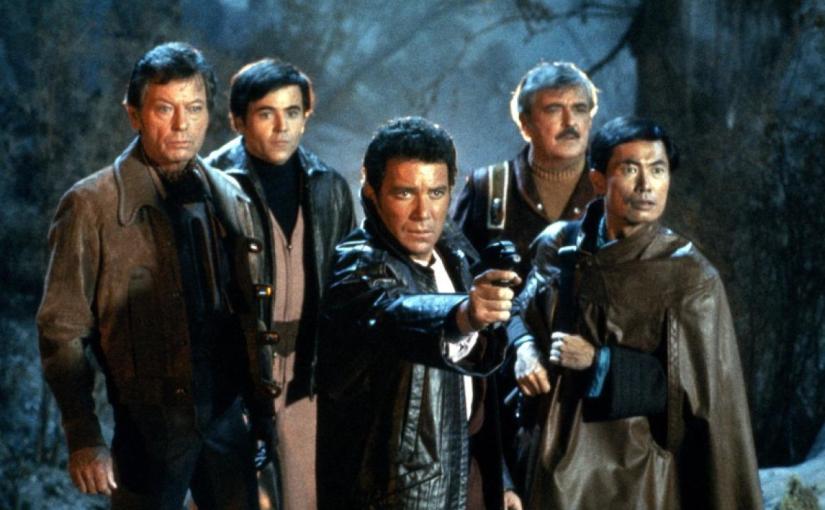
The Enterprise is returning to Earth following its entanglements with Khan.  Admiral James T. Kirk (William Shatner) is morose following the loss of a close colleague. In addition, Dr. McCoy (DeForest Kelley) is mysteriously unwell.  Meanwhile, the newest invention, Project Genesis, is being thoroughly studied by Kirk’s son David and Lt. Saavik, now that it has formed a planet of its own.  Genesis has become a clandestine and highly politicized issue among the Federation Of Planets and it is not to be discussed in public arenas. 

Shortly after Kirk arrives home, he is approached by Spock’s father, Sarek (Mark Lenard).  They both realize that before Spock’s unexpected self-sacrifice, he left his “spirit” within the mind of McCoy.  Now McCoy is unstable in the current life and Spock’s afterlife is not settled as well.  Kirk and crew must find a way to escort McCoy to the planet Vulcan, along with Spock’s corpse that is resting on the Genesis planet.  So, without authorization, they hijack the Enterprise and off they go into the far reaches of space all over again.  It won’t be easy as Christopher Lloyd has been cast as a vicious Klingon who commands a Bird Of Prey ship that can cloak itself just before an attack. 

Due to the enormous popularity of The Wrath Of Khan and The Voyage Home (even numbered installments in the movie series), The Search For Spock doesn’t get the recognition it truly deserves.  People love to point out how the odd numbered installments are the weaker films.  Star Trek III negates that observation for me, though.  Maybe whatever dismissal it carries is also in part because it’s a short film and doesn’t feature the main attraction for many Trek fans, Spock.  Yet, Nimoy with a script written by producer Harve Bennett tackles some shocking developments in the continuing adventures of Kirk, Bones, Scotty, Sulu, Uhura and Chekov.  All these years later and two eye opening moments occur in the film’s third act where I tell myself, “Wow, I can’t believe they actually went there.”

The film has a very gratifying ending.  Yet, it ends with a couple of big cliffhangers.  Look, when Darth Vader revealed his big secret, moviegoers had to wait three long years to find out the backstory and what was really the truth.  With this third Star Trek film, there’s much to account for as to what will become of our first favorite science fiction crew.  Leonard Nimoy hit all the right notes leaving audiences wanting more.

Nimoy has directed a well-versed picture.  The film doesn’t just belong to Shatner this time. Though he’s just as marvelous as the last film.  He just has such a likable charm to him, and his dramatic moments can be heart wrenching.  DeForest Kelley is given good material here.  At times, his mental dilemma is a struggle for the character.  In other areas, his curmudgeonhood comes out for humor as he curses Spock for what he’s left him with.  It’s a humorous kind of sci fi prejudice (sort of like Archie Bunker) that made Spock and McCoy a good pair to traditionally watch spar with each other.  George Takei, Walter Koenig, Nichelle Nichols and James Doohan are blessed with moments as well that feature some funny one liners (“Up yer shaft!” and “Don’t call me Tiny!”).

It’s easy to regard the third film of a “geek culture” as just another film.  However, in its brisk ninety-minute running time, The Search For Spock explores facets of religion, albeit fictional, and debates with science and discovery.  If that’s not good enough for you, at least it’s also a helluva great adventure.

BACK TO THE FUTURE PART III

By Marc S. Sanders

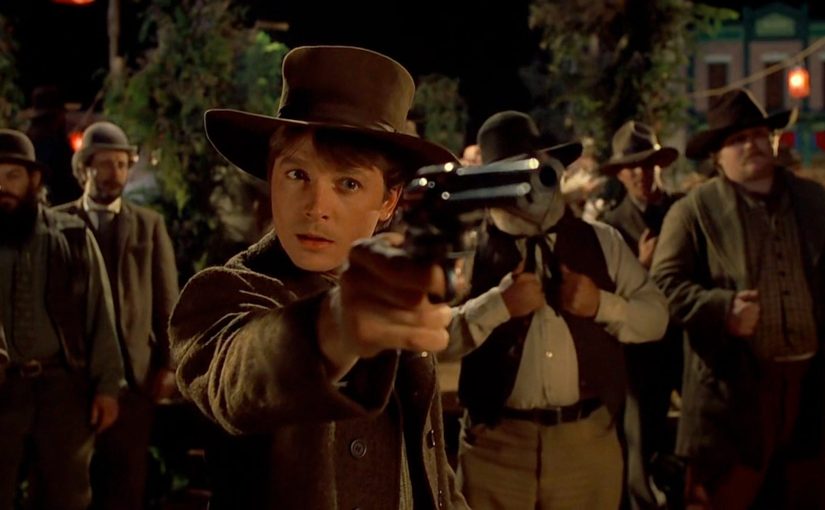
I think Bob Gale and director Robert Zemeckis forgot one thing about Back To The Future Part III. It was supposed to be a time travel movie. Sure, Marty McFly (Michael J Fox) travels back to the Hill Valley of the Old West in the year 1885, but once he gets there, there is not a lot of material for the beloved DeLorean.

The film picks up immediately where the last film cliff hanged. Marty is left trapped in 1955, and he receives a letter sent to him 70 years earlier from his present day Doc Brown companion (Christopher Lloyd) originally from 1985. You still with me? When Marty realizes that Doc gets shot in the back by Mad Dog Tannen (character actor great, Thomas F Wilson), he arranges with the 1955 Doc to send him back to the Old West and prevent that from ever happening.

From there, the film turns into a staple Western. There’s the calvary, Indians on horseback, quick draw duels in the street, a saloon, stage coach and wagons. Most importantly, there’s a steam engine to push the DeLorean to the necessary 88 miles per hour to send our heroes back to the future. That dilemma is solved quickly and early on. They now just have to wait for the train to arrive.

So the film calms down to allow a charming Mary Steenburgen as Clara Clayton, a schoolteacher, to capture the affection of the good ol’ Doc. When the romance seems impossible though, we get a depressed Doc. A depressed Doc Brown is never good for a movie. Consider this. It’d be so easy to just wait for the moment to travel back in time. However, obstacles get in the way, right? In the fantastic first film, Marty has to play guitar at the school dance to get the necessary first kiss between his parents thereby solidifying his existence. That’s fun…and then he kills it while performing “Johnnie B. Goode.” Here, the moment to time travel is approaching, but it can’t happen because Doc is depressed. What’s so fun about that?

Like Part II, Part III is watchable. It’s not terrible by any means. It’s just a little stale. The best gag, however, is Marty taking on the name of “Clint Eastwood” to build his status in the town. This allows a lot of inside jokes. What would’ve sent this film into the stratosphere is if they got the legend himself to make at least a cameo. Alas…. I can dream and wonder.

Back To Future Part III ends the film on a sweet message similar to what you get from other fantasies like The Wizard Of Oz or Willy Wonka & The Chocolate Factory. It reminds me that despite its shortcomings, the entire Future trilogy is great to share with the whole family. No doubt, there’s always something to look at and focus on.

Still, some movies that require focus specifically, takes work. The first film allowed me to wonder. Wonder if all of this could be true one day. Wonder how they thought all this up. Wonder how Marty is actually going to get back to the future.

If I have to choose, I’d rather not focus. I’d rather just wonder.

BACK TO THE FUTURE PART II

By Marc S. Sanders

Back To The Future Part II is a paint by numbers or recipe film more than just a film. This has to be done, so that that can be done, cook on high for just over two hours and all will be wrapped up. Because it is so focused on covering all bases it forgets the wonder and fun of the original film, and just gets down to business. Watching this film makes you feel like dad just won’t throw the football around with you in the front yard. He’s got work to do.

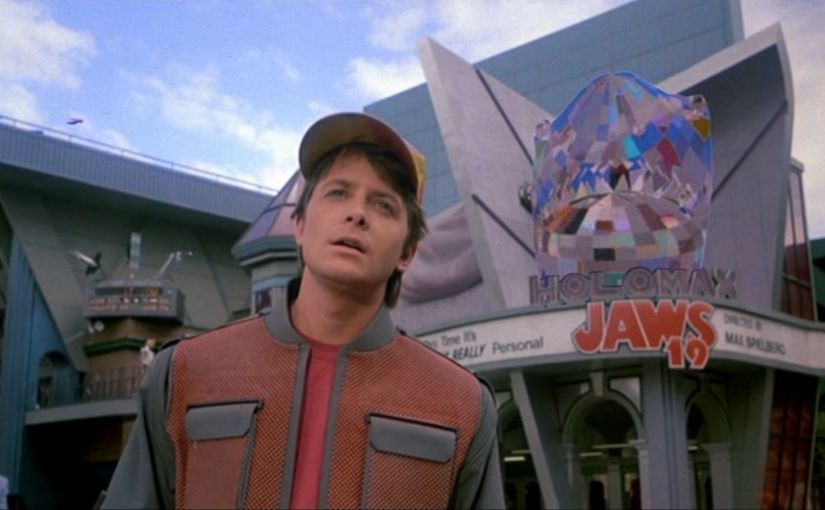
The sequel picks up immediately where the first film ended with Doc Brown (Christopher Lloyd) taking Marty McFly (Michael J Fox) and his girlfriend Jennifer (Elisabeth Shue) to a very zany looking future in the year 2015, complete with flying cars, Jaws 19, the abolition of lawyers, and opportunities to get a redesign of your body complete with a replacement of your spleen and colon just like Doc explains. When an elderly Biff Tannen gets a hold of a sports encyclopedia, he travels back in time to 1955 to tell his younger self to make bets he can’t lose. Now the future is entirely changed, riddled with crime, and Biff in absolute power. Worst of all, the brute is married to Lorraine, Marty’s mom (Lea Thompson, regrettably not given much to do this time around). So, Doc and Marty need to travel to 1955 to set things right all over again.

Look, if you were gonna make a sequel to Back To The Future, this is likely what the script was going to spit out. It’s a watchable film. However, it’s lost the soul of the original installment. It feels like an office project. The comedy is absent. A long sequence shows a middle age Marty in 2015 talking on video phone remotely with his bullying boss, and getting fired, with fax machines all over the house spitting out the message as well. This is supposed to leave me in awe? This is funny?

The second half of the film in 1955 has Marty pursuing Biff the bully while trying to get the sports book back. Biff, played by Thomas F Wilson, is more or less doing the same thing as the first film. Only he’s not the dumb buffoon we laughed at the first time. He doesn’t have George to bully around this time. You realize Biff and George made a perfect comedic pair. That’s missing here. So he bullies some little kids and with extreme harshness and tries to kill Marty on several occasions. It’s not so funny this time. It’s cruel.

A fun motif (that also carries forward in Part III) is that the actors are playing their characters at different ages 30-60 years apart from one another. Fox, Wilson and Shue also play their kids or grandkids. A nerdy Marty Jr is nerdy, but not quite funny. Fox is not doing the fantastic humor that Crispin Glover did as George in the first film. He’s just wearing an oversize jacket with his jeans inside out and squeaking his voice. Meh…not funny, just there.

Robert Zemeckis’ sequel is just okay. It’s disappointing because he and his collaborator Bob Gale worked so inventively on the first film. The construction is solid. I still love the various transformations of Hill Valley, California. If the film were made today that’d all be done with CGI. I appreciate the texture in the construction of the town’s past, present and future. Each time period allows me to look around and see what’s replaced what and so on. So, I’m truly grateful for that.

All and all though, Zemeckis and Gale had all the right ideas. They just didn’t have the best execution in mind.

BACK TO THE FUTURE

By Marc S. Sanders

One of the best fantasy films of all time is Robert Zemeckis’ Back To The Future. No matter how many times I see it I’m astounded by the imagination and attention to detail that is invested in its script penned by Zemeckis and Bob Gale.

First, there is the set that stands in for the town of Hill Valley, California. To set up the film which took place in the film’s present shooting period of 1985, everything appears modern from Pepsi Free soda to Huey Lewis and the News and Marty McFly’s (Michael J Fox) parka vest.

Through a set of circumstances, when Marty travels back in time to November 5, 1955, suddenly the hit song is “Mr. Sandman” and his vest is mistaken as a life preserver. But look at Hill Valley!!!! Twin Pines Mall is now Twin Pines Ranch belonging to a farmer. A exercise workout locale is the corner diner where the future mayor is a waiter, and Marty’s domestic subdivision isn’t even built yet. Zemeckis and his crew are religiously faithful to observing the “science” of time travel.

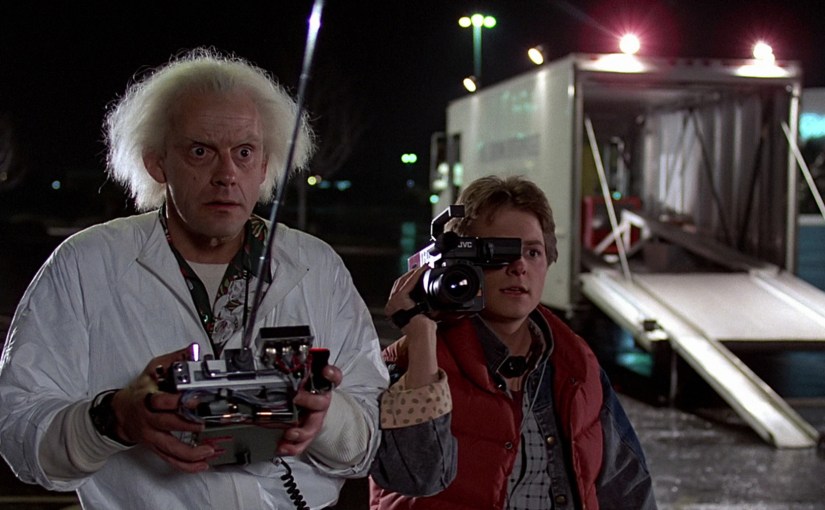
His minister so to speak is Doctor Emmett Brown (a should have been Oscar nominated Christopher Lloyd; absolutely brilliant in his bug eyed, crazy hair, fun loving role). Doc’s time machine comes by means of a DeLorean automobile – perfectly sci fi like. Marty recruits the younger version of Doc to get him back to his present day, or Doc’s future.

Complications occur when Marty interferes with how his parents originally met thereby causing his mother, (Lea Thompson also superb and maybe should’ve been nominated as well) a teen at the time, into falling in love with Marty. Now Marty is at risk of being erased from existence, while his mother has the hots for him.

Complications are compounded endlessly in Back To The Future, and it’s easy to learn all that is at stake. That’s only the skeleton of the nominated screenplay. The dialogue works beautifully as well. Imagine telling someone living in 1955 that Ronald Reagan is President in 1985, and see how he’ll respond. The conservative culture of 1955 vs the free liberal lifestyle 1985 clash so well in the film’s comedy.

Outstanding performances make up one of the greatest casts of all time. It’s difficult to believe that Eric Stoltz was originally cast as Marty. Michael J Fox is so perfectly natural in his hysteria and cool, yet panicky, swagger. Crispin Glover is hilarious as Marty’s ultra-nerd dad, George McFly, and Thomas F Wilson is one of the top ten on- screen bullies of all times as the towering buffoon Biff Tannen.

Without question, Back To The Future is one of the most imaginative films ever made. It has wonder, comedy, suspense, song (yes…we even learn how Chuck Berry came to play “Johnny B Goode”), and brilliant characterizations. It is wholly original in its creativity. It’s fast moving, and it’s great fun.

Credit also goes to Alan Silvestri’s catchy orchestral soundtrack. It is magnificent in accompanying the adventure and misunderstandings that occur. You see the film once, and you never forget Silvestri’s music.

Back To The Future is a magnificent film that every kid should eventually see.

ONE FLEW OVER THE CUCKOO’S NEST

By Marc S. Sanders

After watching One Flew Over The Cuckoo’s Nest for the first time in many years, I recognized a political dual taking place on the battleground of an insane asylum. Director Milos Foreman sets the stage for one patient to win over the community from the Head Nurse in charge.

Jack Nicholson is Randall P McMurphy, a criminal who is transferred to the asylum for examination even though there are likely suspicions he’s faking his current condition as a means to escape prison life work detail. Louise Fletcher is his opponent as Nurse Ratched who has maintained an organized control over the floor of 19 men with an assortment of mentally unwell behavior.

McMurphy is a cut up as soon as he joins the gang. At first he appears observant during Ratched’s daily sessions where she asks the men to contribute to the discussion but at the same time she couldn’t be less encouraging. She’s happy to welcome ideas with open arms but don’t disrupt the process. There will also be “Medication Times” and there will be samples of classical and childlike music to subdue the patients as well. McMurphy may request the volume be lowered, but that’s not a simple request that Nurse Ratched will honor.

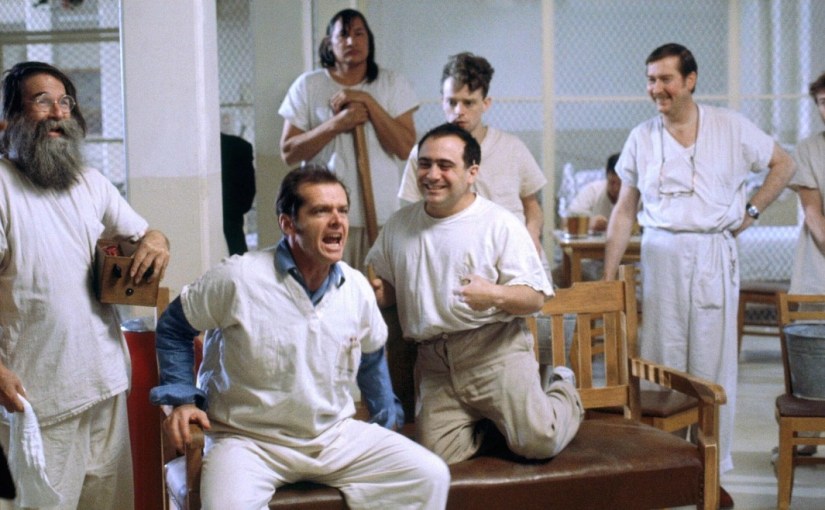
McMurphy’s experience outside the realm of insanity works as a wake up call for some of the men which consist of introductory performances from great character actors like Christopher Lloyd, Danny DeVito and Vincent Schiavelli. The stand out is Brad Dourif as Billy Bibbit, the stuttering suicidal young man with the baby face who fears his mother’s judgment as Nurse Ratched methodically continues to imply.

McMurphy wins over the crowd eventually. A fascinating scene is when Ratched challenges McMurphy to obtain enough votes among the men in order to watch the World Series. The count of raised hands appears to tie, but then Ratched reminds him that he needs one more vote to win. Before he can get to that point, the session is ended by Ratched. The call for election is lost due to a technicality by the governing control. An election won’t silence the voice of the people as McMurphy quickly encourages the masses to watch a blank television screen imagining his own interpretation of the game. Ratched can only domineer to a certain degree. Here’s the flaw in the Ratched character. At last a breakthrough among these ill men is established as they’ve learned to vote for themselves. They want to watch a baseball game. Ratched won’t stand for progress though.

Questions arise in One Flew Over The Cuckoo’s Nest. Is McMurphy truly faking his mental condition? Is Ratched so drunk on control to disregard doctors’ opinions for his release and keep him institutionalized? If he’s not insane, then why would she want him there? Is it all about Ratched’s obsession with winning?

Ken Kesey wrote the original novel the film is based on. He hated Foreman’s approach particularly with disregarding telling his story from the perspective of the deaf/mute six foot five Native American that McMurphy regards as “Chief” (Will Sampson). Chief seems to be the quiet one who does not take sides until McMurphy demonstrates the ease of obtaining freedom such as when the Chief helps him escape over a barb wire fence and then takes the men on a boating joy ride. I can’t side with Kesey’s insistence that the film be done from the perspective of the silent, yet memorable Chief. Film is a different medium than what’s read on a page. You can’t watch people’s thoughts. What I do find interesting is that Kesey opted for a Native American as McMurphy’s best sidekick. This is a man whose ancestors historically lost their land. McMurphy attempts to rob the rule of the asylum from Nurse Ratched. The political undertones just seem so apparent. The government control, however, is hard pressed to surrender even after McMurphy arranges for his own party of celebration complete with booze and alcohol. Ultimately, and sadly, the fate of McMurphy shows that he eventually becomes a product of his own environment. The Chief however, acknowledges his independence though.

One Flew Over The Cuckoo’s Nest is the second of three films to win the five main Academy Awards (Best Picture, Director, Actor, Actress, and Screenplay). It deserved it, and because of the film’s unsettling and messy nature it’s almost surprising that it was so well received. It’s not a glamorous film. It can show the ugliness of men drowning in their own consciousness.

At the same time, the film shows the subtle yet brutal control of those living fulfilling lives at the expense of the constituents they oversee. Sure, let’s have an open minded community of provoking thoughts, but only if it’s confined to the restrictions that remain in place. Step outside those lines and a more permanent technique will be applied so you adapt to what’s mandated…unless you can bodily lift a concrete water fountain and smash it through a cage bar enclosed window to freedom.