UNSTOPPABLE (2010)

By Marc S. Sanders

An adventure of the unexpected needs to start with urgency. 

“Let’s say there’s a runaway train that’s barreling through the state of Pennsylvania and no one is on board to stop it.”

“Not bad.  What else you got?”

“This train is a half mile long. So, it’s a roller coaster of a beast.”

“Go on.”

“How about there’s another train on the same track and the two are going to collide with each other?”

“It’s got potential.  Anything else?”

“Oh yeah.  The train is carrying toxic chemicals that could cause mass destruction and casualties of epic proportions throughout the rural area.”

“Okay.  Now we’re talking.  Any guns?  Can we find a way to get machine guns into the mix?” 

“Yes!  I got it.  How about if the people try to derail it and the only way to make that happen is the cops shoot at this tiny button on the bottom of the engine, and this button is located between the gas tanks?  So it’s gotta be a direct hit while the train is in motion.”

“Okay.  Okay.  That’s genius.  Let’s green light it.”

Now this might have been how Unstoppable, director Tony Scott’s final film, got put into commission, but what is especially fascinating is that this is based on a true story. An out-of-control locomotive actually went off with no one on board to control it.  It happened within the state of Ohio about fifteen years prior to the release of this film.  Only it was not as dramatic or suspenseful as Tony Scott and his crew assembled their movie.  Unstoppable is a pumped-up, steroid enhanced reenactment of the actual story.

The director recruited his most common go to lead, Denzel Washington, for the role of Frank Barnes.  He’s an engineer with over thirty years’ experience who is wiser than the big wig suits on the top floor.  He can bring this potential disaster to a halt before it happens.  Frank is also a mentor to the fresh, young conductor, Will Colson (Chris Pine). 

Will is cranky because his wife is upholding a restraining order against him and the two are at a standstill of hashing their problems out over the phone.  Frank is in a bad mood because the young guys like Will are being brought in to replace the grizzled fellows who are being pushed out.  Frank is also a widower with two estranged daughters. Though, he gets a kick out of telling Will the girls are paying their way through college by working at Hooters.

Denzel Washington and Chris Pine make a good pair.  Buddies who antagonize each other at first, they later share what’s eating at them personally and professionally. Then they work well together to resolve the crisis at hand.  Their characters are not very dimensional, nor should they be.  After all, it’s all about the train.  Yet, I believed them as train engineers/conductors.  Either of these guys could be operating a merry go round and I’ll believe they know some serious shit about how the carousel operates and moves in a circular motion.  My point is these actors really work at it to appear like guys who are well trained within the freight train industry, and I buy all of it.

In the control center, staring at large monitors with high tech maps is Connie (Rosario Dawson).  She’s communicating on the CB with Frank and Will and giving them updates on the status of when their engine will be within hookup range with the one speeding out of control.  She’s also the figurehead with the smart mouth, needed to stand up to her bubbleheaded corporate boss (Kevin Dunn) who threatens to fire all of them.  In other movies, this guy would be the angry police captain in a cop movie.  He’d be the government official who believes he can protect the President while Kevin Costner or Clint Eastwood knows that’s not how it works.  This is a slot role.  Use the same dialogue for a guy like this no matter what the picture is about because it’s all standard stuff. 

On paper, Unstoppable sounds ridiculous and quite ordinary for an adventure.  A runaway train.  Isn’t there anything else?  Yet, Tony Scott applies his quick edits and aggressive zoom in and zoom out shots to the movie’s breakneck progression.  He’s also got those curved Steadicam movements within Connie’s control center accompanied with glowing bright lights of greens, reds and blues. 

News reporters’ updates, along with footage from helicopters, are spliced in between the scenes that Washington and Pine share together in the cab of their train engine.  The glue holds up well.  There’s time allowed for Frank’s girls to cheer daddy on while at Hooters. Will’s wife played by Jessy Schram holds their young son while nervously fidgeting and tearing up watching the news.  I don’t think she has any dialogue beyond the line “C’mon Will!” Soon, she’s live on the scene staring straight ahead for the final act of the film.  That’s a problem.   I’m questioning why she’s looking in the same spot straight ahead if this train barrels on and on.  It’s certainly not in a stationary position.  She’s not watching a baseball game.  No bother.  It’s not fun to question a picture like this with such semantics. 

The exhilaration comes in how Tony Scott sets up his action pieces with daring leaps on and off the train and running sprints on top of and in between the cars.  Guys hang from helicopters with attempts to board the train.  Cop cars turn their sirens on and speed parallel to the locomotive, and yes, as in any Tony Scott film, a handful of cop cars bang themselves up real good in some gritty pile ups. A gorgeous red pickup truck works its way into the story too.

Screeching sound effects are also necessary.  They were nominated for an Oscar. 

Perhaps my one complaint that’s hard to accept is that in some shots, the train, which is supposedly going at over 70 mph, doesn’t look like its going fast enough.  Urgency is important in a film like this and when I get the impression the train is not traveling at a high enough speed, well then the threat doesn’t feel so threatening.  It’s when there are shots underneath from an on the track perspective that you really get an idea of the exhilaration.  In a movie like Speed, the bus always looked like it was accelerating and never slowing down.  Here, the train seems to move slow enough at times that anyone could have just leaped on board, but as Miguel always says, “Then there would be no movie.”

Don’t go into Unstoppable with your Neil deGrasse Tyson laws of physics.  Don’t get hung up on the wife who can see everything that’s happening by staring straight ahead when this speeding train is racing past her from right to left.  Don’t worry. Move on.  It may not look like it, but this train is going faster than it appears. 

Just enjoy the ride, and relish in what set Tony Scott aside as a well-equipped and capable action director.  Sadly, he left this world too soon.  There were more fun action movies to be made by him.  Unstoppable at least reminds you why he is still so sadly missed.
WISH

By Marc S. Sanders

Disney’s Wish seems to stand out from many other films within the studio’s vault because the lack of filmmaking confidence appears so obvious.  What does it tell you when a newly original story is continuously guided by winks and nods from past successes?  We see this thing can’t stand on its own two feet.  So, let’s dress a character up like Peter Pan and literally name a random deer Bambi.

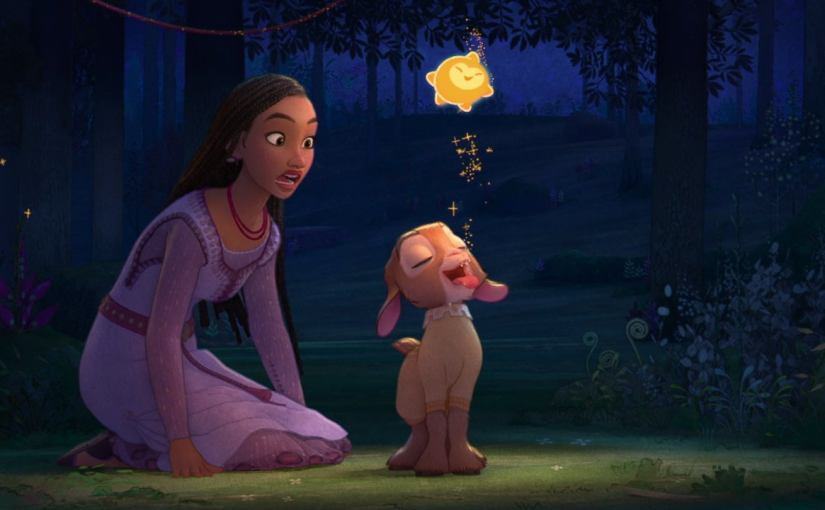
A sorcerer trained in the arts of magic oversees his newfound Mediterranean island kingdom known as Rosas.  He is King Magnifico (Chris Pine) and he has attracted people from all over the world to reside under his rule on the condition that he collects their wishes to be held by him in glittering, floating blue bubbles.  The people of Rosas lose all memory of their respective wishes and now live month to month with anticipation that Magnifico will award them the wishes he holds as a kind of equity or collateral.   

Asha (Ariana DeBose) is a seventeen-year-old who is eager to finally witness her grandfather Sabino’s (Victor Garber) wish come true as his 100th birthday finally approaches.  She also aspires to meet the great sorcerer and hopefully become his apprentice.  As soon as she meets the King though, Asha realizes Magnifico is a greedy, selfish individual who thrives off the admiration of the people of Rosas while savoring the wealth of everyone’s longings.  In other words, Magnifico is a cult leader.

Chris Pine does good voice work here.  He’s gleeful and manipulative and uncaring and evil all at the same time.  Disney’s colorful animation lends to his vocal performance of course with Maleficent inspired glows of green spells which the character conducts.  Yet, my adult mindset could not get past the fact that I’m looking at an animated inspiration of David Miscavage, long time head of the Church Of Scientology.  Magnifico’s wife Amaya (Angelique Cabral) is the quietly naïve representation of David’s wife, Shelly (who has not been accounted for in years).  The poor people of Rosas are the brainwashed disciples believing in this false prophet.  I guess it’s not a terrible concept to apply to a fantasy, but once I see the allegorical connection, Wish makes me feel uneasy.  My fault I guess for watching too many HBO documentaries and listening to former Scientologist Leah Remini too much.

Asha is the hero of this story who makes a wish upon a star.  Actually, a literal character named Star enters the picture.  Star squeaks like a precious darling, ready to be your children’s next plush toy acquisition.  He shoots sparkling trails of gold out of his pointed appendages.  With Star’s help, Asha will reach the standard showdown with the villain by the film’s end and the awakening of the people below.  It’s all trite material that’s been done before.

Wish relies on the vast history of fantastical stories, believing you can fly and be heroic or simply a sidekick tagging along with the protagonist.  Asha has seven friends.  One is referred to as grumpy.  Huh!  How do you like that? Must it be so apparent so often though?  Thanks to Star, forest animals talk and one even makes an inside gag to Zootopia.  You’re practically asked “Get it?  See what I did there?” Magnifico bears a striking resemblance to Jafar and even resides in a similar castle to the Aladdin villain with stone spiral staircases to explore.

The colors and animation are just as engaging as nearly any other Disney film.  A few songs work, but there’s nothing on the level on what was accomplished during the days of Rice and Menken, or even more updated fare like Frozen.  I can’t recall the title of a single number from Wish.  Magnifico sings.  Asha sings multiple times.  The two duet together and it’s not terrible. Ariana DeBose could sing the phone book and I’ll feel swooned.  The supporting people of Rosa sing in choral support as well.

Still, what tainted my experience was turning a very real epidemic of cultish culture into a fantasy catered for all ages to enjoy.  The wishes the people offer up are the endless “donations” that a cult mentality always requests.  While I appreciate being accepted into a fraternity of Disney loving storytelling, I did not need to be banged over the head with so much saluting either.  The end credits contain one classic Disney character after another appearing next to the ongoing scroll.  Hi Dumbo.  Hi Genie.  Hi Peter.  Hi Belle. 

Disney always reminds us to believe our wishes will come true and yet with Wish the studio chose to go with what is blatantly familiar.  It’s time for some fresh ideas again that especially do not source themselves from the reality of harmful sects spreading false doctrines. 

NOTE: I still have a fresh idea from a very popular legendary story that Disney, nor Universal or Warner Bros has yet to touch.  Maybe it’s time I get it down on paper.  Hmm.

A WRINKLE IN TIME

By Marc S. Sanders

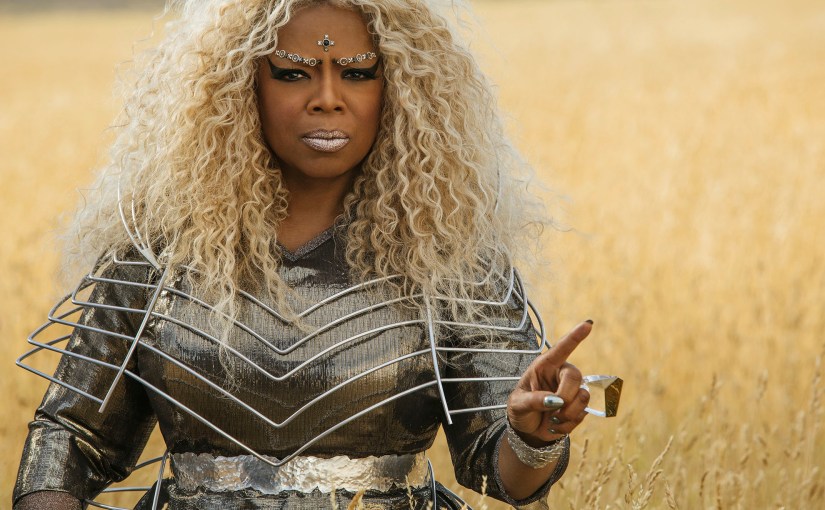
Oprah Winfrey has a big head.

I don’t mean a big head as in a large ego. I mean Oprah Winfrey has a BIG HEAD. So BIG that I caught every sprinkle of glitter in her eyebrows and lipstick that it looked like it came out of the discount basket at Justice For Girls. Why do I focus on this first and foremost? Well…because that is about where the scope of imagination stops in Ava DuVernay’s direction of A Wrinkle In Time.

Remember the first time you saw The Wizard of Oz? Remember when Dorothy walks out of her monochromatic home and into the brightly lit Munchkinland? Judy Garland walked cautiously. Spoke carefully (“Toto, I have a feeling we’re not in Kansas anymore.”) There was a reaction to all of the grandeur and strangeness. Now, over 82 years later, many fantasies on film refuse to take inspiration from that timeless cinematic moment. A Wrinkle In Time definitely doesn’t.

In Duvaraney’s interpretation, Reese Witherspoon, dressed in a white king size bedsheet with hideously bright orange hair can just appear in the living room of a home and no one has nary a response to the unusual. There is neither panic, nor a “wow,” not an eye bulge, not a large swallow of gulp. Nothing. The protagonist, Meg, and her mother just say who are you (actually I’m not sure they even said that), and Reese puts on her over exaggerated smile and cheerful vocal inflection and speaks in some kind limerick dialogue. She walks out the front door, disappears into the night, and no one says anything; no one ponders anything. There is no imagination in the filmmaking here, nor in the scriptwriting. This is a fantasy, right?

Mindy Kaling is another fantasy character in garish makeup and costume. She quotes expressions from various poets and artists from history. Why? I don’t know. What does she lend to Meg’s mission? Yawn!!!! Nothing.

Zach Galifianakis accepted the role of another weird character that Johnny Depp probably turned down, and would have likely been offered to Robin Williams had he still been alive. Zach has nothing to say either.

Meg has a little brother named Charles Wallace. I know this because the script hammers away this kid’s name over and over again. Charles Wallace. Charles Wallace. CHARLES WALLACE!!!!! Not just Charles. This kid is always addressed as CHARLES WALLACE!!!! There’s a drinking game in the making. Give the movie 15 minutes and I promise you, you will be heavily intoxicated after hearing CHARLES WALLACE again and again and AGAIN!!!!

All of these claims go back to my one main, sole issue with this film. A complete lack of imagination and awareness of its fantasy.

DuVernay films Oprah as a towering 20 foot presence (literally) and fills in every void of space on the screen with her head. “CHARLES WALLACE” is about all Meg says to her little brother; there’s no sibling connection. Lastly, the most glaring error, is there is no reaction to the wonder of this fantasy. Were any of the actors informed there would be more to the green screens they were filming in front of?

So, it’s a nay for me. If you are going to do a fantasy make sure everyone in the production gets the memo please.

Oh yeah, Meg is on a mission to find her missing father in the universe of time or something like that. Yeah. That whole thing never mattered much to me. It didn’t really seem to matter much to Meg either.

WONDER WOMAN

By Marc S. Sanders

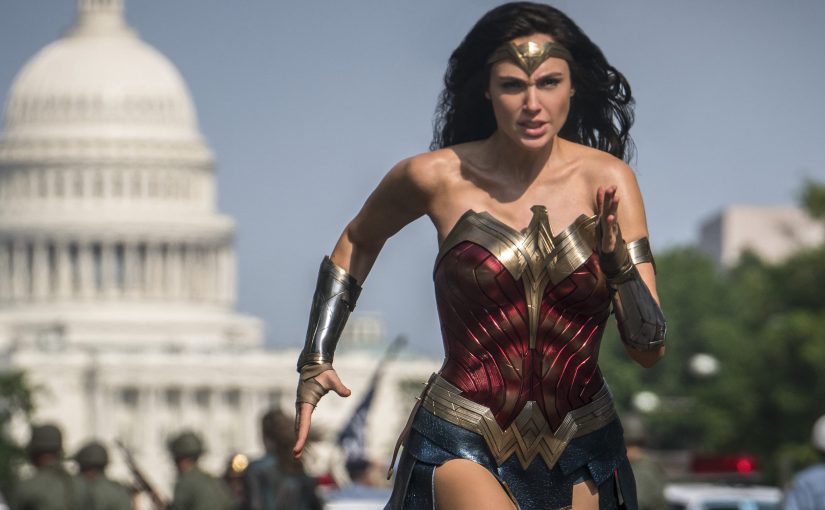
Actress Gal Gadot’s breakthrough role is Diana, Princess of Themyscira. The character was carved out of clay by the God known as Zeus to grant a wish to her mother, Queen Hippolyta (Connie Nielsen) for a daughter. She was then raised by Amazon warriors on this isolated island, cut off from the outside world, and populated only by women. When a World War I German plane piloted by Steve Trevor (Chris Pine), an American spy working for the British, crashes into the waters of Themyscira, Diana rescues him. The two partner up in the real world of The Great War, and Diana now introduces herself as Wonder Woman.

The storyline to the much awaited DC Comics hero adaptation is pretty pedestrian. Diana’s naivety puts her on this path to fight in the war to locate the evil God of War, Ares. If she kills Ares, the war ends and everyone lives happily ever after in peace. That’s her impression at least. Trevor has a much more grounded perspective, though he doesn’t squash Diana’s wild imagination.

Wonder Woman is a very welcome film because of its outstanding cast. Gadot is a good actor and the camera loves her. She’s got great chemistry with the always reliable Chris Pine, who is just as good here as he is with the Captain Kirk role. David Thewlis from the Harry Potter films is the English militarist who assigns them to a dangerous mission on the European front lines. He’s great too. I don’t see enough of him in films. Connie Nielsen is fine along with the influential warrior, Antiope (Robin Wright) who teaches Diana how to be a powerful fighter. They’re all entertaining and different kinds of super beings than what we’ve seen in say all the Marvel films. As well, director Patty Jenkins proves that gender should not be a factor in the capabilities of excellent direction. She stages plenty of good moments.

HOWEVER!!!!!!

The plot, as I said before, is very simplistic; kind of boring actually, and immature. Maybe that’s because the villain(s) of Wonder Woman are not very exciting. Danny Huston is flat as a German commander who absorbs a mustard gas chemical that alters his facial appearance for a fleeting moment to offer some CGI effect. However, we never really see him fight anyone, especially Diana. He just walks into rooms and has really nothing to say or do beyond that. There’s also a disfigured scientist who goes by the comic booky name Dr Poison. Oooooo!!!! Scary!!!!! No witty puns. No interesting skills except for a plastic, deformed facial mask. She just sits at a desk and appears studious. An interesting red herring reveals itself late in the film but that’s not available to carry the picture from the beginning. So the journey is bland.

Because the plot is very trying, the film runs a little too long. There’s a lot of talking moments that do not advance or progress the storyline. As I watched the film for only the second time, I kept regarding multiple scenes as cutting room floor material. There’s just a lot of fat to this film that could’ve been trimmed.

Honestly, I was hoping for more adventure. While the CGI is quite apparent, I can forgive that because Patty Jenkins made a great looking film nonetheless. Gal Gadot looks great in the fight sequences and the war torn European sets are really absorbing. However, when you break it down there’s really only three action scenes in this overly long picture. The supporting cast is fine. There’s humor and heart to the film. I like the moment when Diana tries ice cream for the first time. A sweet moment to humanize the character. Pine and Gadot are great scene partners too. I just think that if the story and motivation of Diana was stronger that we could have had a more substantial script. I mean, really? Find a guy in all of Europe, who’s actually a God of War, kill him, and then suddenly everyone will drop their weapons and make love or bake and sew? Is that what’s going to really here by film’s end? I was cringing often as Diana would insist on this being the only resolution to The Great World War. It just sounds too silly for me to swallow.

Warner Bros with DC films almost always, JUST ALMOST, gets there. Not withstanding the dreadful Suicide Squad, they get good actors to play their heroes. The directors are at least decent. They all blend well together but they go cheap on good screenwriters. I keep holding out faith. After six (I think) films in their “Justice League” universe I’m holding out for that 100% score on the next film. “Wonder Woman” is likely only second best for me behind “Man Of Steel,” but I’m thinking the studios still might have something better up their sleeve that we have yet to see. For the time being, I’m remaining optimistic.

STAR TREK (2009)

By Marc S. Sanders

Well Batman did it, and James Bond did it.  So why can’t Star Trek do it too? 

JJ Abrams adopted another franchise to direct when he rebooted the outer space western originally conceived by Gene Rodenberry over 50 years ago.  He did well with it too, if you are willing to dismiss the final polish to the look of the picture that Abrams couldn’t resist.  Not so much a polish as it is a tarnish, unfortunately.

I was late to the party of realizing that Abrams has a terrible habit of using “lens flares” on many of his films.  Now that I’m attuned, I can’t help but notice.  I typically get quite entertained by his pictures.  Mission: Impossible III is still the best of the series as far I’m concerned.  The Force Awakens thankfully carried the original trilogy tradition of the Star Wars franchise.  His one original film that he directed, Super 8, is criminally underrated.  However, those films were spared the over saturated and very unwelcome lens flare that dominates his first Star Trek film.  The film opens with an outstanding special effects battle as a Federation starship is being overwon by a Romulan war ship.  The sets of the bridge and decks of the ship are slanted to emote chaos.  There are sparks of fire falling all over the place.  Crew members are being sucked into space, and falling over each other.  And there’s lens flares aplenty which are not so distracting within all the hysteria depicted.  The scene climaxes with the birth of one of the two most celebrated franchise characters, James T Kirk.  It’s a spectacular opening sequence that seems to uphold the traditions of Star Trek while feeling fresh with outstanding visual effects.

Afterwards, the visual effects stay on course with the updated technology that Hollywood now relies upon.  Nothing here looks CGI.  It all feels tangible, hot, and operationally functional.  Abrams accomplished a great looking science fiction film, but then he and his cinematographer spray painted a graffiti of light streaks that never end.  Crew members will be walking down a hallway – there’s a lens flare.  A character gets abandoned on a deserted snow planet – there are more lens flares.  A bar fight occurs, only to be blinded by lens flares.  Every time a guy throws a punch, it’s literally followed with a lens flare.  A hearing in an assembly room takes place.  Why do we need streaks of light in here of all places?  If I were on vacation and taking in the sights of the Golden Gate Bridge in San Francisco within this future, my pictures would be terrible.  Apparently, lens flares have taken over the state of California.  (I guess I should be thankful knowing the state did not in fact eventually sink to the bottom of the ocean.)

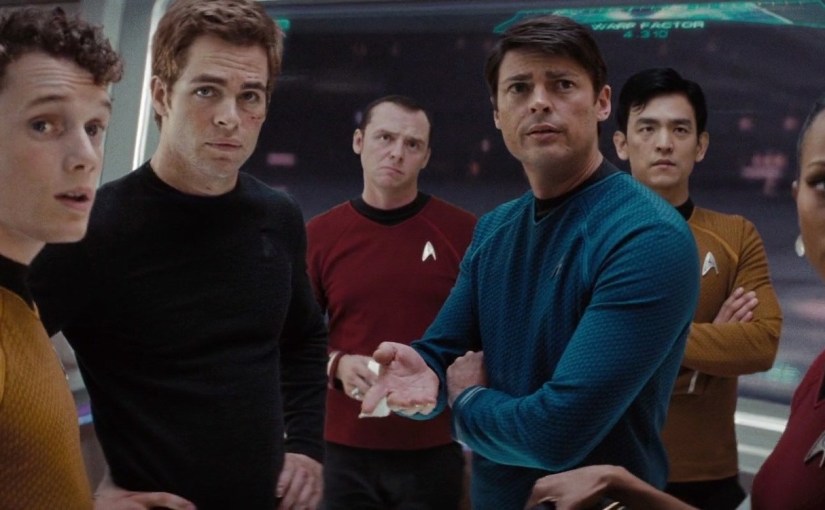
The rebooted story line is fine, yet simple.  A Romulan terrorist named Nero (Eric Bana) from a further distant future is obsessed with exacting revenge on Spock.  Next to that plot, this film serves more as opportunity for production company Paramount Pictures to reintroduce the beloved seven main characters of the original series of television and films with new actors.  Chris Pine is one of the best casting selections.  His Captain Kirk is his own performance and yet when he finally sits in that captain’s chair on the bridge, I could recognize the stature and expressions of William Shatner.  He gives a nice salute to the character and the original actor who played him.  Zachary Quinto is also good as Spock, though this character is distant cry from the original Leonard Nimoy portrayal.  I found it interesting.  This Spock has greater challenges with emotions harbored in the human side of his brain.  Karl Urban is fantastic at taking over the reigns of DeForrest Kelley as “Bones” McCoy, the Enterprise’s eventual resident doctor.  Urban is given the opportunity to be hilariously cynical upon his entrance into the film.

While the visual effects and sets are at the top of their game with Abrams and crew sparing no expense, it is a little eye opening to see the sexuality of the characters take a step forward.  Abrams is not shy about showing Zoe Saldana as Uhura disrobe into her under garments with Kirk standing on the other side of the bedroom.  I’m not offended or prudish about this material but was it really necessary to go with the Porky’s angle?  It doesn’t have to be a requirement to take some of the most beautiful actors in the world and get them to strip to uphold a film.  Star Trek always had much more to offer than that.  Scenes like this come off like a cheap shot.  Pine and Saldana are better actors, worthy of favored franchise fare (DC and Marvel films) than just material like this. 

There are some surprises in this reboot for both the casual and obsessed fans.  It’s kind of welcome actually as it takes the familiar universe of Roddenberry’s conception and turns it on its head.  Certain well known locations and characters arrive at unexpected fates.  Though, unfortunately, the alternate timeline motif pushes its way through the middle of the picture.  I fear for these kinds of stories.  All they do, time and again, is open up unanswered and (forgive me for the pun) illogical answers.  Marvel and DC films are on their way to doing this with their upcoming films following the year 2021 and I can see the whole thing unraveling at the seams.  Was it necessary here, though?  I really didn’t think so.  Abrams had an opportunity to win back an appearance of an actor from the original series and it seemed forced into the film like a square trying to fit into a circle.  The older installments had their moment in the sun.  Let that go.  Focus on this new cast and this new vision.

Again, this Star Trek is a gorgeous looking film full of color and clean looking set designs all around.  The bridge of the Enterprise is something that I’d love to see in person.  The cast is actually quite perfect filling the shoes of their respective roles.  However, JJ Abrams tried too hard I think with a couple of plot developments, and an extremely distracting and very unwelcome LENS FLARE.  I KNOW I’M REPEATING MYSELF.  YET I’M NOT BEING ANY MORE REDUNDANT THAN ABRAMS WAS WITH THE STUPID BLINDING PIECE OF LIGHT. 

Maybe the next time I watch this picture, I’ll wear my sunglasses.