THE CHAMBER

By Marc S. Sanders

Having recently read John Grisham’s fifth novel, The Chamber, I opted to watch the film adaptation directed by James Foley. 

First, allow me to say that Grisham’s novel is primarily stale and boring.  That’s only because his nearly five-hundred-page best seller is occupied with a lot of legal procedurals and tactics necessary to get a convicted, racist murderer off of death row before his scheduled date of execution.  Grisham permits moments where his characters can bond, become forgiven or get even more revolting with each other.  In between though are efforts of appeal after appeal.  It’s likely how it works.  A motion is carried out.  It’s rejected.  On to the next in line.  In fiction though, this is terribly redundant. 

James Foley’s film does not work that way, however.  In fact, it’s a much worse experience.

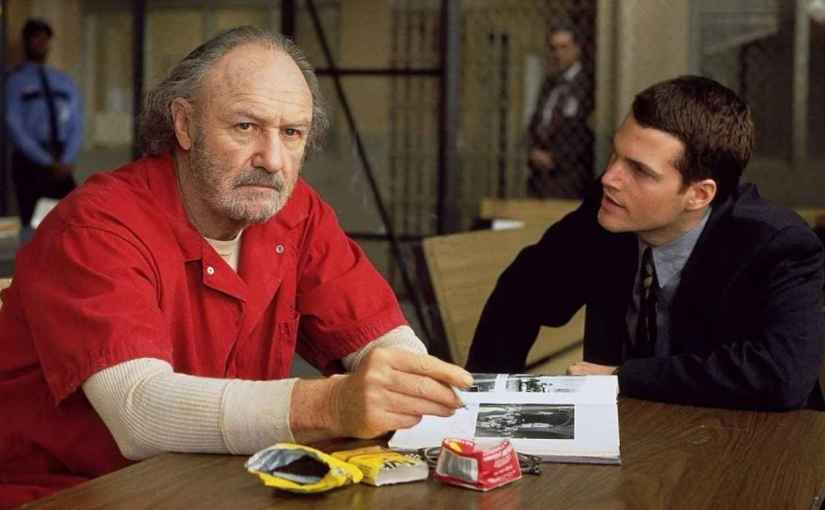
A grey bearded Gene Hackman with oily, stringy hair and tobacco-stained teeth is Sam Cayhall.  He’s a former member of the Ku Klux Klan who is sentenced to the gas chamber for the murder of two young Jewish boys who accompanied their father, a Mississippi civil rights attorney in 1967.  The father lost both legs and years later he took his own life.  Sam is considered solely responsible for bombing the lawyer’s office building. 

Chris O’Donnell plays Adam Hall, a twenty-six-year-old attorney eager to take on Sam’s case and get him off death row.  Sam will finally meet his grandson but he won’t be very welcoming.  Adam is adamantly against capital punishment and he’s repulsed by his grandfather’s past, but that is not enough to send the old man to the chamber.

IMDb trivia documents that screenwriter William Goldman (Butch Cassidy And The Sundance Kid, The Princess Bride) walked away from the film after six drafts.  Another credited screenwriter used a pseudonym to keep his name disassociated with this picture.  John Grisham considers The Chamber the least favorite of his film adaptations thus far.  I can imagine the suffering with trying to assemble something compelling on film.  Frankly, I don’t think it could ever be accomplished.  This stuff is either boring or ugly or both.  Try and project it on a screen and it will not deliver a message like Schindler’s List or Do The Right Thing.

Gene Hackman suffers the most from this film.  His character is clearly there, but the script and directing and even his primary scene partner, Chris O’Donnell, are not up to par.  Hackman puts in the energy with an old man white trash dialect.  He has the expected hateful outbursts of a Klansman.  His appearance is convincing too.  However, nothing he has to say is important.  He’s actually not hateful enough, even if he’s freely uttering the N-word or being derogatory towards the Jewish people who run the legal firm that Adam works for.  As well, the script does not offer empathy for him or enough remorse of his past sins. 

Chris O’Donnell is supposed to be the idealized grandson in the mid-1990s who feels shame for his family’s history of Klan participations and crimes going all the way back to his great, great grandfather.  Hardly any opportunity is offered for the young actor to feel this way.  He barely gets angry or empathetic when he shares scenes with Hackman.  Instead, his moments are wasted with a young staff member of the Governor, played by Lela Rochon. She has too large a role, especially when Gene Hackman could be doing more. The two prattle on about topics that result in no consequence. 

Faye Dunaway plays Hackman’s daughter, now a wife to a Southern aristocratic banker.  She’s a recovering alcoholic, which is assumed to be a residual cost of her father’s misdeeds.  Dunaway, this once great actress, has no connection to either Gene Hackman or Chris O’Donnell.  It’s as if she is not listening or properly responding to either of them when she appears.  Then again, O’Donnell is not lending his best towards Hackman either.  He’s very flat, very plain.  His character from Scent Of A Woman went on to legally represent his racist grandfather.  His Robin, the acrobatic DC superhero, has more personality and drive than this guy.

Thematically, John Grisham builds his thrillers off of what southern American law mandates.  Precedents become obstacles for his protagonists to overcome, or the characters have to learn to embrace what’s at their disposal.  However, it’s tempting to hinge on racial divides to serve as antagonism.  That’s tricky because if you emulate the hate and racism too much, then it looks glamourized. 

James Foley provides many exterior shots of uniformed modern-day Nazis and Klansmen marching outside of Sam’s penitentiary.  Others are there to applaud the death penalty for the old coot.  These are just visuals though.  They say nothing except enhance the image and platforms these sects stand for.  If a film is to bring prejudice to the forefront, then the screenplay or book better have something important to say.  Let’s study the science of hate and where it stems from.  Let’s focus on those who fight against such cruelty.  The Chamber just marches itself towards an inevitable conclusion with nothing gained in the process.

Fortunately, the author’s novel uses its five hundred pages to span the last four weeks before Sam Cayhall is to be executed, and in that time his grandson learns more of what transpired in the convict’s past.  Then the author delves into how Adam grapples with what he learns.  James Foley’s film only flashes back to one very ugly incident.  From there, it’s hardly discussed and it is definitely not focused on enough.  Foley stages the murderous events but his film has nothing to say about any of these things afterwards.  Adam hardly ever gets disgusted or even a little angry.  Sam never regrets or even champions what he’s responsible for.  These are just scenes from a book reenacted for a Hollywood film, and devoid of any emotional weight.  Do something guys!!!!!  Shock me!!!!

I have to credit what Gene Siskel and Roger Ebert observed about the film.  The racist, former Klan member, Sam Cayhall, steps out of his cell and walks down the hallway. A series of hands belonging to African American prisoners shake Sam’s hand through the bars, and they pump their fists in allegiance for their fellow prisoner.  In what world would this happen where the black occupants applaud the cellmate racist buddy?  Forgive the term, but I’d expect they would lynch this guy for what he did before entering this prison.  This kind of staging is an insult to the intelligence of what hate stands for in this country, where it was back in 1996, or nearly thirty years after the movie was released.  Why is The Chamber whitewashing what really happens? 

I was not fond of either the novel (a boring drag of a read) or the film (an insult lacking insight or sensitivity), but at least John Grisham did his homework. Racism is not to be sugar coated for what is genuinely ugly in this world.

BATMAN FOREVER

By Marc S. Sanders

Last month, upon hearing the news of Val Kilmer’s unfortunate passing, Joel Schumacher’s Batman Forever actively swept the social media rounds.  Fans of Kilmer praised his one and done occupation with the costumed role.  Some declared the film their favorite of all the superhero’s cinematic adventures and expressed their immense appreciation of the Juilliard graduate as Bruce Wayne and his vigilante persona.  He’s good.  Yeah.  I’m not going to say he’s great though because the film doesn’t offer much meat for Kilmer to chew off the bone.  As for the film, well, it’s a Joel Schumacher movie.  Should it be good?

The director took over the reigns from Tim Burton.  Michael Keaton opted not to return following two films and thus Kilmer was contracted.  The villains of the week are a very miscast Tommy Lee Jones as Two Face and Jim Carry doing a misbehaved class clown interpretation of The Riddler.  Unlike Burton’s noir approach, Batman Forever is gleefully campy and colorful with overly apparent winks and nods to Batman’s butt, codpiece and notorious chest nipples.  None of it necessary because it’s all wrapped in vinyl and plastic.  Buy the action figures if you want to cop a feel.

Akiva Goldsman was the head screenwriter.  His script carries no reluctance in delivering cliche dialogue.  “It’s the car right? Chicks dig the car!”  or “I’ll get drive thru.” (McDonalds was a proud sponsor.) Worse though are the two halves of the picture.  Kilmer’s Batman endures his ongoing traumatic psychosis of losing his parents, while Jones and Carrey go for a reiteration of the beloved Adam West slapstick TV series.  These two languages never speak to one another.  The hero and the villains hardly confront or challenge each other and never hold a substantial conversation during the course of the film.

Jim Carrey and Tommy Lee Jones try way too hard to duplicate what Jack Nicholson’s Joker portrayal memorably did the first time.  There is no backstory to Jones’ character except a brief news clip.  Otherwise, the middle-aged actor looks like he’s exhausting himself out of breath while trying to match Nicholson and Carrey.  As a Batman fan, he’s entirely wrong for this role.  The Two Face alter ego is the handsomely vain district attorney Harvey Dent.  According to comics lore, when Dent gets half his face grotesquely disfigured, he develops a deep-seeded anger to losing his looks and it leads to his ongoing villainy.  Tommy Lee Jones is a fantastic actor, but he is not the Adonis that Billy Dee Williams (Burton’s Harvey Dent) carried his charming career on.  The makeup job with Estee Lauder pink and purple is awful craftsmanship.

Jim Carrey is doing his usual schtick that skyrocketed his career with Ace Ventura and Dumb & Dumber, but it’s overly abundant here.  Goldsman, Schumacher and Carrey take equal blame.  This Riddler only offers three or four puzzles.  Otherwise, we get Carrey doing the Nicholson gags that should never have made the final print; a baseball pitcher tossing a curveball bomb in the Batcave and a mad scientist routine that drives the bad guy’s stupid plot line of using television waves to absorb the collective intelligence of the people of Gotham City.  The more this side story carries on the more mind numbingly stupid it becomes.  The Riddler’s device is nothing more than a kitchen blender that glows neon green while it hardly maintains balance on anyone’s head.  Junky production value.

Nicole Kidman is radiant as the next romantic Bat gal in line.  She’s so much better than this insubstantial material, though. She consists of zero significance.  Nothing else I can say.

Chris O’Donnell makes his first of two appearances as Dick Grayson, Batman’s sidekick known as Robin.  O’Donell actually has the most interesting storyline as a daredevil kid who tragically loses his family but can’t sit still when adventure awaits.  He gets into all kinds of mischief on his motorcycle and within the confines of Wayne Manor before he finally dons the famous costume. Yet, even when he’s standing in the same frame as Kilmer, both actors look like they are performing in different films.  One guy is hyperactive.  The other is morose and neither seems to be reading from the same script. Their chemistry is begging. Did these guys ever stop and develop an appreciation for one another?

Joel Schumacher applies a candy-colored polish to his Gotham City with black light graffiti, bright lights and more glow, glow, glow!!! Even the street gangs use neon glowing fighting sticks and Two Face’s henchmen work with neon red machine guns.  Oy!!! Enough.  Willy Wonka’s factory was not this sugary sweet.  Batman Forever is one film that can give you diabetes just by looking at it.

Other than an impressive opening scene with a helicopter and a cylindrical bank vault, none of the action sequences are worthy of postponing your bathroom break.  Batman’s fighting prowess and his ugly car and jet look like they are being run by an eight-year-old with his action figures.

So, as I noted before, I took another look at Batman Forever to explore what Val Kilmer did with the role.  He would have been a good Batman if he was given some things to do.  Ultimately, his dashing good looks complement Bruce Wayne’s suits and ties quite well and his square jaw fits perfectly in the mask.

What else can I say except I can’t imagine any chicks loving the car because this Batmobile has a pointless fin sticking out of the chassis and the wheels glow white, plus there’s an odd rib cage of lights on the sides of the vehicle.  Oh, and it drives up the wall of a building.  Is this where people are supposed to be impressed with Val Kilmer?

SCENT OF A WOMAN

By Marc S. Sanders

When it comes to Thanksgiving films, majority turn to that John Hughes road picture.  However, there’s another film that is just as meaningful to the spirit of the holiday and that is Martin Brest’s Scent Of A Woman which features Al Pacino’s Oscar winning Best Actor performance; at last!!!!

Before Chris O’Donnell became Robin in some tired Batman movies or a tough guy on NCIS, he was the staple prep school achiever (see also School Ties).  Here he plays Charlie, a student attending a prestigious boarding school in New Hampshire.  He does not have the wealthy background of his classmates and without the funds to go home for Thanksgiving, he opts to accept a weekend job tending to retired Lt. Col. Frank Slade, U.S. Army (Pacino).  Frank is a frightening lost soul with Pacino’s signature outbursts.  What’s even more challenging is that Frank has been plagued with blindness following a reckless accident with a hand grenade.  Unbeknownst to Charlie, Frank assumes control once his niece’s family leaves town for the weekend and sends himself with Charlie in tow to New York City.  Frank plans to enjoy a pleasant stay at the famed Waldorf Astoria, have a nice meal, crash his older brother’s holiday dinner, get a new tailored suit, bed a beautiful girl and drive a Ferrari.  Afterwards, he’s going to blow his brains out in full dress uniform.

This is not a problem Charlie needs to be dealing with right now.  The pressure is on the young man to identify the students of a prank that occurred just before the holiday break.  The Dean of Students (James Rebhorn) has given Charlie and another student, the privileged George Jr. (Phillip Seymour Hoffman, in a very early role) the weekend to ponder how they should respond.  Charlie, however, seems to face expulsion and likely an opportunity to miss out on admittance to Harvard.  George Sr., a former student and benefactor, will likely save his son.  Frank has predicted this outcome, and Charlie can’t deny that it is likely the truth.  Charlie’s dilemma is in his own morals as a man.  He’s not a snitch who will sell out his future to satisfy the esteemed integrity of the prep school and the ego of the Dean.

I miss the director, Martin Brest.  He has some magnificent films on his resume (Beverly Hills Cop, Midnight Run & Scent Of A Woman).  His other two popular films are broader in action comedy.  Here he is much more sensitive, and he uses the legacy of Pacino’s craft to the highest level.  He allows Al Pacino the freedom to be intimidating and frightening and intrusive.  A most uncomfortable Thanksgiving dinner at Frank’s brother’s house begins with awkwardness and ends in terrifying fear for Frank and all at the dinner table. 

Brest also lives up to the title of the picture.  There’s really not a main female character in the picture.  However, the camera captures a woman entering the frame at random times for Frank’s heightened senses to kick in.  If Frank is going to end his life soon, then he will at least absorb the finest things the world has to offer and that is a beautiful woman.  Charlie doesn’t realize this yet, having spent most of his days at an all-boys private school.  Martin Brest does such good work.  He’ll position his close up on Pacino doing his work and then a brown-haired young lady will enter from behind.  The scene will shift gears from morose to eye opening. Simple, yet great technique at play here.

Pacino may have won the Oscar, where some debate this was not his finest material and that it was a more likely a long-time coming career award at this point.  The portrayal has also become spoofed so many times over since the release of the film (Seinfeld) and “Hoo Ahh!”.  Still, look at the individual scenes on display here.  There are so many different angles to this guy.  Frank Slade is a lonely man who doesn’t directly identify his sorrow, but rather masks it with drill sergeant persona.  Yet, Frank is also a charming man who graciously does a sensual tango in the middle of a dining room with a beautiful young girl (Gabrielle Anwar).  Reader, if you are a regular subscriber to my write ups, then you know I adore a dance scene that occurs within a non-musical.  Scent Of A Woman may feature the number one ranked scene in that category.  Try not to grin or smile during this marvelous centerpiece.  How fortunate for Anwar – the one woman who got to do a tango on film with the great Al Pacino.  I’m thankful it is cemented in my consciousness for eternity.  It’s an amazing scene; one that can be taken out of context from the film and adored on You Tube, many times over.

Pacino and O’Donnell have brilliant chemistry together and it makes sense that the story takes place during the Thanksgiving weekend.  These are two men from very different backgrounds and neither realizes how much they need to be rescued by one another.  Charlie will have to literally save Frank’s life, no matter how intimidating he appears.  Frank will have to save Charlie’s future against an established school that’s offered up some of the country’s most brilliant minds.  Poor Charlie from Oregon, without the coat tails of a legacy to ride upon doesn’t fit the mold for the next President or championship football coach.  Both issues have insurmountable odds of being overcome, and yet these two are the only ones who plow through the challenges.

Scent Of A Woman has delightful moments to simply watch, such as a blind Frank driving a Ferrari through So Ho district and of course that tango scene, but this is an actor’s piece for sure.  The climax confirms that distinction.  The holiday weekend has come to an end and Charlie must face his peers and the Dean and confirm what he will do, but Frank will make sure to attend this makeshift trial. Then the opportunity is given for an outstanding monologue performance that only confirms one simple notion.  Al Pacino is one of the greatest film actors in history. I imagine the dialogue for this wrap up scene is quite something to read on a page.  However, to watch Pacino bring it to life is something else entirely. 

Therefore, on this Thanksgiving, I’m thankful for Al Pacino and Chris O’Donnell and Martin Brest, along with the tango, and I’m especially thankful for Scent Of A Woman.

SCHOOL TIES

By Marc S. Sanders

Robert Mandel’s adaptation of a story from Dick Wolf might be regarded nearly 30 years later as the film with the next generation of up-and-coming brat packers, but School Ties remains an underrated and topically important film nonetheless.  Just as it is still a problem of today, victimized by ignorance and unfounded bigotry, anti-Semitism was an issue that spread like a social disease within the confines of a prep school New England community in the 1950’s.

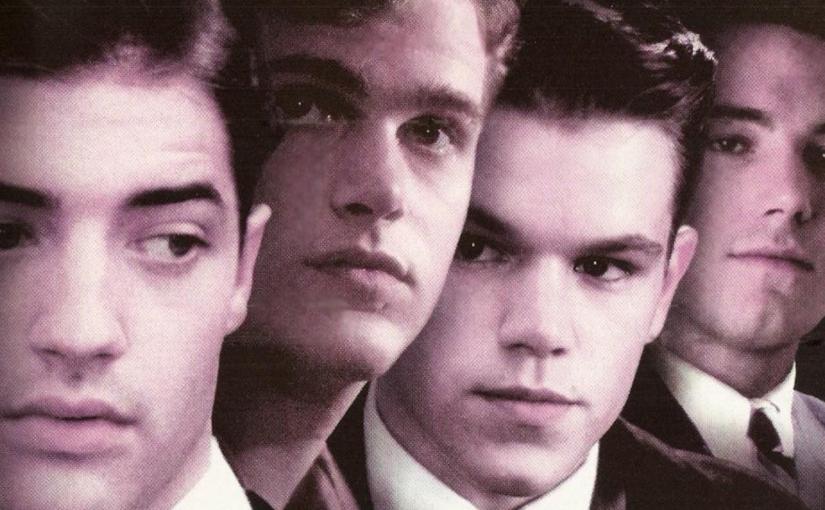
Brendan Fraser is David Greene, a high school senior awarded a scholarship at the school in order to usher in a championship football season as their quarterback.  David is well aware of his ultimate purpose for his scholarship and he brushes that aside as just one year of attendance will ultimately lead to acceptance at an Ivy League school.  He’s just like any other handsome boy attending the school, and he’s immediately accepted among the masses.  He’s hilarious at mischievous horseplay with the French teacher.  The beautiful girl (Amy Locane) at the nearby girls’ school is taken with him.  His football skills are applauded.  It may be a little surprising that he stems from the blue-collar town of Scranton, Pennsylvania and he buses the tables at dinner time, but David is an all-around okay guy who can knock over a linebacker while passing exceptional touchdown passes.  Amid this environment of different Christian denominations and WASP culture, however, David knows that he will stand apart if he reveals he is Jewish.  Therefore, he tolerates the casual jokes and accepts that it’s best to hide his Star of David necklace. 

The most important relationship occurs between David and his back up quarterback, Charlie (Matt Damon, before he became a superstar, but already looks like he’ll be a superstar).  Charlie begrudgingly accepts that David got to cut in line to be the star player.  As David becomes more of the celebrity on campus, Charlie is proud to be by his side.  Yet, Charlie has his own pressures to live up to as the fifth in line of his esteemed family who must carry on the legacy at the school followed by attending Harvard the following year. 

The roadmap of School Ties is easy to navigate.  You know when each note of the script is about to be played.  There will be a swastika that will shockingly appear.  Fist fights will happen.  The blue blood parents and faculty will interfere preaching their own “codes of honor” and the school’s storied 193 year history.  Yet, the film works very, very effectively.  The dialogue isn’t hokey and nothing feels like what could have been an after school special. 

No debate among the viewers.  Anti-Semitism is evil and thoughtless without merit or justification.  Questions appear where is it right to ask if David should have hidden his Jewishness or was he even lying about being Jewish, when in fact he just wasn’t even asked.  Is it right that David confronts his problems with his fists first?  Yet, Wolf’s script, apparently based on personal experience, delves further into the mounting pressures of these prep school kids who are primed from birth to be the latest model churned out from the respective family lineage for greatness in academics and athleticism.  Much of the material is devoted to the horror of actually not acing a class, and I appreciate that it’s not diminished to a standard line of “my parents are going to kill me.”  Raw emotion and stress are legitimized among these students.

The third act comes with no foreshadowing as a cheating scandal is suddenly introduced. Collectively the boys must debate who is the guilty party and why are they the guilty party.  Is it because one is Jewish, or is it because one actually cheated?  Good dialogue, good debate, but this also may be where the standard stuff spills over a little too much.  As such, the ending hinges on the third act, when it should have embraced more of the film as a whole.

The cast is made up of, at the time, soon to be superstars like Fraser, Damon, Chris O’Donnell, and Ben Affleck.  School Ties should be regarded as a winning audition for these guys’ careers that were only just on the horizon.  Their respective performances here are just as good as any of their most well-known roles, and they are happy to hide in the background as extras or step up for a camera shot.