THE HATEFUL EIGHT

By Marc S. Sanders

Quentin Tarantino’s eighth film, The Hateful Eight, has the signature director’s fingerprints all over, but it still stands apart from the rest thanks to a lurid, foreboding soundtrack from Ennio Morricone with an Agatha Christie narrative approach.

During a post-Civil War period, near the mountaintops of Wisconsin, an image of a crucifixion post is blanketed in snow as a stagecoach races past.  The cold symbol spells doom.  The coach is stopped by a curious, well-dressed man in the middle of the road.  This is Major Marquis Warren (Samuel L Jackson), a legendary black Union veteran, now bounty hunter.  With a fierce blizzard on its way, the Major convinces another bounty hunter, who has paid for the coach, to hitch a ride.  That man is John Ruth (Kurt Russell) and he’s escorting his ten-thousand-dollar bounty, a black-eyed unsavory Daisy Domergue (Jennifer Jason Leigh), to her hanging in the nearby town of Red Rock.  A would-be sheriff of that town eventually hitches a ride as well, Chris Mannix (Walton Goggins). The coach has to take shelter from an oncoming blizzard at Minnie’s Haberdashery, where four other men are already holed up.  They are Confederate General Sandy Smithers (Bruce Dern), the charming British hangman Oswaldo Mobray (Tim Roth), Cowboy Joe Gage (Michael Madsen) and the giant like Mexican Bob (Demian Bichir).  Tarantino has invented another collection of seedy two-dimensional characters whose unique appearances and vocal inflections set them apart from the rest of the gang respectively. Still, they are interesting enough.

The first celebrated performer of the piece is Morricone’s Oscar winning soundtrack which is totally eerie, sinister and immersive.  I go back to that carved out wooden image of Christ hanging from the cross and covered in snow.  Morricone’s music replays the same notes but with more intensity each time it starts up again.  It’s as if the Devil is luring us into his hellish lair.  If the famed Conductor’s chords could speak it would start with “Once upon a time, on a dark and stormy night…”

Twists of fate await all of these men and the one woman.  Like a mystery from Dame Agatha, the characters are set up for introduction to each other, with a little bit of back story.  The ones that especially stand out belong to Major Warren who possesses a personalized letter from President Abraham Lincoln himself.  The curious question of what could possibly merit a ten-thousand-dollar bounty for a small woman like Daisy is the other mystery I initially take notice of.  Once everyone is gathered at Minnie’s Haberdashery, how will these people intersect with one another?

The Hateful Eight plays like a short story you might find in a Reader’s Digest.  Taratino might correct me and insist that more specifically it would be found in a magazine of lurid subject matter – pulp fiction.  Go figure.  It is a theme he sticks to and continues to reinvent himself with each passing film.  The creativity comes in the new situations he constructs for his players.  He’s placed his figures in another kind of western by this point already.  He’s applied them to an alternate kind of Nazi occupied Europe during the second world war.  He’s updated swordplay in a zippy Dojo.  Now, he inserts his personalities into primarily a single setting, like Christie did time and again. 

Clues are uncovered as the film moves on to indicate that something may have happened here, before the stagecoach arrived.  There’s a broken door that needs to be nailed shut each time it is crashed opened.  A jellybean?  A chess board sits in front of the General and appears to be in the middle of a game.  And where is Minnie and Sweet Dave, the caretakers? The Major positions himself as the detective and within the small confines of this log cabin suspicions will reveal more about how the men and Daisy are connected and why they are here, now, while a harsh, unforgiving blizzard rages on outside.

The dialogue of The Hateful Eight is not as memorable as other Tarantino scripts.  Yet, the characters are just as colorful, and there are a couple of zips in time to keep you alert when a new development surfaces.  Tarantino is not shy about the bloodshed either.  The violence plays like most of his other films with a kind of slapstick twist.  A character gets violently ill and vomits blood all over Daisy.  That’s after a couple of wallops to the nose and jaw, plus a face full of stew that she’s had to endure as John Ruth’s handcuffed prisoner.  Later, someone’s brains splatter all over her. 

None of the guys are standard cowboys of the Old West either.  Goggins plays a good-natured dimwit.  Jackson is impervious to the racial name calling.  Russell is a cranky old grunt.  Your grandfathers did not take your fathers to Saturday matinee “ride ‘em into the sunset” westerns like these.  This is the most garish of material, and as in your face as it is, it’s also quite entertaining.

Tarantino has definitely graduated from the simplicity of his first films, Reservoir Dogs and Pulp Fiction.  The production value of The Hateful Eight is phenomenal.  Originally, I saw this movie in theaters with a couple of my Cinemaniac buddies.  Tarantino was proud to present it on 70mm Panavision film, complete with some intrusive lines and occasional burn spots.  Don’t tell me if this was not shot on location.  I don’t want to know.  I treasure the illusion. The deep snow-covered Wisconsin mountains are glorious to look at.  I feel completely absorbed in the setting with the harsh whispers of chilly winds happening outside as the dark blue of the snowstorm can be seen through the cabin windows.  This may be Quentin Tarantino’s most atmospheric film to date. 

This movie has a running time of three hours, but I strongly recommend to watch it without stopping.  The blu ray was a Hanukkah gift from my wife, and I tried watching the night before, but I kept having to pause it to struggle with a cold I’m currently fighting.  I only made it to “Chapter Four: Domergue’s Got A Secret.”  The next day, I told myself to start it from the beginning while everyone was out of the house and the experience was very fulfilling as Tarantino’s wintery day moves into night and then finally reaches its bloody conclusion. 

The Hateful Eight works like a graphic novel come to life.  It’s a great late-night rainy-day kind of picture.  If you haven’t seen it or it’s been a while since the last time, like it was for me, then I recommend checking it out during this winter season.  Trust me.  It just wouldn’t play as well on a hot summer night in July.  Quentin Tarantino and his cast work better when they are at their most cold blooded.
HAIL, CAESAR! (2016)

by Miguel E. Rodriguez

DIRECTORS: Ethan Coen & Joel Coen
CAST: Josh Brolin, George Clooney, Alden Ehrenreich, Ralph Fiennes, Scarlett Johansson, Tilda Swinton, Channing Tatum
MY RATING: 7/10
ROTTEN TOMATOMETER: 86% Certified Fresh

PLOT: A movie studio “fixer” in 1950s Hollywood faces his biggest challenge yet when the star of the studio’s most prestigious film in production is kidnapped by a shadowy organization calling itself, “The Future.”


The word “idiosyncratic” feels like it was invented for the Coen Brothers…or maybe vice versa.  Their 2016 film Hail, Caesar! is yet another case in point.  Packed with the kind of early Hollywood detail we wouldn’t see again until 2022’s Babylon, this film is a love letter to the 1950s studio system that produced such classics as All About Eve, Stalag 17, The Bridge on the River Kwai, and Ben-Hur.  However, the comic story surrounding this love letter is a bit rambling and disjointed.  About halfway through, I found myself wondering if maybe the movie wouldn’t have been better if the filmmakers had just ditched the comedy and made a straight-up drama.  But then we got to the climax, and I realized, no, comedy is better for serving up the kind of silliness we get at the end.  It’s no Raising Arizona, but it’ll serve.

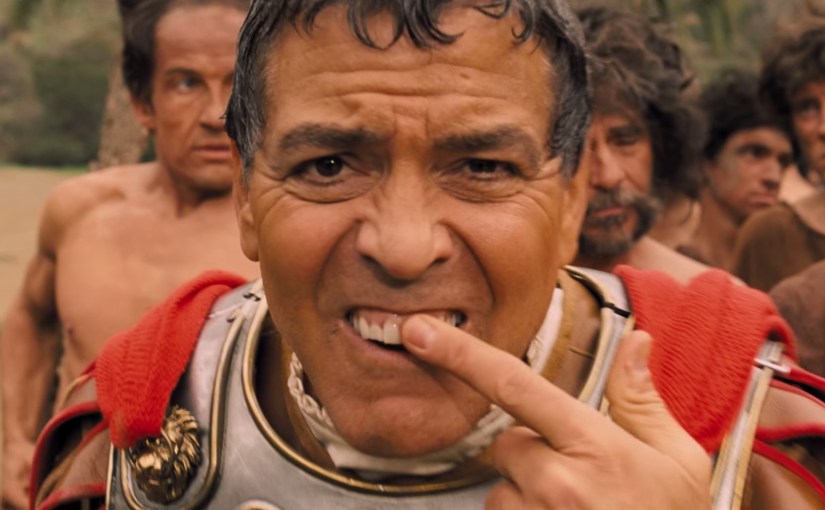
In classic film noir fashion, a narrator (Michael Gambon) informs us that Eddie Mannix (Josh Brolin) is head of production at the fictional Capitol Pictures, which is in the middle of shooting its most ambitious picture ever, an epic Biblical tale called Hail, Caesar!  (Think Ben-Hur with a lower budget and an outright plagiarized screenplay.)  However, their leading man, the improbably handsome and incredibly dumb Baird Whitlock (George Clooney), abruptly goes missing when he is kidnapped by a couple of lurking extras.  Mannix must deal with finding Whitlock while also figuring out what to do about:

  1. DeeAnna Moran’s (Scarlett Johansson) unexpected pregnancy.
  2. Hobie Doyle’s (Alden Ehrenreich) inability to deliver lines without a cowboy accent, which infuriates his director, Laurence Laurentz (Ralph Fiennes).
  3. Two persistent gossip columnists (both played by Tilda Swinton) who are running stories on Whitlock’s disappearance and/or salacious rumors about Whitlock’s past.
  4. A lucrative job offer from Lockheed.
  5. His promise to his wife (Allison Pill in a tiny role) to quit smoking.

Whew!  And I haven’t even mentioned the singer/dancer Burt Gurney (Channing Tatum) or the mysterious group of academics who have apparently kidnapped Whitlock, a group calling itself, “The Future.”  …spooky…

As in many other of the Coen Brothers’ films – not ALL of them, but many of them – the story itself is not really the point.  It just serves as an excuse for Ethan and Joel to present the viewer with scene after scene demonstrating their immense affection for a bygone era of filmmaking.  When Scarlett Johansson’s character, DeeAnna, is introduced, for example, we don’t just get a line or two about what she does (she’s an aquatic star modeled after Esther Williams).  We’re treated to an elaborately choreographed scene with dozens of bathing beauties, ScarJo diving from a great height wearing a mermaid tail, and a mechanical whale complete with a spouting blowhole.

At one point, Mannix visits the chief film editor for the studio, C.C. Calhoun (Frances McDormand), to see how Mr. Laurentz’s film is shaping up.  This scene in particular is lovingly presented, as we get a quick-cut sequence of Calhoun unspooling the film in the dim editing room, re-threading it, punching a button, flipping a switch, click-clack, click-clack, and Mannix watches the opening sequence of “Merrily We Dance” on the tiny Moviola as the projector whirs in the background.  I would bet real money that Martin Scorsese really, REALLY loved this scene.  (Plus there’s a nice little comic button at the end of the scene that is an excellent demonstration of Edna Mode’s immortal dictum in The Incredibles: “No capes!”)

The whole movie is like that.  It’s one of the most nostalgic homages to old Hollywood that I’ve ever seen.  But the movie can’t seem to make up its mind about what it’s about.  George Clooney puts on a clinic of how to play dumb as the clueless Baird Whitlock.  (In fact, this movie serves as the conclusion to the unofficial “Idiots” cycle of films from the Coen Brothers films, which also includes O Brother, Where Art Thou?, Intolerable Cruelty, and Burn After Reading, all of which star Clooney in a lead role…playing an idiot.)  Alden Ehrenreich is pretty convincing as a young star with a pretty boy face and limited acting ability, which I’m sure is far from the truth, but he pulls it off.  His scene where he tries to wrap his Texas accent around the simple line, “Would that it were so simple”, with his director patiently trying to coach him, is hilarious on its own.  But it runs on a little too long, as does the aforementioned scene in the editing room.  The subplot with the gossip columnists feels tacked on, almost as of the Coens were trying to pad the running time.  There’s a magnificently choreographed scene where we watch Channing Tatum’s character do some tap dancing dressed as a sailor for another movie being filmed, but even THAT runs a little too long.

Ultimately, Hail, Caesar! feels more like an intellectual exercise instead of an emotional one.  I hate to keep bringing this movie up by comparison, but Babylon, for example, managed to capture a nostalgia for Old Hollywood AND kept me emotionally involved for its entirety.  There was an energy that kept things moving.  Hail, Caesar! lacks that energy, but I can’t quite bring myself to call it a “bad” movie because I connected with its affection for the monolithic, flawed system that managed to create so many diamonds amid SO many lumps of coal.  (Just like today!)

THE LOST CITY

By Marc S. Sanders

Sandra Bullock’s film The Lost City is nothing more than rollicking fun at the movie theater.  A popcorn movie.  You can simply focus on gorging yourself with endless amounts of popped kernels and large fizzy drinks and you’ll never find yourself lost in a complex plot.  It’s a screwball adventure in the same vein of Romancing The Stone.  What I appreciate is that it is not a duplicate blueprint of Romancing The Stone.  Maybe just the opening scene, but no matter.

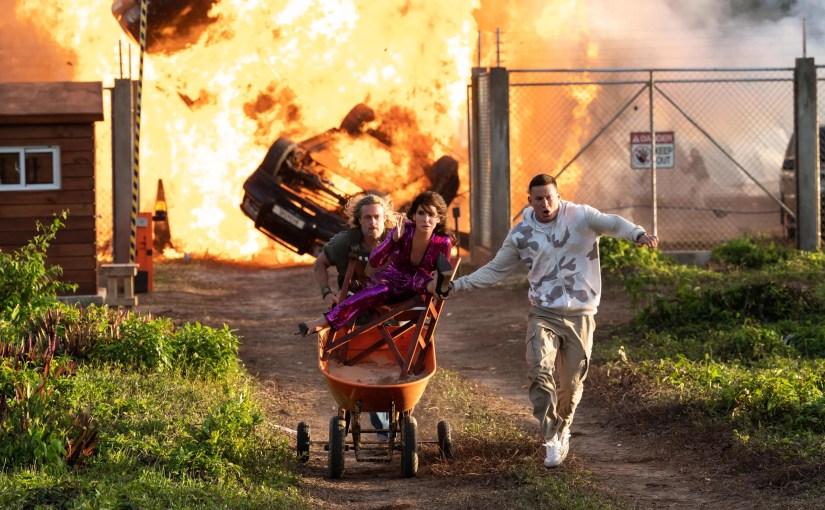
Bullock is Loretta, a reclusive romance novelist, who knows that her books are nothing more than cheesy pulp material to the umpteenth degree.  Her agent Beth (Da’Vine Joy Randolph) keeps a positive attitude as she encourages a book tour to promote Loretta’s newest installment in a series that follows the adventures of Loretta’s fictional swashbuckler.  That hero is preserved on the covers of her novels in the image of fashion model, Alan (Channing Tatum) – a Fabio inspiration.  Alan dons the gorgeous blond locks wig with the beefcake chest and the fans seem to go wild for him more than they do for Loretta’s work.  Even the glittery purple jumpsuit with stiletto heels that Loretta dons for an appearance at a book fair doesn’t deter the screaming fans away from Alan’s muscular build and chiseled chin.

When Loretta is captured by a spoiled brat of a villain known as Abigail Fairfax (Daniel Radcliffe), she finds herself having to research the location of a lost city on a remote island rumored to possess treasures beyond anyone’s wildest dreams.  Somehow, within Loretta’s fiction she implied the actual location of this place.  Abigail needs her to delve even further towards the destination.

This all sounds cliché.  It is, actually.  So what!

What saves The Lost City is the screwball comedic approach to the film.  Bullock and Tatum are nearly twenty years apart in age.  Yet, they make a great pair in the same way that Hepburn and Grant did in Bringing Up Baby.  I could care less about the actual lost city and whatever treasure was there.  The symbols etched on an old piece of parchment that Loretta attempts to decipher never mattered to me.  Two days after seeing the movie, I don’t even remember what the lost city revealed when they eventually got there.  I did like the endless pratfalls of Tatum and Bullock, however. 

Channing Tatum looks like the adventurer of a romance novel.  Yet, he’s nothing more than a pretty boy or a “mimbo” as Jerry Seinfeld might describe him.  He’s actually got a crush on Loretta and upon determining that she’s been kidnapped, he recruits the legendary problem solver Jack Trainer (who could only be encapsulated in the form of a gorgeously blond, tan and muscular Brad Pitt) to rescue Loretta.  It’s important to Alan, though, that he gets recognized as the savior.  So, he kind of learns as he goes. 

Adventures in the jungle abound.  There are bad guys on motorcycles.  Guns, of course.  Fires within Alastair’s luxury SUV. Rock climbing.  Rivers with leeches.  Dark caverns and on and on and on.  Yeah.  I’ve seen this all before.  Again, I say so what!  It’s just a fun time at the movies that brought me back to the fast-paced escapades found in the 1980’s films I grew up on.  Yet, it has its own spin thanks to the relationship of Alan and Loretta.

Daniel Radcliffe and his beard are also great characters.  It’s a nice departure from the shoe horned role that’ll never leave him as a certain boy wizard who will not be named here.  He just brings out his fun bratty side.  His beard seems to wink along with him.

A better side story could have come with Da’Vine Joy Randolph though.  As the agent goes from one traveling step to the next as she attempts to find Loretta herself, Randolph just doesn’t look comfortable in the role with her sky-blue pant suit and big breasted physique that is intentionally in your face.  Where’s the slapstick that should be accompanying her?  She’s specifically made up to look like diva luxury and you’re waiting for one disaster after another to befall her. Beyond having to fly on a puddle jumper plane carrying farm animals, she simply survives her trek unscathed.  Either this storyline should have been excised all together, or it should have been rewritten to be just as silly as what Bullock and Tatum are delivering.  A flop in the mud or a slip in the river would have helped this plotline. 

The Lost City is just a cute film for Sandra Bullock and Channing Tatum to look…well…cute together, and in a world where celebrities are slapping each other silly on live television, isn’t this a much better escape on a Saturday afternoon?

SIDE EFFECTS (2013)

by Miguel E. Rodriguez

Director: Steven Soderbergh
Cast: Jude Law, Rooney Mara, Catherine Zeta Jones, Channing Tatum
My Rating: 10/10
Rotten Tomatometer: 83% Certified Fresh

PLOT: A young woman’s world unravels when an anti-depressant prescribed by her psychiatrist has unexpected side effects.


Side Effects is a rare creature indeed: a movie released during the first two months of the calendar year that is not only good, it’s stunningly good.  It’s too bad almost no one even remembers this movie exists.

Steven Soderbergh’s film tells the story of a young woman, Emily (Rooney Mara), who suffers from depression after her husband returns home from serving a prison term for insider trading.  After a series of events where she apparently tries to harm herself, she sees a psychiatrist, Dr. Banks (Jude Law) who prescribes a brand new anti-depressant called Ablixa.  While it is effective, it also comes with some side effects, including sleepwalking.

One day, Dr. Banks gets a call: Emily has stabbed someone to death, and she did it while sleepwalking, which was caused by the Ablixa.  Banks interviews her; she remembers nothing of the incident.  But now the doctor’s professional and personal life is in turmoil as well.

What we have here is a classic Hitchcockian story…actually, two stories for the price of one.  You’ve got Emily, the wrong woman in the wrong place at the wrong time.  She didn’t ask for any of this.  She just wanted to feel better, be a better wife, be a better person.  And the drugs were working: she was feeling better, doing better at work, doing better with her husband…but now, thanks to this drug and its unintended side effects, people think she’s crazy.

And you’ve got Dr. Banks, the wrong man also in the wrong place at the wrong time.  He was doing his job, prescribing medication that he felt would help…and it WAS helping.  But thanks to this unforeseeable tragedy, his practice dries up.  Who wants to see a psychiatrist whose patient killed someone due to medicine he prescribed?  This creates problems in his personal life: he just bought a new apartment, but now his income is severely diminished.  He and his wife fight more than they used to.  And so on.

…and that’s where I’ll leave it because, like all the best films, it’s better if you watch Side Effects cold, not knowing what to expect.  No doubt there are people out there who saw the various twists and turns coming, but I am not one of them.  I was utterly hoodwinked, and I loved it.

We are a culture of pills and quick fixes, the quicker the better.  Side Effects is remarkably even-handed in presenting us with both sides of the worst-case scenario involving this culture.  (Or I guess one of the worst-case scenarios, but I don’t want to get sidetracked.)  Not only is this strategy effective in providing mental fodder while watching, but it’s also a great storytelling device.  Whose side should we be on?  Historically, “Big Pharma” has been one of the handiest movie villains since the Nazis.  The public perception of mega-corporations with billions of dollars at their disposal, dollars that are used to cover up embarrassing media stories and pay off corporate whistle-blowers, is just too perfect not to use in movies.  But Side Effects gives us the other side of that coin, the dedicated physicians and psychiatrists who are committed to helping people using the best available methods.  If a pill can help people, who would blame a doctor for wanting to prescribe it?  …unless the side effects turned out to be a little extreme?

That conundrum is at the heart of the movie.  But on the surface, it’s just a fantastic mystery/thriller.  Soderbergh directs with restraint, using very few camera moves.  Everything we see is presented with a minimum of flash and maximum impact, so when you’re watching the third act of the movie, you can remember everything you saw in the first two acts with great clarity.

It’s a little bit like a Gene Kelly dance routine.  You know he must have worked for hours to get those moves down, but when you see him in action, he barely looks like he’s working at all.  That’s what Side Effects feels like.  The film is telling a complicated story, but it doesn’t feel like it’s working hard.  It’s just gliding along, showing you this scene, showing you that scene, ho-hum, pay attention now, all leading to the fantastic payoff at the end.

I don’t know if Side Effects is available to stream or not, but I heartily recommend it regardless.