TWISTER

By Marc S. Sanders

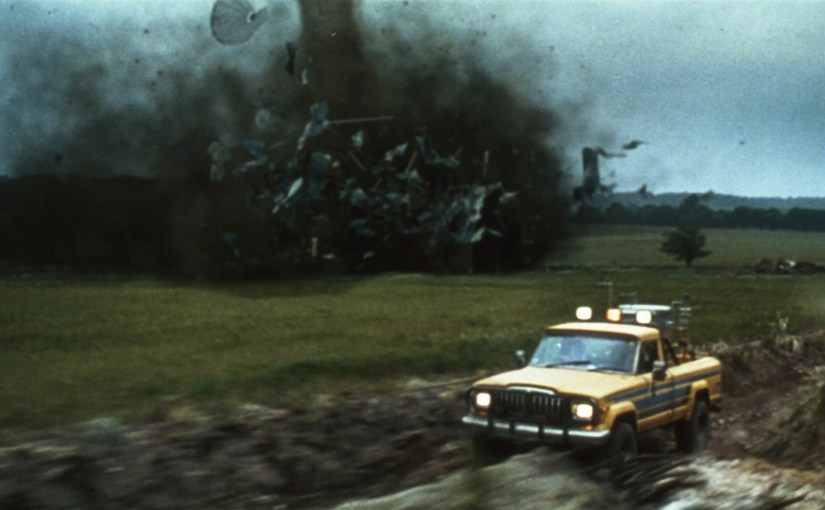
About twenty minutes into Twister, Helen Hunt and Bill Paxton crash their pickup truck while trying to outrun the title character.  Amid the high wind, mud and rain, they take cover under a narrow bridge.  Then Hunt’s character, Jo Harding, becomes enamored, almost hypnotized, with what she sees of the powerful storm and steps out saying she wants to see more while reaching with her hand.  Paxton’s character, Bill Harding, pulls her back down.  Reader, why did Bill have to pull Jo back down?  I don’t care about Jo.  I don’t care about Bill.  They’re not characters.  They’re talking objects.  The only character given any kind of care and treatment is the twister.  The next most important character is the next twister and then after that it is the next twister.

Jan De Bont’s Twister is devoid of a brain with a big head full of wind.

A thin story is inserted to connect these talking props.  Bill needs to convince Jo to sign divorce papers.  Jo is focused on getting a tin can thing named Dorothy into the center of a tornado so it can release sensors and thus their team will be able to study the characteristics of a tornado’s behavior like wind velocity for example.  With each new tornado, their attempts fail and somehow the team has another tin can ready to go.  Where are they hauling these things?  As well, how can such a clunky thing that looks less sturdy than a beer keg offer up so much information?  Dorothy looks like it can easily get its ass kicked by R2-D2.

I guess for escapist humor, Bill brings along his fiancé Melissa (Jami Gertz).  Melissa is here for a couple of lame reasons.  One, to wear a white suit with a fashionable hairdo that you know is bound to get messed up (but actually really doesn’t).  Two, to be used as the device for the rest of the cast to explain where they are going next and what they are seeing.  After whatever explanations have been exhausted, the script literally has her exit the picture in a quick announcement. 

I have not seen the new follow up film, Twisters, but I want to and I’m embarrassed to admit that.  It’s the special effects my dear reader.  The visual effects are all that is to be cared about in these movies.  Visually and audibly these effects are unbelievably impressive and I can only expect some enhancements in the new film.  Unfortunately, once I see one twister, I’ve seen them all.  I’m risking cavities for the five minutes of flavor I get in a Starburst.

What’s regrettable about Twister is that with a good collection of actors that also include Philip Seymour Hoffman, Cary Elwes, Alan Ruck and Jeremy Davies, the acclaimed author Michael Chrichton and Anne-Marie Martin hardly attempt to insert any intelligence into the science of weather phenomena or the trauma that goes with it.  I know just as little about tornadoes as I did before I saw this film. 

A prologue scene has Helen Hunt’s character witness her father being violently taken away in a sudden storm.  However, it is never referenced again.  I started to think about that monologue from Jaws performed by Robert Shaw about his experience aboard the sunken vessel the USS Indianapolis.  The scene is an actor’s dream, but it also makes the nature of the world we live in much more personal for that character.  Shaw’s character has a personal vendetta against sharks based on experience.  That’s what is missing from Twister.  None of it looks personal. Helen Hunt is an Oscar and Emmy winning actor.  She could have had a brilliant monologue that demonstrated her need to follow tornados and learn more about their unforgiving nature.  Chrichton even lent more passion to John Hammond (Richard Attenborough) in the film adaptation of Jurassic Park.  The entrepreneur talked of aspirations for a dinosaur zoo.  Jo Harding possess neither passion nor animosity for her purpose in life.  Twister could have operated better as an observational documentary than a special effects action picture.

Since a tornado cannot have an evil laugh or a handlebar mustache, there must be another source for villainy and that falls on Elwes and his crew.  Jo, Bill and the rest of the gang do not like Bill because he leads a convoy of black (black like Darth Vader) SUVs with the most up to date technology around to study weather patterns.  Yet, what is so wrong with any of that?  We have to hate these guys because they drive shiny SUVs.  Is that all it takes?  At best, the competition heats up as the two convoys nearly sideswipe each other or cut each other off on multiple occasions.  None of this is exciting.

A beloved elderly aunt is conveniently nearby so the gang can chow down and disgust Melissa with their eating habits.  Later, the aunt’s house happens to be in the path of a storm and then a sequence is devoted to rescuing her amid the crashing debris.  We get to see the beautiful mid-west house crash upon itself because to see another twister would just be more of the same.  I hardly got to know the aunt.  So, I don’t care if she lives or dies or becomes catatonic or turns into a superhero named Storm.  This is extra cream filling in an over expired Twinkie. 

The mouth pieces of Twister just don’t matter and while I’m dazzled by seeing a tractor, a cow, another cow (or was it the same cow?), and a house fly around and topple all over the roads amid the wind and the rain, I’m just not taken with any kind of suspense or care. 

Special effects only work if they are ingredients to a story, and not just the story. 

MISSION: IMPOSSIBLE DEAD RECKONING PART 1

By Marc S. Sanders

The object of the Mission: Impossible films is not to wow its audience with thought provoking questions of politics or Cold War intrigue or even daring and uncompromisingly evil villains (apart from Phillip Seymour Hoffman).  The elements of espionage coursing through the TV series are non-existent in the film adaptations.  I’m not watching a film based on a John LeCarre spy novel.  By the time the seventh installment has arrived, titled Dead Reckoning Part 1, the goal of the film series is to sketch out the set ups for one action piece after another.  Only they must be bigger, bolder, and seemingly that much more impossible to overcome for their hero, Tom Cruise (playing a guy named Ethan Hunt).  The action is once again top notch.  The glues that bind these displays of bravado together, you know where the characters have to talk and give us a semblance of a plot, is as nil as the scotch tape that assembles a stretch of film reel into a running time length of nearly two hours and forty-five minutes.

The locales are as grand as any travel getaway. We go through a labyrinthine airport.  A techno night club works as a meeting place for a bunch of characters. There are journeys to the Arabian Desert, Rome, Venice, and a beautiful ride along the famed Orient Express.  Shot on digital, this movie is a gorgeous travelogue.

Let’s get the problems out of the way, though.  The MacGuffin that Ethan Hunt and his trusty pals Benjy and Luther (Simon Pegg, Ving Rhames) have been assigned to recover is two parts of a specially designed key.  One part is supposedly with the disavowed MI6 agent Ilsa Faust (Rebecca Ferguson).  The other half is questionable as to who possesses it, but a thief known only as Grace (Hayley Atwell) may be significant in finding it.  Put the two halves of the key together and it will unlock something that no one seems to know of, or where it is located.  Here’s my first issue.  The audience does know what the key unlocks because it is shown in the first three minutes of the film.  So, while the cast of characters act dumbfounded, we know all along.  So, there goes any curious interest I may have for wanting to follow through with this. 

The other problem is that the same conversation happens over and over and over again.  Lines like (and I’m paraphrasing here, or maybe I’m not) “If this key gets into the wrong hands…” and “Whatever this does unlock, Ethan, could spell the end of the world…” or “It’s important that both halves of the key are not put together…”  or “Whatever this does unlock…”  (See?  Even I just repeated myself in this write up.) Except, we know what it unlocks!!!!!  The same exchange of dialogue occurs over and over.  The redundancy exhausts itself.  It occurs so much in fact that it’s writer/director, Christopher McQuarrie, relied upon the repetitive dialogue to stretch this next M:I chapter into two films instead of one (Part 2 is scheduled to be released in 2024).  I don’t recall the context of any of Ving Rhames’ lines going further than what I have presented here, for example.

The film is also a little too character heavy.  I never understood why two agents (Shea Wigham, Greg Tarzan Davis) are constantly pursuing Ethan.  Just was not clear for me. Heightened suspense?  That’s the best excuse I can think of.  The White Widow from the prior film (Vanessa Kirby) also appears.  Not much purpose to her.  Cary Elwes is the deputy director, there at the beginning and later towards the end, but again I was not entirely certain of his contribution to the story.  Even Ilsa Faust does not seem to have much value, except to work as a step in Ethan’s ongoing trajectory for the key.  I think Rebecca Ferguson had no more than five lines in the whole picture.

Finally, Ethan Hunt seems to be up against an omnipotent enemy, an AI program known as The Entity.  The humans doing the bidding of this phantom program consist of a goatee wearing Esai Morales and his henchwoman, played by Pom Klementieff.  She looks straight out of a James Bond picture and makes for a good car chase through the stone cobbled streets of Rome in a tank like Hummer.  Morales is as boring as most of the other the M:I villains.

What works for the film is what Tom Cruise really wants to impress you with though.  Riding a speeding motorcycle off a mountain and parachuting his way down.  That’s actually a near sixty-year-old Tom Cruise performing that feat.  Very impressive.  The car chase with a handcuffed Cruise and Atwell in a puny yellow Fiat versus an unbeatable Hummer and an army of Italian police vehicles is fun on the level of Roger Moore’s Bond films.  Most impressive for me is the final act where the famed Orient Express train tumbles off a bridge with a gap in the middle, car by car with all the furnishings, piano included, pouring out while Ethan and Grace hold on for dear life. 

It’s the high stakes stunts that work.  Whatever smidge of a story there is fails though.  The script by McQuarrie and Erik Jendresen lacks so much that the cliffhanger the film ends on doesn’t leave me yearning for more because it only hearkens back to the beginning.  The characters catch up to what the audience has known for the last three hours.  So, I’m not losing sleep wondering with what happens next.

Of course, I’ll go see the Part 2 installment.  Tom Cruise won’t let me down in whatever daredevil achievements he’s dreaming of doing next.  However, am I going to these movies to watch Mission: Impossible, or to watch an aggressively updated version of Circus Of The Stars?

KISS THE GIRLS

By Marc S. Sanders

When you’re watching a movie and one character says “Now wait here. Let me handle this!” what do ya think is gonna happen? When you’re watching a movie and one character says “Kate, we’ve covered every inch of those woods. There’s no building there!” whatcha think? You think there actually is a building there?

Let me ask you this, what do you think happens in the film Kiss The Girls?

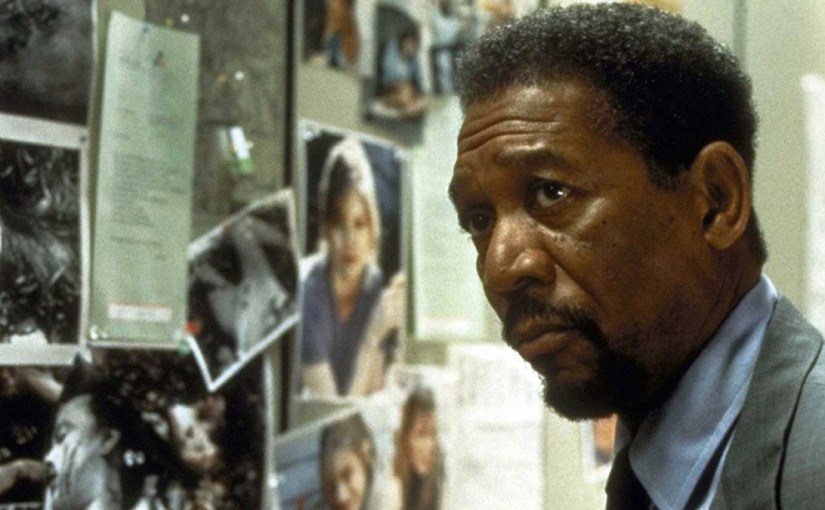
Yup! A whole lot of this nonsense and more that I could cover endlessly. Adapted from James Patterson’s best selling novel featuring his forensics detective hero Alex Cross, Kiss The Girls begins as an effective thriller focusing on the backgrounds of its two leads: dependable Morgan Freeman as Cross, and Ashley Judd as Dr. Kate McTiernan, a skilled surgeon with a specialty in kick boxing (that may come in handy later). At first, we see these characters handling snippets of storylines related to their careers. Cross defuses a suspenseful suicide situation. McTiernan has to console a family whose little girl was in a motorcycle crash. There’s good acting and emotion going on here and I was hoping the film would live up to the promise of these scenes; the characters’ expertise now being applied to Patterson’s main story. It doesn’t.

Instead, the movie just mires itself in plot holes and filler where one character insists on working alone while the other insists on not sitting idly by. This is not character development. This is ping pong volleying. Kate is kidnapped by a serial “collector” of smart, young, beautiful and highly intelligent women by someone regarded as “Casanova.” When Alex’ niece is one of the women taken, he travels from Washington DC to Raleigh, NC to join the investigation.

Soon after Kate has been taken, she manages to be the only one to escape from some hidden dungeon located in the woods. She joins Alex at every turn to find Cassanova and rescue the other captives. Okay. So that’s not a bad set up.

Where it falls apart is in the development. Kate managed to escape by jumping into a river where she’s retrieved by two kids. So wouldn’t law enforcement just sweep that entire area? I mean be really thorough, top to bottom! Surely, you’ll pick up footprints or scents from the dogs. Well, Alex says they did. Fortunately, his niece’s boyfriend finds the map. You know…the map that’s hidden in the library that no one else is aware of and shows this dungeon or whatever it is that’s there. Only one guy, ONE GUY, knows about this map????

When an hour and forty minutes has surpassed, you bet that map is gonna turn up. Remember, also when someone says wait in the car, the one thing you do is not wait. You know, this is a movie. So, Mr. Freeman, please spare me the act of surprise when Ms Judd walks into the bar you’re scoping out. This is all unnecessary, and boring and tired and old.

Kiss The Girls is another film with THAT TWIST! Was it really needed though? Just when the film apprehends the bad guy, and the ladies are recovered safely, there’s a gotcha moment in Kate’s kitchen with lots of knives and pots and pans to play with. Gary Fleder directed this 1997 disturbing thriller in a post age of The Silence Of The Lambs and Seven, which are far superior films. It’s not a film dependent on gore or torture porn, but it’s got the dark stone lined halls for haunted house creepiness. I’m good with that. It’s a thriller after all.

The film’s best assets, however, are Freeman and Judd. These are two top class actors who invest themselves in performance. If only they were working with a much more believable story.

It’s the implausibility in the script that make my eyes roll.