
By Marc S. Sanders
By the time a series of franchise films reaches its third installment there better be something interesting for the characters to encounter. Otherwise, it is the same old show. Not many talk about it, but Rocky III actually does have something new to offer even if the story still feels like the same kind of tread. What’s new? Mr. T!
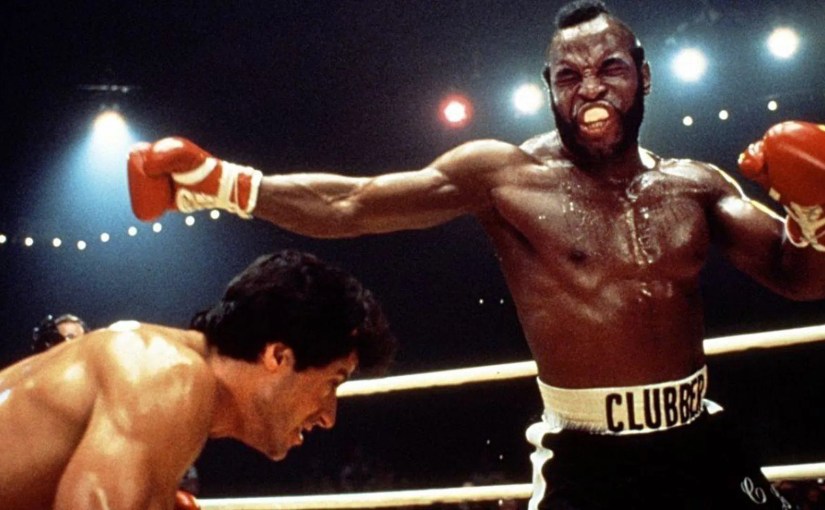
In the lexicon of greatest villains of all time Mr. T’s introductory role of Clubber Lang, the fierce boxer who lacks pity for a fool, should be included within these tabulations. Reader, I challenge you to find him listed anywhere. I don’t think you’ll be successful. Not even as a runner up. That is a terrible oversight.
As Rocky III opens with a quick flashback of Rocky Balboa (Sylvester Stallone who also writes and directs) winning the championship away from Apollo Creed (Carl Weathers), quick cuts of the hero show him knocking out one fighter after another with debonair ease. When he’s not boxing, he’s posing for commercials and magazine covers, or he’s riding his custom-designed Italian Stallion Harley with his wife, a glamorous Adrian (Talia Shire) on the back. Juxtaposed within this montage, played against one of the greatest songs in film history (Eye Of The Tiger by Survivor), is Clubber Lang executing bloodletting beatings on his own opponents. He’s angry and he threatens to kill Balboa in the ring. Rocky’s mainstay coach Mickey (Burgess Meredith) attends these fights and grows fearful of this new menace. Clubber will not give up on this campaign until he has his shot in the ring with Rocky.
Rocky III has a glossy finish the first two installments deliberately withheld. The photography is sharper. Stallone is quite handsome, rich and fit. Adrian has abandoned the meek bashfulness and nerdy, wing shaped eyeglasses. Their furnished house sits on a gorgeous estate complete with servants, a golf cart, and a little boy all their own. The filth-ridden areas of Philly are behind these protagonists. Welcome to the materialistic and decadent 1980s. Frankly, I like how nice and put together everything feels in Rocky III. It truly is a window into what much of the 1980s looked like. Stallone and Shire’s characters have evolved amidst their wealth, and I continue to like them.
The one ingredient that carries over is the alcoholic slob, Paulie (Burt Young), whose grumpiness hasn’t changed. He is a given a substory in the first ten minutes of the film where he shows his resentment for Rock. Then, the slugger bails him out of the drunk tank, gives him a job, and he only remains through the film for a few laugh bits.
(SPOILER ALERT) Following accepting the challenge to fight Clubber Lang, Rocky loses in terrible defeat just as Mickey suffers what will be a fatal heart attack. Not only does he lose, but he cannot overcome his sorrow, and fear has intruded upon his psyche. Apollo volunteers to train Rocky and encourages him to do one last fight against this new opponent, now champion. Only now, Rocky has to get that “eye of the tiger” back and he needs to move light on his feet like Apollo originally learned.
Everyone in Rocky III has an energy about them. These actors are used to one another even if Stallone and Weathers were on opposite sides for the last two films. Stallone’s script experiments with testing his boxing character to lose what he earned organically in his earlier films. He also sketches the guy with conceited fault ahead of the film’s first fight when he showboats his training and does not take this new fighter seriously enough. This is good material for a third follow up piece. It’s certainly more exciting than what Rocky II offered.
However, the film belongs to Mr. T who became a pop culture icon of the 1980s with gold jewelry, the mohawk, a TV action series, cartoons, toys and guest appearances on telethons, Johnny Carson, Diff’rent Strokes and Silver Spoons. Forty years later, he deserves some recognition for the impact he had on the American psyche. This guy was a big influencer. No one has ever replicated what Mr. T delivered. If you watch Rocky III again, you can’t help but get caught up in how hostile his Clubber Lang is. I doubt this guy was written this broad or aggressive in Stallone’s script pages. Clubber Lang is a villain that owns this picture anytime he appears on screen. Mr. T is not a diverse actor by any stretch but the personality that was introduced here is unforgettable. During both training and boxing montages, his muscular physicality is an astonishment, and he’s a terrifying new kind of monster with every threat he screams at this cast of likable heroes. This guy would burn the whole happy village down if given the chance.
I’m also impressed with Talia Shire. She’s not given much to do here. For the most part she is sitting in the audience, cheering on Rocky, or watching from the sidelines while he trains. However, there is one special scene that Stallone wrote for them that turns the tide of this ninety-minute film ahead of the inevitable, pulse racing training montage. Her scene of truth-hurting candor with Stallone’s character on California shoreline where all of the pain and anguish surfaces is carried by her against Sylvester Stallone, the superstar. It’s a reminder why the Rocky films were never anything without Adrian. The love of Rocky’s life has to always be there to rescue the lug from his despair and lack of confidence. I love this scene.
I would never argue with anyone who said this franchise became a sad joke upon itself by the time Rocky III rolled around. The formula is very recognizable. It’s not a tremendous sequel like The Empire Strikes Back, The Godfather Part II, or even Superman II demonstrated ahead of its release. Yet, there is a vigor to Rocky III, and the highs and lows are told efficiently at a very comfortable pace.
I saw Rocky III before I saw the prior two films and at age ten, this had my attention from beginning to end. It’s likely when I left the theatre, I wanted to be a boxer and pound someone’s flesh into a bloody pulp amid a cheering crowd. I recall the whole audience in the theater applauding as soon as Rocky triumphed again. I also recall the tears and sniffles I heard at the midway point when poor Mickey’s life suddenly ends. These are beloved characters that we only want to remain happy and healthy.
Rocky III is not accurate to how it really is for professional boxers. I do not think the well edited cuts of the fights are genuine either. A lot of the footage looks like an action movie more than a sports picture. When Clubber Lang swings with a jab, there’s a whooshing sound. However, Stallone as a writer/director knew how to touch on the melodrama effectively with laughs, sadness, fears and cheers.
With that amazing Bill Conti soundtrack, Survivor’s rattlesnake opening chords of their Oscar nominated song, Mr. T and, oh yeah, a giant named Hulk Hogan as a beast of a wrestler named Thunderlips, Rocky III is outstanding, pure escapist entertainment.
 2 UNPAID MOVIE CRITICS!!!!