DJANGO UNCHAINED

By Marc S. Sanders

Quentin Tarantino’s scripts have never been shy with using the N-word or any other colorful terminology.  He turns harsh and biting vocabulary into rhythmic stanzas of dialogue.  When he films these scripts, he’s not bashful with the buckets of blood splashed all over the set either.  His interpretation of violence works in a kind of slapstick fashion among his seedy one-dimensional characters.  Normally, I never get uneasy with his approach.  I know what to expect of the guy.  Yet, as well cast, written and formulated his Oscar winning film Django Unchained may be, I wince at both his word play and physical carnage.  I think Tarantino gets a little too comfortable with his slave era storylines and the African American actors he stages in his set ups.  A good portion of this Western may be thrilling, but it’s also cringy like watching a drunk uncle at a three-year old’s birthday party, and I defy viewers not to squint at the movie if they so much as live day to day with even the smallest shred of kindness in their hearts.

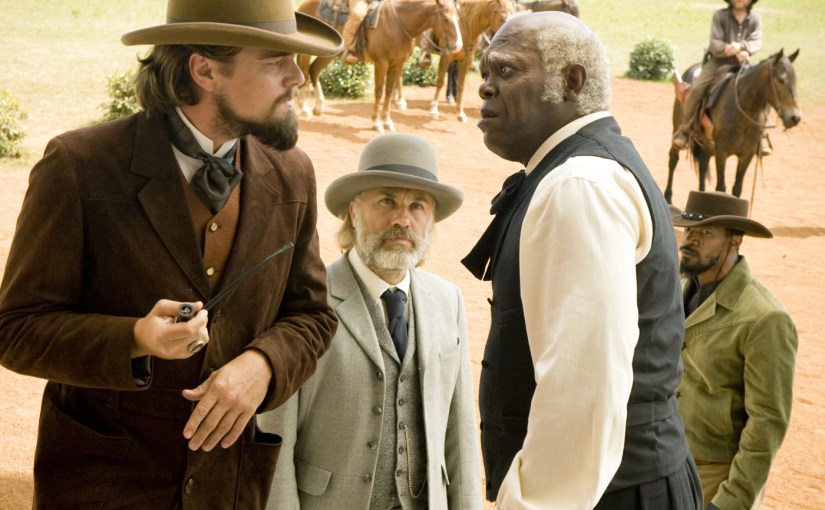
Django Freeman (Jamie Foxx) is released from slavery by the former dentist now bounty hunter, Dr. King Schultz (Christoph Waltz, in his second Oscar winning performance cast by Tarantino).  Django is a good man, though uneducated and mostly illiterate.  Once he assists the doctor with locating and collecting a bounty, the two make an arrangement to stick together through the winter collecting further ransoms.  In return for the former slave’s help, Dr. Schultz will assist in rescuing Django’s wife, the German speaking Broomhilda (Kerry Washington).  She is believed to be held at the infamous Mississippi slave plantation known as Candyland, owned by the ruthless Calvin Candie. He is played by Leonardo DiCaprio in one of his best roles while also delivering one of his most unforgiving portrayals.  Calvin Candie is a mean son of a bitch slave owner who has too much fun with investing in slaves for brutal Mandingo wrestling matches that don’t finish until the loser is dead in bloody, bone cracking fashion.  

All of these figures belong at the top of Quentin Tarantino’s list of sensational character inventions, particularly Django.  He has more depth than most of the writer’s other creations.  This guy goes from an unkempt, nearly naked, tortured and chained slave to a free man proudly wearing a bright blue court jester costume on horseback.  His third iteration places him in a gunslinger wardrobe comparable to a Clint Eastwood cowboy and when the conclusion arrives, Django is meaner, more confident and instinctively wiser, glamorously dressed (purple vest with gold inlay designer seems) like a graphic novel superhero ready to take on an endless army of redneck slave abusing outlaws.  Django is taught everything he needs to know from Doc Schultz.  Christoph Waltz and Jamie Foxx stand as an impressionable mentor/student pair.  They are the spine of Django Unchained.

The villainy of the piece belongs to DiCaprio and his head slave in charge, known as Steven, played by the director’s go to player for happy street slang and N-word droppings, Samuel L Jackson.  Steven is Jackson’s best career role because as an old, decrepit and frightening individual it’s this portrayal which looks like no other part the actor has ever played.    Both actors are funny, and you can’t take your eyes off of their unlimited grandstanding, but they will leave you feeling terribly uncomfortable.

I think what is most unsettling about Django Unchained is that the cruelty persists for nearly the whole three hour run time, and it is more so at a shameless attempt of comedic, pulpy entertainment, rather than just insight and education.  A Schindler’s List finds no glee in the torment that kept the Holocaust alive.  Tarantino didn’t even go to great heights with Inglourious Basterds because that film featured ongoing grisly heroics with his assortment of vengeful protagonists.  The Nazis were never celebrated in that film at the cost of innocent Jewish lives that faced peril and threat.

In Django Unchained, it’s hard to watch the Negro characters and extras getting brutally whipped while bound by inescapable chains.  Kerry Washington’s nude character is yanked out of a sweat box on the Candyland plantation and while I’m watching it, I ask myself if I’m too much of a prude.  No.  I don’t think I am.  This teeters on torture porn. The N-word is now being used way too freely to stab at the slaves for gleeful poetry. It grows tiring and, yeah even for a Quentin Tarantino picture downright ugly and offensive. I imagine Tarantino grinning behind the camera every time DiCaprio or Jackson happily drop another N-bomb.

Quentin Tarantino has been applauded time and again for his excessive abuse and tortuous murders committed by his characters.  Because he’s courageously gone so far before, the line of acceptance is either pushed out farther or maybe in the case of Django Unchained it is entirely erased.  

My compliments to a well-known humanitarian like Leonardo DiCaprio for energetically acting through this bastard of a role that requires a twisted pleasure in watching two husky black bruisers beat the bloody tar out of each other in a formal drinking parlor.  Later in the picture, a weeping slave is shredded to pieces by ravaged, bloodthirsty dogs.  These fictional scenes staged by Tarantino and his filmmakers come off a little too real and even by the director’s standards much too over the top for the temperature of this film’s narrative.  

What could these extras cast to play these slave and Mandingo roles have really been thinking while shooting this picture?  Did these men recognize the racially poetic humor in Tarantino’s verbiage? Did they find a commitment to demonstrate a once historic atrocity for a lesson learned? I doubt it. Did these actors simply succumb because they needed the work?  Believe me.  I empathize.  Yet, Tarantino took this film to a very uncomfortable extreme for a movie intended on following his reputable and always admired lurid material.  Here, despite my reverence for his work, I think Quentin Tarantino goes unnecessarily over the line.  The whippings and dog torture are quite uneven from what The Bride commits in Kill Bill when a Crazy 88 henchman gets spanked with a sword and there’s nothing to compare to whatever sick, graphic novel atrocities occur in his later western, The Hateful Eight – both are PG rated compared to what is offered in Django Unchained.

Much of Tarantino’s signature comedy works.  The Ku Klux Klan of the late 1850s are represented with brilliant stupidity by a cameo appearing Jonah Hill and a racist, foul speaking, plantation owning charmer played by Don Johnson, known by what else but Big Daddy.  The filmmaker turns these guys into bumbling stooges who can’t even wear their hoods properly. And yes, they also freely drop the N-word in cruel like fashion. I get it, Mississippi and Southern Plantation owners were not the Mickey Mouse sort, and I’m not asking for whitewashing what the real-life despicable characters stood for or how they carried themselves. Still, when all of this compounded together, it goes too far. In a drama like 12 Years A Slave, I see an authenticity to an ugly slave era. In Tarantino’s world, I see a kid who learned a bad word and dad said go ahead son, play with the machine gun but make sure the vocabulary ammo will riddle the entire script to pieces.

Django Unchained is a gorgeous looking picture.  Tarantino goes to the outdoor plains following the interiors of Pulp Fiction and Jackie Brown.  Jamie Foxx and Christoph Waltz’ cowboy antics look marvelous riding on horseback or even simply camping by the fire as well written exposition is revealed on cold moonlight evenings.  

I can watch this western on repeat and feel a free-spirited energy when Django steps out in his cowboy outfit with boots, spurs, the hat, and a brand-new saddle to ride off on his steed while Jim Croce’s uplifting “I Got A Name” cues into the picture.  I love how Jamie Foxx appears as a super heroic action star, especially in the final act of the movie.  I can absorb the sadism of DiCaprio’s downright mischievous evil, particularly when he uses a bone saw and skull prop to make a point.  I feel like I’ve gained a comforting friend in Christop Waltz’ kindly sensible Doc Schultz, and I welcome a very funny and altogether different Samuel L Jackson that finally arrives.  

It’s the filling within these strong moments and characterizations that is very hard to swallow.  Django Unchained is that great picture that still should have been made but with a modicum of caution. Perhaps one of the Weinsteins, or maybe even these powerhouse, marquee actors who led this piece should have shared some constructive input with the writer/director.

Django Unchained is fun, but it’s not entirely fun.

SILENT RUNNING (1972)

by Miguel E. Rodriguez

DIRECTOR: Douglas Trumbull
CAST: Bruce Dern, Cliff Potts, Ron Rifkin, Jesse Vint
MY RATING: 5/10
ROTTEN TOMATOMETER: 71% Fresh

PLOT: In a future where all plant life on Earth is extinct, an astronaut works to preserve the last of Earth’s flora, kept in domed greenhouses aboard a spacecraft.


Silent Running was directed by Douglas Trumbull, a visual effects specialist whose VFX credits include Close Encounters of the Third Kind, Star Trek: The Motion Picture, and Blade Runner.  In 1968, he worked with Stanley Kubrick as the Special Photographic Effects Supervisor on 2001: A Space Odyssey.  Shortly thereafter, he was given the opportunity to direct his own film.  With a script by Michael Cimino and Deric Washburn (who would both later go on to fame with The Deer Hunter), Universal Studios offered him a limited budget and final cut (!) as part of a project to encourage independent filmmakers in the wake of the success of Easy Rider in 1969.

With a crew of mostly college students as modelmakers, and with no directing experience whatsoever, Trumbull created a sci-fi parable that has some grand ideas, but it never quite achieves liftoff.  I don’t know how Silent Running reads at the screenplay level, but on its feet and on the screen, it slogs.

In an unspecified future, Bruce Dern plays Freeman Lowell, one of four astronauts living semi-permanently on a massive, mobile space station, the Valley Forge.  It’s part of a small fleet of similar spacecraft, each bearing several greenhouse domes housing the last remnants of Earth’s botanical ecosystem, including plants, trees, and small forest animals like squirrels, rabbits, frogs, etc.  The astronauts are tasked with protecting these greenhouses until the eventual call back to Earth (they’re currently in the vicinity of Saturn).

[Note: there is more than a passing resemblance between this plotline and that of Pixar’s Wall*E, but I’m sure that’s homage, not plagiarism.]

When the call comes, however, it’s not what they expect.  They’re ordered to detach the greenhouse domes from their ship, detonate them, and return home immediately.  No explanation is given.  These orders do not sit well with Lowell, and before long he’s alone on the Valley Forge with one dome left and only the ship’s waddling repair drones for company as he heads for the dark side of Saturn.

That’s about it for story.  Once he’s alone, there’s not much left for Bruce Dern to say or do except have one-sided conversations with the repair drones while he tries to teach them to play poker.  It’s clear that Trumbull’s focus was on putting his visual effect concepts on the screen in a way that would evoke 2001, but he did not appear to lose much sleep over pacing or plotting.  For a movie that clocks in under 90 minutes, there are endless shots of Lowell tending to plant and animal life, programming and reprogramming the drones, staring at the stars while confronting his guilt over his actions.  It’s almost a relief when he is forced to administer mechanical first aid to a drone that gets accidentally run over by an offroad go-cart.  (You read that right.)

There are too many other movies out there about castaways and solo adventures that were way more successful for me to give Silent Running a pass just because of its cult status.  There was never one exterior shot of the spacecraft that did not look like a model.  Explosions in space consist of a bright flare of light that dissipates quickly.  Bruce Dern’s acting is nothing to sneeze at, but it’s put to no good use.  It’s clear that Trumbull was counting on the effects to do a lot of the heavy lifting from a story-telling perspective, but they looked so fake that I was taken out of the story whenever they took front and center…which is a lot.

As a bookmark in VFX history between 2001 and the game-changing Star Wars, I suppose Silent Running does have some historical significance.  It’s clear the movie was made with tender loving care.  But from a cinematic perspective, it’s dull, dull, dull.

[Second Note: the film’s score was composed by Peter Schickele, a rather brilliant musician/comedian who is better known as P.D.Q. Bach.  The score is nothing memorable, but it includes two original songs sung by Joan Baez.  Yes, Joan Baez.  It’s a VFX-heavy sci-fi parable with two musical montages.  It takes all kinds…]

THE HATEFUL EIGHT

By Marc S. Sanders

Quentin Tarantino’s eighth film, The Hateful Eight, has the signature director’s fingerprints all over, but it still stands apart from the rest thanks to a lurid, foreboding soundtrack from Ennio Morricone with an Agatha Christie narrative approach.

During a post-Civil War period, near the mountaintops of Wisconsin, an image of a crucifixion post is blanketed in snow as a stagecoach races past.  The cold symbol spells doom.  The coach is stopped by a curious, well-dressed man in the middle of the road.  This is Major Marquis Warren (Samuel L Jackson), a legendary black Union veteran, now bounty hunter.  With a fierce blizzard on its way, the Major convinces another bounty hunter, who has paid for the coach, to hitch a ride.  That man is John Ruth (Kurt Russell) and he’s escorting his ten-thousand-dollar bounty, a black-eyed unsavory Daisy Domergue (Jennifer Jason Leigh), to her hanging in the nearby town of Red Rock.  A would-be sheriff of that town eventually hitches a ride as well, Chris Mannix (Walton Goggins). The coach has to take shelter from an oncoming blizzard at Minnie’s Haberdashery, where four other men are already holed up.  They are Confederate General Sandy Smithers (Bruce Dern), the charming British hangman Oswaldo Mobray (Tim Roth), Cowboy Joe Gage (Michael Madsen) and the giant like Mexican Bob (Demian Bichir).  Tarantino has invented another collection of seedy two-dimensional characters whose unique appearances and vocal inflections set them apart from the rest of the gang respectively. Still, they are interesting enough.

The first celebrated performer of the piece is Morricone’s Oscar winning soundtrack which is totally eerie, sinister and immersive.  I go back to that carved out wooden image of Christ hanging from the cross and covered in snow.  Morricone’s music replays the same notes but with more intensity each time it starts up again.  It’s as if the Devil is luring us into his hellish lair.  If the famed Conductor’s chords could speak it would start with “Once upon a time, on a dark and stormy night…”

Twists of fate await all of these men and the one woman.  Like a mystery from Dame Agatha, the characters are set up for introduction to each other, with a little bit of back story.  The ones that especially stand out belong to Major Warren who possesses a personalized letter from President Abraham Lincoln himself.  The curious question of what could possibly merit a ten-thousand-dollar bounty for a small woman like Daisy is the other mystery I initially take notice of.  Once everyone is gathered at Minnie’s Haberdashery, how will these people intersect with one another?

The Hateful Eight plays like a short story you might find in a Reader’s Digest.  Taratino might correct me and insist that more specifically it would be found in a magazine of lurid subject matter – pulp fiction.  Go figure.  It is a theme he sticks to and continues to reinvent himself with each passing film.  The creativity comes in the new situations he constructs for his players.  He’s placed his figures in another kind of western by this point already.  He’s applied them to an alternate kind of Nazi occupied Europe during the second world war.  He’s updated swordplay in a zippy Dojo.  Now, he inserts his personalities into primarily a single setting, like Christie did time and again. 

Clues are uncovered as the film moves on to indicate that something may have happened here, before the stagecoach arrived.  There’s a broken door that needs to be nailed shut each time it is crashed opened.  A jellybean?  A chess board sits in front of the General and appears to be in the middle of a game.  And where is Minnie and Sweet Dave, the caretakers? The Major positions himself as the detective and within the small confines of this log cabin suspicions will reveal more about how the men and Daisy are connected and why they are here, now, while a harsh, unforgiving blizzard rages on outside.

The dialogue of The Hateful Eight is not as memorable as other Tarantino scripts.  Yet, the characters are just as colorful, and there are a couple of zips in time to keep you alert when a new development surfaces.  Tarantino is not shy about the bloodshed either.  The violence plays like most of his other films with a kind of slapstick twist.  A character gets violently ill and vomits blood all over Daisy.  That’s after a couple of wallops to the nose and jaw, plus a face full of stew that she’s had to endure as John Ruth’s handcuffed prisoner.  Later, someone’s brains splatter all over her. 

None of the guys are standard cowboys of the Old West either.  Goggins plays a good-natured dimwit.  Jackson is impervious to the racial name calling.  Russell is a cranky old grunt.  Your grandfathers did not take your fathers to Saturday matinee “ride ‘em into the sunset” westerns like these.  This is the most garish of material, and as in your face as it is, it’s also quite entertaining.

Tarantino has definitely graduated from the simplicity of his first films, Reservoir Dogs and Pulp Fiction.  The production value of The Hateful Eight is phenomenal.  Originally, I saw this movie in theaters with a couple of my Cinemaniac buddies.  Tarantino was proud to present it on 70mm Panavision film, complete with some intrusive lines and occasional burn spots.  Don’t tell me if this was not shot on location.  I don’t want to know.  I treasure the illusion. The deep snow-covered Wisconsin mountains are glorious to look at.  I feel completely absorbed in the setting with the harsh whispers of chilly winds happening outside as the dark blue of the snowstorm can be seen through the cabin windows.  This may be Quentin Tarantino’s most atmospheric film to date. 

This movie has a running time of three hours, but I strongly recommend to watch it without stopping.  The blu ray was a Hanukkah gift from my wife, and I tried watching the night before, but I kept having to pause it to struggle with a cold I’m currently fighting.  I only made it to “Chapter Four: Domergue’s Got A Secret.”  The next day, I told myself to start it from the beginning while everyone was out of the house and the experience was very fulfilling as Tarantino’s wintery day moves into night and then finally reaches its bloody conclusion. 

The Hateful Eight works like a graphic novel come to life.  It’s a great late-night rainy-day kind of picture.  If you haven’t seen it or it’s been a while since the last time, like it was for me, then I recommend checking it out during this winter season.  Trust me.  It just wouldn’t play as well on a hot summer night in July.  Quentin Tarantino and his cast work better when they are at their most cold blooded.

MONSTER (2003)

by Miguel E. Rodriguez

DIRECTOR: Patty Jenkins
CAST: Charlize Theron, Christina Ricci, Bruce Dern
MY RATING: 9/10
ROTTEN TOMATOMETER: 81% Certified Fresh Fresh
Everyone’s a Critic Category: “A Movie Based on a True Story”

PLOT: Charlize Theron gives a searing, deglamorized performance as real-life serial killer Aileen Wuornos in Monster, an intense, disquieting portrait of a profoundly damaged soul.


The first time I tried watching Monster, some years ago, I watched it with my girlfriend, but we never finished it.  The scene where Aileen Wuornos (Theron) is attacked and raped, leading to her first murder, was so visceral that my girlfriend had to leave the room before it had finished.  Since that time, she has watched hours and hours of “true crime” documentaries about Wuornos and Bundy and Manson and Speck and so many others.  Go figure.  Having finally finished Monster on my own this morning, I believe she could be ready to give this movie another try, although I’m not sure the version of Aileen Wuornos portrayed in the film will have much resemblance to the one seen in all those documentaries.

In the past, I’ve enjoyed movies like Se7en and Silence of the Lambs and even Zodiac, featuring implacable, inhuman murderers with unfathomable motives and blank faces.  I enjoyed David Fincher’s series Mindhunters far more than I thought I would, despite its disquieting subject matter, partially because the killers portrayed in that series may seem normal at first, but they are eventually revealed to have massive personality disorders, genuine sociopaths with little to no consciences to speak of.  But in Monster, director/screenwriter Patty Jenkins (who wouldn’t direct another film until 2017’s Wonder Woman) denies us the ability to pigeonhole Aileen Wuornos so easily.  She pulls a Hitchcock/Psycho on the audience: getting us to root for the ostensible villain even as she commits one murder after another.

Jenkins accomplishes this by showing how a dysfunctional home life and a sometimes apathetic and cruel society ground down a young girl with the same kinds of hopes and dreams we’ve all had into a damaged woman desperately looking for a connection.  One such apathetic soul in the film says what I’ve thought so many times in my own past about anyone who makes questionable life choices: “Lots of people have bad lives, and they still choose to move towards the light.  Otherwise, we’d all be hookers and druggies.”  Well, sure, that’s easy for me to say, with two loving parents, a private school education, living in a 3-bedroom house and a steady job, etcetera.  But what choices would I have made if my father knew his friend had been molesting me for years and not only did nothing, but beat ME up for it?  What if, in my first job interview, the office manager hadn’t taken a chance on a teenager with no job experience and instead berated me for not having a master’s degree or my own apartment yet?

Monster is not a typical serial killer movie because, while it absolutely does NOT approve of Aileen’s murders, it does not try to pretend she is a mindless, man-hating predator.  She is motivated by hopelessness and, as it happens, love.  Aileen meets and falls desperately in love with a naïve young woman, Selby Wall (Ricci), the first bright spot in her otherwise bleak existence, and will do anything to keep her in her life.  If “anything” happens to encompass hooking and murdering the occasional john, for her it’s a small price to pay for the happiness she has been denied for so long.

Monster has the look of a film shot on a shoestring, much like Henry: Portrait of a Serial Killer, which enhances its authenticity, especially when it’s clear the movie was shot in the real locations visited by Aileen and Selby in real life.  Having lived in Florida for over 35 years, I recognized the feel of the locations, the city streets crowded with convenience stores and car dealerships and seedy motels.  I’m pretty sure I’ve actually been to the “Fun Stop” where Aileen and Selby ride the Ferris wheel.  The usage of these real locations made everything feel legitimate, almost like a documentary.  (Full disclosure: Selby Wall is loosely based on Aileen’s actual girlfriend, Tyria Moore, but Moore refused to allow her name or likeness to be used in the film and divulged little-to-no information about her personal life, so Selby’s character is an estimation at best.)

And then, of course, there’s Charlize Theron’s Oscar-winning performance as Aileen Wuornos.  Anyone familiar with the Wuornos story has seen her most famous photos.  Take it from me: the makeup department used every trick in the book to make Theron look like Wuornos’ double.  It’s uncanny, on par with Rami Malek’s transformation for Bohemian Rhapsody, down to the false teeth that subtly alter her profile.  She even shaved her eyebrows.  But those cosmetic marvels are nothing, nothing compared to Theron’s performance itself.  I recently watched Cate Blanchett in Tár and called that the greatest performance I had ever seen by a woman.  I must now amend that statement.  Theron completely sublimates her famously glamorous persona into a chaotic jumble of nervous speech patterns and a fake swagger and the rambling patter reminiscent of a junkie looking for her next fix.  The only time she ever seems at peace is in the arms of her lover.  This performance is even more remarkable considering how “non-flashy” it is compared to other movie killers like Hannibal Lecter or John Doe.  Sure, she has her outbursts, but rather than feeling like hammy histrionics, they felt raw, like watching hidden camera footage of someone genuinely losing their shit because of some deep personal loss and not because they got the wrong size coffee at Starbucks.  It’s a phenomenal performance.


Attention should also be paid to Christina Ricci’s performance as Selby.  It’s easy to lose sight of Ricci in a film that clearly belongs to Theron, but she pitches her performance just right as another needy soul looking for a connection and all too willing to overlook (initially, at first) the red flags of a girlfriend who comes home in a different car every other night.  Her home life may not have been as scarring as Aileen’s, but she will take any port in a storm offering relief from oppression.

I enjoyed Monster in almost the same way I enjoyed Aronofsky’s Requiem for a Dream.  These people are not the most sympathetic characters ever, or the most relatable, or even the most likable.  But I see how their dysfunctional backgrounds brought them to their desolate situations step by step, and it makes me wonder whether I would have done anything differently in their situation.  I’d like to think I wouldn’t turn to murder and/or drug use in my despair, but Monster made me realize there’s no way to know for sure unless I walk a mile in their shoes.  The last lines spoken in Monster, which I won’t spoil here, lay out the kind of misery Aileen Wuornos seems to have faced at every stage in her life.  Imagine how things might have turned out if she had just been given a chance.


QUESTIONS FROM EVERYONE’S A CRITIC

Best line or memorable quote?
“‘All you need is love and to believe in yourself.’  Nice idea.  It doesn’t exactly work out that way.  But I guess it was better to hear a flat-out lie than to know the truth at 13.”

After watching this film, did you want to learn more about the true story?  Why or why not?
I must be honest and say, no, I did not.  I do not claim that Monster tells the 100% true story from beginning to end.  It’s not a historical document.  It’s a piece of entertainment that strives for truth at the expense of slavish dedication to factual accuracy, and I’m okay with that.  I’m one of those people who believe JFK is a marvelous film, inaccurate though it may be, because it captures the feeling of what it was like during that timeframe.  The same with Monster.  I could watch however many documentaries on the life and death of Aileen Wuornos, and I can’t imagine any other piece of filmmaking approaching truth to any greater degree than this movie did.

FREAKS (2019)

by Miguel E. Rodriguez

Directors: Zach Lipovsky and Adam B. Stein
Cast: Emile Hirsch, Bruce Dern, Lexy Kolker
My Rating: 9/10
Rotten Tomatometer: 87% Certified Fresh

PLOT: A sheltered young girl (Kolker) discovers a bizarre, threatening, and mysterious new world beyond her front door after she escapes her father’s protective and paranoid control.


In the tradition of one of my very favorite sci-fi films, Midnight Special (2016), Freaks is a sci-fi mystery that doesn’t pander, doesn’t spoon-feed (except when it HAS to), and doesn’t insult my intelligence.  It premiered in 2018 at the Toronto International Film Festival, was picked up by a distributor two days later, and surfed the festival circuit for over a year, winning multiple awards, before finally getting a US/Canada release in 2019.

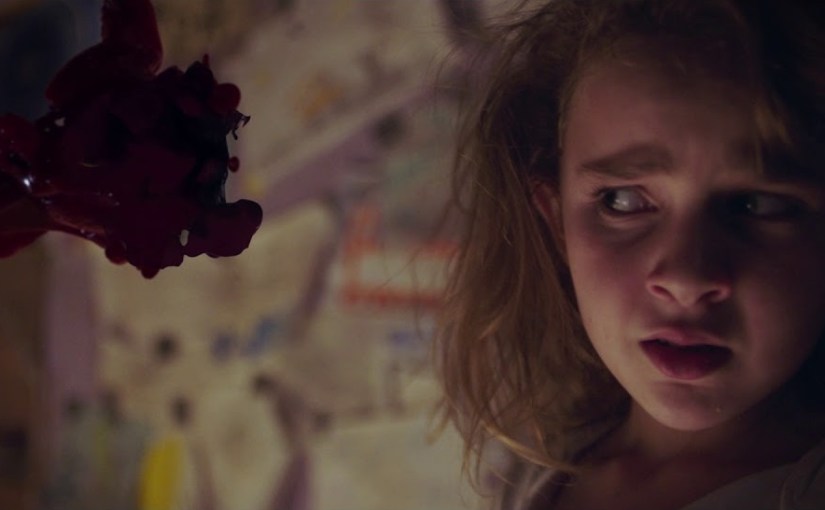
The story opens with a young girl, Chloe (a brilliant performance from Lexy Kolker), who lives with her father in a ramshackle house with covered windows and locked doors.  She takes a peek out the window through curtains that have been duct-taped to the windowsill and sees an ice cream truck outside; in the sky above she spots birds that seem to be…frozen in place?  Hm.  THAT’S weird.

As the opening section unfolds, we learn that the father is doing everything in his power to keep his daughter safe from something dangerous in the world outside their front door.  (She has never set foot outside.)  The movie is cagey at this point about explaining exactly what that something is, and immediately I thought, “Aw, man…is this gonna be another rip-off of A Quiet Place?”  The father walks around the house performing maintenance on drapes and boards and locks, and constantly reminding her daughter how dangerous it is outside, and how he’s doing all this to keep her safe.  Shades of Stranger Things, right?

So the first couple of acts of the movie felt like rip-offs of…sorry, homages to previous contemporary sci-fi entertainments.  The girl portraying Chloe delivers a fantastic, natural performance, but that wasn’t enough for me to shake that feeling of, “Man, I’ve seen all this before.”

At random intervals, Chloe starts to see things.  People in her room, in her closet.  Sometimes these people talk to her, and she talks back.  Are they ghosts?  We’ve learned that Chloe’s mother is dead…could one of these visions be her mother?  And what’s the story with that weird ice cream truck at the beginning, with the creepy, smiling old man who seems to know more than he’s letting on?

These are all threads that make you THINK you know where the story is headed, and you may or may not be right.  You may already think you know what the rest of the movie’s about just based on my description above.  Fair enough.

As for me, I was bamboozled when the true nature of the girl, her father, and the world outside her house was revealed.  I’m not talking about a Sixth Sense kind of reveal that’s kept a secret until the last 5 minutes of the movie.  This movie makes its “reveal” with about an hour left (I’m guesstimating), so I basically felt like I got two movies in one.  Or maybe two episodes of an EXCELLENT cable miniseries.  Once the “reveal” is, well, revealed, the movie shifts into high gear and doesn’t ease off until literally the final frame.

The joy of Freaks is that reveal at the halfway point, and what they do with it afterwards, so it’s extremely hard to know what else I can say without spoiling the fun of discovering it for yourself.  I could mention the visual effects, which are relatively minimal, but EXTREMELY effective, especially during the finale.  I could mention the screenplay’s deliberate attempts to make certain plot points analogous to the current immigration debate.  (I’m gonna mangle this, but one of the lines goes something like, “If you attempt forced relocation, that will only force them underground.”)  I could mention the way certain clues are hidden in plain sight, once you get to the endgame of the movie.

But you won’t get another word from me about the story.  You deserve to discover this one yourself.  I cannot recommend this highly enough.  It’s not quite a PERFECT film, but what are you gonna do, they can’t all be Midnight Special.  I never saw one trailer, not one Facebook ad or YouTube video about Freaks.  I only saw it by pure luck tonight because the showing was at a better time than Ready or Not.

I’m telling you.  Seek this one out. It’s a winner.

ONCE UPON A TIME…IN HOLLYWOOD (2019)

by Miguel E. Rodriguez

Director: Quentin Tarantino
Cast: Leonardo DiCaprio, Brad Pitt, Margot Robbie, Timothy Olyphant, Dakota Fanning, Bruce Dern, Luke Perry, Al Pacino, Kurt Russell
My Rating: 10/10
Rotten Tomatometer: 84% Certified Fresh

PLOT: A fading television actor and his stunt double strive to achieve fame and success in the film industry during the final years of Hollywood’s first Golden Age in 1969 Los Angeles.


Quentin Tarantino’s ninth film is a little bit like Beethoven’s Ninth Symphony.  It’s big, bombastic, and goes the long way around the barn to get to the finale, but in the end it all makes sense and is a transcendent experience.

Let’s see, where do I start?

First of all, the film’s evocation of 1969 Los Angeles is like Mary Poppins: practically perfect in every way.  I’m no fashion scholar or visual historian, but every exterior shot of the city was pretty convincing to my layman’s eyes.  The movie theatres, the movie posters, the restaurants (anyone else remember “Der Weinerschnitzel”?), the cars, those HUGE sedans sharing the road with VW Bugs and M/G’s…it’s clear they did their homework.

There’s the performances by the two leads.  Tarantino once said he considered himself the luckiest director in modern history because he was able to get DiCaprio and Pitt to work on the same film.  Can’t argue with him on that score.  They carry the film in a way that few other tandems could have.  (Newman and Redford come to mind.) Mind you, DiCaprio and Putt don’t look much like each other, considering one has to be the other’s stuntman, but you get the idea.

Above all, there’s the story.  DiCaprio plays Rick Dalton, a former leading man from ‘50s TV westerns who is now playing colorful bad guys in ‘60s TV westerns.  Brad Pitt plays Cliff Booth, the stuntman who’s been taking the dangerous falls for Dalton for years.  Dalton happens to live next door to Roman Polanski and Sharon Tate on Cielo Drive in the Hollywood Hills.

All the trailers, and all the industry buzz, reveal that the Manson family and Sharon Tate play a part in the film.  That’s no spoiler.  Given what we know about those events, the movie plays like Gimme Shelter, the landmark documentary about the ill-fated concert at Altamont that was actually due to take place a few months after the events of this film.  It’s all very suspenseful, in the sense that we know what’s coming, but we’re just not sure how the movie is going to approach it.  So every scene with poor Sharon Tate in it is overshadowed by the fact that we know her ultimate fate in history.

It’s like the famous Hitchcock analogy of suspense.  Two people are eating at a restaurant when a bomb suddenly goes off under their table…that’s surprise.  Put those same two people at the restaurant, where the audience knows there’s a bomb under the table, but it doesn’t go off right away as the two people eat and converse and have dessert, and we’re wondering will they leave BEFORE the bomb goes off or not…?  That’s suspense.

And that’s the genius of this movie, with Tarantino’s sprawling, winding screenplay.  We get to know Rick Dalton and Cliff Booth intimately, we get the rhythms of their relationship, of Dalton’s mood on set, of Booth’s quiet acceptance of his role as Dalton’s sole support system.  We are treated to lengthy scenes showing Dalton at work on the set of a TV western, so we can appreciate the vast differences between an actor and their characters.  There’s a brilliant backstage scene between Dalton and a child actor who is impossibly, hilariously advanced for her age, and who winds up giving Dalton some goodhearted advice.

And interspersed through it all is Sharon Tate.  Sharon Tate bopping to music at home.  Sharon Tate picking up a female hitchhiker on her way into town.  Sharon Tate almost passing, then backing up to admire with youthful excitement, her name on the marquee of a movie theatre, right next to (gasp) Dean Martin’s name!  Sharon Tate dancing, walking, smiling, drinking…living.  She’s the diner at the restaurant, and the Manson family is the bomb we know will eventually go off.  It casts a pall over the proceedings, but not in a bad way.  It’s an interesting way to bring the reality of the situation into focus from time to time.

And now I have to end this review before I inadvertently give away certain, ah, plot elements that elevate Tarantino’s film from a mere character study or period piece into the heady heights of cinematic transcendence.  I have not myself read any reviews of the film, so I can only guess that whatever negative reviews are out there probably center on the film’s finale, or perhaps on its meandering script.  All I can say, or will say, is that I am firmly on Tarantino’s side on this one.  The way the conclusion was written and filmed is the kind of thing that people will still be talking about years from now.

So just take it from me.  If you’re a movie fan, and ESPECIALLY if you’re a Tarantino fan, this is right up your alley.  It’s easily his most slowly paced movie since Jackie Brown, but that just gives you time to e-e-e-ease into the characters, like putting on a tailored suit piece by piece.  This film, like Beethoven’s Ninth, is a masterpiece.

CHAPPAQUIDDICK

By Marc S. Sanders

The morals of Senator Ted Kennedy were tested in July, 1969. While under the influence, he drove his car off a bridge that overturned into a pond. The Senator survived. Over 9 hours later, he reported that a passenger he was with drowned in the accident.

It’s terrible to think about the trust he retained following this incident. He was re-elected to office, and went on to become the 4th longest running Senator in American history. The parents of Mary Jo Kopeckni (Kate Mara) lost a daughter with a promising future.

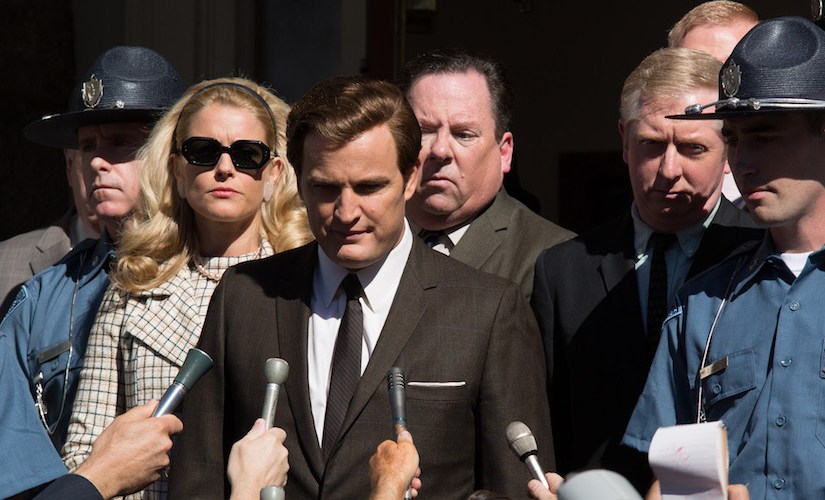
Jason Clarke is excellent as the insecure son of an intimidating stroke stricken Joseph Kennedy Sr (Bruce Dern, effectively overpowering with paralyzed limitation), forced to walk in the shadows of his brothers John and Robert, both assassinated prior to this occurrence. Clarke is great as someone we are to be disapproving of, but for me personally I’m that much more disgusted by the Senator’s response.

Ed Helms is Ted’s cousin Joe who makes all efforts to make this right following the foolhardy actions that occur. Senator Kennedy tries to pride himself as a martyr for the state of Massachusetts, appearing as a victim with a false neck brace, claiming a concussion, hiding left over alcohol and sympathizing with the Kopeckni family. He identifies himself as a “moral compass.” Cousin Joe knows differently as the truly authentic moral character, yet he’s merely disregarded by the army of Kennedy spin doctoring.

Director John Curran will have you believe more of this story and it’s longevity in history did not amount to much considering this all occurred while Neil Armstrong was making his historic walk on the moon, ironically initiated by President John Kennedy. It’s a reason I believe the Senator sustained quite a successful career. Maybe not totally successful. I don’t recall another President Kennedy.

Curran maintains a picturesque image of Martha’s Vineyard and the slow gradual response of all the players, including a police chief who has no scuba gear and must resort to getting down to his skivies to search through the submerged car. The chief is also quite comfortable with accepting an eventual prepared statement followed by a release so the Senator need not concern himself.

None of this was pretty. None of this was Camelot. John Curran’s film reminds you of a young woman helplessly drowning, while the perpetrator did nothing but consider his chances at a Presidency from that point on.

Chappaquiddick is a must see film.