
THE HURT LOCKER

By Marc S. Sanders

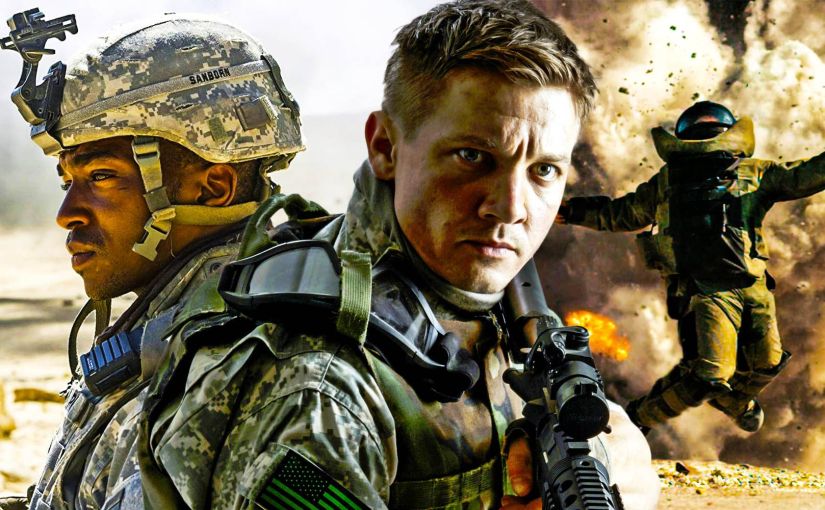
Often the most effective war movies hardly focus on the enemy.  It’s the environment that keeps us on our toes.  Like Oliver Stone’s Platoon, Kathryn Bigelow’s The Hurt Locker is a widely acclaimed depiction of the Iraq War, centrally located in Baghdad in 2004. Her film follows a frighteningly tense perspective of three members of Bravo company – a bomb disposal team.  

After their leader perishes in a surprise attack, Sergeant J. T. Sanborn and Specialist Owen Eldridge (Anthony Mackie, Brian Geraghty) welcome Sergeant First Class William James (Jeremy Renner) to the squad for the remaining thirty-eight days of their rotation. Beyond evading suicide bombers and questionable Iraqi civilians who observe from the sidelines, Sanborn and Eldridge fear they’ll have to survive James’ maverick approach to deactivating sophisticated bombs that hide in the scorching hot desert area. William James claims to be responsible for shutting down eight hundred and seventy-three explosives in his young career.  He’s good at what he does but he disregards the best interests and care for others within his vicinity.

The art direction for The Hurt Locker is most impressive.  The expected sand rubble and distressed tenement buildings are convincing as Jordan stands in place for the film’s Baghdad. Bigelow’s team goes to great lengths with sophisticated explosives.  An early moment has James gently tugging on a red cord that eventually leads to other cords and then what comes out of the desert sand is six identical underground bombs surrounding him from all sides.  With her camera positioned overhead, pointing down, this feels like a monster movie with tentacles springing out in a circumference around the hero.

Another early scene has James recklessly undressing from his bulky, anti-bomb suit, and disassembling an abandoned car to look for the suspected device that’s hidden inside.  With Eldridge and Sanborn remotely demanding updates, the wild man chooses to toss his headset away to focus on his dire circumstance, solo.  

Ahead of the film’s thrilling opening, a quote from someone named Chris Hedges appears: “The rush of battle is often a potent and lethal addiction, for war is a drug.”  A more appropriate phrase would not describe Jeremy Renner’s character any better.  There’s no denying this guy is an expert and the best of the absolute best.  However, he’s positively the worst at accounting for his team or the environment around him.

Kathryn Bigelow is an outstanding director who gets better with each passing film.  The Hurt Locker elevates her finished products that began with cops and robbers fare like Blue Steel and Point Break.  Bigelow is not aiming for laughs or Hollywood shootouts.  With Mark Boal’s Oscar winning script, the filmmaker zeroes in on how someone so proficient with dangerous work pushes beyond limits of caution.  The three characters covered within this tiny sliver of a larger war find themselves tested with each passing day.  

There’s a routine to these guys as they respond to other desert platoons as the sun rises. They are summoned to come upon bombs and mines and people strapped to bombs and mines.  They load up in their Humvee, drive to the next site and do what is expected of themselves like firefighters would in any neighborhood. The conflict is these guys just do not work in sync with each other.  At night, they return to base following a full day’s work to play shoot ’em up video games, drink, and roughhouse with each other as a means to grasp who is the dominant one of the trio.  

Psychologically, James, Sanborn and Eldridge are not on similar planes.  Eldridge is the frightened one who confides in a Colonel with an empathetic, bedside manner.  Sanborn is the sensible levelheaded one.  James seems to lack priority for anyone including his on again/off again girlfriend back home (Evangeline Lilly) and the child they share together.  He’s bent on conquering the next sophisticated, wired device.  It only gets personal for him when one of the few kids in the area meets a gruesome demise and James goes lone wolf at night, within the towns, even though he’s not covert ops. His risks are too great for this war, his squad, and maybe himself.

Kathryn Bigelow effectively sets up environments that’ll rattle your nervous system.  Using handheld cameras, this film often works like documentary footage with quick cuts to citizens of Baghdad who may be staring at what this squad is doing, or maybe they are waiting for their cue to detonate something nearby and trap them.  A local butcher with a cell phone in his hand feels like the worst kind of threat.  A kid with a soccer ball seems untrustworthy.  A guy in a suit pleading for desperate help at the other end of the street is a person I wouldn’t want to stand next to.  There’s an abundance of desert citizen extras to look for and hypothesize about.  Is it that guy with the trigger or maybe it’s that kid or that woman?  Most of these people do not even speak.  Their glazed, war torn and dusty expressions say so little while the powerful machine guns held by the Americans will not do much to prevent a horrifying possibility.

The extensive footage of explosions is very impressive.  I read that Bigelow wanted to display what a real detonation would look like, and not with Hollywood fireball extravagance.  Accompanied with Oscar winning sound editing and mixing, the bombs in this movie lift the dirt and dust particles off the ground, building and automobile surfaces and then plume into mushroom clouds that expand beyond the limits of city blocks. The Bravo Company men even predict how the blasts will take off and where exactly the shrapnel and debris will reach and descend. They think they have this down to a science. This material is entirely different than what other action or war pictures typically show.  

Sniper fire comes at unexpected moments.  An open desert plain actually has an enemy concealed somewhere and quick pierces of sound drops a someone who you might think controls the scene. Then the next someone. The shock of how quickly it’s edited together plays with your senses. Bob Murawski and Chris Innis are the award-winning film editors of this piece. They complete their job to the fullest. This all looks so real and not a product of art.

The Hurt Locker is term to describe where a militant solder will go to when living with internal pain and conflict.  The soldier goes to his hurt locker. This war puts each of these three guys in their own kind of hurt locker, but perhaps they force their situations upon themselves and each other. Mark Boal and Kathryn Bigelow’s film do not just devote time to the three characters who are most at play, but also to devices of war and destruction that drastically change these men.

The Hurt Locker is one of Kathryn Bigelow’s best films.

BOBBY (2006)

By Marc S. Sanders

There’s the distinguished doorman who is retired now but returns each day to play chess with a colleague in the hotel lobby.  There’s the open-minded girl who is inspired to prevent a young man from getting drafted into the Vietnam War by marrying him.  Her hairdresser is married to the hotel manager, who happens to be having an affair with the beautiful switchboard operator.  As well, the dining manager is a bigot who will deny his Mexican employees enough time to leave work and exercise their right to vote.  A busboy will have no choice but to miss what will likely be Don Drysdale record breaking sixth shut out game in a row.  A drunken night club performer can hardly stand up straight while she is completely dismissive of her caring husband.  A wealthy man is ready to introduce his trophy wife to an eventful evening in modern politics.  Two young campaign workers sneak away to drop acid for the first time.  A black man is at a loss following the recent assassination of Dr. King. Though he has hope that at least Bobby Kennedy will uphold his faith for a promising future in America for African Americans to carry equal rights. 

So, what does any of this have to do with Robert F Kennedy?  Not much I’m afraid.  Writer/Director and star Emilio Estevez tells us that all of these stories occur in the Ambassador Hotel on the fateful night when the Senator was assassinated in the hotel kitchen by Sirhan Sirhan.  In Bobby, the only character that is not a character is Bobby Kennedy and that is unfortunate.  More to the point, all of these short stories and other characters are precisely boring.

Estevez committed himself to grinding out stories that occur in the Ambassador that would lead up to Kennedy’s tragic death.  He’s admitted that they are all fictional. Based on his research and photographs, these characters are very loosely inspired by those that were there that night.  Before gathering in the ballroom to hear Kennedy’s victory speech after winning the California primary, these people were going through own personal ordeals.  If Emilio Estevez was not so personally inspired and researched in Robert Kennedy’s purpose to American history and politics, then perhaps Arthur Hailey (Hotel, Airport) would have pieced together this script of anecdotes and vignettes.

I commend Estevez’ efforts here.  The film looks great and even though the Ambassador was being demolished at literally the same time as this film was being shot, the scenic designs are very authentic.  The cast is even more impressive as the director reunites with many co-stars that he’s worked with before including Demi Moore, Anthony Hopkins, Christian Slater and his real-life father Martin Sheen, a lifelong loyalist to the Kennedy family.  The “importance” of this movie seems to sell itself.  Yet, everything is incredibly mundane and of little interest.  When your cast and your characters are just items on a grocery list to check off, there’s not much that’s interesting beyond the coupons.

The juicy gossip that surrounds the real-life actors is more captivating. Estevez cast Ashton Kutcher (Demi Moore’s real-life husband at the time) to play the drug dealer who provides acid to the campaign workers (Shia LeBeouf, Brian Geraghty).  Moore is also Estevez’ ex-girlfriend.  Yet, to watch Kutcher, LeBeouf and Geraghty experience an acid trip with weird visions they see when they open a bedroom closet is unfunny and not captivating.  Emilio Estevez is not living up to the Coen Brothers (The Big Lebowski).

A tryst with the boss (William H Macy) and his young, attractive and naïve switchboard operator (Heather Graham) is nauseatingly hokey.  The aged wife who works in the hotel salon (Sharon Stone) turns it all into squeamish soap opera tripe.

Bobby has an alarming opening.  A false alarm fire call is wrapping up at the Ambassador Hotel and you may feel like you are entering the middle of a panic storm, but things quickly calm down and the film resorts to cookie cutter editing to introduce its all-star cast.  None of what they say matters.  This is a game of who you can recognize.  Joshua Jackson, Nick Cannon, Harry Belafonte, and eventually the guy with the most significant role, Laurence Fishburne, is given his moment, the best scene of the whole film.  Fishburne is the kitchen chef who allegorically uses his creations in cuisine to compare the black man’s experience to the brown man’s, or Mexican. 

Having finished a trip to Martha’s Vineyard, I wanted to show my wife the under-the-radar and captivating film, Chappaquiddick, which covers Ted Kennedy’s personal story of controversy.  (My review of that film is on this site.) To continue on the Kennedy parade, we were motivated to follow up with Bobby.  Yet, this picture offers very little to the significance of Senator Robert F Kennedy.  There are samples of news reports complete with Cronkite.  Plus, the Senator’s own words ring through the epilogue of the picture.  Yet, I felt cheated of learning nothing new about the historical figure. 

Reader, you may tell me to kick dirt and go find another movie or read a book.  Fair!  However, this is film is called Bobby, and if I’m not going to learn about Bobby Kennedy from the man himself, then allow me to get to know the man through the eyes of these individuals.  Who hates him?  Who loves him? Who has a crush on him?  Who is inspired by him?  Who wants him dead and why? 

Estevez’ script does not allow enough material to describe what Kennedy meant to these campaign workers or hotel workers or guests.  They are primarily self-absorbed in their own personal battles to think enough about the fact that Bobby Kennedy is expected to make an appearance later this evening.  Again, their personal concerns for each other is very dull.  I don’t want to be around a drunk and obnoxious Demi Moore.  I don’t want to drop acid with some guys who hide behind a façade for caring about the candidate they are supposed to be serving.  I feel sorry for the busboy who will miss that big game, but that’s not enough to get me engaged in the entirety of the picture.

Bobby lends very little to the confusing times of the late sixties when an unwinnable war was persisting and championed leaders were being killed for others’ agendas.  Any of these stories could have been yanked from this script and slotted into a disaster flick like The Poseidon Adventure or The Towering Inferno

Bobby only picks up momentum when it arrives at its end that many of us learned about in school or witnessed firsthand in documentaries or directly from that very sad and unfortunate evening, June 4, 1968.  This day in history is so much more important than a Helen Hunt character trying to convince her Martin Sheen husband to let her buy a new pair of black shoes.  Bobby Kennedy deserves more recognition than what Emilio Estevez offered.