KILLERS OF THE FLOWER MOON

By Marc S. Sanders

Killers Of The Flower Moon reflects on a period in Oklahoma history that I imagine has hardly been told.  In the early 1920s, the Native American residents, consisting of four tribes, came into a blessing of wealth when oil was discovered on the land they occupied in Osage County.  Almost immediately, white folk from all over the country migrated to this area and built up an infrastructure of capitalism that included private practices, pool halls, movie houses, law enforcement, pharmaceuticals, and even cab drivers.  However, they didn’t want to just stop at developing the area.  They wanted to seize it and they proceeded to do so by wiping out the Native American residents.  Family lineages were all but erased as the whites married into the race and gradually found ways to kill and bring about surprising deaths that would ultimately allow them to legally inherit what was rightfully owned by the Indian people.

Director Martin Scorsese has introduced a new kind of historical education with a film that I believe will be my favorite picture of the year.  I was mesmerized by every photographic shot, closeup, edit, and musical accompaniment contained in this movie.  Everything works so well. 

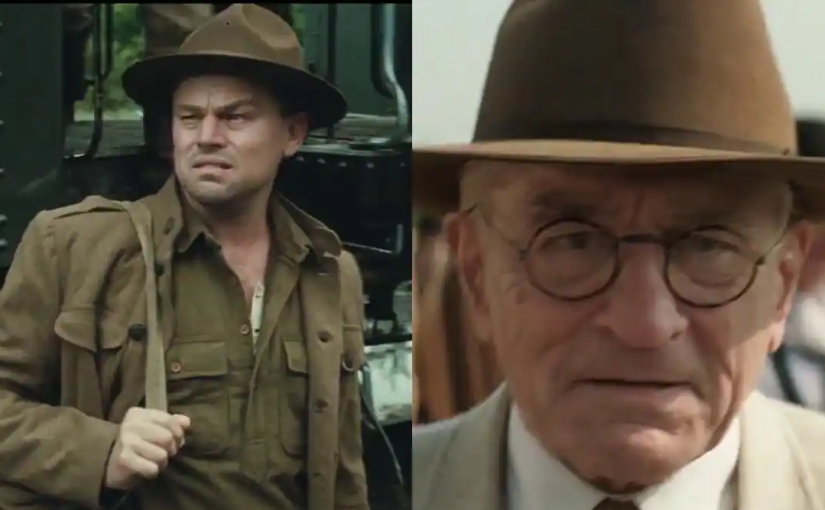
Robert De Niro reunites with the director for the tenth time; an amazing legacy of a partnership spanning fifty years.  He portrays William “King” Hale.  King is a kindly old fellow on the surface, but his intelligence shows as he strategizes how to take over more and more of this area.  He oversees a control of the white gentlemen folk, leading them into quick marriages with the young women of the tribes.  From there, they have children and over time will gradually purify the bloodline.  It’s a ruthless and scheming tactic and it successfully works thanks to how taciturn Mr. Hale is.  De Niro might win his third Oscar for this role.  This character joins that exclusive fraternity of the best villains in cinematic history, ranking up there with The Wicked Witch, Harry Lime, Norman Bates, Darth Vader, Joker, Daniel Plainview and Hannibal Lecter.

Early on in the epic film, The King’s nephew, Ernest Burkart (Leonardo DiCaprio) has returned from the war to work under his uncle.  Ernest starts as a cab driver and meets Molly (Lily Gladstone), the Native American woman he will take as a bride and establish residence together.  DiCaprio does some of his best work following a very boastful career of roles.  He’s also sure to get at least an Oscar nomination.  This is already his sixth film with Scorsese.  Ernest is not very bright, but with The King’s guidance and instruction he’ll also come to own much of this territory.

Mysterious deaths of unexpected natures occur within the tribes of Osage County, particularly in Molly’s family.  Over the course of the film, one relative after another perishes until what’s left of her bloodline is practically only herself.  The children she bears are a mix of Molly and Ernest.  Molly knows something is amiss.  She is starting not to feel well, and her suspicions speak to her.  Others in the community are also suffering peculiar deaths following doctor’s visits or evenings of drunken binging.  An investigation is warranted before it becomes too late.

Lily Gladstone will become a surprise hit at Oscar time as well.  A breakthrough role where her feared silence and bravery matches well against the deceit emanating from the King and even the poorly hidden conniving of her husband Ernest.

Scorsese builds his film with suspense and shock.  A quiet beat of instrumental music haunts certain scenes.  Who will be the next target of the King’s bidding?  The King hides behind his empathy for loss by attending funeral services and allowing the survivors to cry into his shoulder.  On another side, he instructs Ernest to carry out an assignment to some flunky to make a murder appear like a suicide.  A shot in the back of the head will not send a convincing cause and effect though, and the King and Ernest must make up for that. 

The King is everyone’s friend in Osage County, but he’s also a puppet master Grim Reaper.  With the circular rim glasses that DeNiro wears along with his peaceful beige suits, it’s a wonder that this man is an executioner using the hands of others to carry out his bidding.  He dances in the middle of town during festive gatherings.  It even amuses the Sheriff’s office when he voluntarily offers himself up following a warrant for his arrest.  At the risk of getting politically sided, DeNiro was recently interviewed during a press junket for the film.  His animosity towards President Trump is no secret.  I was in the audience at Radio City Music Hall when he led a unified roar of “Fuck Trump” during the Tony Awards.  Still, the skilled actor said he used the enmity he harbors to his advantage for this role.  In the latter half of the film, William “The King” Hale preaches in a similar approach to Trump.  There are figures in our history who just know what buttons to push and absorb massive amounts of influence while earning respect through fear. 

Killers Of The Flower Moon covers a wide berth of its period in history.  Scorsese takes an inspired approach by cutting away on occasion with black and white footage and photographs of the Native Americans coming along with their good fortune and then on to how the white “immigrants” of this area enter this land and assume a daily life within the community, whether they were welcomed or not.  All is depicted from how Osage County quickly changed following the discovery of “black gold,” to how Ernest becomes wise to the advantages of power. 

Leonardo DiCaprio has a great undertaking.  Ernest is not very bright.  He can hardly read.  He’s not subtle with his approach like his uncle.  Yet, the actor maintains an expression of no choice to abide by but what he’s been told is right.  DiCaprio does this incredible expression with long frowned lips and a fat chin that stands out from beneath his nose.  It almost seems like a barrier to finding the humanity he may have once had when he was an infantryman fighting with the allies in Europe.  It is just a haunting performance.

The third act picks up with J Edgar Hoover’s newly established Bureau of Investigation entering the story to investigate the odd happenings in Osage.  Jesse Plemons again plays that guy that you have seen somewhere before.  Often, he occupies similar kinds of roles, and still, I like what he contributes to this picture as Investigator Tom White.  Screenwriter Eric Roth lends the character simple, plainly worded questions for Plemmons to work with and it seems to come off as nothing intimidating.  Rather, the presence of Tom White on Ernest’s doorstep, with Molly mysteriously sick in the bedroom, is enough to rattle Ernest, the King, and the whole county.

It’s no secret that Killers Of The Flower Moon has a long running time at nearly three and a half hours.  However, it is necessary.  This widespread crime is not done in just minutes.  How it is gradually orchestrated needs to be seen, followed by those that uncovered how sinister it became.  Then attention needs to be given to how biased the trials of Ernest and The King had become.  Men who conspired with the King and Ernest serve on the jury.  A lot of unfair wrongs occurred during this time spanning what I believe was at least a decade and a half. 

Roth and Scorsese bring the conclusion of the film with a welcome invention.  In a time where Netflix, Dateline, 20/20 and ABC News thrive off true life crime documentaries that become so addicting, the filmmakers resort to a radio show to sum up what happened to the main players of this devastating episode in twentieth century American history with the director making a cameo to offer his final words for the main victim of the piece, Molly Burkhart.  This bookend to the film has stayed with me since I finished watching the movie, and I applaud Scorsese and Roth for their execution.  Newsmakers of today go for the most sensationalized crimes that have occurred; the ones that leave the most shock and awe and even audaciousness.  What happened in Osage County is unforgivable.  Likely a genocide of bloodlines that were unjustly ceased so that what was rightfully theirs to own could be seized.

Killers Of The Flower Moon is a drama that had to be told because the motivations that led to the series of crimes happens not only to Native Americans, but to practically any other demographic across the globe.  This is a captivating story and one of the best films Martin Scorsese has ever made.

Again, this will likely be my favorite film of the year and Oscars are deserved for DeNiro, DiCaprio, Gladstone, Roth, Scorsese and for Best Picture of the Year. 

NOTE: As I watched this movie, I could not help but think of the film August: Osage County, the motion picture adapted from Tracy Letts’ Pulitzer Prize winning play.  There is one Native American character in the film who is hired to serve the white family living on a wide expanse of land in present day 2013 (2007 for the play).  The first time I watched the movie, I could not recognize the purpose of the character.  On a second viewing, following a conversation among the dysfunctional family of characters about Native Americans, it was much clearer.  Having now watched Scorsese’s film, this picture serves as a great companion piece to watch afterwards.  I’ll be directing a stage production of this soon and much of what I learned from both films will be incorporated into my interpretation.  Even the architectural designs of the homes in both films, interior and exterior, are uniquely similar. 

Look for my review of August: Osage County (featuring Julia Roberts and Meryl Streep) on this site as well.
THE WHALE

By Marc S. Sanders

I still have a lot of catching up to do, but arguably the best performance by any actor in 2022 comes from Brendan Fraser in Darren Aronofsky’s The Whale, an adaptation of the stage play written by Samuel D. Hunter.

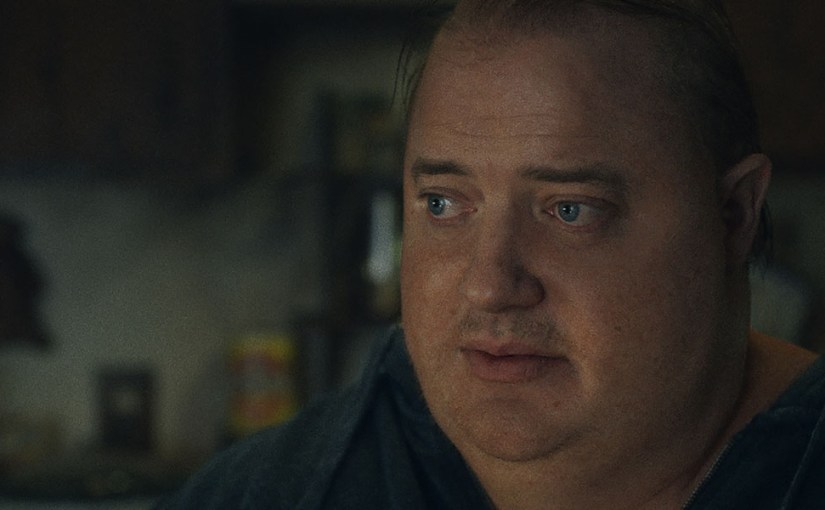
Fraser plays Charlie, an intelligent online writing professor.  His course is done online as he has become an enormously overweight recluse, following the loss of his boyfriend, circumstances to be revealed over the course of the film.  Charlie is so obese that he can barely walk, and he confines himself to the left side of his sofa with the television in front of him and his laptop nearby to conduct his courses or to pleasure himself with gay pornography.  He has a walker to get himself on to his feet and carry his bulk, but showering is not easy.  Even picking a key up off the floor is an impossibility.

He receives visits from his only friend, a nurse named Liz (Hong Chau).  When she arrives on Monday, she discovers that his blood pressure is indicative of congestive heart failure and urges him to go to the hospital.  He insists he can not afford the bills and has no insurance.  He also receives unwelcome visits from a young man named Thomas (Ty Simpkins) spreading the word of God with brochures from the local church.  Lastly, the visits Charlie treasures the most are from his cruel and mean-spirited daughter Ellie (Sadie Sink) who takes no reservations with berating Charlie as a deadbeat dad and only comes to him because she practically demands he write her essays to avoid dropping out of school.  She also rudely takes pictures of Charlie at any given moment.  Each time she raises her cell phone for a click, it feels like she is giving her father the harshest middle finger imaginable.

Much like an earlier film, known as The Wrestler, Darren Aronofsky explores what comes after the main character has tormented himself into a destiny difficult to escape or be rescued from.  Aronofsky is frank about offering up helpless souls only now living with everyday ongoing pain both physically and, as we discover, more importantly, mentally.  Highlights of Charlie’s day are when the pizza is delivered and he shouts through the door that the money is in mailbox.  The delivery guy knows the routine all too well by now and the best he can offer is to ask if Charlie is okay while never seeing his grotesque appearance.

Aronofsky doesn’t offer much variety on the surface.  The film takes place entirely in Charlie’s apartment.  Sometimes we go down the hallway and see another room or we get a conversation between Liz and Thomas on the front porch.  The cast only boasts seven actors.  Yet, Hunter’s screenplay is not limited to what Charlie is having to endure.  There is also an unexpected backstory to Thomas and there’s more to uncover with Liz and Ellie. The pizza delivery guy, who we never see, even discovers something.  One particular essay about Moby Dick that Charlie desperately urges Thomas to read out loud early on has a surprising significance that I didn’t see coming. 

Still, the film belongs almost entirely to Brendan Fraser and how he enhances the performances of his cast mates, particularly Sadie Sink.  Their scenes are so well performed.  She is an outstanding young actor working on a manic level.  I imagine Sadie Sink had to come down from the hyper activeness of her scenes.  She is uncompromisingly mean. When the director yells, there is no way she could just turn that characterization off.  I bet she walked away from the set to catch her breath.  Opposite her, Fraser’s character has no choice but to be more restrained.  Physically, it is hard for him to breathe and therefore speak at times at a high octave.  He cannot stand up very well and rush to embrace his daughter even if he wanted to try.  She is mean enough to challenge him though.  The outcome of that moment will have you hate her character for sure.  Yet, you don’t forget she’s a kid and her current state is a product of something else, perhaps from Charlie’s past misgivings.

Timewise, they are also on uneven playing fields.  Hunter’s script counts down the days as the top of some scenes depict it as Monday and then Tuesday and so on.  Charlie is running out of time and has a lot of hanging threads to tie off.  Ellie has an entire life ahead of her to name call and scream at him and hurt him, but Charlie cannot afford to upset someone and work on apologies later.  The best he can take advantage of right now is to appeal for all the wrongs he’s committed or been accused of.  Most importantly, can he fix his relationship with his daughter?

Liz is a health care professional by trade and knows what is best for Charlie, but likely also knows it’s too late and rather hopeless, considering his current condition.  So, it only makes sense to surrender to his needs by bringing him meatball subs and barbecue ribs.  What she is determined to do is to keep his daughter and ex-wife away from him.  It’s a conflict that Charlie has no choice but to allow.

Thomas is that last new person to ever enter Charlie’s life.  Yet, what is his gospel of God and salvation going to do for Charlie now?  Charlie can’t keep this kid from coming over, but is he really going to listen and take any of it seriously? 

Brendan Fraser’s performance is so limited to the setting of the film and the physical restraint of being a large man with no flexibility.  However, he provides so much in the pain his character has suffered long before the current week captured on screen.  It’s an astonishing achievement in acting.  Within the bulbous head depicted in so many closeups are tired eyes that have gone through so much like toiling with leaving a marriage in exchange for a homosexual relationship, and weakening a connection with his child.

Beyond the enormous weight he lives with, Charlie also lives with an unhealthy food addiction.  Just ahead of the last act of the film, Aronofsky is relentless in showing how Charlie responds to personal suffering, not physical, by drowning himself in enormous amounts of sloppy and messy food as Fraser guzzles everything into his mouth.  Charlie suffers from so much more than just being morbidly obese.  He could live with that.  It’s other moments and people and losses in his life that are hard to continue to live with.  The difficulty of those things is cursed upon by Charlie with uncontrollable amounts of food.  Some people who suffer with difficult matters might hide in bed all day or binge watch television for an entire week.  Some turn to drugs and alcohol.  Charlie binges on food.  He doesn’t love his food.  He only uses it to drown out his pains.

I imagine it’s hard to learn about people like Charlie who are held down by the challenge of extreme obesity.  They have become so physically large that they literally can not get up from their sofa without help and therefore never leave their homes.  Because they never go outside, we are unaware of people like this.  I once had a neighbor that I never, ever saw.  I could hear their TV in the apartment next door but I never saw them.  How is that possible?  Why is it that they never revealed themselves?  There’s a story there.  Maybe a terrible or uncontrollable dilemma.  Darren Aronofsky, Samuel D. Hunter and Brendan Fraser offer a glimpse into what goes on behind this closed door.  It’s heartbreaking. 

Maybe it is so tragic because of why Charlie is shown within his confines by Aronofsky, written within the circumstances that Hunter offers and most importantly demonstrated by Fraser as a man ready for his life to end.  If only he can resolve a final digression with his teenage daughter suffering from a pain of anger likely instigated by him. 

Again, Brendan Fraser’s performance is the best one I have seen this year, and with no doubt in my mind, he should absolutely win the Oscar.  This could go down as the best accomplishment is his colorful career. 

CRASH (2005)

By Marc S. Sanders

Paul Haggis’ vignette themed script for Crash should not have won Best Screenplay. The film he directed should not have won Best Picture. Could it be that because this picture is masked as that special movie with that especially poignant message that it got the recognition I don’t think it ever deserved? I can appreciate the attempt at bringing hot button social issues like racism and injustice to light, but it does not need to be as immaturely contrived as this picture.

Crash occurs over two days within the city of modern day Los Angeles. A select group of characters of different social classes and ethnicities are covered, and the film circumvents back and forth among their perspectives. For the most part, all of these people have major social hang-ups with people outside their race. The first example shows us that if a white woman who is simply cold on a winter night hugs her husband tightly for some warmth, apparently a couple of black men will automatically believe this woman is fearful of their approach.

Especially today, I know that prejudice exists, but to this extreme and this contrived…I’m not sure. I guess I’m not sure because I have not experienced it enough to be convinced yet. When I read a friend’s testimony of falling victim to racial prejudice I lean towards believing everything they tell me. I guess it’s this movie, Crash, that left me feeling dubious and maybe that’s because the circumstances seem way too forced.

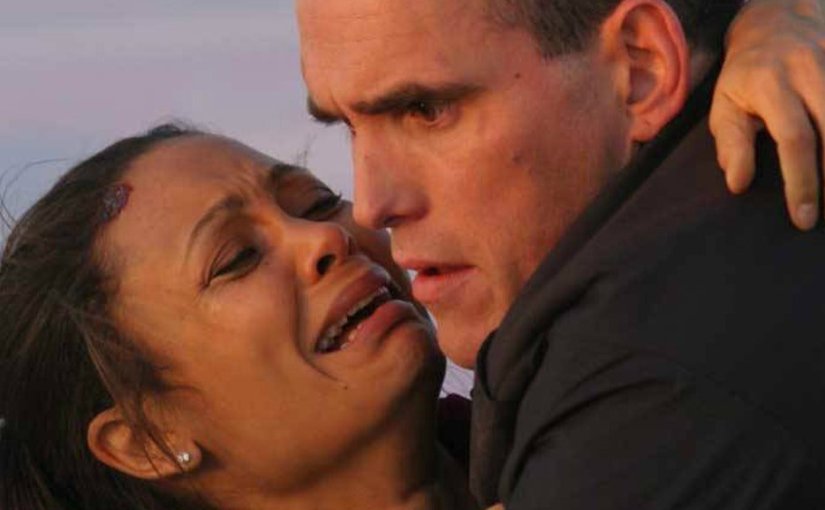
A racist cop (Matt Dillon) will pull over a well to do Muslim man (Terrence Howard) driving a high priced SUV and perform a sobriety test for no reason. Then the cop will deliberately frisk the man’s wife (Thandie Newton) with digital penetration. The next day, it’ll just happen to be that this woman will have no choice but to be rescued from a burning car by this same racist cop. Now I’m supposed to believe that the racist cop is not so bad, and the woman learns to become more tolerant. Well gee, thank heavens for coincidences!

The Muslim man (a television show director) gets car jacked the following day, and in a tense pull over moment he’s mistaken as the criminal. Fortunately, the partner of the racist cop (Ryan Phillipe) is there to subdue the situation. I’m sorry, but life doesn’t work out to be this tidy. Call me cynical, but more often than not we are not given a second chance at first impressions.

One of the real car jackers (Chris “Ludacris” Bridges) gets a moment of clarity and suddenly he’s generously giving out his last forty dollars to a group of Asian people being held in a van for human trafficking. Forgive me. If I want to begin respecting this car jacker who has held multiple people at gun point and even runs over a man, only to toss him out on the drive up to the Emergency Room, I’ll be more apt to do so if the criminal turns himself in.

I dunno. Maybe I’ve got a personal issue with Crash. It could not be more apparently preachy in how it patronizes me to simply understand the seething hate and criminal violations of its characters. I’m supposed to empathize with the racist cop because his ill father can’t get the health care he’s entitled to? I’m supposed to understand the prejudicial anger that the WASP wife (Sandra Bullock) of a District Attorney (Brendan Frasier) expresses because she no longer trusts her dedicated Hispanic housekeeper or the locksmith (Michael Pena) changing the locks on their house following a car jacking?

No. Paul Haggis didn’t earn that response from me in almost all of the short story scenarios his film offers. Maybe it’s because I tend to compartmentalize my episodes. I like to think that I don’t allow one experience with one kind of person cloud my judgement on the next person I encounter. A waiter can totally screw up my order and can even mouth off to me in a heated moment. Yet, I’ll return to the restaurant on another occasion because it’s likely I’ll run into a different waiter.

Haggis depicts people who appear to have a blanket opinion of other people with different backgrounds. These are all extremely prejudiced people with next to no understanding of where each of them stem from. An angry Persian man (Shaun Toub) puts blame on the locksmith after his convenience store is ransacked. The locksmith was only trying to explain that the back door needed to be replaced. The Persian refused to listen because his English is limited. So he just gets angry and curses the locksmith out. Haggis opts to insert a language barrier between the two men to serve up an eventual tense and dramatic moment in a neighborhood driveway with a loaded gun and a little girl. A loaded gun and a little girl! Yup, I think they teach these are the true ingredients for effective drama on the first day of screenwriting class. Again, it all comes about a little too forced.

The conveniences and ironies that bubble up at times are surprising. “Oh that guy is that guy’s brother! I see.” Things like that. However, I don’t think that is necessarily the strength of the picture.

In a film like Magnolia, we are treated to the vignettes of a handful of people too. However, not every single one of those people are sketched by means of their prejudiced natures. They are drawn by a variety of different elements whether it be a traumatic past or an inclination to do good. Then it’s kind of fun to uncover how each player is connected to one another.

In Crash, the players are only connected by the hate they carry within themselves, and Paul Haggis forces a redemption upon most of them with small gestures or a line of dialogue or the purity of a welcome snowfall to close out the film. Sorry, life is lot more messy and complicated than that. I guess I’m saying I may have learned a lot more about human nature from a downpour of frogs than a downpour of snow.

SCHOOL TIES

By Marc S. Sanders

Robert Mandel’s adaptation of a story from Dick Wolf might be regarded nearly 30 years later as the film with the next generation of up-and-coming brat packers, but School Ties remains an underrated and topically important film nonetheless.  Just as it is still a problem of today, victimized by ignorance and unfounded bigotry, anti-Semitism was an issue that spread like a social disease within the confines of a prep school New England community in the 1950’s.

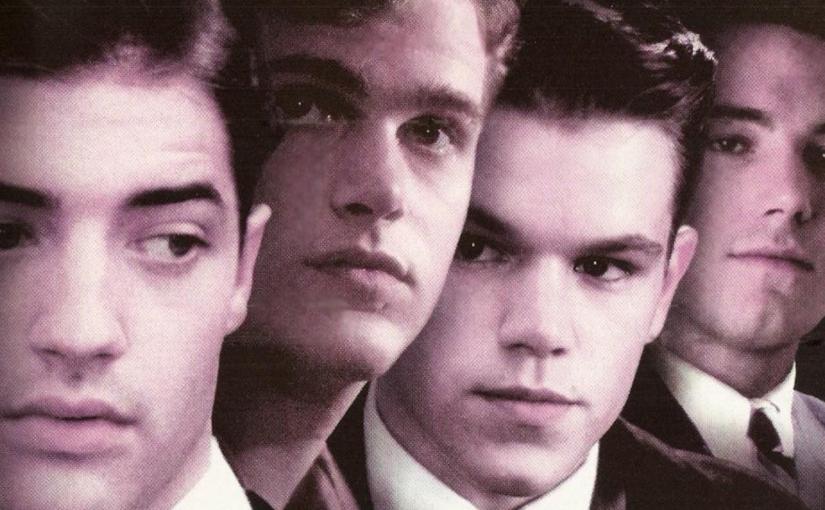
Brendan Fraser is David Greene, a high school senior awarded a scholarship at the school in order to usher in a championship football season as their quarterback.  David is well aware of his ultimate purpose for his scholarship and he brushes that aside as just one year of attendance will ultimately lead to acceptance at an Ivy League school.  He’s just like any other handsome boy attending the school, and he’s immediately accepted among the masses.  He’s hilarious at mischievous horseplay with the French teacher.  The beautiful girl (Amy Locane) at the nearby girls’ school is taken with him.  His football skills are applauded.  It may be a little surprising that he stems from the blue-collar town of Scranton, Pennsylvania and he buses the tables at dinner time, but David is an all-around okay guy who can knock over a linebacker while passing exceptional touchdown passes.  Amid this environment of different Christian denominations and WASP culture, however, David knows that he will stand apart if he reveals he is Jewish.  Therefore, he tolerates the casual jokes and accepts that it’s best to hide his Star of David necklace. 

The most important relationship occurs between David and his back up quarterback, Charlie (Matt Damon, before he became a superstar, but already looks like he’ll be a superstar).  Charlie begrudgingly accepts that David got to cut in line to be the star player.  As David becomes more of the celebrity on campus, Charlie is proud to be by his side.  Yet, Charlie has his own pressures to live up to as the fifth in line of his esteemed family who must carry on the legacy at the school followed by attending Harvard the following year. 

The roadmap of School Ties is easy to navigate.  You know when each note of the script is about to be played.  There will be a swastika that will shockingly appear.  Fist fights will happen.  The blue blood parents and faculty will interfere preaching their own “codes of honor” and the school’s storied 193 year history.  Yet, the film works very, very effectively.  The dialogue isn’t hokey and nothing feels like what could have been an after school special. 

No debate among the viewers.  Anti-Semitism is evil and thoughtless without merit or justification.  Questions appear where is it right to ask if David should have hidden his Jewishness or was he even lying about being Jewish, when in fact he just wasn’t even asked.  Is it right that David confronts his problems with his fists first?  Yet, Wolf’s script, apparently based on personal experience, delves further into the mounting pressures of these prep school kids who are primed from birth to be the latest model churned out from the respective family lineage for greatness in academics and athleticism.  Much of the material is devoted to the horror of actually not acing a class, and I appreciate that it’s not diminished to a standard line of “my parents are going to kill me.”  Raw emotion and stress are legitimized among these students.

The third act comes with no foreshadowing as a cheating scandal is suddenly introduced. Collectively the boys must debate who is the guilty party and why are they the guilty party.  Is it because one is Jewish, or is it because one actually cheated?  Good dialogue, good debate, but this also may be where the standard stuff spills over a little too much.  As such, the ending hinges on the third act, when it should have embraced more of the film as a whole.

The cast is made up of, at the time, soon to be superstars like Fraser, Damon, Chris O’Donnell, and Ben Affleck.  School Ties should be regarded as a winning audition for these guys’ careers that were only just on the horizon.  Their respective performances here are just as good as any of their most well-known roles, and they are happy to hide in the background as extras or step up for a camera shot.