
By Marc S. Sanders
Consider this for a second. You’re an African American thirty year old who has recently begun a promising relationship with an affectionate, loving Caucasian woman. As she attempts to ease your apprehension about meeting her parents for the first time she tells you her dad would have voted for Obama if he could have run for a third term. When you arrive at their upstate home, one of the first things dad tells you is that if he could, he would have voted for Obama for a third time. Exactly why is that so important to say? From her? And later from him? Why is it necessary for an audience to hear the statement twice within a span of less than fifteen minutes? While it should sound assuring, it feels anything but trusting. That’s how smart Jordan Peele’s debut horror/thriller is. He has a way of delivering two different perspectives with one simple statement.
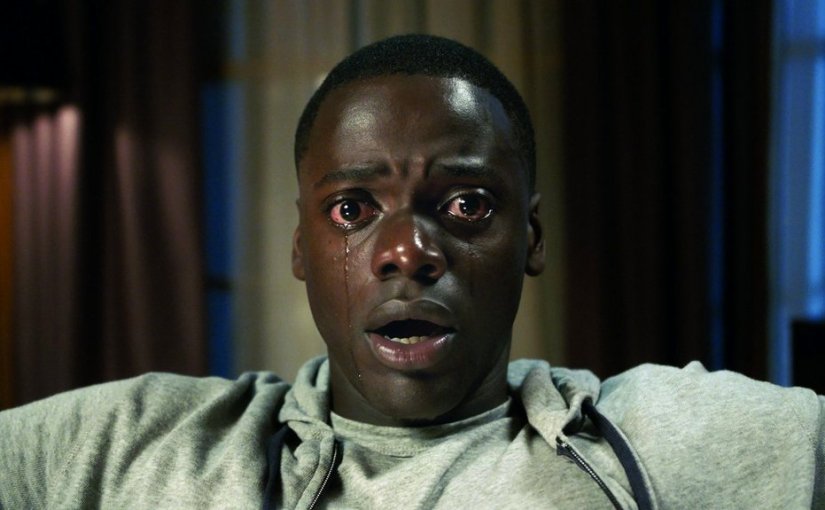
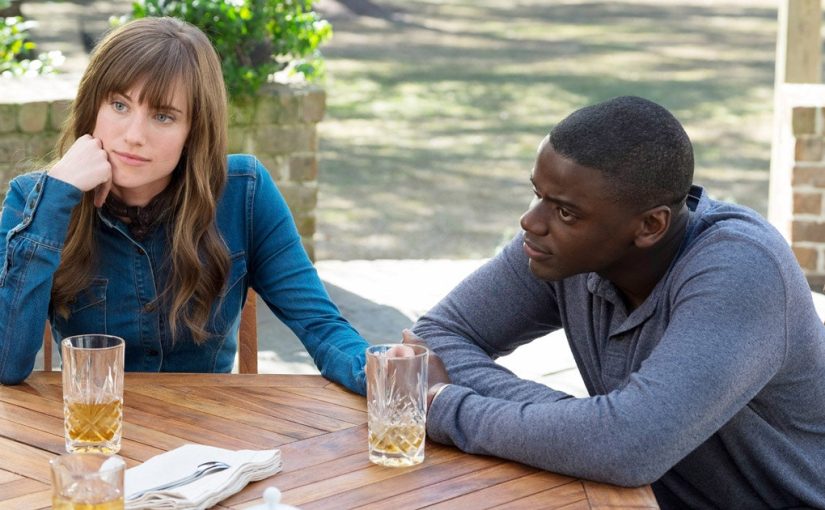
In Get Out, Daniel Kaluuya is Chris. His girlfriend is Rose played by Allison Williams. These actors are a perfect pair on screen but that’s about all I want to share with you considering their relationship.
Chris is meeting Allison’s family at their home for their weekend. It’s a beautiful, quaint estate off the beaten path from any intrusive neighbors. Burrowed within the woods, this is a place to escape the stresses of city life. Just like with any horror film though, the characters do not know they are operating inside a horror film. The audience always does, and the best filmmakers find those frequent moments to get their viewers to squirm in their seat, tuck their knees under their chin, clench the butt cheeks maybe and say, “Don’t do that!,” “Don’t go in there,!” or maybe they’ll urge you to “GET OUT!!!!”
Nevertheless, the storyteller finds it important to bring up Barack Obama on more than one occasion????
Before they even get out of the car, the landscaper, a black gentleman, seems curious to Chris. Friendly handshakes and welcoming hugs on the porch segue into the furnished home and there’s the maid, a black woman, who is as intriguing as the first black person to be seen. Wouldn’t you know it but over lunch, you learn that tomorrow there’s the annual party gathering of friends. Oh my gosh, was that this weekend?
Jordan Peele doesn’t turn on the creepy music you may expect. He relies on his visuals and while you are being as observant as Chris, you just might be alarmed and less sensible than he is. That credit goes to Kaluuya, giving a reserved, contained performance. This guy does not look like a hero in the least because he has instincts but seems to never look for a fight or a debate or the need to set an example. An unexpected stop on the drive over demonstrates where Chris stands in a topsy turvy world of political divides in the twenty first century. He just wants to make life easy. So, he also will not make waves when that groundskeeper runs directly at him in the middle of the night. This is just too freaky, but Chris tells us to just get through the weekend.
Rose’s brother seems like a weirdo from a Judd Apatow comedy, but he’s not being a clown. Dad (Bradley Whitford) is a successful surgeon always ready with a relaxing tone and an open hug. Mom (Catherine Keener) has done well as a psychiatrist performing hypnosis on her patients. Yet, a late-night encounter with her leaves Chris feeling uneasy. Visually, it’s disturbing when he reflects on what he thinks he experienced with her. However, he tries to give the family the benefit of the doubt especially when he shares his concerns with Rose. Allison Williams is quite good with being convincingly dismissive. I trust her, and I like her too.
Then there’s the party the next day. All the guests, primarily white, arrive exactly at the same time in a convoy of tinted black sedans and SUVs. Chris doesn’t hide himself despite feeling awkward, and he doesn’t initiate the odd conversations with these middle age WASPs, but he politely keeps engaged with them. Ironically, the strangest conversation he experiences is when he approaches a fellow black guest who is oddly dressed inconsistently compared to everyone else while his demeanor looks like he’s in a trance.
For comedic effect, Jordan Peele incorporates a best friend for Chris to confide in with opportune cell phone calls. Lil Rey Howery is Rod and I can say, unequivocally, he is the best endorsement for the TSA. I do not recall seeing Howery in other films of late, but this actor deserves a long career for making a big splash in Peele’s busy picture. Get Out would never be as inventive if Howery’s role is edited out. Rod is the only other guy who, from a distance, can tell something is not right, here.
Get Out closes on an airtight ending. Explanations for everything that is questionable is provided. Yet, on both occasions that I’ve watched the movie, I think about it long after it’s over. It takes some of the best elements you might uncover from The Twilight Zone, plus what you might have seen in the original Texas Chainsaw Massacre, and builds new ideas off of those circumstances.
It is especially fun to read the IMDb trivia about the film to uncover a wealth of appropriate symbolism that does not jump directly at you. You’ll appreciate how clever Jordan Peele is as a writer. Froot Loops without milk in a bowl says much about a character. Another character is engorged with the antler of a taxidermic deer head. One character scrapes cotton stuffing out of an armchair. Jordan Peele approaches his scary fiction with an educated eye.
This movie is inventive. Its horror does not seem redundant and thankfully the monsters are not vampires and zombies all over again. There are new tactics at play. There are fresh approaches to victimize the heroes, and there are creative ways to surprise the audience.
Get Out is amazing the first time you watch the film. On a second viewing, Jordan Peele’s story works like a class experiment in social standards while it still has fun by keeping you in triggering suspense.

 2 UNPAID MOVIE CRITICS!!!!