NIGHTMARE ALLEY (2021)

By Marc S. Sanders

Guillermo del Toro’s Nightmare Alley is a visual feast of the macabre set in a Depression era western America.  Every caption caught on film is unbelievable to look at, and while I know del Toro released his picture in black and white to enhance its film noir theme, I was truly delighted with the color version of the film.  With del Toro’s direction and photography designed by Dan Lausten, every dimension and sparkle of color from a sunset to a dreary cloud in the sky to the lights on a Ferris wheel spinning in an open field from the distance is absolutely jaw dropping.  Nightmare Alley is a modern technical masterpiece.  It makes me want to go back and watch the original 1947 version, as well as explore other productions in the film noir category.

Bradley Cooper portrays Stanton Carlisle, a murderous drifter who ends up accompanying a traveling carnival of garish figures who entertain their quirky qualities for townsfolk to be marveled and amazed.  There’s the flexible snakeman, the world’s strongest man (del Toro regular, Ron Perlman), the smallest man alive, the electrical woman, the psychic and the terrorizing, caged “geek” who will eat the head off a live chicken in front of your very eyes.  At first Stanton serves as a heavy meant to carry loads and set up and strike the tents and stages as the show moves from town to town.  He connects though with the psychic (Toni Collette) and the architect behind her façade (David Strathairn).  Soon, Stanton is adopting their techniques of using code words and hand gestures to “read the minds” of the various audience participants. 

He goes even further by redesigning the electrical woman’s presentation. Before she was using teslas to demonstrate her will to generate electrical currents.  Now she can be zapped in an electric chair.  The woman is Molly (Rooney Mara), and a relationship begins that sends her and Stanton on a successful tour away from the carnival where they entertain more sophisticated and wealthier nightclub guests with his psychic abilities.  One attendee, however, is on to Stanton’s devices, a beautifully alluring psychiatrist named Lilith (Cate Blanchett).  She maneuvers Stanton into using his manipulative talents into conning her clients.  She has recorded her sessions and will share confidential information with Stanton. Then, he will use that towards his ongoing psychic advantage as a means to swindle them of their fortunes.  Lilith and Stanton will split the rewards.  The play seems convincing enough for the likes of a wealthy industrialist named Ezra, played by Richard Jenkins yearning to reconnect with his deceased wife at a cost of thousands of dollars for Stanton’s services.

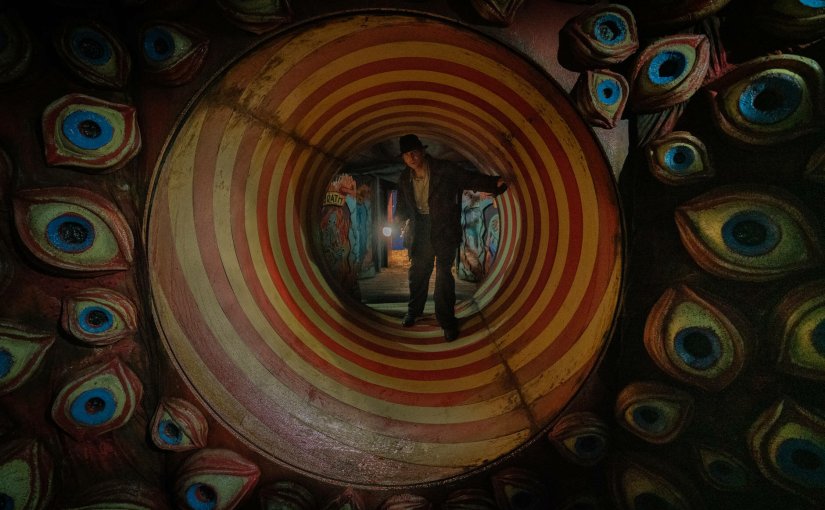
The narrative of Nightmare Alley is so absorbing.  Everything is beautifully staged.  A fun house hall of mirrors has a décor of disturbing imagery.  Stanton enters this place symbolically at the beginning of the film in search of the runaway “geek.”  The surroundings display the seven deadly sins around a large skull and other haunted house imagery.  del Toro demonstrates what Stanton is about to enter, which occupies the remainder of the film.  Stanton performs on the motivations of greed and lust and vanity.  Maybe, pride as well.  At least those are the first couple of sins that come to my mind.  How will his actions reflect back on him later on, though?

The film is also performed by a magnificent cast.  Cooper is doing some of his best work here.  While I feel like I’ve seen Blanchett’s deceitful character before, I don’t mind.  I can’t think of anyone else to play the role.  Curiously, del Toro has Mara, with her snow-white complexion, dressed in red quite often amid a cast of characters and extras wearing blacks and dark greys.  She’s meant to stand out as the innocent.  Molly questions Stanton’s decisions while also trying to convince him to end his charades.  Yet, she only serves as a disturbing pawn in the shyster’s tricks.  Will Stanton corrupt Molly though?  It’s one thing to put on a magic show for a couple of hours each night.  It’s another when you are swindling the massive fortunes of others and toying with their despair. 

Other surprise performers that appear include Willem Dafoe as the showman for the “geek,” and a late appearance by Tim Blake Nelson to close out the film and deliver what’s to come of Stanton. 

Nightmare Alley deliberately moves at a slow pace, but that only allows you to take in its various environments.  From the carnival tents to the nightclubs to the alleyways, to Ezra’s snow covered never-ending garden, and even Lillith’s gold embossed office of cabinetry and furniture are so hypnotic and dark in its intended film noir way.  Again, while I’m sure there’s some striking qualities to the black and white interpretation of the film, I really fell in love with the colors provided by Lausten’s photography.

I won’t call this a favorite film of mine, but I loved the journey of it all.  I appreciated the script by del Toro and Kim Morgan, adapted from the novel by Lindsay Gresham, that depicts a sinful man like Stanton devolve into more sin, until he’s only undone by a smarter sinner than he; a sinner masked within beauty and wealth with a noble and educated profession.  Bradley Cooper and Cate Blanchett perform beautifully with one another.  They make a terrific pair.  I only hope they’ll do another film together.
SILVER LININGS PLAYBOOK

By Marc S. Sanders

Bipolar disorder can be a crippling ailment, not only to the person, but to his/her family as well. That, I imagine are the limits of my knowledge on the subject. David O. Russell’s Silver Linings Playbook will have you believe a way to embrace the disorder is to be involved with people who accept it and love you regardless.

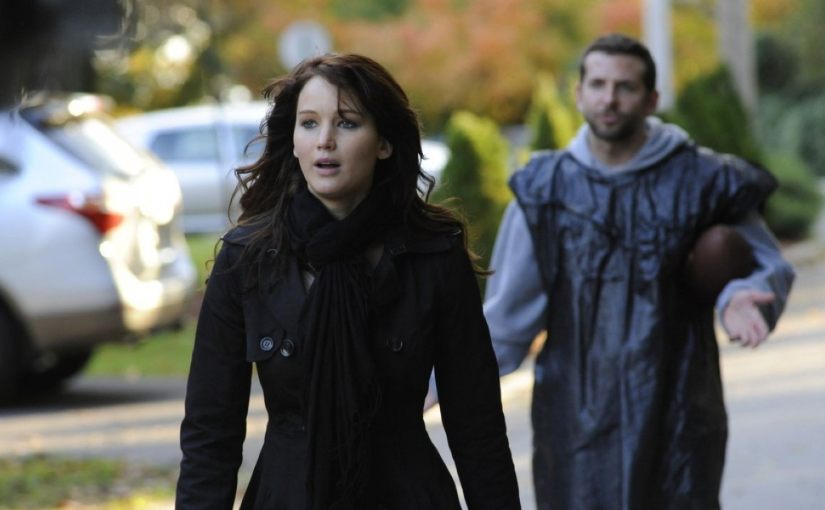
Bradley Cooper is magnificent as Patrick; a hyperactive man suffering from his own demons. He is short tempered, confrontational, and prone to exhausting and uncontrollable outbursts. Because of that, he has lost his wife, his job, his friends and when the film begins, he is being picked up by his mother from an eight month court ordered stay in a mental institution on his way to live with his parents, Dolores and Patrick Sr., played brilliantly by Jacki Weaver and Robert DeNiro. Patrick is determined to rebuild his life. He feels confident that he is now on a positive track of exercise and healthy eating, and he wants to win back his wife. It is not so easy however, when Pat refuses to take his prescribed medication and his own father probably suffers from a similar disorder and he has to share a house with him. This means dealing with Pat Sr’s obsessive compulsiveness over his beloved Philadelphia Eagles, as well as his own short temper and his insistence on using family time with Pat Jr as a means to break the “jeu, jeu” that has cursed the team. Pat Jr. wants to move on with his life and find meaning and peace. His own obsessions with winning back his wife and overcoming witnessing the affair she was having behind his back do not help.

However, then Pat Jr meets Tiffany (Jennifer Lawrence in her Oscar winning role) and her own past is tormenting her, following losing her policeman husband in the line of duty. It’s clear she has not overcome this experience and she has taken up dance, which she is teaching herself in a refurbished garage. Tiffany is not quick to accept Pat Jr, but eventually the moments necessary for any film about relationships line up despite some screaming and shoving.

It sure sounds like I’m describing a heavy, miserable drama, here. Reader, I’m not. David O. Russell offers up moments of comedy without any of his characters really trying. No one is outright normal in this film. They are all burdened with their own idiosyncrasies and diagnoses, even Pat Jr.’s therapist, who we learn is an obsessed, face painted Eagles fan himself. Russell repeatedly uses a steady cam (I believe) to rush right up into the face of his characters, individually, when a moment is overtaking him or her. It’s a way of showing that no one else in the room can see what the sufferer is seeing. Everyone else is bound by their own disorder. Russell uses this device to isolate the character that owns the scene whether it is Delores, who endures the aggravation of her husband and son, Tiffany who can not get over the loss of her husband at a young age, Pat Sr. who must live with his Eagles losing another game, or Pat Jr. who is only trying to adapt to a new way.

There is no calmness in the domesticity of Pat Jr’s life and it only feeds the fire of his bipolar disorder. What he needs is someone who will not shun or ignore the disorder but embrace it and Tiffany is that person. Tiffany is also the person who will beat up on Pat Jr in one scene to bring his self-involved neglect to light. A helpful gesture for Pat Jr, but not a fulfilling action for Tiffany. Then in another scene she will solely come to his defense. The best moment in the film belongs to Jennifer Lawrence as she storms through the door and quickly confronts DeNiro on his own shortcomings, basically disarming him with sports statistics of every Philadelphia team, only to prove that Pat Jr had nothing to do with the outcomes of these games. Lawrence is harboring a machine gun of dialogue and she does not let up. DeNiro, I’m sure, loves to balance scenes like this with talent of this caliber. (I’d imagine he was missing great acting moments like this when he was shooting his Focker movies.) Russell wisely captures most of this scene in one shot. He is well aware of his leading actress’ strengths.

The ending is as quirky and inspired as Little Miss Sunshine, where Pat Jr and Tiffany participate in a dance competition that has everything is on the line, not just for their own sanity, but also for that of Pat Sr and the rest of the family. At the risk of spoiling a piece of the story, I have to recognize the dance sequence in this climax. Russell and his choreographer wisely mix it up with contemporary music that quickly switches over to head banging heavy metal and back to contemporary again. I caught it as an allegory of the mood swings these characters, especially Tiffany and Pat Jr, go through. The dance is messy, unsophisticated, aggressive and most of all it is adorable and lovable all at the same time. Psychologically, there must be something eating at Pat Sr and Pat Jr, and Tiffany and the rest of the cast, but that is, in no way, a reason not to love them.

NIGHTMARE ALLEY (2021)

by Miguel E. Rodriguez

Director: Guillermo del Toro
Cast: Bradley Cooper, Cate Blanchett, Toni Collette, Willem Dafoe, Rooney Mara, David Strathairn
My Rating: 6/10
Rotten Tomatometer: 80% Certified Fresh

PLOT: An ambitious carny with a talent for manipulating people with a few well-chosen words hooks up with a female psychiatrist who is even more dangerous than he is.


No good movie is too long; no bad movie is short enough. – Roger Ebert

Nightmare Alley is director Guillermo del Toro’s longest film to date at exactly two-and-a-half hours.  Going by Ebert’s dictum above, I have to say that it was too long by maybe a half hour or more, but that doesn’t make it a “bad” film.  Just a poorly edited one.

The story revolves around a Depression-era drifter with a troubled past who becomes a carny with the kind of flea-bitten traveling circus that tours all the urban hotspots of Iowa and Kansas, and which is almost all sideshows: a psychic (Toni Collette), a giant (played by del Toro regular Ron Perlman), a rubber man, a girl impervious to electrical currents (Rooney Mara), and a geek show, among other things.  What’s a geek show, you ask?  Why, that’s where people pay two bits to watch a man bite the head off a live chicken.  We are shown one such performance in the opening minutes of the film.  It’s hard for me to believe people were entertained by this, no matter how long ago it was.  I mean, the geek did not look like he was having much fun…although he did seem to be having more fun than the chicken.

Anyway, to make a long story short, the carny, named Stanton (Bradley Cooper), befriends the psychic and her husband (David Strathairn) and reveals that he has always been a student of human behavior, and with a few quick observations, he can make factual statements about someone that boggle the mind.  One thing leads to another, and eventually he leaves the carny behind, with the electrical-current girl, Molly, in tow.  Soon he is headlining nightclubs and posh bars with his mind-reading act, with Molly as his assistant.  One night a beautiful psychiatrist with a level-headed gaze (Cate Blanchett) sees one of his performances and suggests a con: she will provide detailed information about her rich and powerful patients on the sly, and he will do command performances for these elites, making them both rich.  What happens next, I leave for you to discover.

(I must be honest: this is not the kind of film I was expecting from del Toro.  A character study of tragic greed and hubris?  Where are the monsters?  The supernatural nightmares of the title?  But I’m always telling people to criticize the movie the filmmakers made, and not the movie you wish they had made.  I press on.)

I’m finding it hard to summarize my thoughts here.  The movie looked great.  I mean, it looked amazing.  At one point, Stanton runs into the carnival’s funhouse looking for someone, and it’s filled with the kind of over-the-top prop demons and fake ghosts that made me hope we would get a later sequence where these things came alive in some horrifying way.  But no, it’s just intended as throwaway scenery, glimpsed once and never seen again.

There is an extended sequence where Stanton tries to revamp Molly’s act as the “Electric Girl”, coming up with new costumes, new props, new patter (patter is important with sideshows), and it’s a relatively lengthy sequence which felt like it was setting something up.  And, yeah, there’s kind of a payoff, but not the kind I felt it was building towards.

The movie left me with a vague sense of frustration throughout.  We are fed gobs of information about the tricks used by sideshow psychics, the sad ploy used to hire the geeks, the psychic’s husband looms large in the story and then abruptly becomes a non-factor, and it just went on and on and on.  Then in the “riches” part of the rags-to-riches story, Stanton has become insufferable, a believer of his own press releases, willing to put his livelihood (and his life) in jeopardy for that one last big job.

This is all very intriguing stuff, on paper.  But as executed and written, there seemed to be unnecessarily long scenes with loads of information being dumped on us with nothing moving the action forward.  I would pay money to watch Cate Blanchett read a Denny’s menu, but even her extended “therapy” sessions with Bradley Cooper felt interminable.  I felt like those random crowds in Monty Python and the Holy Grail periodically yelling, “GET ON WITH IT!”

To be fair, the Stanton character does eventually get his comeuppance, in literally the final ten minutes of the film.  Full disclosure, I will say without spoilers that it is very gratifying, it had me and some random dude behind me exclaiming loudly in the movie theater, and it features some of the best acting Bradley Cooper has ever done.  But…it came long after I had started shifting in my seat and wondering if I would miss anything important if I ran to get some more candy.

I give Nightmare Alley a 6 out of 10, mainly because it looks so damn good.  del Toro has yet to make a movie that doesn’t look masterful (yes, even Blade II is a beauty to behold).  Also, the acting all around is top notch.  There’s talk Cooper may get an Oscar nod, which wouldn’t surprise me.  But it boils down to a very, VERY long drive for an all-too-short day at Denouement Beach.  A ninety-minute movie crammed into 150 minutes.  Alas.

LICORICE PIZZA (2021)

by Miguel E. Rodriguez

Director: Paul Thomas Anderson
Cast: Alana Haim, Cooper Hoffman, Sean Penn, Tom Waits, Bradley Cooper
My Rating: 7/10
Rotten Tomatometer: 92% Certified Fresh

PLOT: The story of Alana Kane and Gary Valentine growing up, running around and going through the treacherous navigation of first love in the San Fernando Valley, 1973.


You know that old saying, “You’ll either love it or hate it”?  I’m afraid that doesn’t apply to Paul Thomas Anderson’s latest film, Licorice Pizza.  At least not for me.

The plot: Gary, an impossibly precocious and business-savvy 15-year-old child actor, still in high school (the movie opens with him getting his yearbook pictures taken), develops a crush on Alana, a 25-year-old production assistant, and pursues her – and pursues her and pursues her – while she wrestles with her own emotions and the fact that, dude, he’s fifteen years old.  He calls a shaky truce on his emotions so they can remain friends, and in the process they…let me see if I can remember it all…go on several auditions, help Gary’s mom with her public relations business, open their own business selling waterbeds, fly to Texas (?) and back, fall in and out of “like” with each other several times by attempting to form physical relationships with people their own age, meet an actor who is clearly meant to be William Holden, and by the end of the movie they finally seem to be mutually in love with each other.  Sort of.  Maybe.  It depends on your point of view.  But moving on…

For all its faults, Licorice Pizza did keep me grinning for virtually all of its longish running time, and it also made me laugh out loud many times.  Only in a Paul Thomas Anderson – or maybe also a Tarantino movie – could you have a scene where a mixed-race couple (white husband/Asian wife) have a conversation in which the white husband speaks the most atrociously absurd, cringeworthy pidgin Japanese to his wife, and it gets an earned laugh for the sheer audacity of the scene.  Is it offensive?  Certainly, if this happened in real life, the husband would be cancelled faster than an all-Latino sitcom.  (Ba-ZING.)  But I’ve gotta be honest, that was one of the great belly-laughs in the film.  I found it funny in the same way that Robert Downey Jr. in blackface in Tropic Thunder was funny, in that the people committing the offenses are clearly dumber than sacks of sand and so have absolutely no idea they’re being morons.  But I’ll leave the Theory-of-Comedy discussion for another review…

In true P.T. Anderson fashion, the dialogue is as sharply written as anything by Sorkin or Mamet.  Not a second is wasted on unnecessary exposition or explanation.  (Although, to be fair, a LITTLE more explanation would have been preferred…more on that later.)  Each scene gets to the point, either directly or indirectly, with surgical precision.

There are some editing jumps that will keep a viewer on their toes.  The movie shows a scene of Gary testing a waterbed for the first time, then jumps to him hawking them at a “Teen Fair”, then suddenly he has his own storefront, sales reps, and a bank of telephone operators.  We can only assume that he had the capital, the licenses, and the business logistics to not only make this happen but to clearly be successful at it, at least for a while.  I mean, he is fifteen years old, so why wouldn’t he know how to do all this, right?

[Actually, now that I think about it, there IS a precedent for this plot: Rushmore, Wes Anderson’s 1998 film about another precocious 15-year-old boy who falls in love with a much older woman and spends most of the rest of the film attempting to woo her while she wrestles with her emotions and her desire for a relationship with someone who was born in the same decade as she was.  Do with that information what you will.]

When the age gap between Gary and Alana was explained very clearly at the beginning of the film, I was pretty sure the two of them could never be in a relationship, and I was taken out of the movie a little.  However, as the movie progressed, the film’s charm and effortless wit made me forget how far apart they were.  Gary behaves in such a way that I forgot just young he’s supposed to be, and I forgot just how old Alana is supposed to be.  The film expertly took me by the hand and got me rooting for them to be together, despite how – let’s not mince words – illegal it would be for them to be together.

SPOILER ALERT, SPOILER ALERT, SPOILER ALERT, YOU HAVE BEEN WARNED.

SPOILER ALERT.

So the movie does its job, that I’ll grant you.  But when the film ends, and Gary and Alana kiss and go running off screen together, and Alana finally says, “I love you, Gary”, and the credits started rolling…I stared at the screen, raised my arms in supplication to the scrolling credits, and said, “Say WHAT…?”  Because it was at that point, after the abrupt ending, that I started to have questions.  Lots and lots and LOTS of questions.

If Gary is a high school student – and he is a high school student – when did he ever go to class?  The film never shows us.  One could make the case of, well, you have to ASSUME he’s going to class.  Okay…but when?  In between auditions and plane flights to a live taping of a musical number in front of a live audience and opening not one but two small businesses where his employees seem to be composed entirely of his school-age buddies?  And one of these businesses involves him buying a large quantity of pinball machines to start an arcade.  Where is this money coming from?!  His acting paychecks?  He’s not a major star.  He’s a minor bit player, at best.  And yet, not only can he finance two small businesses on his own (he has a mother, but we only meet her twice), but the maître d’ at a local restaurant knows him by name and treats him like Hollywood royalty – he even has his own table at this place.

And let’s talk about that ending.  She says, “I love you, Gary”, and they run off screen.  What does this mean?  Does this mean she’s about to embark on a physical relationship with an underage boy?  One could say, “Well, of COURSE she’s not going to start going steady with him or anything.  She’s twenty-five and he’s fifteen!  The idea’s absurd and icky!  No, there’s no way anything like that can happen between the two of them, so this ending is just her affirming her love for him in a platonic way because that’s all they will ever be able to be to each other: devoted friends.”

Yeah, but…are we just supposed to make that assumption out of thin air?  The entire movie has been working on getting these two characters together, and it ends (quite suddenly) with that happening, and…we’re just supposed to think, “Yeah, but they’re not TOGETHER-together”?  If that’s the case, I feel there should have been a little more information to make that clearer.

I’m reminded of something I read where a college professor is teaching film students about Hal Ashby’s prescient film Being There.  MORE SPOILER ALERTS, kind of unavoidable here…but the film ends with a humble gardener with an IQ in the double-digits walking serenely out onto the surface of a lake.  The professor asks his students what this final scene means.  And the students say, well, there’s a sunken pier just out of sight under the water, or the water is quite shallow, or they even theorize that the scene isn’t really happening, it’s just in the gardener’s mind.

The professor pounds on his desk and says, “No, no, NO!  What you see is what you get.  The guy is literally walking on water.  Nothing in the film mentions a sunken pier or low water levels, and we’ve never seen any of his dreams before now.  Any explanations you’re giving for why he’s walking on water, aside from his ability to actually do it, is just you bringing something the scene that isn’t there.

That’s what I think about the ending of Licorice Pizza.  It’s problematic because, to me, it doesn’t matter what I think happens at the end when she proclaims her love and they run off.  The movie is clearly indicating they DO wind up in a relationship.  We can infer all we want about what may have happened after the cameras cut, but we are left with what the film has presented to us.  And that left me feeling weirdly uncomfortable.

To be sure, there are movies out there, acknowledged masterpieces, that depend heavily on the viewer doing some heavy lifting.  The one that comes to mind the most for me is 2001: A Space Odyssey, a film whose ending is suitably awesome and beautiful…but what in the Sam Hill does it MEAN?  Do enough reading and analysis and there are conclusions to be made that make sense and which elevate that film.

But Licorice Pizza is no 2001.  This is just not the kind of movie that lends itself to that kind of theoretical dissection.  If there are buried truths to be discovered, fair enough, but how much digging am I expected to do?  As the great man once said, “If you have to ask what something symbolizes, it doesn’t.”

First impressions are very important. And my first impression of Licorice Pizza is that, while it’s solidly acted and directed, and the dialogue is pitch perfect, the story itself leaves something to be desired.

[P.S.  A friend of mine said that if you were to switch the genders in this movie, it would never have been made.  I might agree, were it not for the fact that there have already been several films already made about that very topic, that is, an adult man in an inappropriate relationship with a much younger or underage woman.  American Beauty, Lolita, Lost in Translation, etcetera.  Maybe Lost in Translation is not the best example, as both characters are legal adults, but you get my point.  Frankly, I thought the gender switching in Licorice Pizza was kinda refreshing…up to a point.]

LICORICE PIZZA

By Marc S. Sanders

Can you ever imagine topping your pizza with licorice?  Seems weird, odd and just…well…no!  That’s the message of Paul Thomas Anderson’s winning film Licorice Pizza.

As I watched the picture, I knew that many would not get the point.  They may become bored or even think this is a weird movie.  That’s what I thought when I first saw Anderson’s 1999 film, Magnolia.  I loved that film, but that ending is…yeah…waaaaaay out there. 

Anderson’s script centers on a 15-year-old boy named Gary Valentine (Cooper Hoffman; son of Phillip Seymour Hoffman) and the girl-SCRATCH THAT-woman, I mean, that he becomes enamored with named Alana (Alana Haim).  Gary approaches Alana at his high school where he is about to have his class picture taken.  She’s there working in a dead-end assistant position with the photographer.  Fast dialogue takes place in this opening scene where Alana can’t take this kid seriously even though he’s a seasoned child actor, known throughout the San Fernando/Encino, California landscape among known casting directors and agents.  Eventually, the relationship blossoms as Alana serves as an adult escort for Gary who has to go on a television program.  (Mom was not available to accompany underage Gary; hence the word escort.)  Soon after, it’s established that though Gary seems more mature than a typical 15-year-old because he’s had a career during most of his young life, Alana is in a limbo of not reaching adulthood yet, despite the number of her age.

Gary’s worth as an actor is expiring as he’s not the cute precocious kid that Hollywood is looking for anymore, and so he’s on his way to his next venture, never allowing himself to be set back.  Why not sell the newest innovation of the early 1970’s?  Waterbeds!  Meanwhile, Alana does her best to move on to her next life changing chapter by dating an actor her age.  However, things don’t work out.  He was born Jewish, like her family, but he defiantly announces he’s an atheist over Shabbat dinner and will not recite the kiddush prayers. 

The contrast in Gary and Alana’s progress through life in 1973 couldn’t be further separated from one another.  Anderson writes these two characters as they are going in opposite directions.  They are 10 years in age apart from one another.  Gary doesn’t allow himself to be defeated when one business venture after another doesn’t pan out.  Alana is short tempered and easily stuck in a rut, however, when things don’t go her way.  This is the running theme of Licorice Pizza.

Other folks that I’ve discussed this film with find it weird that a 15-year-old boy and a 25-year-old woman are hanging together and drawn to one another.  Yeah, it’s weird, but it happens.  Out there, there are unusual relationships or friendships.  Spend a month working in a community theatre like I have and then tell me weird relationships don’t happen.  Forget about whether they are legal or not.  Forget about if it’s perverted.  (Though, truly it really isn’t depicted in a perverted manner in Anderson’s film.) There’s a relationship between Alana and Gary where romance and attractiveness are certainly tested, but that doesn’t mean it’s ever consummated. 

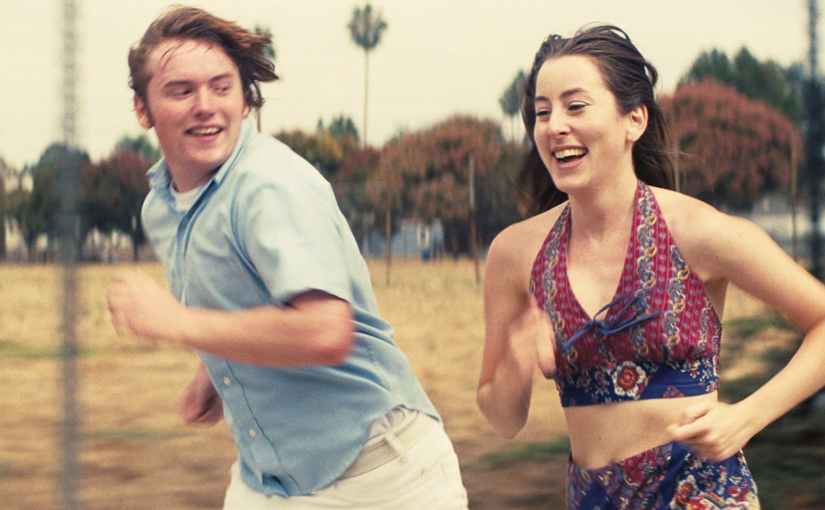
The fact that the relationship between the two characters is difficult on them and the audience is the point of Licorice Pizza.  Anderson is a brilliant writer/director here because he has an ongoing visual theme happening.  Often during the film, both characters are filmed running towards something.  They are either running towards one another or something else or they are running away from each other.  Gary and Alana seemingly know that this relationship could never come to an intimate, loving, romantic relationship.  After all, he’s fifteen!  She’s twenty-five!  Yet, what Paul Thomas Anderson demonstrates is that no matter how physically fast you can run or how far you can run, these two characters will never, ever catch up to one another. 

Gary yearns for Alana because lust interferes in most boys at age fifteen.  Alana needs Gary, however.  She tries and tries new opportunities to stimulate her daily lifestyle beyond Gary, like volunteering on a politician’s campaign or attempting to get in the good graces of a well-known Hollywood actor (a brief, yet memorable appearance from Sean Penn).  Dating a man closer to her age also doesn’t work out.  She’s outgrowing her Jewish home life that she’s still stuck in as well.  Alas, it doesn’t ever work out for her. 

The actress, Alana Haim, who takes on the role is surprisingly skillful.  She’s tough and sad and lost.  Anderson may have written the character, but Haim evokes the emotions that progress her listless story arc.  Each time, something happens to Alana, I couldn’t help but feel such despair for her.  I’ve been there.  When I graduated high school!  When I graduated college!  When I broke up with a girl!  When I had to move into an apartment!  When I became a father!  How many of us truly go on to the next plateau knowing exactly what to do?  Some folks like Gary, can do that.  Others like Alana just can’t.  I think more people have been in her spot than they care to admit.  Paul Thomas Anderson is brave enough to not present Alana’s triumph so easily or quickly.  Movies don’t always have to show the happily ever after ending.

Gary moves from one chapter to another as well.  Because he’s a well-known kid actor of yesteryear, he’s granted more resources than Alana, even though he’s ten years younger.  He always gets a table at the local restaurant.  He knows all the casting directors.  He knows how to get around and get things started.  Audiences are smarter and likely know that whether Gary is selling waterbeds in a run-down business shop or later turning the place into a pinball arcade (now that pinball machines are legalized; which I never knew they were illegal to begin with), he won’t become such a successful entrepreneur.  Yet, that never fazes Gary.  This is just the next big thing that occurs to Gary.  So, he’ll just give it a go.  The confidence Alana lacks in herself, Anderson gifts with the Gary character.  Cooper Hoffman makes a grand debut with Anderson’s direction and character foresight.  He’s definitely not performing in his father’s shadow here.

Licorice Pizza carries so much symbolism in the point to the story that you might not even realize how apparent it is until later when you reflect back on the film. Obviously, Paul Thomas Anderson is very careful to insist how far apart these two people are, not just in age, but in how they carry themselves and their lifestyles.  However, he does not stop with just the two main leads.  A side gag has a guy who’s the owner of a Japanese restaurant discuss an advertising campaign with Gary’s mother.  A suggestion is proposed by Gary’s mom.  The man then “translates” to the woman simply by repeating the same thing in English with a terribly awful Japanese accent and then the Japanese woman sitting next to the man speaks in her native tongue.  The man carries himself as if he understands the woman and translates back to Gary’s mom in his own Americanized dialect.  It’s shockingly funny how wrong and insulting this guy is.  This guy knows nothing about Japanese cuisine or culture or what they say or what interests them and yet he’s trying to make a business venture out of it.  It’s wrong and highly inappropriate (which makes the scene very funny), but it exists. It’s garish to watch this behavior, but there are thousands of insensitive people doing thousands of insensitive things every day; people who couldn’t be further apart from practicing what they truly were not destined to preach.  If you stop and think for a second, you can’t deny that this is one more weird thing out there in the world that’s odd and yet probably exists somewhere down the street or in another state or another time.  This guy has a connected with a Japanese woman without any concept of understanding or appreciation.

The title of Anderson’s film is never literally addressed.  (Later, I read that Licorice Pizza was actually the name of a popular record store in California way back when.)  Yet, my mind periodically went to its significance while watching the movie.  Try eating pizza with a thick, doughy crust and topped with tough, taffy texture like licorice topped on it.  I’ve never done it, but I’d imagine it’s hard, very hard, to swallow.  So, while Alana and Gary are certainly friends, the hormones of a fifteen-year-old boy and the lonely, lost nature of a twenty-five-year-old woman becoming involved with one another are hard to digest as well.  No matter how Gary and Alana approach their connection to one another it just does not work.  Alana falls off a motorcycle at one point. Gary runs to her.  We see that all the time in movies.  But what’s he going to do when he reaches her to offer aid?  What more can Gary do except to say “Are you okay?”  Gary gets arrested during another time in the film.  Alana runs after the police car Gary is handcuffed in, and tells him it’s going to be okay.  Yet, what is she really going to do?  She doesn’t know anybody like a lawyer or an adult that can help.  She doesn’t have the capability of helping him.

Run as fast as you want.  Run as far as you want.  Gary and Alana can never, and will never, catch up to one another.  They’ll never meet at an appropriate age, always living a decade apart.  They’ll never share a commonality with each other that promises a loving and intimate relationship.  So, while Licorice Pizza has a silly, comedic name, it’s truly a tragic story of impossible love. 

Licorice Pizza is definitely one of the best, most inventive and sensitive films of the year.

A STAR IS BORN (2018)

By Marc S. Sanders

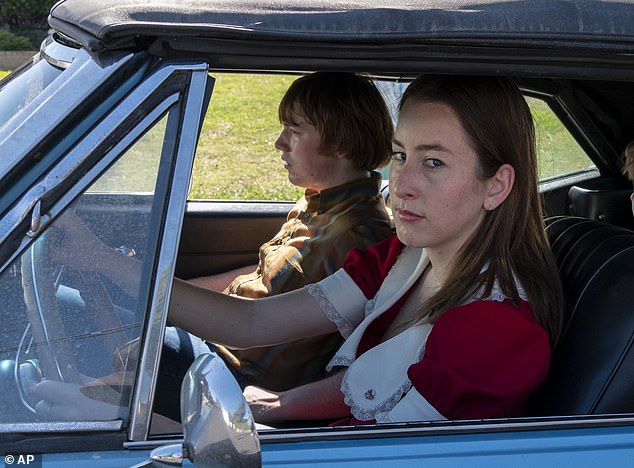
Bradley Cooper produces, directs and co-writes himself with Lady Gaga in the fourth iteration of A Star Is Born. They will go down as the hottest screen couple of October, 2018, but not much beyond that.

The chemistry is maybe there between the two stars but I won’t say it’s very electrifying. Individually, I really liked what each of their performances offered. Together? Meh. At times when they are in a scene it almost looks like they are not paying attention to one another; as if they aren’t listening for their cues. Oddly enough, Sam Elliott and Cooper have terrific chemistry as brothers. They truly look and sound like they came from the same cloth. Same with Gaga and Andrew “Dice” Clay as her father (a welcome surprise; I wish he had more material). The scenes with Gaga and Cooper however don’t measure up.

Cooper directs outstanding musical performances of himself and especially Gaga, though I’d argue she relieved some of the pressure with her experienced talents. Her first concert introduction is show stopping; that note she hits stays with you. Her final performance is just as effective and reminiscent of the legendary status Whitney Houston made for herself in The Bodyguard.

Cooper’s directorial debut absolutely must be commended. The concert set pieces are especially authentic. However, the film is too long. For a simple and familiar story, two hours and fifteen minutes is a bit much. A small appearance by Dave Chappelle as Cooper’s friend is wasted and pointless. He shows up an hour into the film, does a quick scene and then he’s never mentioned again. Definitely a scene worthy of the cutting room floor.

Lady Gaga has wonderful moments especially at the very end and during the first half of the film. The 2nd act is by no means her fault but when her stardom blossoms, I didn’t care for the image of a what seemed like a 2nd rate Miley Cyrus act. I would have preferred something more sophisticated like Celine Dion, Adele, or heck even a Lady Gaga. The artificial orange/red hair is a major distraction. I couldn’t help but get fixated on this car accident of an hairdo and not on the performance. A poor choice.

It’s a good film. Not great. Some songs are memorable. Some are very forgettable. I think Bradley Cooper did a fine directing job more or less. I just hope he gets a little better.