PATRIOT GAMES

By Marc S. Sanders

You may remember Patriot Games as a tense thriller featuring the favorite hero Jack Ryan doing the wherewithal action that is demanding for the adaptation of Tom Clancy’s best-selling novel.  Harrison Ford (taking over the role from Alec Baldwin) plays the guy who will thwart an assassination attempt on the Royal Family or punch out a terrorist thug invading his home or on a speed boat during a dark and stormy night.  Only a small bit of the action sequences are flawed, but that doesn’t take away from what makes the picture truly special.  In the follow up to The Hunt For Red October, Jack Ryan goes back to the CIA to investigate who wants revenge against him and who was responsible for that assassination attempt.  What the picture serves as the covert halls of the Central Intelligence Agency is what is especially convincing and most fascinating.

On the surface, the Irish Republican Army appears to be the scapegoat for attempting to murder members of the Royal Family as they are pulling out of the front gates of Buckingham Palace.  Jack Ryan is in London vacationing with his wife Cathy (Anne Archer) and daughter Sally (Thora Birch) when he comes upon the incident just in time to foil the crime.  In the process, Ryan takes a bullet to the shoulder and kills the younger brother of the most dangerous squad member, Sean Miller (Sean Bean).  A quick trial puts Miller behind bars and Jack is recognized as a hero.

However, Sean Miller escapes with his surviving comrades and vows revenge on Jack and his family.  An attempt is made on the Ryans’ lives and Jack insists on getting back into the CIA to locate Miller and his team.

The revenge plot is the main thread and its pretty ho hum.  We’ve seen all that many times before.  However, what branches off are the conflicts within Irish politics and how Jack Ryan gradually uncovers who and where this small faction of terrorists may be.  Cold War commentary is delivered by an under the radar performance from one of my favorite character actors, Richard Harris.  He attempts to deny responsibility of these attacks and offer an olive branch to Ryan.  Ford and Harris have three good scenes together, two of which are minimal on dialogue but effective in sending their messages to one another. 

As well, Harrison Ford occupies another great heroic role.  I agree with a majority who believe he was too old to play the novice Jack Ryan described in Clancy’s early novels.  Many insist casting Baldwin was perfect.  It was. Yet, I am able to look past that as the character does not have the rookie appearance or regard in this picture.  With Harrison Ford, Jack Ryan is now at a point where he looks seasoned and experienced like the character eventually becomes in the book series.

Director Phillip Noyce is good at using the mysterious and quiet orchestral accompaniments of James Horner to follow Jack as he studies photographs or reflects on the day of the assassination attempt in order to piece together random clues.  In other films, this might get boring and tedious.  However, the director captures good closeups of Harrison Ford and quick flashbacks are edited to help identify what were important blink and miss it moments necessary to assemble the puzzle.  A simple visit to the restroom for Jack Ryan and a glance at a woman’s ponytail lead to a solid conclusion.

Sean Bean has the physical and quiet intensity to his role.  He’s the muscle of the terrorist group, not the leader (played by Patrick Bergen).  Bean serves the revenge element and his physique and weapon handling work well as a nice threat to the hero of the picture.

As the story progresses, the audience follows along with Ryan.  Satellite photographs are studied and zoomed in seeking some semblance of an image in a blur.  Sometimes Jack Ryan is moving in the right direction but in other times he’s unsure.  Even though we always know how the bad guys are doing and where they are, we empathize because Harrison Ford’s character does not.  Still, it’s a thrill to witness him eventually make his discoveries.

A nice approach occurs when the CIA sends in troops to what they believe is an enemy base camp.  We watch Jack Ryan and all of the government officials stare with intensity on a big screen as little black pixels drop down and move at a running pace from an overhead satellite shot.  We don’t have to endure one more machine gun battle.  This kind of intensity is much more interesting where lives are taken as a means of protection, but still a principled man like Jack Ryan does not feel good about what has to be done.

Patriot Games works well with its plays on espionage, spy activity, traitors, and government relations between America, Great Britain and Ireland.  The select action scenes are done well and hold their suspense for quite long.  However, the final sequence is challenging to sit through. 

As the enemy prepares a covert attack on the Ryans’ Virginia home where the Royal Family are guests, there is much running around upstairs and down, in the basement, and outside the roof and so on.  It’s pouring rain with the standard thunder and lightning in the middle of the night as well.  Once the villains and the hero make their way to some getaway boats, the film unravels.  The picture shakes like crazy against the waves and rain.  There’s little light on any of the shots as well and the sound goes loud due to the boat engines and the storm setting.  All of these elements make it challenging to get absorbed in the movie’s climactic ending. 

Hollywood pictures fall back on this approach often in films like Ang Lee’s Hulk and the first installment of The Hunger Games.  It’s dark and wet and shaky and rainy. So, it is hard to decipher who is hitting who and who is shooting at who and who is driving which boat and where are they now.  It’s a shame really because Patriot Games is a taut thriller that holds your attention for nearly two hours, but then you give up in the final few minutes to simply rely on your instincts for how the story is going to wrap itself up.

Jack Ryan’s second adventure is worth watching but oddly enough, maybe wait for your restroom break until the last ten minutes of the picture.
JFK – DIRECTOR’S CUT

By Marc S. Sanders

Oliver Stone’s JFK is told through perspective, not necessarily history.  It’s not a biography and I do not believe Stone would ever claim it to be so.  It’s a thinking person’s picture that gives viewers entitlement to question what occurred, how it occurred and why it occurred.  It might guide you not to trust what anyone says, sees or hears, but let’s face it.  Probably the day Kennedy was shot, November 22, 1963, could we ever completely trust anyone ever again? 

(Forgive my cynicism.  I must backtrack a little.  I still trust my wife and daughter.)

Oliver Stone works through the eyes of New Orleans Prosecutor Jim Garrison (Kevin Costner, in what may have been his most challenging role to date at the time).  Garrison sees a little too easily that there are circumstances out of place, or maybe too neatly in place to satisfy the ultimate resolution that a known American defector to the Soviet Union, like Lee Harvey Oswald (Gary Oldman), acted alone in the assassination of the President.  Stone wrote the script for JFK with Jim Marrs and used Garrison’s input from his own novel. Nearly every scene builds into another possibility of how that fateful day came to be.  Stone even questions if a famous photo of Oswald on the cover of Life Magazine is real.   Too many cover ups with a building list of body count witnesses and too many coincidences keep Garrison up at night.  So, he assembles a crack team of investigators and fellow attorneys to reopen the case and question the official Earl Warren Commission.

Firstly, JFK is magnificent entertainment with a hair raising and unusual original score from famed film composer John Williams.  His notes on percussion with dings and harpsichord strings cue in at just the right moments when Stone introduces another one of many scenes that point out what seems cagy and suspect. The music of JFK works as a narrator.  This narrative keeps you alert.  Maybe you should look in each corner of the screen at times for some subtle clues.

It was also wise of Stone to go with a well-known cast of actors.  The Oscar winning editing from Joe Hutshing and Pietro Scalia moves at a breakneck pace.  Yet, because I recognize fine performers like Ed Asner, Jack Lemmon, Kevin Bacon, Tommy Lee Jones, Brian Doyle-Murray (Bill’s brother), John Candy and Joe Pesci it is easy to piece together who is playing who and what significance they lend to the many theories Garrison and Stone question next.  

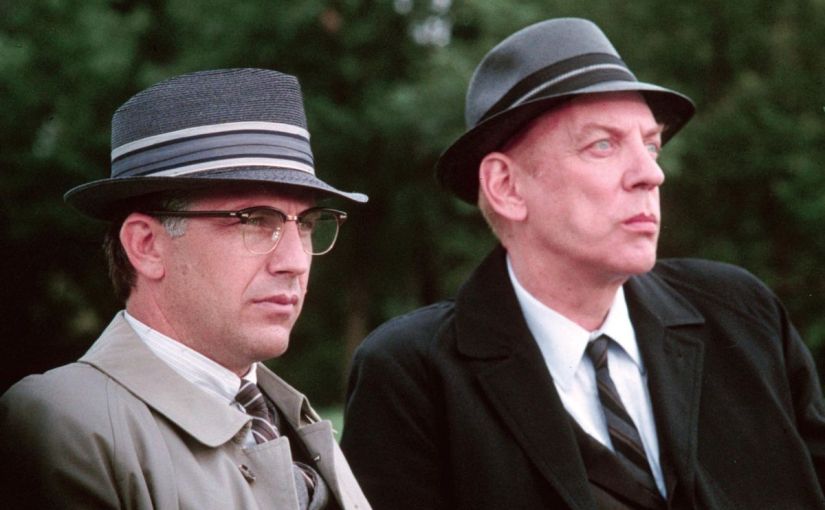
My admiration for the casting continues with the Garrison team that performs with Costner – Michael Rooker, Laurie Metcalf (especially impressive), Wayne Knight, and Jay O. Sanders.  There’s also a clandestine trench coat guy named X portrayed by Donald Sutherland.  Who even knows if this guy ever existed?  He’s more secretive than Deep Throat, but Mr. X has a hell of a lot of information to justify Jim Garrison’s suspicions.  That is an especially marvelous sequence between two men strolling through Washington D.C., eventually concluding a disturbing realization on a park bench.

Sissy Spacek brings out another dimension to the Jim Garrison character.  She’s his wife and the mother of five who suffers the loss of her husband’s attention which is entirely focused on this compounding investigation.  I like Costner’s take on the Garrison character.  Early on he politely asks one of his associates to stop cursing.  He does not like that kind of talk.  Later, it is Garrison who is dropping a number of eff bombs in front of his wife and young children.  This conundrum of a case, a very puzzling detective story, is unraveling the investigator. 

JFK was instrumental for further Congressional consideration following its release.  Files were reopened.  Additional research was executed, and soon many of those secret documents pertaining to the assassination will be revealed in 2029.  Back in 1991, of course that appeared to be a lifetime away.  It’s time we know everything, though.  Arguably, most of who were involved in this incident are dead by now.  Let us know our history.  Still, Garrison was bold enough to point skepticism at not just the adversarial relationship Kennedy may have had with Castro, the Cubans and their Communist allies, but also the people within the CIA and the FBI.  Lyndon Johnson is not even free from scrutiny after he’s sworn in.  Some on Garrison’s team went so far as to factor in culpability from the mafia.  Garrison was not so keen on that theory, actually. 

The construction of Oliver Stone’s film is unparalleled.  I think it’s his best film to date and I can find few others that even compare to how he assembled the picture.  It begins with the voiceover of Martin Sheen laying out many news cycles that were occurring ahead of Kennedy’s murder such as the Bay Of Pigs and the President’s supposed efforts to withdraw from Vietnam.  Sheen’s narrative comes at you very fast with Stone incorporating real life home movies of Kennedy along with his brother Bobby, as well as Castro, and television news footage from Vietnam and anywhere else events were happening.  By the end of the roughly five-minute opening, your head might be spinning. 

Thereafter, though, Stone goes through Garrison’s day on November 22, 1963, watching the outcome following the momentous event and the writer/director works his way into the drama beginning with Asner and Lemmon as two drunk old guys walking through the rain and getting into an argument. 

Three years pass by and so begins Jim Garrison’s motivations to follow multiple trails of breadcrumbs that lead to a lot of different places, all unlike what Earl Warren surmised. 

The scenes work quickly from that point on, and cuts of theoretical reenactments occur.  Who knows if any of these scenes are factual?  Stone and Garrison want you to at least consider their reasonable likelihood.  Moments happen where Joe Pesci and Tommy Lee Jones’ characters appear to be lying about even knowing one another while Stone will depict a sexual role play encounter between them which also includes Kevin Bacon as someone with no more reason to lie. 

Episodes are deeply focused on Lee Harvey Oswald depicted as an infamous and suspected patsy in association with others who may have a reason to want Kennedy dead.  Gary Oldman hides so well in the role.  Oliver Stone even lends focus to how different witnesses describe Oswald.  In some scenes it is Oldman, but then there are other times where a shorter, more overweight man may have been the real Oswald. Later, there’s an Oswald who is taller and more slender. 

A few years ago, I was visiting Dallas, and I was able to spend a some time walking around the crossroads where Kennedy was shot in the convertible while seated next to his wife Jackie.  Watching JFK again lent more clarity to all of the locales such as where Oswald was supposedly shooting from the top floor of the corner book depository.  Kevin Costner and Jay O. Sanders go through the motions of Oswald firing the three shots from his rifle in the short amount of time span.  The script also questions why Kennedy was taken out by Oswald after the turn off the corner of Elm and Houston. There appears to be a better wide-open clear shot long before the turn with the car only going ten miles per hour.  The men question if it was Oswald, then why didn’t he take advantage of the clearer shot.

I know.  I could go on and on.  I have to stop myself.  There’s a ton – A TON – of information in JFK.  It becomes addicting to watch.  You don’t even want to pause the long film for a bathroom break.  I watched the extended Director’s Cut by the way. 

Many common critiques of JFK lean towards how many of these scenes did not even happen.  People are happy to point out there’s no evidence to truly say any of Oliver Stone’s enactments occurred.  I agree, but that’s not the point of this director’s piece.  This is primarily told through the eyes of Jim Garrison.  Kevin Costner is great as the listener, the observer and especially at the conclusion, the describer.  Watch him physically respond to anyone he shares a scene with.  There’s a memorable twitch he offers while at the scene of the assassination that works perfectly with a jarring echo of a gunshot edited into the film.  He’s also great at turning his head down as the thinker while Mr. X lays out an enormous amount of information that comes from several different directions.  Because the film comes from Garrison’s perspective, it does not have to be true.  It only has to be what the investigating prosecutor reasonably believes, and what he absorbs from suspects, witnesses, and his devoted team. 

A final speech of Garrison’s is told at the trial of suspect Clay Bertram, aka Clay Shaw (Tommy Lee Jones), who was the only man tried by Garrison for Kennedy’s murder.  First, it’s important to note that during this fifteen-minute sequence, when Stone cuts back to Garrison in the courtroom, Costner is wearing different suits.  So, while it is assembled as an ongoing rundown, it is not meant to all be in one instance.  Garrison lays claim to an endless amount of possibilities and circumstances that at times have no correlation with each other but could possibly all merge together towards November 22, 1963.  Critics argued this speech of Garrison’s never took place.  That’s correct.  However, this is a movie and for the efficiency of information to come out, a funnel must be opened up to learn what is being pursued and what has been uncovered.  This is the strategy that the script for JFK adopts and it works, leaving you thinking and rightfully doubting what our governing bodies and history books have told us.  Most famous of all of these nonsensical happenings delivered by Garrison is the “Magic Bullet Theory” made extra famous by Jerry Seinfeld with Wayne Knight on the comedian’s sitcom.  It’s silly but it is also a response to the impact that came from JFK.

JFK has a very glossy appearance from the Oscar winning cinematography.  Reflections and natural glares come off of Jim Garrison’s glasses.  The exasperation, along with the shiny persperation of John Candy’s sleazy lawyer character is undeniably noticed as his integrity is being questioned.  Staged reenactments are shown in black and white, clear color or grainy distressed output (such as recreations of the known Zapruder Film).  Nothing is clear about what led to Kennedy’s murder.  So, Oliver Stone’s filmmaking team will ensure that nothing should look consistent.  There are no straight answers; only endless amounts of reasons to ask another question after another.

Oliver Stone does not make JFK as complex as some will have you believe.  It’s quite easy to piece together who represents what in this story.  Many theories are offered at lightning speed, but they hardly ever intersect with each other until a probability is completely laid out on the table and then the film moves on to the next one.

JFK may have a long running time and a large cast with a lot to say and ask, but it’s an exhilarating thrill to behold.  Who knows what is true?  The importance of Oliver Stone’s masterpiece demonstrates that much of what we were told as truth may not consist of the entirety of facts. 

Again, question your governing bodies and ask the hows and whys and whos.  Oliver Stone reminds us that we have that right as the citizens of America. 

What really happened to our President, and who was really responsible?

DEMOLITION MAN

By Marc S. Sanders

In the years since the Sylvester Stallone/Wesley Snipes futuristic action picture Demolition Man came out in 1993, bloggers have been giddy to post about how brilliant the satire is, especially since much of its fictional future set in a totalitarian San Angeles (formerly Los) in the year 2032 ended up becoming real to some degree.  Okay, fine.  I’ll go with what they say.  However, Reader, this is not on the same level as Paddy Chayefsky’s prophetical film, Network, and the legacy it has bestowed.  Demolition Man remains just as stupid as it was when it first came out.

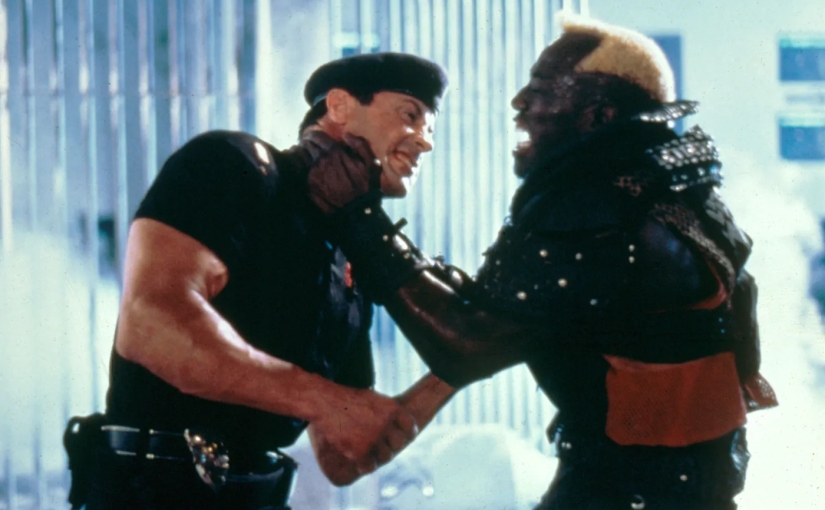
In a mid-1990s prologue of fire, gunfire, and flames, a vicious killer named Simon Phoenix (Snipes), with a happy go lucky habit of giggling through the mayhem he unleashes, is apprehended by decorated cop John Spartan (Stallone).  However, both men are sentenced to decades of cryo-freeze imprisonment because the hostages that Phoenix held had perished and Spartan was found neglectful.

The film jumps to 36 years later. Phoenix has been released and immediately returns to his old habits.  The problem is the law enforcement of this period is not equipped to contain the crazed criminal.  So, Spartan is defrosted as well to go up against Phoenix.  This future is occupied by the cute smiles and charms of Sandra Bullock, Benjamin Bratt and Rob Schneider as the cops who happily sing the melodies made famous by radio and television ads.  Guns are entirely outlawed along with drugs, alcohol, spicy food, and obscene language.  Say a curse word and a machine is nearby, quick to charge you with the offense.  Touching and the exchange of bodily fluids are forbidden as well.  A high five with no contact was an uncanny precursor and is now reminiscent of the early days of the Covid crisis when it was strongly urged that people not even shake hands.  About the only favorable improvement of this future is that toilet paper is no longer used, and people resort to solving their hygiene problems with three seashells.  Regrettably, the technique is never demonstrated.

This film invests a lot of time in its satire, and I appreciate the attempt to find its humor.  The problem is the humor is delivered by Sylvester Stallone and he’s not Bill Murray or Aaron Eckhardt (check out Thank You For Smoking).  Satire is not a wheelhouse for Stallone to reside in.  Sandra Bullock on the other hand is cute in her response.  A memorable scene could have been so much better had Bullock had a more appropriate scene partner.  Lovemaking takes on a whole new method in this 2032 future.  Head devices are used to stimulate the mind.  Oddly enough, you could say that’s the direction that virtual reality has taken.  I appreciate the intuitiveness, but Stallone’s performance doesn’t.  What was intended to be a foreign experience for sexual gratification, comes off very clunky with Stallone.  Imagine what Ben Stiller or Paul Rudd could have done here.  Bruce Willis would have been marvelous in a scene like this.

Wesley Snipes is just as good an action star as Stallone or Willis or Schwarzenegger.  Unfortunately, his Simon Phoenix is so one note as a villain.  He’s a got a bleach blonde crew cut and a giggle and nothing else.  Stallone’s character describes Phoenix as a dirt bag, and the dastardly bad guy shoots guns and does quick kicks.  There’s nothing to know or learn about this guy.  He’s just a target for Sylvester Stallone to do his typical Sylvester Stallone with a shotgun and a handgun and his signature rahhhhhhh bellow that he’s provided in Rambo and Cliffhanger and Cobra and most of the rest of his career.  (Don’t get me wrong though.  Stallone does have a good repertoire of movies.  This one in particular is what doesn’t work.)

Denis Leary lends to the thin plot for a time.  Back in ’93, Leary was known for a few MTV ads where he did his infamous ranting monologue while popping a cigarette.  Because the script for Demolition Man is so nil, the angry comedian is granted opportunity to do his schtick here…twice!  It didn’t amuse me in ’93.  Now it’s just terribly outdated.

Back to the satire, I question the response of the players.  This film takes place only 36 years after a time of violent crime and cursing and smoking and drinking and all the debauchery that we were tolerated.  When Rob Schneider and the police look shocked and terrified at Simon Phoenix’ measure of violence, they are completely oblivious to what’s occurring.  I dunno.  Should they be that gullible?  This guy is only from a time that’s just over thirty years ago.  It hasn’t been that long.  Bullock even has a poster of Lethal Weapon 3 hanging in her office.  The response was hard for me to swallow, and that’s what killed the satirical attempts.  You can’t be that dumbfounded or naïve, can you?

There was a good idea here, but any kind of semblance of thought went out the window once that was jotted down.  The right player was not inserted into the main slot.  Stallone is miscast.  That’s the biggest problem.  Demolition Man hinges on the ho hum gunplay of any Sylvester Stallone actioner and stands on a sliver of irony with how dynamics have played out since the film’s release.  That’s not enough to consider it a fun kind of popcorn flick, though.  Demolition Man needs to remain frozen in time.

FRACTURE

By Marc S. Sanders

When director Gregory Hoblit was shooting this film, did he ever wonder how preposterous this courtroom mystery is?  

This ridiculous effort featuring a tired Anthony Hopkins as a suspect representing himself, and a very green Ryan Gosling as the prosecuting attorney proudly boasts a centerpiece storyline of simply finding a gun used in an attempted murder.  That’s it really.  No nuances.  No subtle riddles.  Just a “what happened to the gun?” plot line.  

It’s any wonder that I had never heard of this movie until I found it on Netflix.

Take my advice.  Find something else on Netflix.

THE SHAWSHANK REDEMPTION

By Marc S. Sanders

The purest form of humanity can be found in some of the most unexpected places. Frank Darabont’s first film, The Shawshank Redemption, based upon a novella by Stephen King is a perfect example of that truth. In a federal prison, the true test of a man’s character is established. Will a prisoner be as cold hearted as the crime he’s been punished for, or will he find a deeper meaning to his existence for himself and those around him? What if this particular man is actually innocent, wrongfully convicted? Will his innocence of crime be upheld?

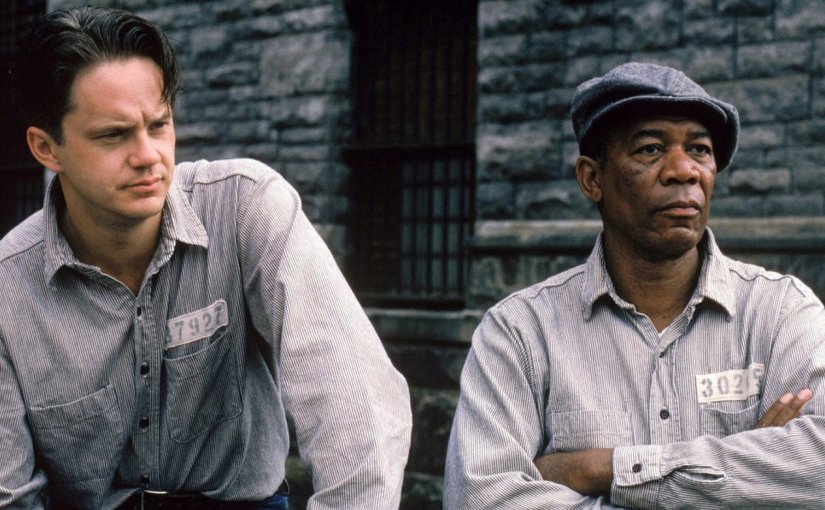
To experience The Shawshank Redemption is to learn about a community that I am completely unfamiliar with, and I’d bargain most of its viewers are as well. Shawshank prison is not a place I would like to check into. Though many of its residents display heart and comradery, nonetheless. These men likely didn’t know they were capable of such merit until Andy Dufresne (Tim Robbins) arrived to serve two concurrent life sentences for murdering his wife and her extramarital lover. Andy says he’s innocent without any desperation or urgency because none of that elevated showmanship would make a difference. The evidence and circumstances at trial unfortunately were coincidental to easily sentence Andy for a crime he didn’t commit. Everyone at Shawshank insist they’re innocent. Likely though, Andy is the only one who can genuinely make that claim.

Andy’s introduction to the prison is hard for the first couple of years. He’s consistently beaten and raped by inmates who need to exhaust their sexual tendencies. Fortunately, he sidles up with Ellis “Red” Redding (Morgan Freeman in maybe my favorite role of his career). Red is the go-to man for contraband resources like whiskey or as Andy requests a small rock hammer and a large poster of Rita Hayworth. Everyone is happy to know a guy like Red. Yet, Andy does not lose sight of his personal value. He was a banker by trade and when an opportunity opens up, he assists the viciously frightening prison guard Byron Hadley (Clancy Brown, who really should have more villainous roles in film beyond his voiceover as Lex Luthor in cartoons) with a legally accepted government tax exemption. More importantly Warden Samuel Norton (Bob Gunton) takes advantage of Andy’s talents to sustain his seemingly innocent money laundering schemes.

There is much education to be had from viewing The Shawshank Redemption. I learned what the term “institutionalized” means from Red’s experience. A man who has served a near half century has become accustomed to prison life. He offers little significance or purpose outside the prison walls. I also learned the value of music and literature and art. It’s needed to survive those lonely nights in a prison cell, or worse in the hole where you can wind up should you step out of line from the Warden’s strict guidelines of adhering to discipline and the Holy Bible. What you hear and what your read stay with you in your heart and mind, offering a most valuable commodity – hope. A life sentence will take away your liberties to walk freely among the masses, but nothing will take away what you’ve absorbed. If you can at least hold on to your memories, then you will never lose hope. Andy reminds Red and his fellow prison inmates of the hope you hold onto no matter how long you are held against your will.

Frank Darabont introduces a spectacular midway scene where Andy finally receives a donation of books and records for a prison library he envisions building for Shawshank. He uncovers a vinyl record of an Italian opera and with complete disregard for rules, he airs the music through the intercom. Darabont gathers gorgeous close ups of the hundreds of prison extras with overhead shots of the yard, woodshop and infirmary. The men freeze for a moment to look up in the sky from where the music is emanating from while mixed in with the soothing voiceover narration from Freeman. It’s a beautifully directed scene. A risky scene for late 20th century audiences who are used to quick cuts of action in their films with powerhouse soundtracks and pop music. Darabont found a way to connect the audience delicately to the film through Andy’s personal values and Red’s learned observations.

The Shawshank Redemption is an exceptional piece of writing. I can’t compare it to King’s source material as I’ve never read the story. Having said that, I’m typically hot and cold on the author’s books and screenplays. Sometimes they go too over the top for me. However, Darabont honed in on a perfect balance of likable characters and honest life within a prison; at least I feel that it’s honest. All men are created with good inside them. What they learn from day one is what can drastically change them and what can come of their sins can revert their instincts. Andy Dufresne is the instrument that redeems the men of Shawshank prison. Tim Robbins is right in this role; maybe his best role for his career as well. He does not underestimate any of the men in Shawshank and keeps to his personal enrichment which he also shares, despite the selfish hypocrisy of those meant to maintain order like the Norton and Hadley.

Morgan Freeman is the man who is becoming more and more institutionalized to prison life, always failing to get paroled for a murder he committed when he was a young and stupid kid. If not for Robbins’ melancholy performance as Andy, Freeman’s performance as Red would not realize a new kind of importance for himself. In fact, many of the inmates wouldn’t be able to acknowledge what they are capable of or what they mean in the world they live in without Red, but more importantly Andy as well. Morgan Freeman and Tim Robbins make for one of the best on screen couples in film history. Their chemistry is magical. Any scene between them can be studied for the weight of emotion or lack there of which the two actors carry. They both went on to win Oscars later in their career, respectively from a pair of Clint Eastwood projects actually, but the argument can be said that the awards should have come their way for Darabont’s film.

The ending to The Shawshank Redemption is an unforgettable and unexpected piece of storytelling that never seems to imply itself before the reveal and yet pleasantly makes so much sense. Maybe the one convenience to build to it’s winning conclusion stems from the location of Andy’s cell within Shawshank prison. Bah!!!! I dismiss that little contrivance to allow me to joyously appreciate this film over and over again.

There are ironies and unfortunate moments to see in The Shawshank Redemption. Still, there are revelations and opportunities to cheer and feel better about yourself when watching the movie. It’s one of the most uplifting films you will ever see. It’s inspiring and imaginative. Most of all it is smart and defiant. The Shawshank Redemption never believes in despair. It only grasps upon the hope of its characters. The Shawshank Redemption is a must see film.

THE LINCOLN LAWYER

By Marc S. Sanders

Michael Connolly authored a series of best seller legal thrillers featuring his famed character Mickey Haller. His most favored book of that series was adapted into a 2011 film called The Lincoln Lawyer with Matthew McConaughey in the role and directed by Brad Furman. I only wish more of Connolly’s books were adapted thereafter, because this movie is at least as good as the novel.

McConaughey is well cast as Haller, a defense attorney who operates out of his Lincoln Town Car working to get low level criminals off on technicalities or by easy settlements with the prosecution. His clients range from prostitutes accused of possession to notorious motorcycle gang members. When these clients can’t pay, Mickey wisely becomes resourceful with favors they can provide later on. One of his former clients drives the car while Mickey works in the back seat making calls out of his mobile office.

Louis Roulet (Ryan Phillippe) has just been arrested for beating up a prostitute at knifepoint. Roulet is a spoiled, preppy thirty something who is protected by the vast wealth of his mother (Frances Fisher) and their successful real estate enterprise. So it’s surprising that Roulet turns to street lawyer Mickey to be his legal counsel. At the same time though, this is a big score in legal fees. So Mickey is enthusiastic to accept the case, and go to trial. Louis doesn’t want it any other way to prove and insist upon his innocence.

It wouldn’t be fair to reveal much more about The Lincoln Lawyer because it’s got a lot of welcome surprises and twists along the way. What I can reiterate is how good an actor Matthew McConaughey is as I’ve written before. He just performs with a relaxed and confident swagger about himself. Mickey Haller is written as a smart and very strategic attorney. He knows the ins and outs of the courtrooms. He not only uses his clients for additional help, but he also sidles up to the bailiffs so he gets his clients cut ahead of the line to quickly face a judge. McConaughey is really good at not glamorizing the intelligence of Mickey Haller, but rather the charming personality of the guy. The character doesn’t come off as having all the answers at his fingertips, even though he likely does. It makes the film that much more dynamic to see McConaughey’s personality ahead of a Sherlock Holmes or Perry Mason kind of lawyer who might telescope everything five steps ahead of what’s eventually going to happen.

The supporting cast of The Lincoln Lawyer is also magnificent with Marisa Tomei, Bryan Cranston, John Leguizamo, Bob Gunton, Michael Pena, Trace Adkins, Josh Lucas and William H Macy. These are just great character actors. Everyone serves a purpose, even if it is just for a few moments.

Again, Mickey Haller is a great, modern day crusader. Like other literary characters such as Alex Cross and Jack Ryan, based on this film, I always hoped McConaughey followed up with at least one or two more additional films. I’d sure as hell be there to watch. Heck, the eventual Oscar winner went on to be a spokesman for Lincoln automobiles. So why couldn’t he have continued to carry the torch on the big screen?