
FLAGS OF OUR FATHERS

By Marc S. Sanders

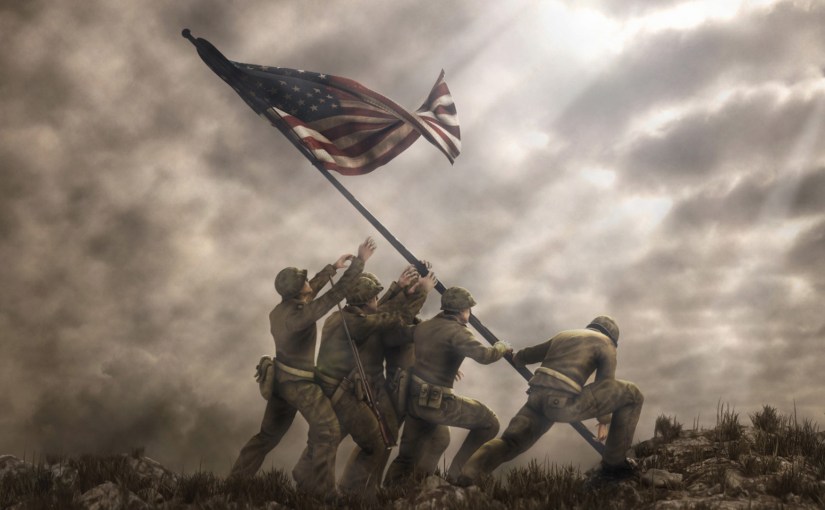
Arguably the most famous photograph in American history is that of the six soldiers raising the flag on the island of Iwo Jima while battling Japanese forces during World War II.  I remain fascinated by the image.  

I recall visiting the landmark statue in Washington DC when I was traveling by myself.  I took countless pictures of the piece.  I got close ups, wide lens shots, pictures of the flag and pictures of each sculpted soldier.  It’s heroic in any aspect.  It looks like something out of a Superman comic book.  As it turns out, the famed image was just a happy accident during a violently terrible time in twentieth century history.  Photographer Joe Rosenthal didn’t even realize what his camera captured until his film was later developed.  Turned out this was the second attempt at raising the flag.  Furthermore, this occurred on the fifth day of the conflict – with thirty-five days still to go before the Americans could claim victory over the bloody crisis.

So, while Rosenthal’s image seems to declare American patriotism at its finest, the real story is not as romantic.  In fact, one of the narrators of Clint Eastwood’s film, Flags Of Our Fathers, suggests that there are no heroes to celebrate.  Whoever the men in that picture were, they were not so much fighting for their country as they were trying to stay alive and look after the comrades ahead and behind them.

Flags Of Our Fathers has a very reminiscent feel to producer Steven Spielberg’s Saving Private Ryan with unforgiving battle scenes of blood, death, bombings and young soldiers storming a beach while screaming for their buddies.  Spielberg might have impressed me first, but Clint Eastwood masterfully shoots wide landscapes and up-close turmoil with his reliable strategies of shooting in shadows and silohouettes.  Eastwood’s film, scripted by Paul Haggis and William Broyles Jr veers into a unique direction though as Rosenthal’s picture takes on a life of its own back in the states.  It makes the front page of every paper.  Harry Truman stands proud of it along with all the decorated military leaders.

Now that America has entered the war, it is appropriate to ignite a propaganda campaign.  This picture of the Stars and Stripes getting elevated into the sobering, smoky war-torn skies will motivate citizens to buy war bonds to further fund the war effort.  The spokesmen will be the ones believed to be the remaining surviving three of the six in that image.  Ryan Phillipe is Navy enlisted John “Doc” Bradley.  Jesse Bradford is Rene Gagon, and Adam Beach plays Native American Ira Hayes, both of the Marine Corps.

I believe Flags Of Our Fathers embraces what every enlisted person did to serve the efforts of America during the war, and the picture mourns the countless sacrifices and losses that occurred.  However, it frowns upon the domestic response to what really went on overseas.  Those that returned carried terrible and unforgettable trauma based on their experiences.  Yet, the three thought to be part of the flag raising were pushed to celebrate their achievements summed up in a split-second image.  Bradley, Gagon and Hayes were skeptical if they were the ones in that picture.  Government Bureaucrats could care less.   There were others on that hill who cannot speak for themselves, but officials in suits and ties will insist otherwise to uphold a countrywide tour complete with recreations of the hill they ran up on that fateful day.  Even desserts are crafted like the famed image.

Ira Hayes is the one who is especially conflicted with his new responsibilities to the governing body that historically acquired his ancestors’ territory.  Adam Beach portrays a torn individual who is limited in celebration by the United States and certainly patronized.  Who he stems from does not matter.  He represents a false interpretation of the English acceptance of his Native heritage.  His obligation to this machine of propaganda only doubles the exaggeration that his other two peers are coerced to parade with marching bands and fireworks.  All that the ongoing extravagance does is keep him absorbed in the Japanese lives he brutally slaughtered and the bloodshed that surrounded him.  It’s a heartbreaking performance told with an absence of true appreciation for what Hayes gave up on that battlefield.

I learned much from Flags Of Our Fathers, but I had issues with comprehending everything.  While the immense war footage is chaotic with sharp editing and camerawork, it’s challenging to match names with faces in the picture.  There are two elderly men who are recounting what occurred and what happened to these men and their families long after the incident was over.  It was hard for me to line up which older man was who, on top of who they are talking about at times.  Paul Walker is one famous face in the crowd.  So is Barry Pepper but I could not identify the names of their characters until the film was arriving at its conclusion.  It was not until the epilogue of the movie arrives that it became a little clearer.  I also had to later reference what is listed on IMDB.  

The entire design of Eastwood’s movie is authentic from the battles staged for the Iwo Jima conflict to what mid-1940s domestic life looked like back home.  Truly absorbing while both storylines seem so different.  Clint Eastwood also wrote the soundtrack composition, and it is truly sobering.  His son Kyle performs with the orchestra.  

Flags Of Our Fathers partnered with Clint Eastwood’s follow up later in the year, Letters From Iwo Jima, which offered the Japanese perspective of the incident.  Bridge the films together and you get an incredible cinematic experience.  So many war pictures are one sided.  In all fairness, most movies do not have the time, luxury or finances to expand their palettes from one side to the other.  Because these two films are companion pieces, the viewer gets a fair account of how this battle, located on a tiny island, treated the men on the ground while their governing bodies celebrated their stands for patriotism, victory and monetary funding.

Eastwood demonstrates that the war destroyed practically everyone who was engaged in it regardless of the countries these soldiers served.  Many were slaughtered, but the innocence of those that physically survived died with everyone else during this period of time.  Clint Eastwood directed two films that explain this never-ending atrocity.  These men eventually laid down their weapons, but they never left the war.
SAVING PRIVATE RYAN

By Marc S. Sanders

How much blood needs to be spilled to change the color of an ocean red?  The battle of Normandy during World War II showed quite a bit, and Steven Spielberg more than convincingly duplicates that terrible episode in world history with his war picture Saving Private Ryan

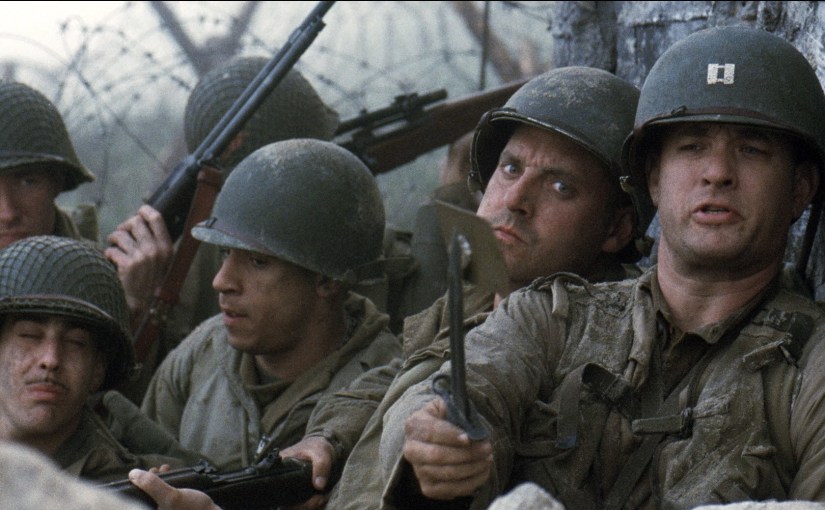
Spielberg earned his second Oscar for direction with this film from 1998.  It’s not only a technical marvel, but it’s a story that tests the nature of humanity when a squad of American soldiers ask themselves if saving the life of one man is worth sacrificing themselves.  Tom Hanks leads the team of recruits.

Saving Private Ryan begins on June 6, 1944 when thousands of American soldiers were inevitable sitting ducks as they washed ashore on Normandy Beach to engage in battle with German forces.  Spielberg’s footage is astonishing.  First of note is the cinematography is wisely washed out of color.  The sky is grey.  The ocean water and sand feel frigidly cold.  The most dominant color is blood red.  The fear displayed on the thousands of extras portraying soldiers, who never look mentally ready for battle, is palpable. 

The shots in this roughly thirty-minute opening do not compromise.  A soldier is seen walking around looking for his arm that has been shredded from below his elbow.  Other soldiers will turn over one way out of camera, but when they roll back into frame there’s a smoking hole where their face used to be.  Deadly head shots come out of nowhere.  Army medics have their hands soaked in bright red blood while trying to use scissors and thread to sew up wounds caked in wet sand. 

The action slows down at one point to focus on Hanks.  We haven’t even gotten to know his character yet, but we realize he is exhausted of this violence.  His hearing seems to deafen for a moment while he watches the horror quickly unfold as he puts his helmet back on only to have blood-stained water shower down over his head.  War is not meant for heroics and glamorization.  War only serves chaos and brutal death. 

Following this incredible opening sequence, one of the most impressive ever to start a film, Captain John Miller (Hanks) receives orders to locate the titled character, a paratrooper named Private James Francis Ryan (Matt Damon).  The army insists on sending the young private home to his grief-stricken mother, who has recently lost her other three sons in the conflict.  So, Miller recruits a handful of men consisting of fantastic actors like Tom Sizemore, Edward Burns, Vin Diesel, Adam Goldberg, Barry Pepper, Giovanni Ribisi and Jeremy Davies to make the trek across war torn Europe and rescue Private Ryan before he perishes as well.  How is that really fair though?

Any one of these men are sons to a worried mother back home.  The script for Saving Private Ryan by Robert Rodat has the men question why should they risk their own lives to find this one kid?  What makes him more special than any one of them?  Is the United States Army being fair?  Are they using this special mission as a means of propaganda?  Questions like this are irrelevant to the war department.  Just get him the hell out of there.

The journey of Miller’s squad is not just a simple hike.  At any given moment, they will come across a bombed-out town or another regimen who has just experienced their own kind of hell.  Further questions are asked when Miller recognizes an opportunity to take out an enemy battalion.  His own men suggest circumventing around this potential battle.  Miller won’t hear of it.  He’s a soldier.  Yet, after it is done, there is loss of life.  Should he have listened to their warnings or was he right to engage the enemy to avoid another team of allies suffering a terrible fate? 

Other dilemmas also come into play.  Should they escort a family and their young children who have lost their home?  The brutal dialogue of the script says that’s not their job.  Their goal is to take out the enemy and eventually rescue this one man.  Should an unarmed German prisoner be forced to dig his own grave and later be executed for the atrocities he’s committed?

War tests the ultimate limits of man.  What has to be done to allow us to finally, ultimately and justifiably shed ourselves of our humanity?  A correct answer is never provided in Saving Private Ryan.

Amid a series of astonishing battle scenes and images, two parts of the film stand out for me.  Following the loss of one of their comrades, there is disorder within the ranks.  This is where Tom Hanks takes control of a chaotic scene.  John Miller knows his soldiers have placed bets on what he does for a living back home.  Considering the strategist that Miller shows himself to be, its quite startling to find out what his occupation is.  It’s so surprising that Hanks as Miller uses it to temper his men which segues nicely into why Miller honors the mission assigned to him, even if it means risking his own life.  It’s not the best answer to why one man is more valuable than any other, but it’s the only one we are going to get. 

An even more powerful image comes to mind in the third act.  Jeremy Davies plays a Corporal assigned to the team to be a German and French interpreter.  He’s a soldier in this war, but he’s the last one you would want in combat.  As the American forces await the inevitable arrival of a German tank and a large number of troops to arrive, the men assign Davies to hold on to the long chains of ammunition and artillery.  He is draped in bullets around his neck and shoulders.  As the battle engages, shots are fired in all directions, men are quickly dispatched and Spielberg wisely has his cameras follow a helpless, weeping Davies do nothing but run from one end of the street to the other and up the stairs of a blown-out building.  He has all of the power in the world but he lacks the muster to kill and destroy which is what the nature of war demands.  He can even hear a man slowly die by stabbing in the floor above him. Yet, the Corporal can’t even rush to rescue his friend, and slaughter the enemy.  War destroys, but it also paralyzes man to act beyond an intrinsic nature of peace.  Each time I watch this scene, I can’t get past what this poor young man is truly capable of while being utterly helpless at the same time. 

I found Spielbergian techniques in Saving Private Ryan that hearken back to other celebrated moments in his film repertoire.  Tom Sizemore engages an enemy, only for both of them to run out of ammunition.  So, they wind up clumsily throwing their helmets at each other.  Indiana Jones might have done something like this for the sake of some form of slapstick.  Spielberg applies desperation to this scenario however.

The German tank at the center of the third act is somewhat reminiscent of the shark from Jaws.  Before we get an opportunity to see it, a focused Barry Pepper in a sniper’s bird’s nest gives a visual description of how big it really is and what accompanies it.  Later, Miller and Ryan have taken cover in a trench of rubble only to be overtaken by this beast as it careens over them.  The mouth of its cannon seems to come alive just before it blasts out a tower.  It’s just as scary and shocking as even Spielberg’s pictures of fantasy and adventure came before the release of this picture.  Every shot Steven Spielberg provides in any one of his films build towards an intrinsic and organic response from his viewers.  He always works with that goal in mind.  The tank is the tool used here.

The art direction is fascinating in this film as well.  A knocked over chair is picked up before a soldier stands it up as sturdy as he can on top of splintered wood and crumbled stone.  Sand on the beach is blasted up and out, sometimes splattering the lens of the camera.  Ocean water too.  Pockets of afterburn flames will be seen in the distance of a war-torn area.  The tangibility of these set pieces works cohesively with the distressed colors of a weathered and battle-stricken Europe. 

As chaotic as Spielberg demonstrates war to be, the editing is also commendable.  A war movie like this is not an action picture for the sake of escapism.  We don’t need to see the gun that fired the bullet that pierces the skull of a person.  We just need to see the person get a bullet that penetrates his helmet only to blow his head off to understand the unforgiving nature of war.  A man might be dialing up headquarters requesting air support, but he suddenly will not finish the conversation.  Editing allows the unexpected to become all too common in the midst of battle.

Saving Private Ryan is one of the best films ever directed by Steven Spielberg.  He had already shown real brutality not embedded in fantasy with films like The Color Purple, Empire Of The Sun and especially Schindler’s List.  Yet, with this picture, small factions of men, seeking world conquest, might have started this terrible conflict, but the movie does not concern itself with those instigators.  Instead, we witness the pawns at the disposal of war.  We see the collateral damage that suffer and die at the hands of unseen powers that be.  With Robert Rodat’s script, Steven Spielberg questions the value of one man versus a collection of men, and how any man, who may physically endure this terrible period in time, can also mentally survive long after it is all over.