INTERVIEW WITH THE VAMPIRE: THE VAMPIRE CHRONICLES

By Marc S. Sanders

Fantasy of the supernatural or science fiction work best when the writer can teach the reader or the viewer how its foreign worlds work and how the characters who occupy the environments function and live.  Anne Rice had her own interpretation about how creatures of the afterlife live by night.  Her vampires possessed theatricalities.  Some were charming and sophisticated, and relished how they lived immortally while satisfying a hunger for the blood of living humans.  Some struggled with the discomfort that comes from being a remorseful bloodsucker.  The first of Anne Rice’s series of vampire novels, Interview With The Vampire, runs a very wide gamut of perceptions.  By the end of the film adaptation, directed by Neil Jordan, I’ve earned quite an education.  (Frankly, Rice’s novel was tediously slow moving and bored me to tears.)

In present day San Francisco, a young man (Christian Slater) sets up his tape deck to record a conversation with a soft spoken pale faced man in a dark suit with a neat ponytail in place.  This mysterious person is Louis, played by Brad Pitt.  His story begins two hundred years earlier, in New Orleans, back to the day when he was incepted into an immortal life as a vampire. His agent of delivery is the devil-may- care and mischievous Lestat, one of Tom Cruise’s most surprising and unusual portrayals.  He gives a brilliant performance that’s as far a cry from his lawyer roles or his Maverick and Ethan Hunt heroes as possible.  

Lestat is eager to guide Louis into the benefits of vampire life.  Louis, having already been depressed following the loss of his wife and daughter during childbirth, cannot grow comfortable with Lestat’s insatiable appetite to feast on aristocratic figures or plantation slave servants.  This is not a match made in heaven and their chemistry as a couple is tested. Louis would rather miserably feast on chickens and rats, while Lestat grows frustrated by unsuccessfully swaying his partner to taste the sweet nectar of blood dripping from the wrist of a lovely young lass.  Lestat turns towards a grander extreme to maintain his embrace of the morose Louis.

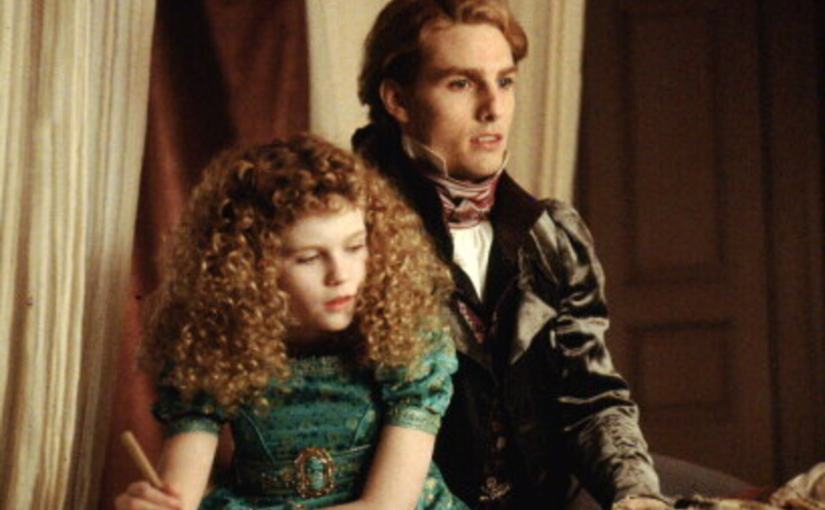
Through deception, the men welcome an eleven-year-old “daughter” into their underworld.  Her name is Claudia, played Kirsten Dunst in her introductory role.  I still believe this is her best performance, worthy of an Oscar.  The life of a vampire is delightful to the child, the same as Lestat perceives it.  However, as the decades move on, with changes in fashions and industry quickly developing, so does Claudia’s understanding.  Her body never matures, destined to always remain within the shell of a preteen child, and thus she commiserates with Louis.

It appears like I’ve summarized Anne Rice’s entire story, but I have not even come close.  Interview With The Vampire is to gothic horror the same way The Godfather is to mafia gangster life.  Both communities victimize people of an innocent world, but their members are expected to follow codes of decorum and respect.  The conflict lies in living as a bloodsucking vampire or a criminal gangster.  When a peer interferes or does not cooperate, then the individuals of these respected worlds become violent unto each other.    The viewer/reader observe how their patterns of behavior all play out and how one action or policy generates one response after another.  These films are high ranked authorities on their subject matters.

Louis explains to his interviewer how Bram Stoker’s celebration of vampires is dreamed up escapist fiction, though coffins and the avoidance of sunlight are absolute necessities to carry on.  Just like any person, vampires want to live happily, but life gets in the way and that can be frustrating on any number of different levels.  

Neil Jordan’s film is a marvelous exploration into the mindset of being a vampire.  Tom Cruise perfectly exudes Lestat as a vampire ready to joyously live with sin while he savors and lives a life of eroticism and material wealth.  A child like Claudia sees the attraction of being spoiled and spoiling herself, and she cannot get enough consumption of blood. Eventually though, her mentality outgrows what becomes redundantly mundane.  Louis is relatable like many people.  He is unhappy living the life he was born into.  Lestat grows aggravated with his family’s resistance to partake of what he relishes.  There is an extensive range of emotions on display with Interview With A Vampire. To be a vampire can be a privilege or a curse. It all depends on who you interview.

The look of this film is astonishing.  I know it was shot within New Orleans, Paris and San Francisco locations.  However, I can easily recognize some sound stage locales, and I have no complaints.  The art designs from Dante Ferretti are thoughtfully crafted with lantern lit, rain-soaked cobblestone streets of the seventeenth century to mucky, moonlit swamps.  Horse drawn carriages transporting abundances of coffins serve a purpose of humor and narrative as character misdeeds are routinely committed by Louis, Claudia and especially the trickster Lestat.  The furnishings of the aristocracy are embracing too.  It’s a remarkably convincing step back in time.  

The periodic costume wear by Sandy Powell completes the settings with colorful, silk garments, white ruffled shirt sleeves and buckled shoes for both the men and women as well as for Kirsten Dunst and some cherub cheeked children who come into play.  Everything looks so rich. The whole picture feels like stepping into one of those late-night ghost walking tours I’ve taken in small southern towns like Savannah and St Augustine.  Every scene, even when the film jumps to late twentieth century, is immersive.  

Anne Rice’s screenplay adaptation tells so much within two hours.  She allows time for the characters to sail to Europe seeking out others like them.  The second half of the film teaches us more about what it means to uphold oneself as a vampire.  

Neil Jordan sometimes delivers his film like a how-to documentary because you are consistently learning new details, not so much about plot but about a people you are not as familiar with. Often, the film segues into theatrical play as you might expect from Phantom Of The Opera.  It’s no wonder since eventually Anne Rice puts us in touch with the cabal known as Theatres des Vampires. Stephen Rea and Antonio Banderas get to take center stage within a literal theater where the facade of behaving like a vampire can be executed beyond the suspicions of a – ahem- live audience.  

Rice and Jordan get playful while also performing with horrific familiarity.  The bites on the neck are known to many of us for drinking blood.  Did you also realize that a vampire can drink from a crystal wine glass? There’s an elegance to how the actors’ characters consume the blood of humans.  Cruise and Pitt begin by going in for a passionate kiss, either on the neck or the weightless wrist of a victim.  Lestat is more aggressive. Louis caresses his meals on the rare occasion he dines. Claudia gives a puppy love bite. Cruise especially finds new and titillating ways to dine with each new feast.  Both actors are deliciously homoerotic, but on different parental planes with their child. Their love/hate relationship operates like Shakespearean stage work. That’s why I really take to Neil Jordan and Dante Ferretti’s choice of soundstages.  

I’ve become so bored with zombies and vampires.  How many iterations must be churned out of the same kind of monster.  This year’s horror hit, Sinners, was superb until it stopped being eye opening with surprise.  It eventually became the same old thing and offered nothing new to show me in its final blood-shedding act.  

Interview With The Vampire is one of the best vampire films though.  The film never ceases to speak directly to its audience.  The settings describe how life is lived.  The characters grapple with both internal and external struggles.  

It’s one shortcoming is that Anne Rice, Neil Jordan and cast/crew did not follow up with the author’s subsequent tales.  The subtitle, The Vampire Chronicles, seemed to promise an extension of this universe. I know of other Anne Rice film adaptations that chose not to continue on from what was done here, and the execution was terribly poor and disappointing.  There’s a biographical intelligence to Neil Jordan’s film that many films of all genres lack.

Anne Rice’s first film adaptation set the standard on vampire culture, and I have trouble thinking of anything since its release that closely matches it.  

Interview With The Vampire is the only one with a blood curdling bite.

INDIANA JONES AND THE DIAL OF DESTINY

By Marc S. Sanders

When a film director, the writers, and producers are trying to make a fifth installment of a franchise that spans over forty years, centered around one of the most iconic characters in history, it is important to consider every factor involved in the process.  My colleague, Miguel, commented that Indiana Jones And The Dial Of Destiny had four writers attached to the project.  Normally, I call that a shortcoming.  When you’re stumped for imagination, turn to yet another writer.  In this case, however, I believe it served to ensure they were providing a fitting send off to the famed archeologist in search of rare antiquities.  Dr. Jones’ final silver screen adventure hits all the right notes thanks to storytellers focused on imagination and sensitivity for the celebrated character.

James Mangold, a director who I don’t think gets enough credit for his accomplishments (Walk The Line, Logan, Ford Vs Ferrari, 3:10 To Yuma) takes over for a busy Steven Spielberg who occupies the producer’s chair this time.  The Dial Of Destiny has a modern Mangold gloss to the cinematography, compared to the distressed, washed out films of Indy’s earlier adventures.  However, it remains a very well-constructed film that should be recognized especially for some outstanding editing.  At the center of the film is a swashbuckling chase through Tangiers on three-wheel scooters and cars. It is as breathless as any of Mangold’s prior work or Spielberg’s pieces.  In fact, all the fined tuned action sequences function so beautifully.   Give the editors an Oscar nomination now!  The DC superhero films need to take a lesson from this esteemed house of Spielberg.

The film has a wonderful prologue worthy of being in the same fraternity with the other films in the series as Indy (a de-aged Harrison Ford) and his colleague (Toby Jones) come face to face with Nazis as Hitler’s reign is quickly collapsing.  The set up of the titled MacGuffin is introduced aboard a high-speed locomotive through German territory.  Flash forward to 1969 in New York City, and it is the eve of Dr. Jones’ retirement being overshadowed by America’s parade celebration of the moon landing.  Circumstances that our hero was never looking for occur and before you know it, Indiana Jones is riding horseback through a subway tunnel after being set up by his long-lost goddaughter, Helena Shaw (Phoebe Waller-Bridge).  Clandestine antagonists are hot on their trail, particularly a professor who goes by the name of Schmidt (Mads Mikkelsen). Then it is on to Morocco, followed by a diving expedition among a school of threatening eels. Sicily is next, and I dare not even reveal where the final destination takes place, but it’s a welcome and very appropriate surprise.  Bravo to the promotion machinists for not even hinting where this new film eventually escorts Indy and his pals.

When George Lucas invented the famed archeologist with the fedora hat, crackling whip, and leather jacket, I believe he was simply looking to arrange with Steven Spielberg to offer an update of the Saturday cliffhanging serials they watched as adolescents.  Indiana Jones was not a character in Raiders Of The Lost Ark.  He was a carving.  Harrison Ford occupied the well-worn image. Spielberg’s silhouettes of the man kept him thankfully recognizable.  Later films gave the world traveler more depth with back stories pertaining to his father (a timelessly memorable Sean Connery) and his one true love Marion (Karen Allen; isn’t she great?).  Indiana Jones is an archeologist by trade. Yet, in an age of advancing technology with television sets in every home during the 1980s and video games being updated quicker than people pay for them, the character is cinema’s greatest historian and one its most adoring adventurers.  The greatest achievement that The Dial Of Destiny offers is an absolutely perfect send-off to the character that movie goers have gotten to know since he first appeared in 1981, when he was the best alternative to James Bond.

Unlike the British secret agent, though, I truly believe only one actor can play Indiana Jones.  All five films demonstrate that Harrison Ford is irreplaceable.  Unlike Bond, who is written to adapt to the respective modern age in which every new film is produced, Ford has aged in line with Jones.  Indiana Jones is a traveler through the history of the twentieth century, researching and uncovering evidence of centuries past.  In his youth he’s fallible, and his improvisation to get out of a tight squeeze remains thematically the same during his elder years.  Time passes and evolves over the twentieth century, but Dr. Jones’ profession and vast intelligence lives in a past before evolution and technological advancement.  

This film features snippets of 60s rock music and references the moon landing.  Jones clearly is grumpily dismissive of these new discoveries.  They are not appropriate in his world. His best skills in the field to fend off what interferes with him are a weapon of ancient times (his whip), some hard-hitting punches and a six-shooter pistol.  Other than his researched knowledge, he doesn’t advance further than that.  So, the character ages physically and out of modern date, just as the man who portrays him does as well.  Ford goes shirtless in one scene.  The wrinkles, grey hair, pot belly and love handles show.

The cast is very welcoming in this latest movie.  Phoebe Waller-Bridge is especially fun and spunky in the same vein as Karen Allen.  She’s smart and instinctual.  Daringly adventuresome too.  I know she’s a newly celebrated screenwriter, but I’d love to see more of her in front of the camera as well.  Toby Jones is that character actor who always looks fitting for a period piece.  Mads Mikkelsen is who casting agents dial up for the quiet, yet scary, villain that the best heroes in film need to face off against.  He’s not doing anything we haven’t seen him do before, but he works well as a smart Nazi stooge.  Antonio Banderas is here, not doing much really.  A kid actor named Ethann Isidore joins the party, reminiscent of the Short Round character, and John Rhys-Davies as Indy’s trusty pal Sallah returns for a few scenes to welcome applause.

The cast is dynamic, and all have their shining moments, but the film belongs to Harrison Ford. I regard his latest performance with a warm smile as a salute to his distinguished career of playing those everyman roles without the bulked-up muscles or tough guy bravado.  He never had the skillful soldier like ease of getting out of any dangerous situation like a Stallone or Schwarzenegger.  Ford steers his characters to those pictures where none of them, including Indiana Jones, ever expect to get caught up in grand adventures.  Yet, when it happens his performances leave you yearning for him to triumph and win out in the end.  The best example is Indiana Jones, of course.  He carries his audiences with the smarts of the character and the pursuit of the unknown and what we can learn more about.  The Indiana Jones series is one of the greatest inventions to ever grace a movie theater.  Because they are born out of history, they will always remain timeless and priceless with each passing generation that discovers these wonderful films.

It’s good to have Indiana Jones back in theaters.  I can’t wait to see this movie again.

UNCHARTED

By Marc S. Sanders

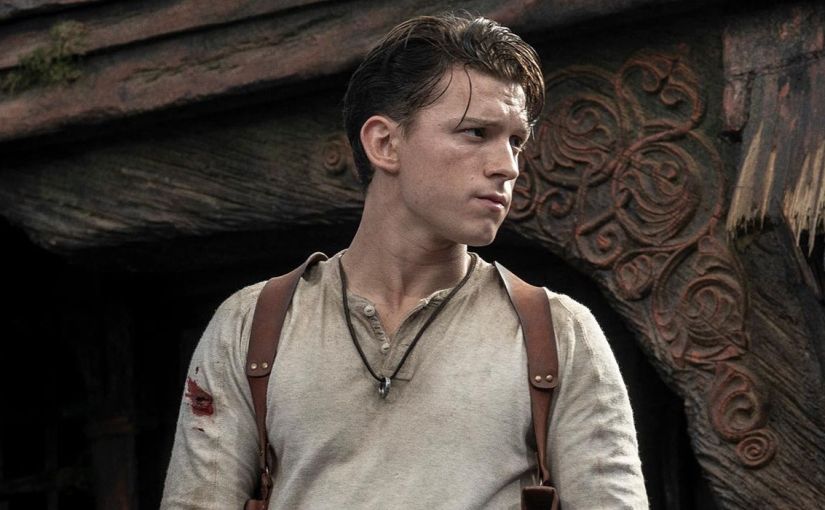
None of what is said in the film Uncharted matters.  The film opens in the middle of a death defying, albeit CGI, action scene with heartthrob Tom Holland dangling from a cargo net that’s hanging outside of a plane thirty thousand feet above the ground.  He apologizes as he kicks a couple of faceless thugs out into the great wide open, and he rolls his eyes at an oncoming sportscar driving off the plane’s ramp in his direction.   But it’s not like he’s worried that the car will mow him down and kill him before the fall would even do so.  That’s because even here he’s just charming Tom Holland who’s never afraid to die.  I guess that was my problem with this escapist film, based on a popular video game.  No one was ever afraid they’d die.  So, why should I be?  Excuse me while I refill my popcorn.  You don’t have to tell me what I miss.  I’m sure I’ll catch on.

Holland portrays treasure seeking adventurer Nathan Drake.  Early on, it is established that his brother is being held captive somewhere.  Nathan is receiving postcards from him, with statements written on them that seem more like riddles.  Hmmm!  Is his brother sending him clues, do you think?  One of their last conversations while they were living in an adoption house was something about gold hidden by Magellan.  The conversation went on longer than I cared, honestly.  I gave up on the details.  These scholars weren’t going to tell me anything intriguing.  That’s the best way to approach Uncharted.  Just watch for the CGI stunts, Holland’s agility on bannisters and bar counters, and see how all the secret doorways open. 

Soon after the exposition, Nathan is accompanied by a slightly older adventurer named Victor Sullivan, or Sully (Mark Wahlberg).  Holland and Wahlberg toss some smart alec zingers at one another.  See they’re only supposed to get along so much. 

The guys attend a black-tie auction where I knew Nathan was gonna be dangling from those hanging ceiling lamps somehow, and then they are on their way to Barcelona.  Oh yeah.  A diary helps them out as well with some clues that turn up only when they have to conveniently turn up.  A map will help them too, only when it’s conveniently there.  I’m not interested though in watching Tom Holland and Mark Wahlberg trace their fingers across a map.  There’s also the beautiful adventurous girl, Chloe (Sophia Ali), who we are supposed to trust or maybe not trust.  The bad guys are Antonio Banderas, who’s really given nothing to do except have his name listed in the credits.  Look at that!  PlayStation Studios actually contracted Antonio Banderas to be in their movie!!!!!!  I did say bad guys, right?  Sorry.  The other one is an Asian woman named Braddock (Tati Gabrielle), who’s only interesting trait is the blade she carries is in the shape of a scythe.  It’s only held and hardly gets used.

Are you starting to recognize that all I’m describing is surface material here?  There’s no depth to anyone.  Uncharted is so afraid to swim in the deep end, that it doesn’t even connect our hero Nathan with his long-lost brother.  Like ever!!!!  The film acts like a video game and thinks like a video game.  So why not just leave it as a video game?  If you want to make a movie, then the filmmakers should have gone a lot deeper.

It’s easy to compare this modern update on the adventure film to Romancing The Stone or any of the Indiana Jones pictures.  What continues to set those forty-year-old movies ahead of this fare, is that we actually feared for the characters.  Kathleen Turner’s apprehensive motive for going from New York City to the rain swept jungles of Cartagena was to rescue her kidnapped sister while trying to uncover a priceless treasure along the way. Her sister could be fed to the alligators at any given moment, or worse Turner could be brutalized by vicious Columbians on her tail.  When the famed archeologist, Indiana Jones, gets trapped in an underground room full of snakes or is left dangling over a bottomless pit, he looks terrified.  He has no rope to hang from and there really is no way out, and he knows it.  This could be the end. 

Nathan Drake, however, knows it’s never the end for Nathan Drake, and that’s…well…that’s boring. 

What can I say?  I’ve always gotten bored quickly with video games.  I know.  I know.  You’re gonna debate with me that this is BASED ON A VIDEO GAME.  Fine.  I agree.  Yet, I paid for a movie.  At times Uncharted moves like a video game character that walks in place when confronted with a wall.  Your joystick can’t figure out how to turn the guy around so he can trot in another direction away from the edge of your flatscreen TV.  It just doesn’t go anywhere until, how do you like that, Sully and Nathan turn to the right page in the diary or read the right post card from the long-lost brother that we never get to see.  Wait!  Let’s look at the map!

I really like Tom Holland.  He’s charming and handsome and athletic.  Spider-Man has demonstrated that he’s a good actor too, beyond the comic book action.  He’s definitely cut out for a tongue and cheek action picture.  Mark Wahlberg is ready to be the mentor.  He’s fine as well.  He’s just done it better in a film like The Italian Job.  They look like a great pair of partners.  Unfortunately, they are given nothing to demonstrate how good a pair they really could be.  Put a little fear in these guys.  Make believe they’ll actually drown or fall to their death from a helicopter.  Put them at the wrong end of a gun or a sword.  Heck, when you give them a sword, allow me to believe they aren’t so proficient with it.  I mean Holland is only 25 or 26 here.  How much could he have learned already.  Let them get shot in the arm, and still carry on.  Give them a limp.  Cut their lip or bruise their temple.  Uncharted doesn’t do any of that.  It only jumps to the next level, and as soon as you dispose of a baddie, they fade away out of the scene…like in a video game.

It’s not terribly bad.  Uncharted is like going over to your friend’s house, though.  He shows off his PlayStation by popping in the game and he promises he’ll let you have a turn to play.  Only your turn never comes, and while you sit there gazing at the posters and trophies in his room, your friend thinks he’s entertaining you for hours as his game goes on and on and on.  So, uh…when’s it my turn to use the controller??????

PHILADELPHIA

By Marc S. Sanders

Tom Hanks most certainly deserved the first of his two Oscars for his portrayal of Andrew Beckett, one of the first protagonists to be an AIDS victim on screen in Jonathan Demme’s 1993 film, Philadelphia. Its a good film but not a great film.

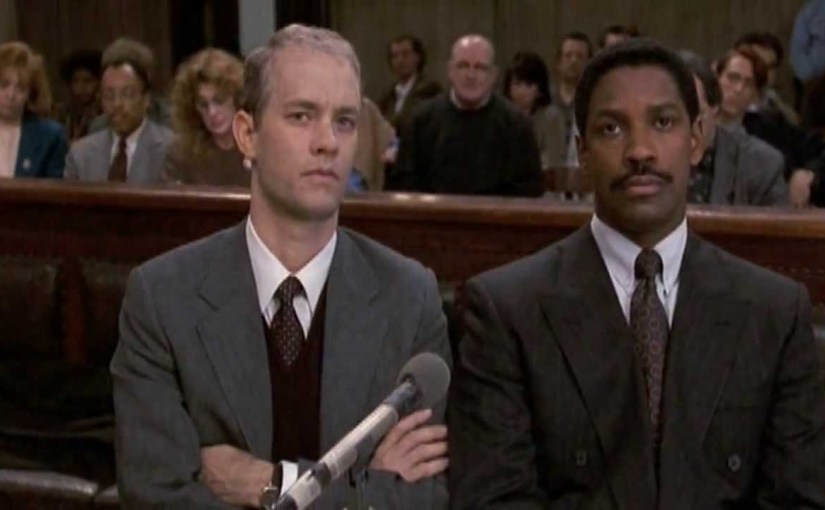
I recall seeing Philadelphia when it was originally released. Seeing it today, my opinion hasn’t changed. I don’t believe the film takes enough risks and the script from Ron Nyswaner is too cookie cutter and simple. Beckett hires Joe Miller (Denzel Washington) to represent him when he proceeds to sue the law firm who wrongfully fired him for having AIDS, and most likely being gay as well. The argument hinges on proving that having AIDS is a handicap that never interfered with Andrew’s work performance. Andrew is clearly made out to be the firm’s best of the young attorneys when he’s assigned their biggest client. Nine days later he’s sabotaged, and soon after he’s fired for an attitude problem and carelessness. Eventually, Andrew and Joe assemble, despite Joe’s prejudices against homosexuals.

The trial, Andrew’s struggle of living with AIDS, and Joe’s own inner debate with associating and defending a homosexual, AIDS victim are the three main storylines.

The first storyline is the best. Demme does a masterful job of showing the evolution of the disease. Andrew could be looking at papers on a desk and when he turns his head, a lesion appears on his neck. Makeup artists Carl Fullerton and Alan D’Angerio deservedly were Oscar nominated as Hanks’ appearance seems to change from one scene to another and another. He’s thinner in one moment with very fine ash gray hair. In another scene, he’s got a full head of hair with an energetic way about him. I cried for Andrew’s deterioration. Hanks and Demme carry that aspect very, very well. The actor does great work of changing his voice when he’s fighting a cold with a terrible cough or evoking massive weakness. As the film progresses and Andrew gets sicker, he’s incredibly pale with a droopy eye. The makeup artists tell the story with Hanks’ performance and Demme’s direction.

The 2nd and 3rd storylines don’t offer much of a challenge. The law firm primarily represented by head partner Jason Robards is too easily “evil.” There’s no subtlety here. Robards gets right in the face of the film – “Andrew brought AIDS into our office.” A better script would wait for the bad guys’ momentous third act Freudian Slip. This case was unchallenging really. It was too easy to win. Especially true considering this great and powerful law firm hires Mary Steenburgen as defense counsel. Steenburgen plays her part very mousy and unaggressive though. This case is too lopsided and uneven and I just couldn’t get past that.

Joe’s own reservations are too apparent as well. He’s meant to represent those that simply never understood the mentality of gay love, nor the scientific evidence of the AIDS virus. He rushes to his doctor following an initial meeting with Andrew. Demme does an extreme close up of this doctor to teach the audience the basics of AIDS. This guy is right in your face with his dialogue. I didn’t care for moments like this. Too patronizing.

A side story attempts to show the intimate relationship of Andrew with his boyfriend Miguel (Antonio Banderas). I still feel the same about this part. The script holds back. Hanks and Banderas give each other “bro hugs” and kisses are done on the bottom cheek. Back in’93, filmmakers were not prepared to go all the way with depicting the true nature of homosexuality. I found it insulting. You finally want to make a film that shows AIDS and homosexuals at the forefront but you stop short at the finish line.

Ironically, Joe has a repetitive line “Explain this to me like I’m a 4 year old…” Demme adopts that method throughout the film with major “in your face” close ups to glaringly make the beliefs of what any character values or has to say as obvious as possible. I felt as an audience member that Demme didn’t have to take it this far. I get it. You don’t have to be THAT FORTHRIGHT.

Washington is a great actor as always. He’s likable even if he’s tripped by the fault of misunderstanding. His “TV GUY” ambulance chasing lawyer is comic relief at times within a film of very heavy subject matter.

Demme’s filmmaking does make some wise choices despite some of my issues. The opening credits offers a lot of footage of the city with people carrying on their daily lives while waving to the camera, selling fish at the market, street dancing, etc, all accompanied by Bruce Springsteen’s sweet, yet haunting theme “Streets Of Philadelphia.” I like this opening as it shows what we see on the surface of the people we live with does not necessarily reveal the struggle any one of us might be enduring. This is a moment where the script is not so easy to grasp. There’s a challenge to accepting Demme’s footage blended with Springsteen’s overture.

Jonathan Demme is a good director, who is sadly no longer with us. I appreciate Philadelphia for showing the illness but not much else. It’s a film that should be seen. I’d argue most would embrace more of the movie than I did. I just felt the envelope could have been, actually should’ve been, pushed further. It was too careful with its subject matter.

A great observation though was recognizing the many faces that appear in the film from Demme’s other film, The Silence Of The Lambs. As well as naming Joe’s baby daughter “Clarice.” I also recognized an identical tracking shot that Demme offers. When Joe goes to visit Andrew in the hospital, it is a shot for shot remake of the tracking movement when Clarice goes to visit Jack Crawford in his office, at the beginning of Lambs. This might not be original, but I had fun recognizing it, nonetheless.

THE LAUNDROMAT

By Marc S. Sanders

Steven Soderbergh gets a little too inventive in his delivery of revealing “The Panama Papers,” in his new film The Laundromat now showing on Netflix.

His film is too convoluted deliberately to drive home the point of shell company, laundered fraud within the world. As such, it makes it very challenging to comprehend every point crammed into his short 90 minute film.

The two Panamanian attorneys behind the scheme, Mossack & Fonseca (played with great duet chemistry from Gary Oldman and Antonio Banderas) narrate the film by introducing different ways in which a shell company valued at everything on paper but tangibly nothing from an actual monetary standpoint.

Primarily, it focuses on Ellen Martin (Meryl Streep) a driven senior citizen who learns the truth of the plot when insurance does not compensate following the tragic accidental drowning of her husband on a boat tour.

Streep is brilliant as always. Such a natural with her monologues and her seemingly useless efforts to gain restitution for her loss.

The whole cast is excellent but the intentional confusion behind the story falls short of satisfying entertainment or enlightenment. I needed some moments where Soderbergh would give it to me straight. A diagram or a graph might have helped.

With The Laundromat Steven Soderbergh fails at becoming the next Jay Roach (The Big Short and Vice). Imagine if Roach actually got his hands on this script. Then there’d be a lot more buzz about this film. Oh well.