
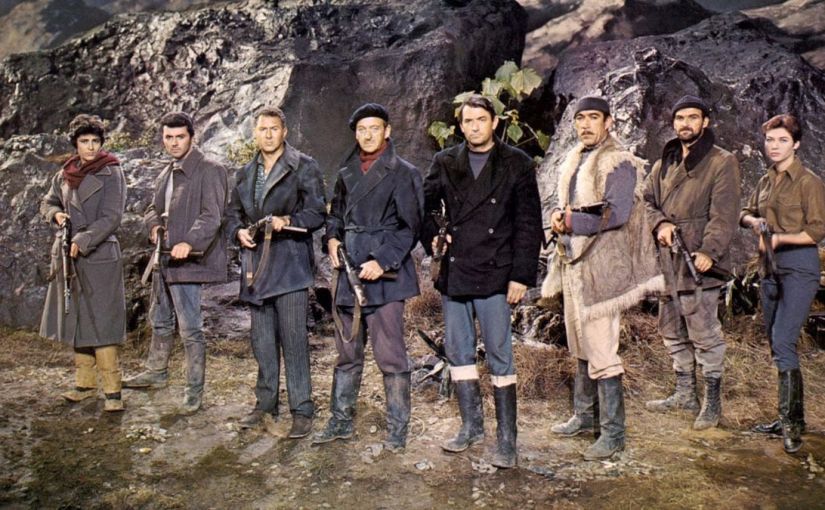
THE GUNS OF NAVARONE (United Kingdom, 1961)

by Miguel E. Rodriguez

DIRECTOR: J. Lee Thompson
CAST: Gregory Peck, David Niven, Anthony Quinn, Anthony Quayle, Irene Papas, Richard Harris
MY RATING: 8/10
ROTTEN TOMATOMETER: 92% Fresh

PLOT: A team of Allied saboteurs is assigned an impossible mission: infiltrate an impregnable Nazi-held Greek island and destroy two enormous long-range field guns preventing the rescue of 2,000 trapped British soldiers.


The Guns of Navarone is a “message” picture cleverly disguised as a World War II action-adventure/thriller.  No surprise there since the screenwriter was Carl Foreman, who also co-wrote 1957’s The Bridge on the River Kwai, another stirring wartime adventure with a strong anti-war message buried inside.  I found it interesting that, in the multiple behind-the-scenes documentaries on the Blu-ray, not one of them mentioned the one movie which I feel most resembles The Guns of Navarone: 1967’s The Dirty Dozen.  In both films, teams of men mount insurmountable odds to accomplish an insanely difficult mission, incurring casualties while ultimately succeeding.  In both films, there is a buried, or not-so-buried, subtext about the futility of the mission and/or war in general, while still gluing audiences to their seats.  However, given the timeframe of the release of The Guns of Navarone in the early 1960s, I find it to be the more surprising of the two, despite the foregone conclusion of the movie.

The movie’s narrated prologue tells us everything we need to know.  (Forget for a moment that there is not, and never was, a Greek island called Navarone.)  In 1943, two thousand British soldiers marooned on the island of Kheros must be evacuated before Germany convinces Turkey to join the Axis.  But the only sea lane to Kheros is defended by two massive German guns built into the sheer cliffs of the island of Navarone.  The guns must be knocked out of commission by a team of Allied saboteurs before any rescue attempts can be made.  This team will be led by Captain Mallory (Gregory Peck), Corporal Miller (David Niven), Colonel Stavros (Anthony Quinn), and Major Franklin (Anthony Quayle).  Along with the rest of the team, they must sneak on to Navarone, scale a steep cliff at night, and sneak across the island to the guns, hooking up with Greek resistance fighters along the way.  These details are laid out with admirable brevity, during which we are given just enough information about each of the three primary characters to understand their actions once the mission is underway.

The Guns of Navarone may be constructed almost entirely out of war movie cliches regarding desperate men behind enemy lines on a secret mission, staying undercover, close calls, and unexpected setbacks.  However, I enjoyed how much Navarone sort of “leans into” the material.  It’s almost as if the filmmakers said, “Okay, so this is a cliché, right?  We might as well embrace it and do it up right.”  For example, we find out that one of the squad commanders has a nickname: “Lucky.”  In the history of movies, any character in a war picture named “Lucky” has been anything but.  You know this, I know this.  Even so, as events transpired, I found myself thinking less and less about the most cliched material and just admiring how it was executed.  It’s a tribute to the director, J. Lee Thompson, that he found a way to present everything in such an uncomplicated fashion that its very directness pushes aside our suspension of disbelief.

That’s not to say there aren’t a couple of surprises.  Capt. Mallory devises an ingenious method of dealing with a man so injured he may have to be left behind.  A clandestine trip to a local doctor turns into something quite different, offering Anthony Quinn the opportunity to perform some amazing off-the-cuff histrionics that would make Nicolas Cage envious.  The Greek resistance fighters turn out to be two women who offer much more to the story than mere eye candy or comforting shoulders.  (One of them, played by the great Irene Papas, may even be the strongest member of the squad…discuss.)  David Niven’s character, Corporal Miller, is given two remarkable speeches that would have stopped a lesser film in its tracks, considering their anti-war and possibly even anarchic sentiments, including this exchange:

Mallory: And if Turkey comes into the war on the wrong side?
Miller: So what!  Let the whole bloody world come in and blow itself to pieces.  That’s what it deserves.
Mallory: And what about the 2,000 men on Kheros!
Miller: I don’t know the men on Kheros, but I do know the men on Navarone!

Was that kind of dialogue or sentiment even possible in a war movie made in the ‘50s?  (Aside from The Bridge on the River Kwai, of course.)  A war movie made in 1961, just fifteen years after The Greatest Generation rallied to defeat the worst dictator in history, and one of the main characters seems to be advocating desertion in order to survive the night?  Wow.

In my eagerness to describe how, I guess, subversive The Guns of Navarone is, I have yet to mention the action.  It’s top-notch.  Find it in your heart to forget how some of the effects are clearly matte paintings and models and miniatures and remember that this was top-of-the-line production values in 1961.  In fact, Navarone won the Oscar for Best Visual Effects that year.  There’s an impressive shipwreck sequence, attacks from dive-bombing airplanes, massive formations of tanks and troops (provided by the Greek monarchy), and the titular guns themselves, full-size props that dwarfed the actors and belched real fire when activated.  No expense was spared to provide audiences with true spectacle.

Is The Guns of Navarone perfect?  I mean, I personally could have done without the sequence where one of the soldiers sings along at a local wedding.  The story itself is ageless, but the film doesn’t quite feel timeless, despite its anachronistic tendency towards liberalism in the middle of a war zone.  There are one or two story decisions that I found questionable.  (One character’s death looked as if he was basically committing suicide, and I found no reason for it story-wise.)  But there’s no denying it’s a thumping good yarn.  And come on, who doesn’t enjoy watching Gregory Peck and Anthony Quinn tear up the screen for two-and-a-half hours?
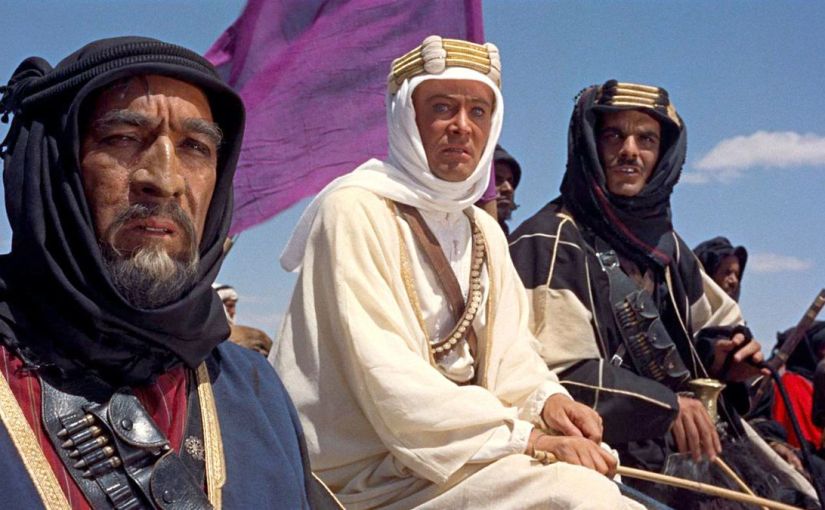
LAWRENCE OF ARABIA

By Marc S. Sanders

The moment finally arrived where I was able to see David Lean’s epic, also regarded as my colleague Miguel’s favorite film, Lawrence Of Arabia.  It truly is an eye-opening spectacle, and one of the most beautiful pictures I have ever seen, especially enhanced by an up-to-date Blu Ray restoration.  With a near four hour running time there is hardly an element or sliver of film that does not appear out of place.  Far ahead of the conveniences of dazzling special effects and CGI to arrive later in the twentieth century and beyond, Lawrence Of Arabia must be one of the greatest cinematic achievements ever created. 

When you factor in what David Lean made with an earlier picture, The Bridge On The River Kwai, it is fair to say that he was the James Cameron of his time – a bold, daring film director who did not surrender until every shred of a masterpiece was included in a final cut.  What puts a man like Lean ahead of Cameron perhaps, is that he depended on the resources of thousands of human extras and animals, broad desert landscape locations, painstaking architecture to set designs and buildings, along with authentic explosions and battlegrounds while delivering the story of British Lieutenant T.E. Lawrence and his efforts to aid an Arab nation into battle against the Turks during World War I. David Lean was persistent in bringing as much natural quality to his finished product as possible.  In fact, Miguel informed me that Lean was seeking out any possible way to point his cameras at the desert sun to heighten the feeling of the sweltering, unimaginable heat endured by his cast of characters.  It likely pained Mr. Lean that he had to settle for an optical illusion.  Nevertheless, when I was watching the movie, it did not occur to me once.  I was still appreciating his strive for absolute authenticity.

Peter O’Toole is the title character in his unforgettable film debut.  A daring, handsome, charming blond leading actor poised for adventure.  Lawrence is assigned to ally with the Arabs during the war to hold on to the necessary access of the Suez Canal which is a through way for oil, supplies and territory.  His determination for crossing wide, endless desert plains under a sun drenched open blue sky turn him into a leader, and a hero to the Arab soldiers, particularly represented by Sherif Ali (Omar Sharif).  They are a small band of fifty men, but Lawrence proceeds with the intent of gaining fifty more as he begins a long trek from one side of the desert to the other with persistent walking or by riding camel.  Lawrence won’t even leave a single man behind.  His resolve is courageous but could be costly later.

The technical construction of Lawrence of Arabia is likely what many notice and remember first, but the film comes with a well-set character arc for its protagonist.  Peter O’Toole was a perfect casting selection for this role.  Lawrence changes over the course of the film and it’s not a celebratory transformation.  Oft times, it seemed ironic to consider him the villain; perhaps a hero who falls from grace.  His derring-do is impressive, but likely also his undoing.  Lawrence allows strength and confidence to awaken a weak Arab nation who only survived for themselves with what little they held onto before their encounter with him.  Yet, the monster Lawrence creates within his own psyche may have also spawned a challenging threat from the Arabians for many years to come, long after this war is over and further generations come into play.  Bless a people with power but be aware of how that gift is used thereafter.

Lawrence accomplishes what has been regarded as seemingly impossible and now the Arabs adorn him in heroic white cloths (which must be one of the memorable costumes in film history).  He is who they look up to as the giver of their strength and confidence.  However, like most heroes that we find in the best of stories, T.E. Lawrence is weighed by fault, particularly his own hubris.  After his conceit gets him captured and tortured, it is not so easy to return to his home country who insist he continue to carry out his leadership.  Madness is invading his mindset and the hero we have borne witness to for well over two hours of film is now significantly diminished.  Parallel to that is the overconfidence and newfound freedom a political leader like Prince Faisal (Alec Guinness) absorbs for his Arabian people.  The end of David Lean’s film seems to imply what came of T.E. Lawrence’s contributions to the Arabs.  Was the world better or worse for what he achieved with his pioneering, yet dedicated military efforts?  What about Lawrence?  How did he fare, personally?

Forgive my incessant urge to compare David Lean to James Cameron.  I look at a film like Avatar and I see the monies and efforts invested to make that piece.  Yet, I feel like I walk away with little substance.  The films of Cameron not only fall short of story, but often lack texture as well.  I could never reach out and shake the hand of a “Pandoran.”  When I see Lawrence Of Arabia, though, I can feel the sweat and heat that O’Toole and Sharif experience.  Both are big films, not made on the fly. Rather, time and stress and a means to improve and show what’s never been seen or done before are offered.  David Lean might have been given all the monies in the world or the keys to kingdom to make his masterpiece.  However, it’s how he used these resources to painstaking perfection that lend to longevity in reputation for his career and Lawrence Of Arabia.

A train explosion near the start of third act is very impressive.  Lawrence and his men detonate a planted bomb on the tracks, and we see the locomotive derail onto its side, plowing into the hot desert sand.  We feel the immense weight of that steam engine.  We can detect the sand cloud that forms from the crash.  The collision of the cars being ripped apart and burned black thus create a new setting as Lawrence’s Arab followers rush to loot the train.

Grand battle scenes on horse and camel backs are meant to be seen at least ten times over in order to capture every piece of activity from the numerous extras and animals occupying a thousand different corners of the screen.  The bigger the screen, the better enhanced is the viewing experience. 

Long walks and camel rides in the desert may seem tedious for some, but not for me.  I was accompanying T.E. Lawrence and Sherif Ali on this journey.  This is another film where its running time affects what Lean set out to accomplish.  A trek through the desert is impossible to rush and this film is a testament to that notion.  I can’t say I’ve hiked through a desert plain that bears no end in near sight, but now I can lay claim that I’ve watched Lawrence Of Arabia.

Having only seen David Lean’s picture once thus far, I know that on repeat viewings I’d likely see something new each time hereafter.  This film is so alive of its period setting and backdrop and the unforgettable original score from Maurice Jarre give definition to the sweeping adventure that awaits with T.E. Lawrence’s travels.  The cast is marvelous as well.  Peter O’Toole is positively engaging.  Omar Sharif and Anthony Quinn are scene stealing character actors, much like Robert Shaw would become known for a decade later with Jaws.  Alec Guinness may be doing a brown face appearance as an Arab leader, but I’ll just salute the performance.  A charming actor of grand, yet subtle, skill.  I’m glad I’ve discovered him all over again from beyond …River Kwai and Star Wars.

Movies like Lawrence Of Arabia must remain at the top of the broad lexicon of films to watch.  It’s length and scope may be challenging, but its edits, its score, its immense visuals, and the performances therein, are unmatched by most anything else available to watch.