
MURDER ON THE ORIENT EXPRESS (1974)

By Marc S. Sanders

When considering Sidney Lumet’s admirable body of work, many would likely connect him with covering corruption within police precincts and the legal jargon of courtrooms.  Fortunately, on occasion, he experimented outside of those genres, and we are all the better cinematic viewers because we were treated to an all-star cast, devouring up the scenery in an adaptation of Agatha Christie’s celebrated mystery Murder On The Orient Express.

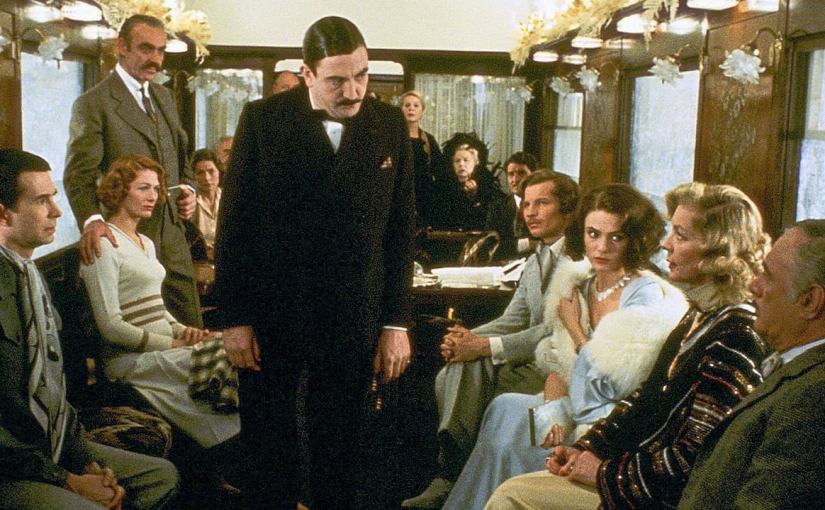
Lumet abandons his penchant for the metropolitan jungles of conflicted souls and high stakes drama to offer up a deliciously fun who done it, with Albert Finney gleefully playing the oddball, mustached Belgian (not French) detective, Hercule Poirot.  Despite a cast that features Sean Connery, Lauren Bacall, Jacqueline Bisset, Vanessa Redgrave, Martin Balsam, Richard Widmark, Michael York, John Gielgud, Anthony Perkins, and an Oscar winning performance from Ingrid Bergman, it is Albert Finney who makes the film wonderfully delightful.  His stature that seemingly hides his neck within his stout torso, along with a shoe polished, flattened hairstyle and a thick, echoing dialect tempo are an absolute combination of pleasure.  He makes the glossary of Tim Burton’s bizarre characters seem rather straightlaced.

He’s strange, but funny.  Before the expected murder gets underway, we observe an unrecognizable Finney performing Poirot’s nightly routines, including applying cream to his hands and unique mustache, as well as donning a kind of strap beneath his nose to keep his signature trait in its proper shape.  Batman maintains care of his cowl.  This crime fighter must preserve his facial hair.  It’s completely normal for Hercule.  While these mundane tasks of his are executed, the great inspector is also alert to several rumblings and bustles going on in the nearby cabins aboard the famous train in the title. Lumet ensures we see how smart and observant Mr. Finney chooses to portray Poirot; unique, and instinctively wise without limits.

An impolite and bossy man named Ratchett (Widmark) is discovered dead with multiple stab wounds to the chest.  It doesn’t make much sense considering the other passengers should all be complete strangers to one another.  Or are they?  Each one has an alibi, and their respective personalities couldn’t be more different.  Who would have the motive to kill a stranger aboard a moving train?

There appear to be twelve suspects for Poirot to consider.  That’s quite a list.  The standouts for me include Bergman, Bacall, and Perkins, but Lumet allows at least a scene or two for each celebrated actor to shine.

Ingrid Bergman dresses down to portray a shy, nervous, homely Swedish woman.  Sidney Lumet knows to back off on directing inventions when working with talent of such magnitude.  In one uncut take, Bergman controls an interrogation scene with Poirot and the camera stays fixed on her never diverting away and very subtly tracking behind Finney to stay with the actress’ nervous portrayal and expression.  The question is, should we trust this person? If Ingrid Bergman is putting on a façade, she’s awfully good at it.

Lauren Bacall carries such a strength on screen.  She walks with square shoulders and utter confidence that makes it seem like she’ll be impenetrable to Poirot’s inquiries.  Bacall’s booming signature voice would make me back down at any given moment.  She commands the supporting cast and appears to defy intimidation.

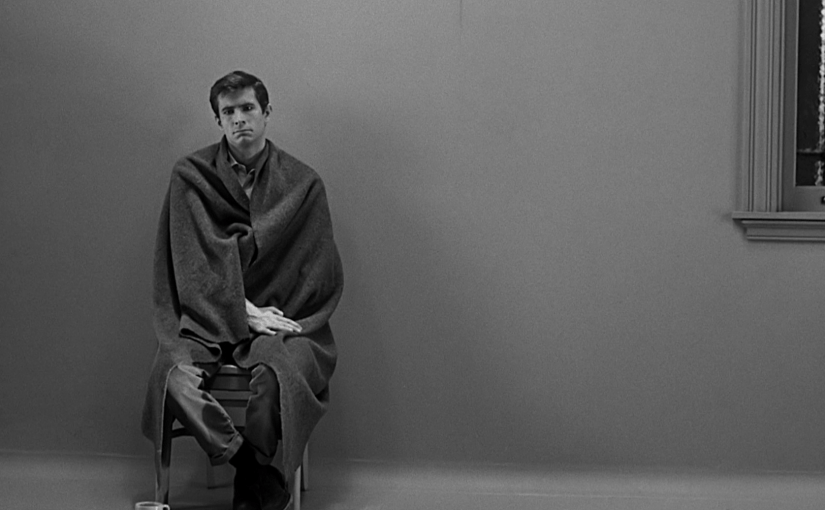
This film was made fourteen years after Psycho and yet Anthony Perkins portrays Mr. McQueen, a secretary of the murder victim, with youthful naïveté.  His stutter is perfectly timed and authentic, and he’s got body language that flails from one direction to the next when put to the test, not just by scenes he shares with Albert Finney, but anyone else in the cast as well.  His character is clearly unrelaxed.

I decided to watch this picture for reference.  In September of this year, I will be portraying Hercule Poirot in a stage adaptation of Agatha Christie’s story, written by Ken Ludwig.  My colleague Miguel Rodriguez is in the production as well, occupying Martin Balsam’s role.  They’re brilliant with magnificent energy by the way; Balsam and Rodriguez.  I had to watch Lumet’s film twice to appreciate the gleeful nuances he offers with this celebrated cast, including the actual train which serves as not only a claustrophobic setting but a character as well, stuck in a snowdrift, trapping the guilty party with no means to escape.  The dialogue flies fast and many of the various accents (Belgian, Russian, Scottish, Italian, Swedish, Hungarian) are challenging to decipher on a first watch, particularly Finney’s performance.

On a second watch, I was more wide-eyed to the detective’s behavior and how he breaks down a suspect during an interrogation.  No two interviews of suspects are even remotely similar.  Finney alters his way of approaching a scene partner each time.  I’ll credit the screenplay’s dialogue from Paul Dehn for that achievement as well. 

When a cabin door is opened to reveal the deceased victim, Finney’s odd mannerisms drastically change as he enters the room knowing what to say and look for immediately.  Sidney Lumet characteristically will position his camera pointing up at his actors, so the audience is the perspective of the subject being looked upon.  Albert Finney is gifted a wide scope within a narrow quarter to react as the famed detective.  This filming technique was an inspired choice by the director. Hercule Poirot is built up to be the foremost detective and now we see him demonstrating his specialty for examining a crime scene, and thus where to begin with his examination.  Albert Finney received an Oscar nomination for this role and it’s because of the skills he orchestrates under a guise of heavy makeup with a thick incomprehensible dialect.  All are meant to be taken as winning compliments from me.

The art design of the train is breathtaking.  The exteriors are magnificent too, particularly the train station located in Istanbul where the Turkish merchants crowd each cast member as they enter the film for the first time ready to board the Orient Express.  In one spot, a steward is inspecting the food cargo.  Another area has a merchant spilling over a carriage of oranges.  Locals crowd Bacall, Bissett and York with trinkets to buy.  Lumet captures the whole exotic tapestry.

Richard Rodney Bennett’s musical score is unforgettable.  A sweeping, romantically uplifting waltz accompanies the locomotive’s ongoing trajectory.  Then it gets more brooding when the journey comes to an unexpected halt in a chilling snowdrift, with the thought of a dangerous killer nearby.

Sidney Lumet is to be applauded for stepping back to allow his who’s who of legendary cast members play with Agatha Christie’s famous mystery.  He’s done this on other occasions including his outstanding cast in Network and Paul Newman’s career best performance in The Verdict

Those who are not familiar with the Agatha Christie’s tale are fortunate to experience the wonderfully twisted ending that serves the story’s continued appreciation.  Lumet deserves credit for the final touch though.  It’s not often that a film boasts such a collected caliber of talent together.  So, the best way to cap it off is with a charmingly giddy champagne toast.  It’s Sidney Lumet’s perfect little garnish to wrap one of greatest literary mysteries to ever be published and adapted for the stage and screen.
PSYCHO

By Marc S. Sanders

To watch Alfred Hitchcock’s Psycho today is a blessing and a curse.  You can’t take your eyes off the craftsmanship of the film.  Yet, you know all the surprises and plot twists.  There’s only so much blood you can draw from the stone. 

Recently, I told my fourteen-year-old daughter, who doesn’t like scary movies, that she needs to watch the film.  If only because she knows absolutely nothing about Psycho.  She has no idea what’s to come of Marion Crane (Janet Leigh). She’s never heard of the shower scene.  She doesn’t know about the true relationship between Norman Bates (Anthony Perkins) and his chastising mother.  Imagine, assuming you have seen the movie and/or know all its secrets already, watching the movie with someone who is seeing it for the first time with a completely blank canvas to go on.  Oh, the reactions you’ll get to see!!!

Hitchcock’s film, with a screenplay from Joseph Stefano, works under a lot of different dimensions.  It’s classified as the first “slasher movie.”  That may be true.  However, it’s much more intelligent than a typical Jason or Freddy Krueger fright fest.  Psycho begins as one story with a central character, seemingly innocent, carrying out a crime.  Later, it turns on itself and becomes something else altogether.

Marion Crane makes off with $40,000 in cash from a chauvinistic, obnoxious client of her real estate boss.  She hits the road, heading towards her lover’s home in nearby California.  Her impending doom is never implied.  Stefano and Hitchcock focus only on Marion’s scruples with the crime she’s committed.  She gets haunted by a curious police officer.  She certainly wonders what her boss must think when he’ll discover that she never deposited the money in the bank.  Is the used car salesman going to follow up on her after she urgently trades in her car for a new one with new plates?

Soon though, none of that will matter when she has no choice but to pull off the road for the evening to stay at the Bates Motel, currently with twelve cabins and twelve vacancies.

For the one or two readers who have never heard of Psycho, I’ll stop there with the narrative.  However, what I appreciate about the second half of the film is that the new central character, now young, quirky, altogether strange Norman Bates, seems to respond with avoidance when a private investigator named Arbogast (Martin Balsam), and then later Marion’s lover Sam (John Gavin) and her sister Lila (Vera Miles) start questioning him about Marion’s whereabouts.  Arbogast is on the trail of a thief who went off with $40,000.  Sam and Lila are also curious about the theft that seems unheard for Marion to commit.  Yet, there’s something else leaving them curious.  Norman, on the other hand, knows nothing as to what Marion was up to.  In his eyes, the only odd thing about her is that she checks into the motel under a different name.  All of these characters are coming in conflict with one another, but not for the reasons they think they are.  The fun part is that we are the only ones who know the hands that each player is holding.  Even more fun is when we uncover a secret that Norman has been hiding from the audience all along.

Hitchcock tricks his audiences with Psycho.  With its first story, we are in suspense of one criminal.  Will she get away with the theft? Rather, how and when will she get caught?  With its second story, we are unnerved by someone far worse and frighteningly mysterious.  Following the infamous shower scene, it’s a little nerve wracking to watch as Norman tries to hide the evidence in the trunk of a car that he pushes into the nearby swamp.  Any storyteller would just have the car simply sink.  Hitchcock brings in shadowed close ups (with his wise idea of black and white photography) of Norman chewing gum, and then becoming completely still when the car actually stops sinking midway through its descent.  As a viewer, your jaw drops.  What is Norman going to do if the car doesn’t fully submerge?

Later, it’s a wonder how Norman is going to circumvent around the unexpected visits form Arbogast, Sam and Lila.  Then, we are in suspense of their safety.  They’re just looking for the missing money while tracking where Marion went off to.  Unbeknownst to them, they have can’t even fathom her demise.

I was talking with one of my Cinephile brothers about Psycho, explaining how it follows a similar dynamic that the second half of Vertigo moves upon.  In Vertigo, the main characters, Scottie and Madeliene, are both in love with one another.  Yet, it’s for different reasons that they can’t explain to each other.  In Psycho, the characters are all under suspicion and even paranoid of each other, yet for all different reasons.  Norman never knew of Marion’s crime.  Though the other characters suspect that he does.  In both pictures, only we, the audience, know almost everything at play.  According to various documentaries I’ve watched, Hitchcock wholeheartedly trusted his screen writers to flesh out the stories.  He concerned himself more with constructing the film with a faithfulness to the script.  What’s commendable about the films Alfred Hitchcock chose to make is that he sought out these conundrums where his chess pieces are left bewildered or unaware of why they are sharing the stage with the other players.  The director had a way of channeling into deceiving his characters against one another, allowing the viewers to relish in their trickery.  Going a step further though, Hitchcock reveals other twists never suggested in the film to turn the audience on their ear in shock.

You can’t take your eyes off Psycho, even with knowing all the goodies that Hitchcock provides. 

Anthony Perkins especially is a tense and unnerving menace.  He has a boyhood innocence to him that should not appear threatening to Janet Leigh’s Marion Crane.  It’s in his relaxation with the role that it feels all the more terrifying to the viewer.  Simply look at the way Arbogast pulls up to the motel and Perkins is sitting calmly on the porch eating his bag of candy.  Watch how he casually shares with Marion how he relishes in stuffing the birds he has mounted on the parlor walls, or even how he casually offers cabin number one for Marion to occupy so that she can be close to everything.  Norman Bates hides himself very well in his virtue.  A wolf in sheep’s clothing.

The Bates Motel and the large house poised behind it on the hill were set up on a Universal back lot.  It remains one of the most famous settings in film history.  When you see the silhouette of Norman’s mother in the window from afar or young, slender Norman standing in front of the house, the images of the chilling locale stay with you whether it is on a dark and stormy night or even during a sunny afternoon.  Hitchcock opted to shoot the film in black and white to taper the goriness of the piece.  Outside of the gore elements though, the black and white lends a foreboding feeling to this destination.  Even before we realize that Marion is in danger, we feel uneasy with just arriving at this place.

The shower scene of course is one for the ages.  I’m not here to discuss all of the mechanics of film’s centerpiece.  The assembly of the scene’s elements are masterful though.  Can you imagine the scene without Bernard Hermann’s shrieking score?  Hermann was to Hitchcock like John Williams is to Steven Spielberg.  The aftermath is brutally shocking as well.  The camera does a zoom out on Janet Leigh’s eye as the soaking head of her corpse lays down on the bathroom floor.  I notice the eye does just the slightest twitch.  For me, that’s all the more disturbing than just a very still open eye.  It implies the last bits of life leaving her body and consciousness.  Later, when Norman cleans up the bathroom, Hitchcock shows his process with a mop and neatly wrapping Marion in the torn shower curtain and disposing of anything belonging to her, including a newspaper that isn’t just a newspaper.  Norman is methodical.  Perhaps this strange man has done something like this before.

I do have one grievance with Psycho.  The air is kind of sucked out of the film in its last few minutes before that delicious last close up on Norman.  Stefano’s script offers up a psychological explanation for what Norman Bates seems to suffer from.  It’s as if we are given a scientific description for what ails him. This is all painfully boring.  I dunno.  Maybe in 1960, when Psycho was a pioneering kind of horror film, and moviegoers were not as familiar with the genre that seemed far scarier than Boris Karloff, and vampires and mummies, they needed a summation like this.  Sixty years later, naturally this is not necessary.  We know all to well that there are disturbed people who live among us.  We know, sometimes, to be cautious of folks like these.  For someone as reputed as Hitchcock was, being identified as the “Master of Suspense,” this long monologue, spoon fed diagnosis from the psychiatrist kills all of the horror we’ve bared witness to over the last two hours. 

Psycho was the first slasher movie.  It was the first movie to feature a toilet and have it flush on film. It has one of the most famous characters in all of film history.  It has one of the most famous scenes of all time.  It was directed by one of the greatest directors of all time.  Yet, it also has one of the worst conclusions of all time.  If ever a scene should have been cut from a finished product, it is the second to last scene of Psycho.

Now, go find someone who has never heard of Psycho, knows nothing at all about Psycho, and watch them watch Psycho.  Of course, as the famous marketing campaign for the film insisted, by all means do not start the movie or walk in the middle, and never reveal any of its secrets.

THE BLACK HOLE

By Marc S. Sanders

In 1979, Walt Disney Studios must have felt compelled to respond to the resurgence of science fiction, following 2001: A Space Odyssey, Star Wars, Close Encounters…, and even Moonraker, with The Black Hole. Their contribution to the genre falls flat however with shiny looking, helmeted, stiff robots that hardly use their joints and even more stiff performances from the human cast. If these actors didn’t have dialogue to speak, I would have thought they were dead.

Maximillian Schell is the deranged James Bond villain reject Dr. Reinhart, resigned to helm the mad plot of this film. His long-lost space craft is found at the border of the mysterious black hole. His intent, now that he has converted his entire human crew into mind-controlled humanoids, is to enter the unknown void that’s ahead and discover its secrets.

The small crew of another ship that discovers him consists of Robert Forster, Anthony Perkins, Joseph Bottoms and a poor imitation friendly robot named V.I.NC.E.N.T. who resembles R2D2 in shape and talks in cliche with C3PO’s voice. Their lack of personalities boards the ship simply to listen to Dr. Reinhart’s insane plan to fly into the black hole. Then in the final 30 minutes, the band of heroes run away across the pointlessly long platforms of the lost vessel as it crumbles apart during its slow-very slow-descent into the hole.

This is a film that lives up to its title. There’s no one to really rescue here. No romance or swashbuckling. No one for the villain to threaten. No reason to stop this nut job from committing his own mad suicide; Reinhart could care less if this band is with him or not. Even John Barry’s (“James Bond”) music lacks harmony, as the film contains at most two of his compositions to play over and over again.

When none of the mainstay ingredients for adventure carry any weight, then what’s the point really?

The Black Hole was Disney’s way of pushing action figures with the menacing razor blade bearing red robot Maximillan and the hardly lovable V.I.N.C.E.N.T. I recall when I was a kid the merchandising hardly made a dent in pushing the agenda for this film. A film catered towards kids, but barely entertaining for kids. There’s a lot, a whole lot, of speechifying going on here, mom and dad. What kid would be interested in listening to old farts like Ernest Borgnine or Maximillan Schell just yak away?

The Black Hole is as nothing as its title suggests. A void of a film. A franchise or cultural impact never came to be from this movie, and rightly so.

Though I do recall my mom buying me the pop-up book adaptation of the film. I wonder if that’s a valuable collector’s item these days.