THE MEAN SEASON

By Marc S. Sanders

I get caught up in movies focused on serial killers.  As an actor, I imagine it must be fun to portray a deranged psychopath like Norman Bates or Hannibal Lector, or maybe even John Doe from Seven.  On the other hand, maybe not because an effective screenplay needs to be nearby.

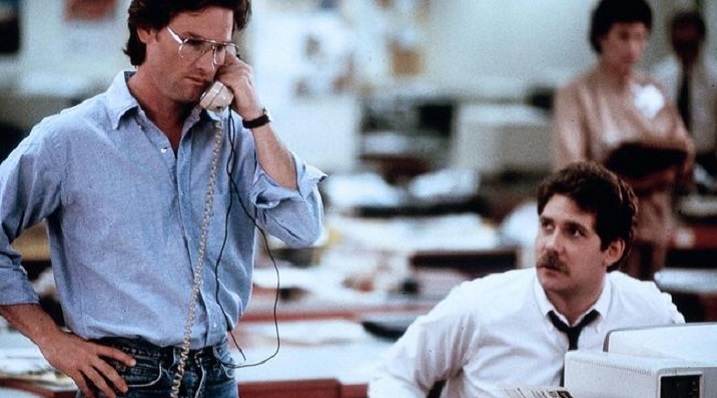
The Mean Season from 1985 has an effective premise but that’s where the positives of the picture stop.  Kurt Russell portrays Malcolm Anderson, a burnt-out reporter for the The Miami Journal.  He is the paper’s most reputable writer but just as he is ready to resign and move to Colorado with his loving girlfriend, Christine (Mariel Hemingway), he’s tasked with writing an article about the murder of a teenage girl on the beach.  Soon after, he’s getting phone calls from the killer himself, played by Richard Jordan whose face is concealed through most of the film by his hand holding a telephone.  The killer insists on only maintaining communication with Malcolm and no one else, especially not the cops.  He relays that the city of Miami can expect four more murders.

The title of the film stems from south Florida’s well known weather variations that occur at the start of hurricane season, primarily in July.  That does nothing for me, but the title alone sounds marketable enough for a thriller.  Almost sounds like a Stephen King novel.  The Mean Season!!!!!  Unfortunately, that’s all that this movie has to rely on, even if Kurt Russell is doing his best like he always does in better suspense movies like Unlawful Entry and Breakdown.

The fault with The Mean Season resides with the director’s amateurish approaches.  Fifteen minutes into the film, with the story hardly in motion, a nude Christine is taking a shower.  The haunting music begins and suddenly the shower curtain is pulled for Malcolm to deliberately startle his girlfriend.  So, we have the Psycho salute.  Check!  Later, following an argument between the two lovers, Malcolm gets in his car and is startled by Christine coming up from behind in the backseat. Ha!!!! Okay and there’s the Halloween nod.  Another check!  I bet these cheap tactics were not even written in the script.  Director Phillip Borsos (never heard of this guy before; doesn’t surprise me) must be so insecure in his skills behind a camera that he just goes for duplicative tripe.

Threats to the couple elevate as the film moves on and when Malcolm gets wind of Christine being in danger, he’s in his Mustang racing to her.  The cops (Andy Garcia, Richard Bradford) are right behind him, and no one thinks of summoning a squad car to where Christine is expected to be?  Of course not.  If they did, then we wouldn’t be treated to a clumsy sequence where an elevated bridge gets in Kurt Russell’s way forcing him to make a leap across the gap and come down on the steep other side and continue his foot race.  Kurt Russell really looks stupid in this moment, and I’m sure he was thinking I can not believe I agreed to this.

As with any of these movies, there is a just when you think the bad guy is dead, there he is again.  No wonder we didn’t get a long enough closeup on the corpse found in the dense Everglades.  However, we get treated to seeing a long, meaningless sequence of Kurt Russell being a passenger on a swamp buggy.  Big deal.  Does this enhance any kind of suspense?  Does it move the story along?  The director got access to a couple of swamp buggies and a day of shooting in the Everglades and said we gotta get this in here.

The final fight is as moronic as the rest of the picture.  Richard Jordan and Kurt Russell are going at it in the living room while a hurricane rages outside.  Mariel Hemingway just sits on the sofa and watches.  She just watches.  She doesn’t reach for a kitchen knife or a vase to smash on the bad guy’s head and help her poor boyfriend.  We just get a sad excuse of a damsel who is not in distress. 

Thankfully, Kurt Russell’s career survived this junk of standard jump scares and shortness on intellect. 

As I’ve said before in other columns, there was a better movie here.  There could have been a movie that explored the endless hours that an investigative reporter must endure.  His editor and photographer (Richard Masur, Joe Pantoliano) could have shared the heightened fear and suspense.  The cops on the case could have applied more pressure and/or assistance to the reporter.  They don’t even tap his phone to trace where the calls are coming from.  In 1985, I think they already had the technology to do that.  A tape recorder was used though, and the audience not only gets to listen to the conversations once as they are happening but then again as the characters listen to the tape.  Why?  Is there something I missed the first time I heard Kurt Russell say hello?  This is filler crap. 

A better movie would have pursued what motivates this killer we hardly get to know.  We should have learned more about this guy because he’s the one making the phone calls.  So, it is obvious he wants to be heard.  However, the guy has nothing to say of any significance.  Even a psychologist who’s recruited for one scene doesn’t make any observation that gives me, or the characters in the film, pause. 

The Mean Season is an “I got it!” film.  It’s where the director gets his big break and declares “I’ve got it!!!!  We’ll do Psycho and then we’ll do Halloween.  Gotta make sure we see Marial Hemingway topless.  That’s definitely at the top of the list. Oh yeah, and then we’ll get swamp buggies and can we get some wind and rain machines for a really, really, really mean—I mean very mean—season!”

THE MULE

By Marc S. Sanders

Earl Stone (Clint Eastwood) was once considered one of the best horticulturalists in the country.  In fact, he devoted more of his time to raising the most unique flowers and plants that anyone could find than he ever did to his wife, Mary (Dianne Weist) or his daughter, Iris (Alison Eastwood).  He even missed Iris’ wedding, to attend an award reception in his honor.  At age 90, though, Earl is quickly forgotten by his ardent fans thanks to the ease of ordering horticultural specimens off the internet.  There’s no longer value in meeting the maker.  Just as Earl never took account for his family like he did with his beloved occupation.

Clint Eastwood portrays Earl Stone in The Mule, which he also produced and directed.  Written by the Nick Schenk, this film is one of Eastwood’s best directing efforts.  It is inspired by a real life story where the forced to retire horticulturalist finds himself working as a drug mule for the Mexican cartel.  Earl is corralled into making easy money by driving a duffel bag across country.   At the destination, he leaves his truck and returns shortly thereafter to find large amounts of cash in his glove compartment for his trek.  

Earl is so naive to all this activity though that he doesn’t even know how to use the various cell phones the dealers give him for each new journey.  It’s only on the third drive that he opens the bag to find kilos of cocaine.  

Earl is a perfect front for the cartel.  The Don (Andy Garcia) sees the value of this camouflage.  Who’d ever suspect a frail ninety year old Korean War veteran, who’s never gotten a traffic ticket, of doing their bidding? Certainly, the sharp witted FBI agents (Bradley Cooper, Michael Peña) could only get as close as determining this mule is driving a black pickup truck.  Beyond that they are at a loss, despite the leeway and patience awarded to them by their superior (Laurence Fishburn).

This film boasts an outstanding cast from all four corners of its various stories.

The Mule works so well because of Eastwood, the filmmaker.  He offers thrilling overhead highway shots (with no car chases) of Earl’s pickup truck running parallel to a helicopter as well as how the cartel escorts follow behind.  There’s humor in how impatient they get with the old codger by how slow he drives and the old time music he listens and sings along to.  Wait until you see two tough armed Mexican cartel members relent to singing along to Dean Martin.  Eastwood cuts and stages these hilarious moments that are most welcome, even if they had no business being in a story like this.

Clint Eastwood’s performance is really shining through.  You recognize his signature scowl and his heightened walk despite his frail physicality.  The Earl Stone character is so well drawn and Eastwood, as director and especially actor, answers every demand of the script sharing celebrated scenes with Andy Garcia who treasures his prize mule and gifts him a couple of women to make him feel comfortable.  Other moments allow wonderful exchanges between him and Dianne Weist as Mary, Earl’s estranged and very ill ex-wife.

The Mule is a crime picture, sometimes lighthearted and on occasion heavily serious.  Yet, it’s also a well-drawn out family drama.  Earl is grateful for the rewards that come with being a drug mule.  He’s generous to his friends.  He modestly treats himself.  He lends attention to his adult and loving granddaughter (Taissa Farmiga).  He accepts Iris’ disregard for him.  Yet, none of these gestures buy back or exchange any time he’s lost with the family he never got to know.

The film plays like two different movies until finally a sacrifice must be made to appease one part of Earl’s life versus the other.  I almost wished for everything new that came upon Earl in his late life to remain on that trajectory.  Yet, like the best stories, interference will eventually get in the way.  It’s that much more crushing when Earl’s new pattern is upended.  Still, that’s what makes for good drama.

I highly recommend seeking out Clint Eastwood’s The Mule. It surprised me in the best ways possible.  I did not expect to be so impressed.  Eastwood continues to be an inspiration with the persistent longevity of his talents as an actor, a screen legend, and a gifted filmmaker.  The Mule shows he’s as sharp as he ever was before in some of the best films of his decades long career. 

DEAD AGAIN

By Marc S. Sanders

Kenneth Branagh is inventive director.  Arguably, his most uncelebrated film is the noir inspired mystery, Dead Again, which features himself and his wife at the time, Emma Thompson, in the leading roles. 

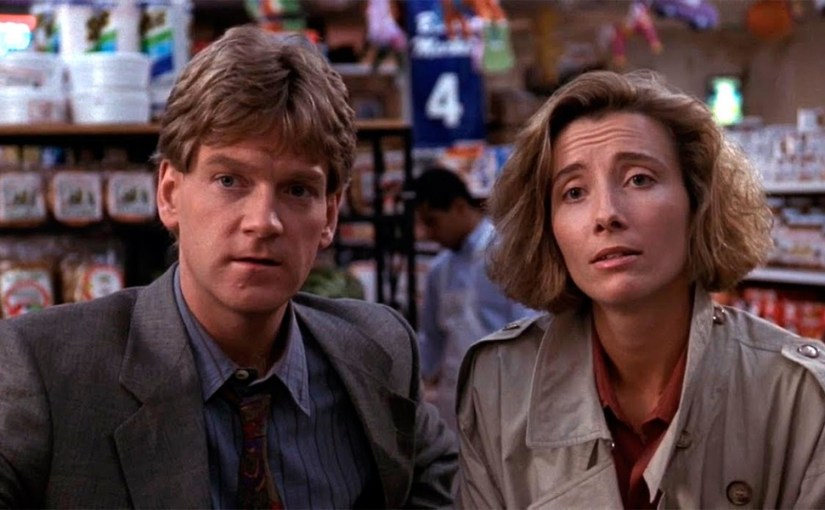
Branagh and Thompson do double duty, playing multiple parts in two different time periods.  In a 1940s post war Los Angeles, they are Roman and Margaret Strauss.  Roman is a composer.  Margaret is a musician in his company.  They quickly fall in love and live in the limelight of glitz and glamour amid the gossip magazines of the time.  Their life together only becomes juicier when Roman is sentenced to death for the murder of Margaret.  The weapon of choice, a pair of scissors.

In present day 1991, Branagh portrays a private detective named Mike Church who ends up being responsible for an amnesiac, Thompson, who can’t even speak when she’s found.  The woman has unexplainable dreams that recall moments of Roman and Margaret’s life together only to end up as terrible nightmares.  A curious hypnotist (Derek Jacobi) enters the story to lend aid to Mr. Church and the woman.  He serves as a guide, bringing her back to the times of the celebrity couple, helping her to find clues that perhaps could lead to her true identity and uncover exactly why she is haunted by these dreams.

Additional characters enter the storyline as well.  There’s Wayne Knight as a humorous sidekick for Church.  In the flashback 1940s, there’s Andy Garcia as a handsome Pulitzer winning journalist who follows the escapades of Roman and Margaret.

Dead Again is not a long movie, and that lends to how good a film it is.  It’s a lean picture that sets up its clues the moment it starts.  Branagh gives you a background tutorial with newspaper headlines that flash up within the opening credits.  The two time periods are separated with the 1940s shown in gorgeous black and white, while the modern scenes are presented in color.  Branagh puts on a German accent for Roman.  Thompson is English for Margaret.  In the present day, they are Americans.  Of course, it is acknowledged that the respective characters look alike and that allows for possibilities of reincarnation, karma and past lives to enter the frame. 

The screenplay from Scott Frank gets you curious.  What connection could these two wildly different couples have with one another?  What don’t we know about the murder of Margaret at the hands of her husband, Roman?  Who really is the woman that Thompson is portraying in modern times?  How is it possible that a private dick like Mike would coincidentally end up with this “Margaret lookalike” amnesiac?

The cast is having a lot of fun with the puzzle, particularly Derek Jacobi.  His old English mannerisms offer a relaxing storyteller’s narrative to the film.  It feels as if his hypnotist carried over from an Alfred Hitchcock film.  I also appreciate how far apart the respective characters that Branagh and Thompson play.  Not only am I watching a thrilling mystery, but I’m looking at skilled, well-trained actors demonstrating a wide range of performance work.  At times, it’s as if I’m watching two different movies.  How exactly are they going to intersect, though?

I originally saw Dead Again in theatres and was taken with it immediately.  I did not see the end coming and when the veil was lifted, my eyes went wide open.  It has a terrific plot twist.  Branagh, known at the time as a celebrated Shakespearean actor/director, introduced a sweeping, mystery yarn that relishes in fun escapism like Hitchcock or Orson Wells would apply to film noir.  It only makes sense, looking back over thirty years later, why the director opted to turn his craft towards rejuvenating the classic Agatha Christie stories (Murder On The Orient Express, Death On The Nile) for film.  We are better for his contributions.

Now, Dead Again is a film that deserves the attention from a new generation of movie lovers.

NIGHT FALLS ON MANHATTAN

By Marc S. Sanders

Sidney Lumet is the director known for shining a light on police corruption. His films were not crime dramas or legal thrillers really. They were an examination in what turns righteous professions within the confines of law and order into something tainted in violations of morality. Night Falls On Manhattan showed what can happen when the politics of New York City could be stained by the policemen who lost their sense of distinguishing right and wrong.

Andy Garcia plays Sean Casey, a newly deputized, very green district attorney and former street cop. His image looks perfect to prosecute a big time drug dealer who wounded his own policeman father, Liam (Ian Holm), and killed two other cops. Richard Dreyfuss does an inspired Alan Dershowitz personality portraying the defense attorney for the dealer, by angling a theory that police corruption is unfairly working against his client. It seems like a very open and shut case for Sean, which occupies the first half of the film.

Afterwards, Sean appears to have a white hot image in the public eye and he is quickly nominated and wins an election as Head District Attorney for the city, following a heart attack from the incumbent and his boss played by Ron Leibman. Conflicts arise though when it is uncovered that perhaps Liam, along with his partner Joey (James Gandolfini), have been taking money under the table as part of a group of dirty cops spread among three precincts.

Sidney Lumet’s films always present topical and complicated real life problems with no expected solutions. These issues of transgressions exceed any kind of quick fixes. He’s shown this time and again with films 12 Angry Men, Serpico, and The Verdict. With his original script here, Lumet gets a little personal. What can you do when a city relies on your image of ethical practice, but your own loving father may be a traitor to the laws he’s vowed to uphold? How can Sean work ethically for his constituents while his father and his longtime partner are possibly betraying sworn policy?

I was always engaged in Night Falls On Manhattan. What is Sean going to do? The dilemma is never patched up with a band aid. It actually feels like it gets worse and worse because it is next to unsolvable. Cops are heroes in this film and a cold blooded killer seems to have been rightfully sentenced? So how can Sean, Liam, Joe and the rest of the cast live with themselves when the end results they wanted all arrive, but came about in all the wrong ways?

This is a terrific assembly of talent. Most especially, credit has to go Ron Liebman as the head DA whose overbearing loud mouth is necessary for the city that never sleeps and the endless amount of police troops and city prosecutors he has to answer for. If New York City had an actual voice that emanates and speaks the endless noise of the Big Apple , it is Ron Liebman. He should have been Oscar nominated. He comes carved out of the concrete of the city landscape.

This is really an unsung picture of Lumet’s that should be seen, much like Find Me Guilty with Vin Diesel. My one issue is the preachy monologue that Sean delivers at the end of the picture. It comes off like a concluding statement and left me with the impression that the conflict of the story painted these characters into an inescapable corner. So, tack on a speech to bring on the credits. The monologue just didn’t work for me though. It didn’t give me that bookended impact I was hoping for.

Other than that, however, Night Falls On Manhattan is another fine piece of filmmaking rooted in a metropolitan setting that becomes a character all its own. Lumet was a genius about acknowledging his settings. This is another perfect example.

INTERNAL AFFAIRS

By Marc S. Sanders

Internal Affairs has a promising start as we see Richard Gere as decorated officer Dennis Peck compromise a police shooting in favor of his fellow officer (Michael Beach) who has just shot a fleeing unarmed suspect in the back. Right away it’s apparent that Gere is the bad guy here and soon we will see how Andy Garcia as new Los Angeles Internal Affairs officer Raymond Avila will investigate Peck for his violations. Unfortunately, the movie from director Mike Figgis reduces itself to simply having the male characters of the film, including William Baldwin as another dirty, drug addicted cop, physically abusing the female characters around.

This film from 1990 shows its age for sure with frizzy hair sprayed dos and large lapel jackets and skinny ties, but that was not my main issue. It would not be until 2006 in the Martin Scorsese film The Departed that we would see what I was hoping for with Internal Affairs; how a dirty cop works, and how the righteous cop gives pursuit. If only Figgis’ film was smart enough to focus on the method behind Dennis’ actions of crime and police superiority. Instead, we get a Richard Gere who actually shows he can play an effective bad guy, psychologically messing with Andy Garcia’s character by giving him the illusion that he’s having an affair with his wife. What’s Garcia’s response to this? He slaps his wife, played by Nancy Travis, in the middle of a crowded restaurant. When the two clear the air about what’s going on, they slap each other again before making up.

Gere also slaps and physically threatens his own wife played by Annabella Sciorra to drive the point home that she better not talk to the Internal Affairs department. As well, Gere also slaps around his mistress, a wife of one of his criminal associates. William Baldwin’s character slaps around his wife too. You seeing a pattern here?

It’s one thing to depict domestic abuse in film. There’s room for that. Because it sadly happens all too often, it’s appreciated if it’s handled with sensitivity. Here though, the abuse against women is used as a punchline to a scene, one after the other, and the overall theme of the picture is not supposed to be domestic violence. It bothers me that Mike Figgis tosses this kind of material around like effective drama, seemingly trying to make it look sexy to smack a good looking woman around by a good looking man. About the only woman in the cast not to get abused is Laurie Metcalf as Garcia’s lesbian mentor and partner. She gets referred to as a “dyke,” by both the villain and the hero of the film. This is just a very cold, thoughtless picture that runs short on imagination.

How does Garcia get the idea to investigate Gere’s character? He just has a sneaky feeling about the guy. That’s all that’s necessary to move things along here. In a better police film like The French Connection, the cops were displayed with step-by-step surveillance tactics that first put them on to a low rent street hood that ultimately leads to something bigger. We saw a method to their instincts that led to something tangible and proof worthy. I wish Mike Figgis, with a screenplay by Henry Bean, delved more deeply into what made the Dennis and Raymond characters so good at what they do. Films like Heat and Dirty Harry explore those backgrounds. Internal Affairs just takes the cheap shots of beating and dominating the women in these characters’ lives, while never showing the drive for what they do. Ultimately, the film comes up short sighted, and especially very, very insensitive. This is just an abusive film.

THE UNTOUCHABLES

By Marc S. Sanders

Brian DePalma directed the very loose cinematic adaptation of Eliot Ness’ squad of treasury agents during the 1930s prohibition era. The movie is The Untouchables, based on the famed TV show starring Robert Stack. It’s a gorgeous picture with incredible set designs, props, and Georgio Armani costume wear. It’s also bloody as hell.

Kevin Costner solidified his leading man status as the righteous Eliot Ness who swears by the law he promises to uphold, while making efforts to topple Al Capone’s (a convincing looking Robert DeNiro) massive Chicago empire that thrives on the buy and sell of illegal alcohol. Capone controls the city on all levels, from government officials down to the police force. His power is unlimited, but he has not filed his tax returns in four years. It’s crazy, but that just might bring him down.

Ness teams up with veteran beat cop Jimmy Malone played by Sean Connery, in one of the most celebrated and winning roles the Academy Awards ever bestowed. Malone knows where the underground liquor operations are located. He knows who accepts the bribes and kickbacks too. The question is how involved does he want to get. He’s the grizzled Irish mentor for Ness, and his timing is perfect for David Mamet’s script.

Memorable additions to the team also include a young and tough Andy Garcia and nerdy Charles Martin Smith as the IRS agent happy to pick up a shotgun for the cause.

DePalma’s film carries the epic look. There’s much splendor in the art direction of the film. It’s a glamorous piece of film, but it’s also just a movie.

Mamet’s script takes lots of liberties against the actual occurrences that came through historically. I do not recall hearing that The Untouchables ever took down a deal while riding horseback alongside the Canadian Mounties, for example. A villainous henchman for Capone is Frank Nitti (a happily slimy Billy Drago), always dressed in bad guy white and putting on the bad guy charm. His demise in the film never happened and most certainly not so adventurous or violently, but DePalma and Mamet clearly don’t care. This is lean entertainment for action sequences set in a gorgeous gangster period. The Untouchables is a slick looking gangster flick and nothing more.

A real star of the film is the Oscar nominated score of the film from The Maestro, himself, Ennio Morricone. His opening piece of drum beats with quick piano keys during the credits will get your pulse going. He also has great horn sections that capture the four heroes in tight shots of shining cinematography from Stephen H Burum. For me personally, this is my favorite soundtrack of Morricone’s massive career.

Costner is well cast. He has the handsome hero look to him. Garcia became a well-known and sharp looking tough guy. Smith did not move on to more celebrated material beyond this. He was remembered comedically here, just as he was in American Graffiti. He also directed since this film. As a team though, Costner, Garcia, Smith and Connery have wonderful chemistry together.

DeNiro actually took a step back from the spotlight here. His Al Capone is not so much a character as he is an every so often antagonizing appearance with a couple of well paced lines from Mamet’s famed dialogue. He’s got a memorable moment with a baseball monologue that convinces you of Capone’s strong arm, but his villain does not get too personal with the hero.

The Untouchables holds a special place in my heart. It was the last film I saw before my life changing move from New Jersey to Florida in 1987. Because the move was hard on me from a teenager’s perspective, I found great escape with this film as I memorized the lines of the enormously colorful characters along with getting absorbed by the violence and emotional variety of tones in the score. Having watched the movie many times since it was released, it’s become a kind of therapeutic experience for me. I take in the gorgeous craftsmanship of the film, the humor and the surprise moments many of the beloved characters face.

The Untouchables is not a perfect film I thought it was at age fourteen. It’s almost proud of its admitted inaccuracies, but it remains a favorite and very personal piece for me. I still love the film, all these years later.

THE GODFATHER PART III

By Marc S. Sanders

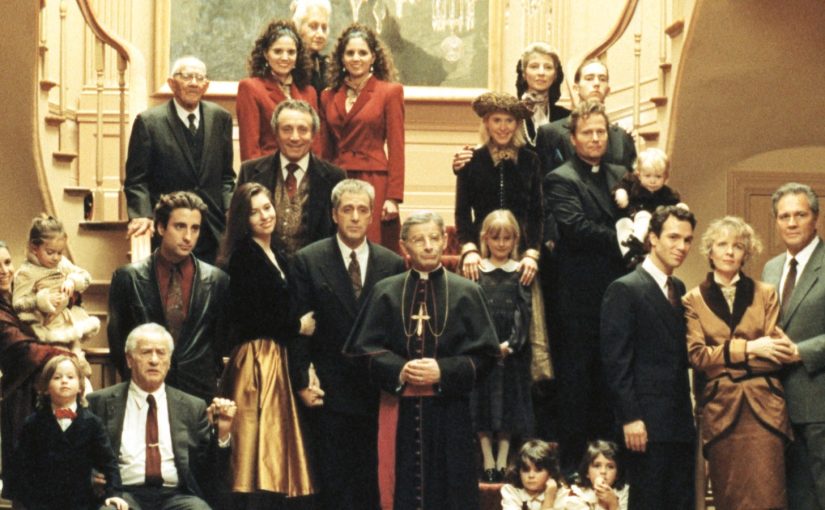
Francis Ford Coppola and Mario Puzo finished out their Corleone trilogy in 1990 with The Godfather Part III. Not so much a sequel, this third film feels more like an epilogue jumping towards Michael Corleone’s (Al Pacino) elder years as the Don of the most powerful Mafia family in the late 70s/early 80s.

Michael seems exhausted with his rule as he suffers from diabetes as well as remorse for his past sins; especially feeling the guilt of ordering the execution of his brother Fredo.

Still, he is drawn to crime, but on a more sophisticated and righteous nature by taking advantage of the Roman Catholic Church. Michael intends to purchase the powerful bank associated with the church but that’ll have to fall in line with the Pontiff’s agreement. It doesn’t help that the Pope is in failing health. The setup of all this lends to another grand opening where Michael earns a prestigious award from the church in the same tradition of an austere celebration of many guests that lend to character set ups for the film. A Godfather movie is not a Godfather movie without a grand reception to open the film.

The most interesting character is Michael’s nephew, Vincent (Andy Garcia), a fierce hot head like his father Sonny. He wants to work for Michael desperately while fending off a street hood boss (Joe Mantegna). An older don also comes into play by the great character actor, Eli Wallach. Diane Keaton as ex-wife Kay is also here but more or less to quietly bicker with Michael. Sister Connie is here, too, with Talia Shire. The Connie character always changes from each movie. Here she’s a deadly black widow. There’s also Michael’s daughter Mary (Sofia Coppola, contrary to popular opinion, I insist she’s very good in the role). Is Mary a legitimate cover for the family as the spokesperson for a fundraising effort? Is the possibility of Vincent and Mary (as cousins) getting intimate a terrible risk?

I like this film and hold it in high regard. Namely because Coppola and Puzo took an approach straight out of the news when there was an embezzlement scheme occurring within the Vatican bank. The problem for many I believe was that the plot of this grand scheme was not flashy or bloody enough, even if a participant is revealed to be hanging from a London bridge with fraudulent receipts falling out of his pockets…which actually happened in real life.

The film allows many opportunities for Michael to allow his anguish in guilt to flow. Fans grew used to a fierce Michael Corleone from the first two films. The elder Michael here would rather not get involved. Hence the introduction of Garcia’s character. He’s very good in the role. Yet there’s not much dimension to Vincent. He’s a scary violent guy, and a contradiction to what Michael seeks. Yet, thats about all there is. I would have wanted more dimension to this role; the guy destined to carry on the reign.

Sofia Coppola is fine in her part and undeserving of the lashing she received upon the film’s release. She’s Michael’s young daughter; a young adult dangerously close to the fray. The one innocent constant within the family. For me, I found a dramatic stake in her character.

The ending is very powerful. Slowly methodical as the family assembles in Sicily to see Michael’s son’s stage opera debut. There are elements that are consistent with the other films’ endings, but this violent conclusion comes with quite a shocking result. I was really moved by it.

Coppola didn’t measure up to the first two films with this effort. I agree with that. Still, The Godfather Part III is worthy of holding its place in the saga. It carries the traditions of the prior films in set up and music and operatic narrative. Be patient with its slow pace because I think the ending will grab you.

STAND AND DELIVER

By Marc S. Sanders

One of the most inspiring classroom setting films is Stand And Deliver directed by Ramon Menéndez and written by him with producer Tom Musca. This pair took great pains to protect the integrity of their script.

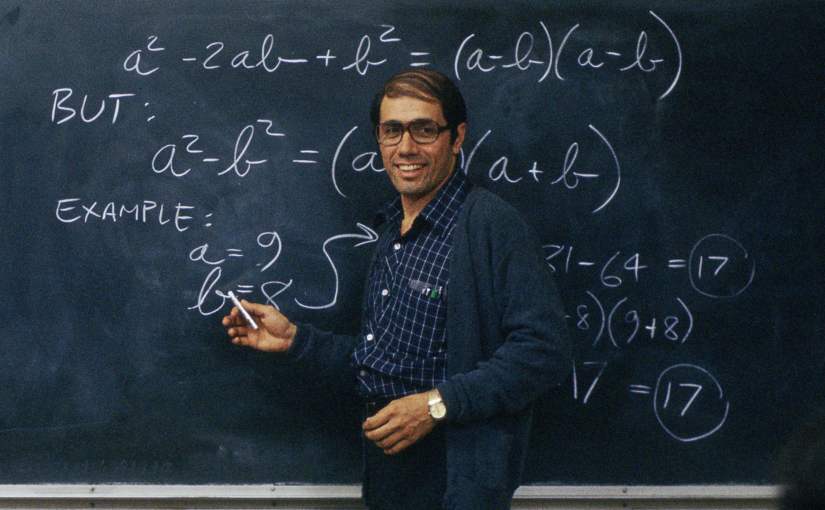
The film tells the story of math teacher Jaime Escalante’s (Edward James Olmos) uncompromising drive to bring 18 students at Garfield High School to passing the state’s AP Calculus exam. These students come from working class Hispanic families who hardly offer their own children any bright future beyond fixing cars, waitressing in the family restaurant or remaining as a gang member in a life of crime. Their parents laugh and shake their heads at their dreams of becoming doctors or engineers. Their parents never had a teacher like Jaime Escalante.

Escalante motivates them to find a ticket out, and become the first members of their families to graduate high school and go to college. The first two acts of the film focus on Escalante’s drive and brief encounters with some members of his classroom. He shows how he’s not intimidated by gang member Angel (Lou Diamond Phillips) and how he convinces a restauranteur to allow his daughter to return to class. Another student is overcome with stress. Escalante listens but doesn’t allow the student to give up. I like these scenes a lot and my descriptions do not give these moments enough credit.

The film does not rely on classroom speechifying or inspiring rock music to cut in with sequences of kids reading books. Instead, it drives home the fact that Jaime Escalante never loses sight of the nowhere potential these students live with. The students learn to respect the one man who never underestimates them, regarding him as “Kemosabe.” He never allows them to lose their “ganas;” a desire for something better.

Even after they pass the exam, the students’ own environment will not allow them to celebrate their success. It’s too hard to accept the result. It’s easier to accuse them of cheating as it’s presumed that this sect of Hispanic/Mexican people could never have accomplished what their scores indicate. No other explanation could merit what’s occurred. Escalante is angered by this racism, but his confidence in his students pushes them to retake the exam. Blatant racism will not prevent a future without poverty.

The students consist of mostly unknown actors. Following this film from 1988, I’d catch one of them guest starring on a TV show here or there. Collectively speaking though, they really come through by convincingly displaying their lower class lives. It’s easy to see a lack of potential for these kids early on in the film. It’s also comfortably easy to see how Escalante takes command of their lives with a sense of unity and motivation. No one ever told these kids they could solve some of the hardest mathematical equations ever conceived. No one ever told these kids they could amount to something. It took someone from their own environment to help them defy a stereotype and demonstrate that intelligence is a gift that any human being is blessed with. They just have to have the “ganas.”

Edward James Olmos was nominated for a Best Actor Oscar. I’d say it was one of the most under the radar performances to ever be considered frankly. Stand And Deliver was made on a small budget. It’s easy to see that. Still, that is also what is so special about the film. This film stood on its performances and the genuine inspiring story it’s based on. It had all the ingredients it needed to be a winning film. This film eventually reached the exclusive annals of the prestigious National Film Registry of the Library of Congress. Stand And Deliver will tell you to never surrender.