BLUE MOON

By Marc S. Sanders

Ever hear of a guy named Lorenz Hart?  He was a lyricist.  I’ll bet a few of you know some of the songs he was responsible for like My Funny Valentine and Blue Moon.  Yup!  That guy, Larry Hart, wrote hundreds of songs that might have established an ongoing pop culture lexicon.  His partner was Richard Rogers.  Surely you know him.  Of Rogers & Hammerstein fame.   After a twenty-year partnership, Rogers distanced himself from Larry Hart’s substance abuse and procrastination, and went on to collaborate with Oscar Hammerstein II.  On March 31, 1943, their first effort together premiered on Broadway, receiving endless critical praise.  That production was Oklahoma! (Yes. To poor Larry’s chagrin the exclamation point was included in the title.)

On this celebratory evening, the producers, cast, crew and theatrical big wigs are planning to catch up at Sardi’s after the curtain call.  Larry, played with shrimpy, raspy, hyperactive, bitterness by a sensational Ethan Hawke, left the performance early to saddle up at the bar and regale the tolerant bartender, Eddie (Bobby Cannavale), with his bygone accomplishments and resentment towards his friend Richard (Andrew Scott) and now the replacement, Oscar (Simon Delaney).  He insists Eddie bring him a shot of whiskey-only to gaze upon, not consume.  We’ll see how far that goes. Wouldn’t you know it, but trying to keep to himself, in the corner, is E.B. White (Patrick Kennedy), the writer who’s working on a children’s book about a mouse.  

Writer/Director Richard Linklater once again partners up with his go to leading man, Ethan Hawke.  Together, they’ve done several films, some of which occur primarily over the course of one night (Before Sunrise, Dazed And Confused, and now Blue Moon).  This loose boxed-in, and theorized biography relies so much on the individual performance of Hawke.  

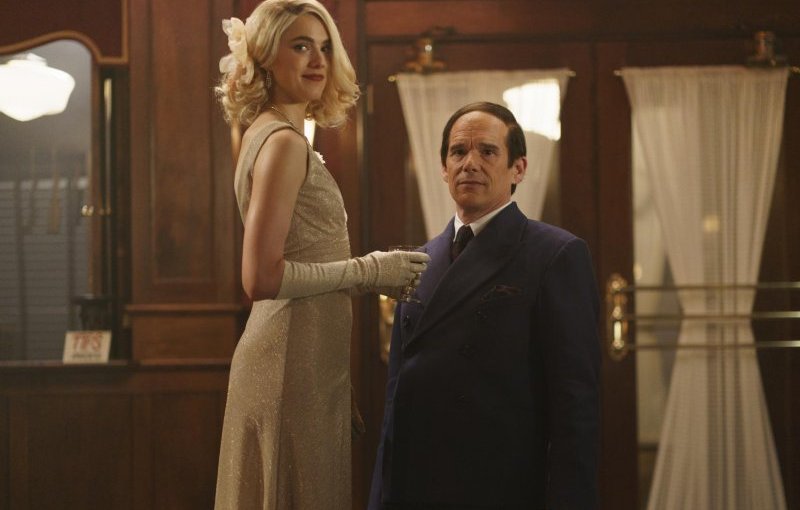
Nearly the whole script of dialogue belongs to the actor. As expected from most resentful and bitter artistes, Larry does not shut up.  Eddie and the piano player and later E.B. White may be his designated listeners, but schlubby Larry, with his balding combover and squat height is only talking to himself.  I read that Linklater had to modify his cameras and set design to more accurately capture the real subject of this film.  Ethan Hawke has a much taller height than Larry Hart. I think the actor and director pull off the illusion quite well.  Compared to everyone else in black tie evening wear, Larry looks like a reject from Middle Earth Hobbit-town in an old blue suit.

Like any good writer of such adored classic numbers, little Larry has a muse. She’s a twenty-year-old blond bombshell named Elizabeth, played with alluring exquisiteness by Margaret Qualley.  I must compliment the actress’ hairstylist for getting the blond coiffed hair to perfectly cover Qualley’s left eye, while the green right one draws us in, complimented by an hourglass hugging, glittery white evening gown.  

Larry is plagued.  Elizabeth is grateful for all of his attention and his guidance with getting her into the limelight. However, is he in love with her, or is his suspected penchant for men a reason why he lives through this young adult’s recent sexual conquests?  There’s a magnificent scene when Larry and Elizabeth hide in the restaurant’s cloak room, crouching down on the floor.  In a series of great talkie scenes for Ethan Hawke, his best moment might be when he’s squatting down on his haunches like a child, with little to say, and absorbing the whispered narrative delivered by Qualley.  It almost doesn’t matter what she’s describing.  It’s more about how she tells the story and how her acting partner responds with his hands clenched together under his chin.

Larry Hart was a real artist with a magnificent talent that in no way reflects his image, personality or physique.  His song lyrics are ALIVE and timeless, adoring too.  On the other hand, he’s stand offish and exhausting to be around, even if everyone at Sardi’s finds a moment to express what an inspiration he’s personally been.  A guy named George Hill looks up to Larry and is advised to make films about friendship (you know, like The Sting or Butch Cassidy And The Sundance Kid).  Then again, there’s also a snot nosed, know-it-all kid named Stephen who thinks Larry’s lyrics are pedantic at best.  This brat named Sondheim will probably go nowhere.

I knew nothing about Lorenz Hart.  Never heard of the guy.  Wouldn’t recognize his picture if I saw it on Sardi’s wall.  Don’t remember seeing it the last time I was there.  He’s a Saliere to Richard Rogers’ Mozart.  This poor guy had demons that ended his life at a young age.  

The best that can be said is that he provided so much cheer to the world during is forty three years on this planet.  It’s sad, but interesting to capture Richard Linklater’s one evening in this sap’s life that can sum up who he was and how he was regarded only to be quickly dismissed.

Larry Hart put everything in the spotlight but never had the opportunity to stand there himself.

WAKE UP DEAD MAN

By Marc S. Sanders

Benoit Blanc is back with a new mystery to solve in Wake Up Dead Man.  With three films, all directed by Rian Johnson (Knives Out, Glass Onion), Daniel Craig’s eccentric detective now belongs in the ranks of Sherlock Holmes and Hercule Poirot.  He’s a pleasure to watch with a smirk on your face.  Ironically, he doesn’t make his entrance until at least a third of the picture is complete.

Josh O’Connor is Father Jud Duplenticy who first reveals a wide berth of exposition ahead of the murder mystery that awaits us.  He’s a catholic priest who works hard to contain his temper that might resort to raising his fists.  He’s been assigned as the assistant minister to a church in a small New England town where everyone knows one another, especially repulsive Monsignor Jefferson Wicks (Josh Brolin).

Whodunit mysteries should never be spoiled.  I certainly wouldn’t imply how this film wraps up.  I also do not want to reveal who the victim(s) is/are.  I urge you to see Wake Up The Dead Man because this puzzler of a story is as gleeful as the title itself.

Like the Agatha Christie film adaptations from the 1970s, Rian Johnson does his best to provide a lineup of suspects with celebrity familiarity including Brolin, O’Connor, Mila Kunis, Kerry Washington, Thomas Hayden Church, Cailee Spaeny, Jeremy Renner and a standout performance from Glenn Close who steals much of the film away from the rest of the cast.  After seven nominations spanning over forty years, give her the Oscar already.  She’s eerie and needling, spooky and fun.  As Detective Blanc continues his investigation, a character tells him this all seems like something straight out of Scooby Doo.  Glenn Close, donned in black with an elderly bleached facade certainly feels like she’d come in contact with the animated pup and those meddling kids.

Rian Johnson writes with that classic narrative that Agatha Christie or Arthur Conan Doyle adopted, only it’s modernized.  The director of The Last Jedi even throws in a Star Wars reference and the joke soars.  The writer/director crafted this script as an invitation for hair raising merriment with his design.  If you can’t be a part of a mystery dinner theater party, he ensures that you can participate in this one.

An old church, priests who curse, habitually pleasure themselves and confess to an abundance of sins, a gothic tomb, a dark basement with a repulsive bathtub, a bar with a photograph of clues, startling entrances, unconventional dialogue and a quizzical murder weapon function like page turning literature.  Even better is to understand how impossible the first murder can be under the limitations of a locked door mystery.  How can someone be killed right in front of our eyes when no one else is in room?  The answers await and thankfully the revelations are not far-fetched.

Wake Up Dead Man is a fun time at the movies.  It’s coming to Netflix on December 12, 2025.  Nevertheless, I encourage you to go your local cinema.  The crowd we saw it with was responding consistently with us, and that only enhances the experience.

SPECTRE

By Marc S. Sanders

It’s fortunate that the success of Mike Myers’ Austin Powers franchise did not wash out the best features of the James Bond series. Had it done so, we wouldn’t have been treated to the outstanding production of Daniel Craig’s film, Spectre, with an opportunity to face off against a reinvented Ernst Stavro Blofeld played perfectly by Christoph Waltz. One of my few complaints however, is that we didn’t get enough material for the two-time Oscar winner.

Director Sam Mendes returns following Skyfall to reinvigorate the original traditions and blueprints that attracted audiences to 007 in 1962 with Dr. No. Blofeld lays in wait in his secret fortress of a lair housed within a desert crater (an upgrade from the volcano in You Only Live Twice), ready to offer exquisite hospitality to Bond and his love interest before providing an unrequested guided tour of his technology and hideous plots. No, he never had to show Bond anything. Yet Blofeld was never bashful, with or without his cat. Waltz is the right choice for this 21st century iteration of the staple villain. Gone is most of the camp presented in the character during the later Connery films. Most of the camp actually. He does still have the white cat after all.

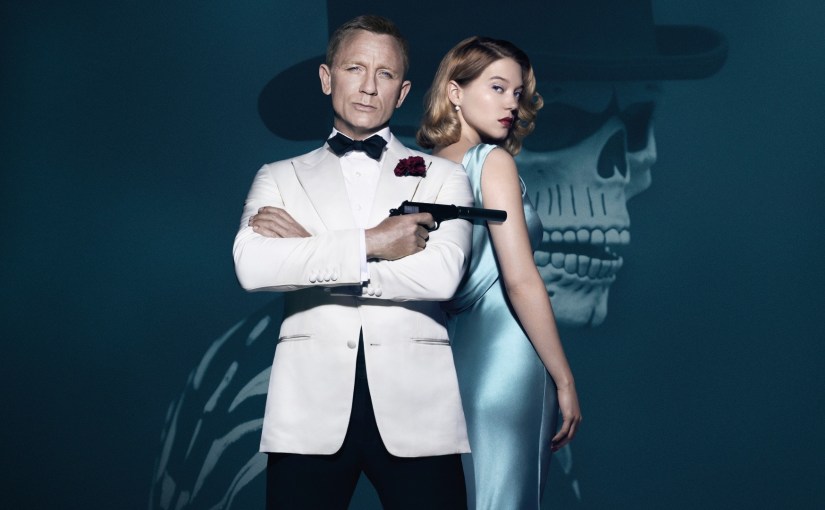
Craig remains a great 007. The role is not a mimic of past Bonds. Craig is everything of the “blunt instrument” that author Ian Fleming described. Thanks to his physique and some great fight choreography, a marvelous fisticuffs scene occurs between him and brutish Dave Bautista aboard a moving train. Craig always looking great in the white dinner jacket tux, even while he’s getting pushed around.

Lea Seydoux is serviceable as the Bond girl, Madeline Swann, daughter of an old enemy of Bond with information necessary in the pursuit. Seydoux is not the best Bond girl. Others have offered more intellect beyond the beauty. Still, that might only be due to the limits of the script. She’s a good actor nonetheless.

Ben Whishaw and Naomie Harris are great as Q and Moneypenny. The roles have stepped up in frankness and skills that stretch out more than a traditional one scene cameo. Whishaw as Q is more of a know it all and Harris as Moneypenny reminds the audience that she has a life outside the office.

Ralph Fiennes is good too as M. Though I do wish his storyline was better here where he is dealing with an over abundant policy in complete government surveillance. The antagonist against Fiennes is nothing special and as quick as this storyline started, you knew how it was going to end. Still, I like watching Fiennes in the role.

Spectre has great scenes, most especially the signature opening taking place on the Day of the Dead in Mexico City that culminates in the destruction of a city block before Bond disables two bad guys aboard a spiraling helicopter. Steady cam and very clear edits make this a knockout.

I also appreciate the gag that not all things work accordingly for Bond. He orders his signature Vodka Martini, shaken not stirred, and is denied as he is at a bar located in an isolated strict health retreat. As well, his Aston Martin is not as reliable thanks to empty hidden machine guns hidden behind the logo in the trunk. Not everything comes as easy for Craig’s Bond, and that allows for some tongue in cheek humor.

I liked Spectre more on a repeat viewing. Mendes shot a gorgeous looking globetrotting picture of Mexico City, Rome, Austria, Tangiers and clear evening London.

Considering the next installment is likely to be Craig’s last film is disheartening. With Spectre, a summation of all the prior Craig films is assembled leading to what has been a great miniseries within the storied franchise. I’ve liked following this James Bond. There are revelations about the character including his orphan history, his faults and his coldness that only serves to protect the Queen’s country. The Daniel Craig Bond is the best following the very different albeit wry interpretation of Sean Connery.

Still, I’ll take what I can get, and once again happily look down the target scope aimed right for 007 before the blood comes pouring down.

1917 (2019)

by Miguel E. Rodriguez

Director: Sam Mendes
Cast: Dean-Charles Chapman, George MacKay, Colin Firth, Mark Strong, Benedict Cumberbatch
My Rating: 10/10
Rotten Tomatometer: 89% Certified Fresh

PLOT: Two British soldiers during the First World War are given an impossible mission: deliver a message deep into enemy territory that will stop 1,600 men, including one of the two soldiers’ brothers, from walking straight into a deadly trap.


Bear with me for a second…I promise I’ll actually get to the movie in a second.

I’m not a professional movie critic.  I write reviews simply because it amuses me to do so, and because one of my friends made it possible for him and I to post our reviews in an online forum.  For about two months, though, I haven’t written a single review.  I pondered this with Marc a little while ago, and the only reason I could come up with was that I didn’t feel INSPIRED to write something.

Not that I haven’t seen good movies in those two months. Waves, Uncut Gems, Star Wars: The Rise of Skywalker, Jumanji: The Next Level, Frozen 2, Little Women, Bombshell, maybe one or two others – they were all good, even great.  (In the case of Uncut Gems and Waves, I’d even call them “must-see” events.)  But I never felt compelled to run home and put pen to paper, or fingers to keyboard.  I simply felt that I had nothing to contribute where those movies were concerned.

Well, tonight I saw 1917, and now I have to say, this is a different case altogether.

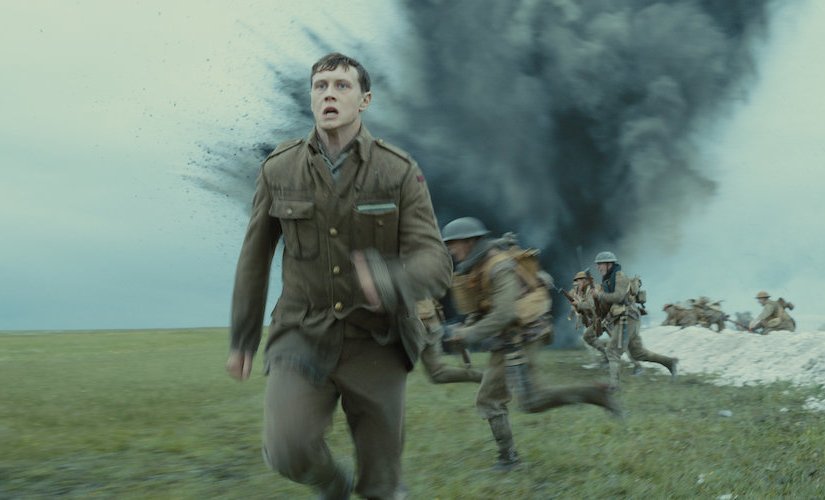
For anyone who’s not quite aware of why this movie is so special, aside from it just being really good, 1917 was hyped as being told in one single shot with a camera that follows two soldiers through battlefields and countrysides as they attempt to deliver an important message to a distant company of English soldiers.  No cuts to different angles, no cuts at all, in fact.  (Actually, there IS a single cut, but more on that later.)

While I originally felt it was a bit of a stunt to get it noticed at Oscar time (remember Birdman [2014]?), after seeing the movie it was abundantly clear that this was no mere trick to dazzle an audience with.  This specific story is particularly suited to this specific method of filming.  It forces the audience to empathize with these two soldiers immediately, and only them.  I was reminded for some reason of Saving Private Ryan, and a line spoken by Tom Sizemore: “This time the mission is a man.”  Well, this time, the men are the mission, and the mission is paramount.  The single-take strategy has the uncanny ability to put us in the shoes of these soldiers more so than many other war films.  You feel like you’re right there in the mud with the empty artillery shells and the corpses and the rats.

And that’s the supreme achievement of the movie: its ability to put us there and KEEP us there for two hours without ever calling attention to the fact that, “Hey, we haven’t cut yet and it’s been over a half hour!”  A lot of that has to do with camera placement and movement and, of course, the actors’ ability to keep us engaged.

But one thing that I kept noticing throughout the movie was the small details.  I’m not going to remember them all, but they included:

  • At one point, the British soldiers walk through an abandoned German bunker.  In a throwaway detail, the name “KLARA” is seen scrawled on one of the walls.  The camera doesn’t focus on it, but it just passes by.
  • We encounter a group of British soldiers, and of them is a Sikh.  The other soldiers are doing bad impressions of their superior officers, but the Indian’s impression is clearly better than the other Englishmen, with proper diction, upper-class accent, everything.
  • In the British trenches, various sections have unique names.  The one I remember most clearly is “Paradise Alley.”
  • As they walk, one of our two heroes notices cherry trees, and he quickly rattles off several different varieties of cherries.  He knows them because his family has an orchard back home.
  • An intense scene where someone has to literally wade through dozens of corpses.
  • In one remarkable scene, the movie pauses to listen to a song. Fighting is imminent, death may arrive at any moment, but for a brief moment, everything stops. It’s a brilliant moment…almost holy.

Little things like that.  The reason I bring them up is because some of them seemed unnecessary to the story, but they colored the story so that it felt more real than most.  And the closing credits reveal that this movie is based on stories told to director Sam Mendes by his grandfather, who served in World War One.  So many, if not all, of those little details were probably one hundred percent REAL details, the kind of details that could only be remembered by someone who was there.

Another reason the movie is so suspenseful is because we’ve become subtly programmed to believe that, in a war movie, the ending can’t be too Hollywood; otherwise, it’s not real enough.  The soldiers must deliver a message.  Will they even survive long enough to deliver the message?  Assuming they do, will the officers receiving the message even follow the order?  A civilian appears at one point…will they live?  They engage in combat…who will live and who will die?  I was on edge the whole movie because I never really felt “safe”, which was EXACTLY the kind of feeling you want when you’re watching a war movie.  In my opinion.

Now, about that whole single-shot thing.  There actually IS one cut, a SINGLE cut, during the whole movie.  You’ll know it when it happens.  But when you’ve seen as many movies as I have, you’ll also notice “invisible wipes”, where the camera passes by something in the foreground – a pillar, or a rock, or a tree – that comes in between the camera and the person/object being filmed.  Using clever editing and lighting, you can cut two shots together using that pillar/rock/tree as the splicing point.  And there is a LOT of that going on in this movie.

I’m not taking anything away from the achievement of the film, it’s spectacular.  It’s just something I noticed that I could not UN-notice for the duration of the film.  A minor quibble, nothing more.

1917 is definitely a top contender for Best Picture of 2019.  I have only seen a handful of World War I movies, but this is certainly one of the very best.  I’d rank it up there with Kubrick’s Paths of Glory any day.