MEGALOPOLIS

By Marc S. Sanders

Francis Ford Coppola’s Megalopolis is undeniably the director’s most ambitious project of his long career.  Like other films, Coppola put up the entire $120 million to finally make the picture, including selling his well-known vineyard to make it happen.  Every penny he invested is well spent.  Especially seeing it on IMAX, this is an absolutely gorgeous motion picture, like James Cameron’s Avatar films.  I mean…wow do the colors pop and shine.  

However, as beautiful as the visuals are in Coppola’s self-described “Fable” (it literally says that in the title card), it is mostly devoid of substance beyond the paint by numbers debates that cause conflict among these very strange characters.

In New Rome City, an alternative reality to the Big Apple (the Statue of Liberty holds the torch in her left hand), Caesar Catalina (Adam Driver) is a “designer” who recently invented Megalon, a substance that he believes is the answer to a utopian future.  It’s indestructible and it can be molded to serve practically any purpose.  For example, you don’t even have to walk to where you’re going.  Step on the Megalon puddle and it will move you there.  Not much of a departure from the flat movable floors you find in nationwide airports.  This is one of Megalon’s major innovations, designed to impress me?

Megalon can also be used for healing, and it has the ability of transparency.  It is more durable than wood, steel or concrete.  It’s truly the next greatest wonder of resources.  Frankly, I was more dazzled by the Vibranium found in Wakanda.

As Caesar the artist pushes his agenda for absolute Utopia, the hardened Mayor Franklyn Cicero (Giancarlo Esposito) is the opposing side of the argument declaring Utopia to be an impossibility.  Caught in between the two figures is Julia (Nathalie Emmanuel), daughter of Cicero and in love with Caesar.  Gotta have a soap opera element to this piece so the stubborn divide between these two men remains firmly in place.

Just as in typical political rings, the Mayor works to smear Caesar the idealist who is solely focused on his end goal design.

Outside the boundaries of their public quarrel are other overly colorful and garish looking characters such as the banker Hamilton Cressus III (Jon Voight), his wife, the gossip reporter Wow Platinum (Aubrey Plaza), Constance Cassius Catalina who is Caesar’s mother (Talia Shire), a lone, crazed revolutionist and nephew to the Mayor called Clodio Pulcher (Shia LeBeouf) and Nush “The Fixer” Berman (Dustin Hoffman).

These names are exhausting.  Coppola’s film is even more tiresome.  The filmmaker truly must believe he is the second comings of both Nostradamus and William Shakespeare.  The ego of this picture could not be more apparent.  The director’s head must be THAT BIG to believe he has the nerve to tell this story of such biblical proportions.

Much of those character names, and the actors who play them, are here for show and tell.  Their value to this piece is nowhere near as prized as anyone living in Harry Potter’s world, though. Megalopolis only takes time to calm itself down when the three principal players have scenes isolated to themselves or when they only occupy the screen together.  Otherwise, this movie serves as vehicles for much of the cast to be adorned with updated and trendy Roman costume wear, from fig leaf crowns to golden armored chest plates.  At times, LeBeouf is so unrecognizable in hair, makeup and clothes you don’t even realize you’re looking at him.  

The performances are all over the place.  I never once believed that whatever Dustin Hoffman was talking about that he knew what he was even saying or representing.  Shia LeBeouf mostly runs with the privilege of getting to say “Fuck Caesar!” while finding motivation only in whatever weird appearance he’s dressed in.  Adam Driver can lead a picture for sure, but here he looks like he showed up for filming with a bewitching overnight hangover.  

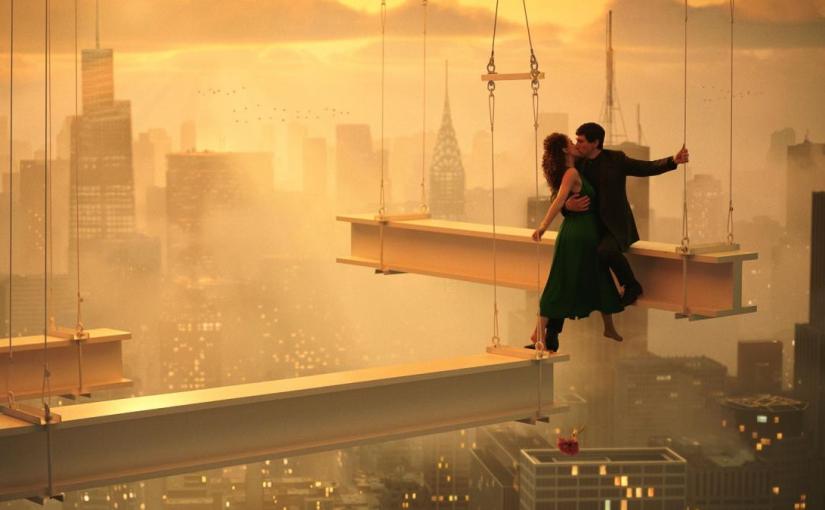
This is a film that cannot be ignored for its technical achievements at Oscar time.  For no reason other than aesthetics, Driver and Emmanuel will share a scene while balancing themselves on swinging steel construction beams high above the city. The view is spectacular.  All undeniably eye opening.  You also cannot look away from the costumes or scenic art direction.  The sound mixing in an IMAX theater totally envelops you in this weird world.  It’s a digital film’s dream just like James Cameron banks on.  

Still, maybe none of these efforts will be recognized because frankly much of the visuals, audio and physical construction make zero sense or relevance to the central storyline that Coppola is striving for.  Namely, the possibility for Utopia versus the practicality of simply living through life with the necessity for economics, technology, healthcare, fuel and on and on and on.

Of all films I thought about while watching Megalopolis, my mind went to William Shatner’s Star Trek V: The Final Frontier.  Shatner had the idea to have the Enterprise crew meet face to face with the almighty God.  Well, if you’re going to deliver God to a movie house, without George Burns or Morgan Freeman in the role, you’re setting yourself up to disappoint at least half or maybe even one hundred percent of your audience.  When you factor in the tremendous assortments of beliefs and religions, I’d argue no two people who believe in God, see the ethereal, omnipotent entity in the same way.  The same goes for Utopia.  How can Francis Ford Coppola be so audacious as to believe audiences will accept Caesar’s vision of a perfect land?  

Reader, he can’t!

My Utopia is different than your Utopia.  This is practically an untouchable subject and Francis Ford Coppola is far from the fabled prophet that the world needs or will draw their attention to.

Still, I remained as open minded as I could with Megalopolis all the way towards the ending that finally arrived.  The Utopia shown on this giant IMAX screen was told by the film’s narrator (Laurence Fishburne, also paying Caesar’s chauffeur) that the world was showered in gold dust.  A far cry from the Bible’s claim of arriving upon a land of milk and honey.  Why should I ever need the nourishment of milk and honey when I can have gold dust?

Think about that for a second.  Gold Dust.  I know.  The narrator is being allegorical.  Still, couldn’t that be interpreted as a little too materialistic for the Utopia we yearn for?  Gold is only a precious metal the same way a diamond is only a precious stone, or the Atari 2600 is now an expired precious commodity among former twelve year old kids in the 1980s.  

I have little shame.  I’m an admitted materialistic kind of guy.  My Mustang and my flat screen TV and my Star Wars collectibles mandate that I am. Yet, none of these possessions have ever delivered me into a paradise of perfection.  The Mustang needs precious fuel to operate.  Try as I might, I can’t collect everything.  My flat screen TV is still on the fritz.  (DAMN YOU BEST BUY GEEK SQUAD!!!)

Coppola contradicts himself with the conclusion of his fantasy opus.  He pans over the extras who occupy this film with big toothy grins of enormous gratitude while the very well dressed and bejeweled surviving characters of his story seem to be shot from an elevated stage above me, the viewer, and all who occupy a brightly lit Times Square located within the heart of New Rome City.  I am meant to look up to these giants!!! 

THIS IS UTOPIA???  

No!  I could never accept this interpretation of grand decadence as the enigmatic paradise we have all envisioned in dreams and discussion and literature.  Shouldn’t Utopia consist of a life where stress is absent, and pain is a foreign unfamiliar word and feeling? I’m not even giving Utopia its fair due.  It’s practically impossible to describe, but I’m at least certain that the rich shades of gold and black glamours within a Times Square shopping district is not the way to go.  Yet, Francis Ford Coppola is suggesting this is all that it is.  A Times Square showered in gold dust.

Frankly, I normally would give much more credit to the man who pioneered the stellar Godfather films along with the bombastic Apocalypse Now and the intimate The Conversation.  He’s never been more short sighted though, than when he finally made his “fable,” Megalopolis.

The greatest flaw and tragedy of Megalopolis is the very broad contradiction that Francis Ford Coppola declares within his fictional, fantasy-like prophecy.  Once the “fable” is all over, I feel like I paid an enormous amount of money for a cult like weekend seminar meant to brainwash me into broadening heights of positivity and awareness, showered in gold dust of course.  

Where’s The High-Level Minister Coppola?  

I’d like my money back because this preach is no more believable than an L Ron Hubbard doctrine.  Battlefield Earth just might be a little more convincing Megalopolis.
BLACKKKLANSMAN

By Marc S. Sanders

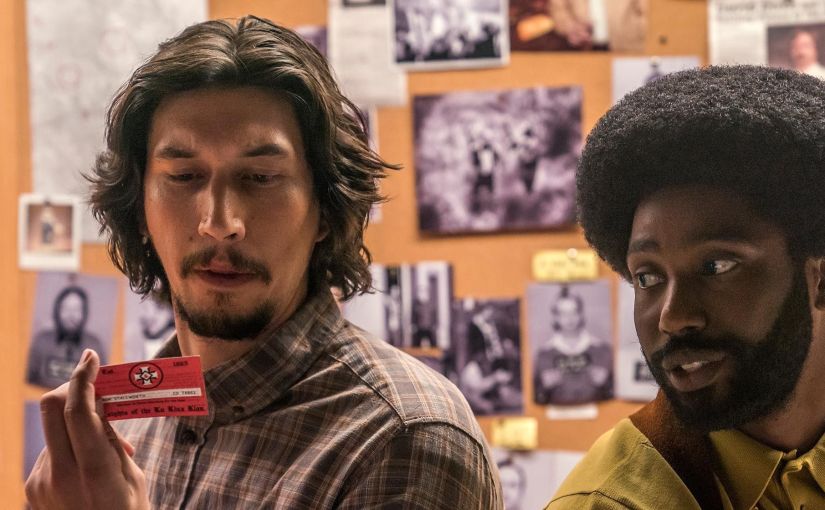
Spike Lee has finally received a Best Director Oscar nomination for his film BlacKkKlansman. It is based on the book by Ron Stallworth. In the 1970s, Stallworth was the only black police officer in the Colorado Springs police department. He was always ready to face the backlash and criticism for his afro and skin color. He also orchestrated an infiltration of the Ku Klux Klan while developing a trust with their Grand Wizard and eventual Presidential candidate David Duke.

John David Washington (son of Denzel) portrays Stallworth with high intelligence, instinct and even tolerance to stay focused on the end goal of incriminating Klan members out to do more than just march. Stallworth partners up with Flipp Zimmerman, a Jewish cop who will make his presence as Stallworth among the ranks of the Klan. Call it a Cyrano set up. Stallworth does the talking over the phone. Flipp stands in their presence.

I’ve usually been hot and cold on Spike Lee. Forgive me but when a “Spike Lee Joint” debuts in theatres, my subconscious immediately expects a very biased and unfair viewpoint of racial tensions in America. I don’t care for Lee’s outspoken statements in the media at times and I shake my head at some of his misguided actions. That’s another conversation that I welcome to have with anyone at another time. However, Lee takes a very aware and balanced approach here. The film opens with Alec Baldwin as an evil messenger of hate attempting to record a sermon for his disciples. Lee films Baldwin very disturbingly among different color hues and jittery close ups and wide angles. It’s nauseating and it should be.

Then Stallworth’s story begins and he is assigned to go undercover at a former Black Panther member’s (played by Corey Hawkins, who I loved in the revival of 24) speaking event on a college campus. The police expect this will be an orchestration of violence among the black community but Stallworth sees it is anything but that. Lee commits a beautiful filmmaking effort as he shows the faces of black people listening to the speech in spotlights as Hawkins continues on. These are college students simply looking for a way to never succumb to anyone who considers them inferior. The speaker does hold the white man accountable, yes, and I don’t care for that as I’m a white man with no instinct of superiority. Therefore, don’t lump me in with a small sect of misguided people, please. Still, the scene is effective and relatable. America has its ugly histories and America is not settling for insensible and uncaring treatment of its people either.

From here, the film takes on a more linear story as Stallworth and Zimmerman build their case.

Lee offers good debates among his cast of characters. Stallworth becomes attracted to an activist named Patrice, played very well by Laura Harrier. Here’s hoping to a long, successful career for her. Patrice believes the police are the enemy and even questions if Stallworth will remain a police officer following this case. Stallworth takes pride in being a cop. Black Life vs Law Enforcement.

Stallworth and Zimmerman bear witness to the mentality of the Klan. Over and over the Klan members suspect Zimmerman of his Judaism. He denies it and goes to great lengths to disprove his heritage and yet the Klan continues to question him, despite some high level members truly believing his guise of white supreme devotion. White Supremicists vs. Judaica & Black Life.

Lee has offered a powerful film that left my wife and I up until two in the morning discussing its dynamics; discussing how many things have changed for the good since the 50s; discussing how many have gotten better, have gotten worse and how some things have sadly resurfaced in recent years.

BlacKkKlansman reminds me that Lee is truly an accomplished filmmaker. Beyond his messages and viewpoints, Lee knows how to edit a scene and offer inventive camera angles and direction. He’s a prize student of film, now a teacher. This latest effort is a reminder of how Lee’s production of Malcolm X in 1991 was robbed of recognition at the Academy Awards, a true injustice.

BlacKkKlansman is Spike Lee’s best film since Malcolm X and one of the best films of 2018.

HOUSE OF GUCCI (2021)

by Miguel E. Rodriguez

Director: Ridley Scott
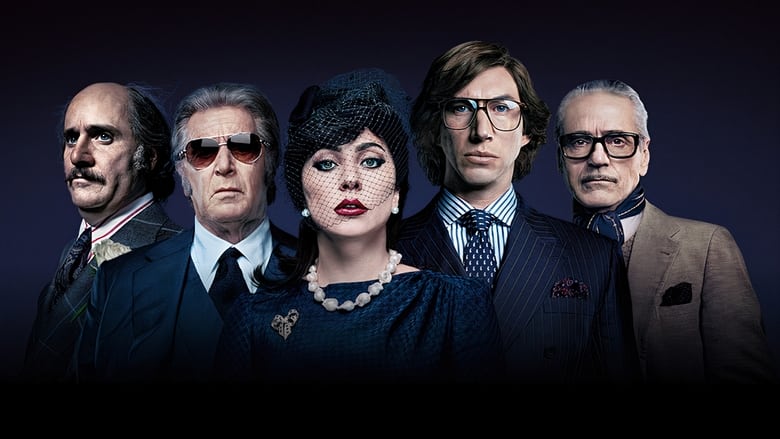
Cast: Lady Gaga, Adam Driver, Jared Leto, Al Pacino, Jeremy Irons, Salma Hayek
My Rating: 5/10
Rotten Tomatometer: 61%

PLOT: An outsider marries into the Gucci family, and her unbridled ambition triggers a downward spiral of betrayal, revenge, and violence.


Watching Ridley Scott’s House of Gucci was a curious experience.  I could see glimmers of a great entertainment through bars of slow pacing, a meandering story, and unanswered questions.  The performances are top-notch, no question, but they are at the service of a movie that doesn’t seem interested in meeting their level of passion.

Inspired by true events, the movie tells the story of Patrizia Reggiani, a young woman from humble beginnings who meets and eventually marries Maurizio (Adam Driver), one of the heirs to the Gucci fashion empire.  Patrizia is played with fury and fire by Lady Gaga, who seems destined for another Oscar nomination.  Her character is portrayed as a latter-day Lady Macbeth, someone who sees through the deceptions of her new husband’s business associates and manipulates people and events for her family’s benefit.  In true tragic form, her ambitions threaten to derail everything she loves.

Adam Driver plays Maurizio as a rather slow fellow who disinherits himself so he can marry Patrizia but finds a way back into the fold via his uncle, Aldo (Al Pacino), who sees Maurizio as a good substitute for his own disappointing son, Paolo.  Paolo is played by Jared Leto, in another of the film’s performances destined for Oscar recognition.  Buried underneath flawless makeup and a skin cap, Leto portrays Paolo as a self-deluded buffoon whose fashion designs aren’t so much daring as unfortunate.  (Apparently, pastels and brown were never meant to mix…who knew?)

I mention the performances because they are the sole highlights of the film.  For two-and-a-half hours, these performances play against a backdrop of one dreary scene after another. Sure, the performances are fun to watch, but at the end of the day, if they don’t have anything interesting to say, it gets a little boring.  We get behind-the-scenes intrigues and betrayals that seem to owe more than a little to earlier crime epics by Scorsese and Coppola, but there was nothing to get really excited about.  Nothing grabbed me.

Ridley Scott’s films are normally way more imaginative than this.  They look better.  The cinematography is usually more inspired.  I’m not talking about his action or sci-fi epics, either.  I mean his small-scale triumphs like Matchstick Men or Thelma & Louise.  What happened here?  Was he not inspired by the story?  There is great material here, more than enough back-stabbing and lying and cheating to go around.  Yet everything is subdued, and plods, and inspires more yawns than anything else.  I didn’t experience any kind of excitement or passion one way or the other for any of the characters, or for the story.  It just didn’t make me care.

By the time House of Gucci is over, we’ve seen betrayals, marital infidelity, divorce, back-stabbing business deals, sex, and murder.  I have a friend who wrote a stage play that has almost all of those things, and it was WAY more entertaining than this film.

MIDNIGHT SPECIAL (2016)

by Miguel E. Rodriguez

Director: Jeff Nichols
Cast: Michael Shannon, Joel Edgerton, Kirsten Dunst, Adam Driver, Sam Shepard
My Rating: 10/10
Rotten Tomatometer: 83% Certified Fresh

PLOT: Two men go on the run with a child in tow, pursued by federal agents and by members of a cult who believe the child has special powers.


The general concept of “mystery” in a film is a subtle art.  Not enough mystery, and people will say they’ve seen it all before.  Too much mystery, and people will wonder why they’ve spent good money to be confused for two hours.

Every now and then, though, a movie comes along that shows everyone else how it’s done.  It manages to plunge the viewer headlong into the story with little to no exposition, provides just enough clues to keep things intriguing without giving the game away, and supplies a climax that is not just satisfying, but revelatory.  Prometheus is one of those movies.  So is Freaks (2018).

And so is Midnight Special, from director and screenwriter Jeff Nichols (Take Shelter, Mud).

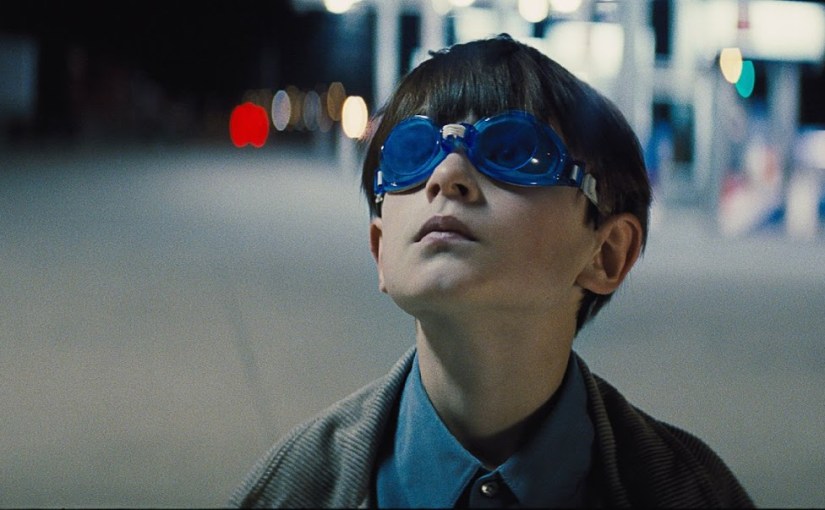
This movie grabs you right from the opening minutes.  Two men appear to be holed up in a hotel room with a young boy wearing blue swim goggles.  Cardboard and duct tape cover the windows.  A news broadcast on the TV reports on the young boy’s kidnapping.  However, he does not appear to be distressed in any way.  One of the men may or may not be his father.  He goes willingly when they vacate the room and hit the road.

In another part of the country, a pastor watches the same newscast with concern.  He later leads a church service, but the scripture reading consists of non-sequiturs and random numbers.  The FBI interrupts the service and hauls each and every church member in for questioning about the missing boy.

What the deuce is going on here?  How is this church connected to the boy?  Where are the two men taking the boy?  What’s with the blue goggles?  What is so important about this boy that the two men with him would be willing to kill for him?

These are all very good questions.  Whenever the movie takes the time to answer one of the questions, two more spring up in its place.  And I may as well tell you now: not every question will get an answer.  But instead of feeling frustrated, I just got more and more involved in the film.  I felt like I was an active participant in figuring out the story, along with the characters.  There’s nothing quite like feeling involved in a movie, rather than simply watching a movie.

When the revelations arrive about where the men are headed with the boy, why they’re headed there, and why the FBI is interested, I’m not gonna lie, I was gobsmacked.  In retrospect, I suppose I should have seen some of the plot points coming a mile away.  But that’s the beauty of the screenplay and the direction.  I wasn’t interested in trying to second guess what surprises were in store.  As a result, when the surprises arrived, I was constantly in a state of jaw-dropping amazement.

I would also like to point out the great restraint used by the filmmakers when it came to the few scenes that required CGI enhancement.  There are a hundred ways these scenes could have gone wrong, resulting in a shot that completely takes you out of the movie.  They avoided all those pitfalls and instead created scenes of startling beauty, even when things seem to be going wrong…or when they at last go right.

This is a movie that deserves to be seen with as clean a slate as possible.  It didn’t exactly make a dent in the pop-culture zeitgeist, so it’s not likely you’ll see any spoilers on the internet without Googling the movie, but why would you want to do that?  Keep an open mind, don’t ask how it ends, and find a way to see this movie.  You won’t be disappointed.

STAR WARS: THE RISE OF SKYWALKER

By Marc S. Sanders

Star Wars: The Rise Of Skywalker is a well packaged thrilling adventure of spectacle, emotion, thrill and salutations to a film saga that’s lasted nearly a half century. JJ Abrams, with backing from the franchise’s new owner Disney, invents a storyline that bears consistency with the episodes that have been seen before. There’s just so much to appreciate.

To get the story rolling, it appears the villainous Emperor Palpatine (Ian McDiarmid in a role that has never garnered enough deserving praise) returns from the dead, intent on recruiting the confused Kylo Ren to kill Rey. From there, it becomes a race for Rey and her allies (Finn, Poe, Chewbacca C3PO & BB8) to find “wayfinders” (like directional compasses) that will lead to Palpatine’s location. Naturally they get sidetracked with some unexpected encounters like flying Stormtroopers (“They fly now!”) and Lando Calrissean (a very welcome and delayed return for Billy Dee Williams). As well, Rey gradually learns more of her back story and there are some quite surprising moments to see.

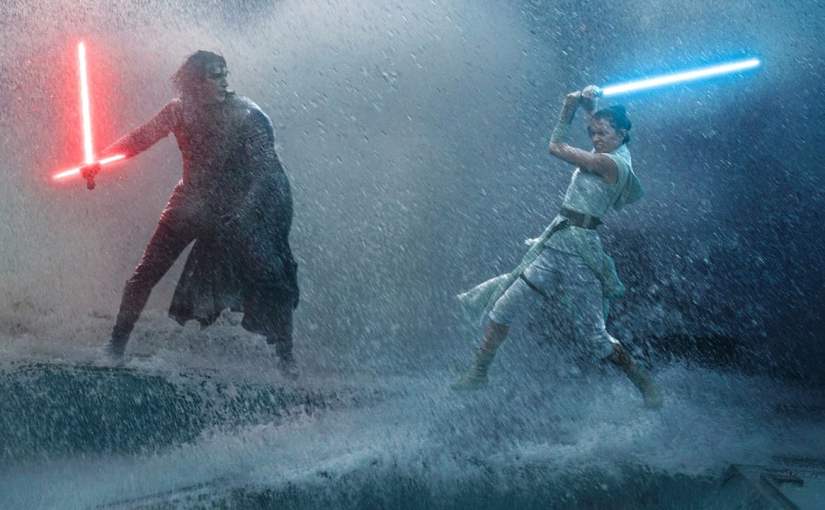
ROS is really a beautifully shot piece of cinematography. Abrams still loves the occasional lens flare but it’s never distracting. Outer space flights and battles have a clear exactness to them. The moments between Rey and Kylo Ren are well edited conversations and lightsaber duals that occur at two different parts of the galaxy as background settings seamlessly change at times. This is an element from the prior often sour Episode VIII known as Rian Johnson’s The Last Jedi that still works for these new characters.

Abrams and company really get everything right here by neglecting wasteful narratives from Johnson’s installment to allow reflections on the other films in the series with fan loved cameos of characters and ships from before.

Episode IX is bound to displease some fans who carry their own vision that challenge them to accept something satisfying. I dare not consider what those thousands of possibilities could be.

All that I know is that the newest chapter is never boring, often surprising and in the most capable hands possible with the Mouse House engineers.

Major applause for the Daisy Ridley giving her best performance to date followed by John Boyega & Oscar Isaac offering terrific buddy chemistry with fun, wry dialogue and major kudos to Anthony Daniels who is given much material that reminds the audience that the Skywalker saga is quickly approaching closure. Daniels has always offered a quite humane performance to a character that can show one expression but still carries dimensions of fear, wisdom and humor. An actor limited in expression who only provides a vastness of emotion.

The Rise of Skywalker delivers a lot of story and some new, albeit unnecessary characters (except for new merchandising to sell), but everything is a visual treat.

Abrams’ contributions offer opportunities of laughter and tears and messages of redemption and sacrifice for a greater good.

There’s much to this to consider and appreciate. I absolutely loved Star Wars: The Rise of Skywalker.