

AMERICAN FICTION

By Marc S. Sanders

Cord Jefferson directs his first film and it’s a winning combination of Tootsie with the prose of Alexander Payne.  

American Fiction follows author/literature professor Thelonius Ellison, otherwise known as Monk (Jeffrey Wright).  He’s encouraged by his university to take some time off as his patience with the mindset of students and colleagues has reached its tipping point.  Upon his return to visit his mother (Leslie Uggams) and sister Lisa (Tracee Ellis Ross), he realizes that mother is beginning to suffer from Alzheimer’s disease.  An unexpected tragedy also strikes, and now Monk has to figure a way to afford round the clock care for mother.

A side story also gnaws at Monk. His literary agent, Arthur (a hilarious John Ortiz) encourages him to write a book about “black life,” much like the current bestselling novelist Sintara Golden (Issa Rae).  Her book is celebrated, particularly by the middle/upper class white demographic, for its “authenticity” in urban black dialect and situations.  Monk is disgusted by this kind of reception.  He may be black, but he’s simply a novelist. Best to take his hard cover novels out of the African Studies section at the bookstore.

After a drunken binge of adopting Sintara’s approach, Monk writes a book, under a gang like pseudonym, as simply a gag to demonstrate how foolish consumers and the top publishers can truly be.  Arthur submits the manuscript to potential publishers and immediately fortune finds him.  A publisher is so moved by the book’s plight, she wants to gear it as a summertime bestseller and Hollywood wants to adapt the story.  It’s also a serious contender for a literary award, of which Monk is on the judging panel.  To Monk’s reluctance, he must don a persona of a fugitive criminal author, unwilling to disclose his identity or location.  White consumerism eats all of this up.  At best, all of this hoopla is covering the cost of his mother’s care. Otherwise, he despises being a part of this charade in front of his new girlfriend, Coraline (Erica Alexander) and his family which also includes his gay, undependable brother, Cliff (Sterling K Brown, another winning actor in this outstanding cast). 

American Fiction works on several levels, but the balance is between satire and relatable drama.  There’s a past that defines Monk’s character.  It defines what irritates him as a black man who is encouraged to digress from the sophisticated intelligence and formal education he possesses.  No one encourages him to live up to his disposition as simply a good writer.  Because he’s black, he can only be regarded as a black writer.   

Jeffrey Wright breaks free of his well-known character actor performances (James Bond films for example) to lead this stellar script adapted from a novel called Erasure by Percival Everett.  He wears multiple hats in this film, which include tender moments shared with Erica Alexander and Leslie Uggams, as well as more challenging debates with the sibling characters while addressing a common family problem of dealing with an elderly parent’s care.  His siblings sardonically address him as “Detective Dictionary” when engaged in a debate. As well, Wright’s comedy works as he’s the irascible author who is flabbergasted at how seriously his little prank takes him so far.  It disgusts him that this novel, this deliberate smack in the face to what readers embrace as black literature, generates a sensation. The further it’s regarded in hype, the deeper Monk has to hide as that urban gangster fugitive.

Thelonius “Monk” Ellison is one of the best characters to come out of 2023.  Ironically, the first film I saw this year was a dreadful comedy called You People with Eddie Murphy and Jonah Hill.  That film attempted to poke fun at what presumed were the stereotypes of blacks and Jews when in fact it had no discernible concept.  American Fiction explores how black life and culture is perceived by a white populace only to genuinely demonstrate an unfair delusion, and it works perfectly.  It’s a very smart script with intelligent and likable characters, and the dialogue is never pandering but absolutely forthright.  

American Fiction pokes fun at perceptions.  How Hollywood addresses black history and culture and a sad truth of what garners attention for fiction with black characters and storylines.  For black actors and authors, like any of their industry peers regardless of race/demographic, there’s more than just stories focusing on life in the ghetto or on a southern plantation.

Cord Jefferson’s screenplay reveals a midlife crisis for Monk that allows a provocation to consider what is genuine in black and white people.  At the same time, while Monk only wants to reveal a false delusion, he also has to live up to unwanted responsibilities as a son, a brother and a boyfriend.  Jeffrey Wright is worthy of an Oscar nomination for his role.  

Nearly every scene in Jefferson’s film can prompt you to hit pause and think about what was just said or demonstrated.  This movie is also very, very funny in its honest truth of what consumers absorb.  Yes! I do believe Hollywood would likely make a revenge slasher horror picture on a Louisiana cotton plantation, complete with Ryan Reynolds as a slave owner getting beheaded by an Afro blade.  

American Fiction is one of the ten best films of 2023. 
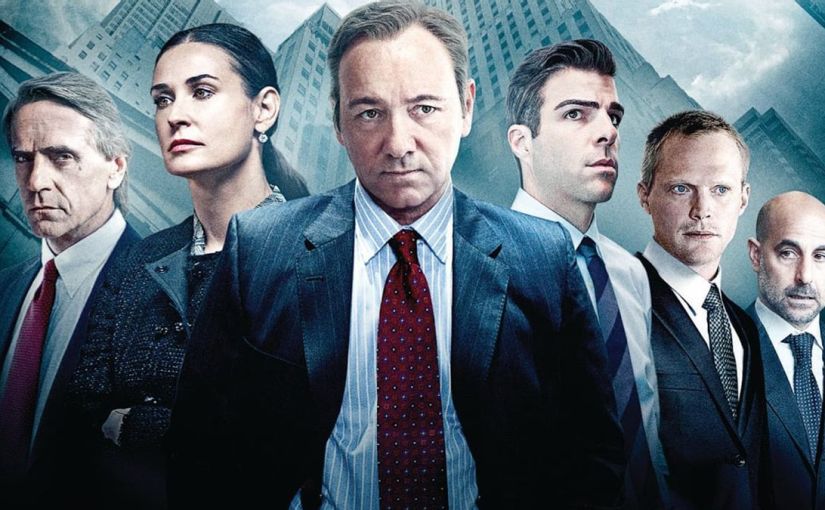
MARGIN CALL

By Marc S. Sanders

Could it have been possible that a rocket scientist and a bridge engineer uncovered one of the biggest market crashes in American history?  Writer/Director J.C. Chandor’s first film, Margin Call, will have you believe that.  It makes sense when you think about it.  Numbers and bar graphs and pie charts and zig zagging lines become so complex with themselves that you have to wonder how people wearing $1500 designer suits and selling products over the phone could decipher such nonsense.  So, it would take a rocket scientist to unravel such an exceedingly large ball of rubber bands in only one night.  Yet, how does a rocket scientist and a bridge engineer come to encounter this predicament.  Easy.  It’s all about money.  You might be the greatest scientist in the world, but if the pay isn’t right, is the science really worth it? 

Zachary Quinto plays Peter Sullivan, the rocket scientist from MIT.  Stanley Tucci plays Eric Dale, the bridge engineer.  They abandoned their college majors and specialties to go where the earnings are much more lucrative.  They both work in the risk management department for a large, unnamed New York investment bank.  On a Thursday afternoon, along with a whole slew of other people, Eric is fired.  His company cell phone is immediately shut off and he’s escorted quickly out of the building along with his personal belongings.  Before he leaves, he’s able to pass off a computer file for Peter to have a look at.  Eric was close to completing something deeply impactful, but didn’t get a chance to finish.  When Peter stays late after work to download the file, a stunned look eventually appears across his face, and he’s quickly calling back his workmates at 10 o’clock at night.  Those guys were getting hammered at the nightclub downtown, celebrating that they were not on the chopping block earlier in the day.

The cataclysmic results of Peter’s discovery is first passed on to his buddy Seth (Penn Badgely), then to the next level up which is Will Emerson, supervisor of trading (Paul Bettany).  Will then tosses it over to the higher risk supervisor, Sam Rogers (Kevin Spacey), who then passes it on to the Jared Cohen (Simon Baker), maybe the company’s second in command.  Jared assembles the men to meet with Sarah Robinson and Ramesh Shah (Demi Moore and Aasif Mandvi), who compute risk at even high level. 

Chandor is so genuine with his script and characters that as the earth-shattering news gets shared and then shared again and again, each higher up the food chain demands that it be explained to them in simple English.  By the time, Jared passes on this news to the head, HEAD Honcho, John Fuld (Jeremy Irons in a thankfully scene stealing performance), it is being requested of Peter to speak to John as if he were a golden retriever.  I guess in the corporate world, the sharper your clothes and hairstyle are, as well as the more formal your position title is called, the simpler the explanations need to become.  The ones who earn the big bucks don’t sit on the top floor to be belabored with charts and graphs that lack prestige and personality.

I want to point out a symbolic sequence here as well.  Each higher up seems to work on a higher floor than the other.  So, Seth and Peter accompany Will and Sam up an elevator to where Sarah, Ramesh and Jared are located.  After this meeting, Seth, Peter and Will go up on the rooftop of the building to smoke and commiserate.  Will even considers jumping.  They are then interrupted from an even higher level beyond the pinnacle of the building.  A helicopter arrives with John in tow.  God has descended at this inconvenient hour to tend to his prophets and their disciples.

Margin Call might sound like a complex assembly of numbers and math.  It really isn’t though, because Chandor approaches his film without ever really giving away how complex the issue is.  Instead, he demonstrates how deep it is.  Sam focuses on a computer screen and asks “Wait, is that number right?”  Peter’s nervousness is enhanced with his hands laced behind his head as he paces back and forth.  Will has been chewing on Nicorette gum up to this point.  Midway through the film, he’s back to smoking.  Seth understands that the mass firing he just survived hours earlier will inevitably catch up to him and all he can do is cry on the toilet.  Sarah comforts herself by asking Peter if the report he’s laid out is his work.  She wants to be excluded from being a cause of the crisis.  The best indicator of how serious and intense this has become is when an ice cool looking and handsome Simon Baker (even the blue tie he wears says icy cool) as Jared asks for the time.  It’s 2:15am.  He mutters to himself “Fuck me,” and then asks again for the time.  It’s 2:16. “Fuck me,” with a leap off the chair and a distant stare out the window.

The nature of the problem isn’t so important to grasp.  What’s necessary to take away from Margin Call, is that the gods of currency have irresponsibly and deliberately neglected the warning signs.  The returns have just been too damn good.  Now the boat has taken on too much water to stay afloat, though.  Chandor opts to focus on the response and behavior to the dilemma at hand.  There’s whispered blame to be exchanged.  There’s the need to stay silent.  When Jeremy Irons eventually comes into the fold, he holds a board meeting and calmly asks for someone to explain the situation.  Chandor points his camera on concerned close ups of middle age men not willing to speak up; messengers who truly believe they’ll be killed for delivering the dire news.  Even Jared can’t speak.

The sad outcome of the film is actually how the crash of 2008 with Collateralized Debt Obligations and Sub Prime Mortgage Defaults (see Adam McKay’s The Big Short) played out on the eve of its first day.  The investment bank in the film opts to sell off its worthless assets that enormously exceed the entire net worth of the billion-dollar company.  Chandor’s film reminds us that it’s legal to do so, and the buyers of this “odorous bag of excrement,” are John and Jane Q. Public.  At 9:30am, these brokers will put on the charm and sell at a price of $100/share knowing that by 2:00pm, it’ll be worth .65 cents/share, if they’re lucky.  Their customers paid for porterhouse, but went home with a cold burger in a doggy bag.  It’s the only way to survive. 

There are no heroes in Margin Call.  There are only profit makers.  Profits that are earned at the expense of everyone else on the planet.