FOR A FEW DOLLARS MORE

By Marc S. Sanders

The bloody landscape of the Wild West continued in Sergio Leone’s second chapter of his Dollars trilogy. For A Few Dollars More improves upon the first installment, A Fistful Of Dollars. The plot is cleaner and joining Clint Eastwood’s Man With No Name is a very cool fellow bounty hunter dressed in black. Lee Van Cleef plays Colonel Mortimer, a former soldier armed with an array of weapons.

Mortimer and the Man form an uneasy alliance in order to track down the vicious Indio and his gang. The prize $10,000 for just Indio; a whole lot more for the entire gang.

Leone reminds audiences of the techniques he used in the first film. Yet he makes the tension grander with cut away close ups at his gunslingers’ eyes before a quick draw. A great middle moment occurs with a bank robbery. Leone strategically uses sharp edits on Eastwood, Van Cleef, Indio’s gang, the exteriors of the bank and the precious vault inside. Accompanied with Ennio Morricone’s whistler ballads, Leone continues his back and forth close ups of all involved in the scene only he speeds up the edits to build more tension and suspense. Finally, the scene is blown wide open with a moment I never expected. Great fun.

Eastwood does not invent anything new here. His costume is even the same as before. That’s the legendary image and that’s fine by me. Van Cleef is especially good. A real scene stealer with his crackling voice that tells of a past where his Mortimer character protected his boundaries by being the sharpshooter that he is.

Watching this for the first time only tells me that action films today work too hard throwing everything at you. Films today often don’t give enough about the character or the heroes. You don’t see what makes them tick. You don’t see a raw talent to the character. In this film, it is quick draw gunslinging. Look for a great scene where The Man and Mortimer meet for the first time in a quick draw duel of wits at night in the center of town. When you see how good they are with a six shooter, you believe it all.

Today, a hero’s talent is inherited by something gone awry normally. Leone leaves the mystery open as to how guys like Mortimer and The Man With No Name acquired their abilities. Why waste time on character background? Let’s just see what these cowboys can do.

A FISTFUL OF DOLLARS

By Marc S. Sanders

Sergio Leone’s A Fistful Of Dollars is a pioneering classic. It set the standard for the spaghetti western. It made Clint Eastwood a household name and it set a trend for tension filled violence in cinema often imitated by directors like Robert Rodriguez (Desperado) and Quentin Tarantino (Kill Bill, Django Unchained), as well as even Clint Eastwood (Dirty Harry, High Plains Drifter, Unforgiven, Magnum Force) who regarded Leone as well as director Don Siegel as his inspirations and teachers in filmmaking.

The set up is simple. A desolate town plagued by two warring factions is met by the antihero, only known as The Man With No Name (Eastwood). The Man plays the best interests of the Mexican Rojas family against the Baxter family. In the midst of it all, he continues to collect bounties from both sides.

Leone seems to have invented trademark shots that have become routine staples in films like the protagonist appearing from behind a cloud of smoke, the zoom in camera during a quick draw duel, the surprise survival against the odds, and even the memorable one liner (“Get three coffins ready”…”My mistake. Four.”).

It’s exciting entertainment and it paved the way for a different kind of western. The good guy no longer rides a horse named Trigger while dressed in white. Here he welcomes the violence because he knows he’s the only who can eliminate the threat of bloodshed.

Eastwood’s character is a man of few words to keep the viewer curious. Where does he come from? Who is he? How long has he been traveling? It’s one of the all time great movie characters that leads threads hanging and inspired future favorites like Dirty Harry, Rambo, Wolverine, Neil McCauley (Michael Mann’s Heat played by Robert DeNiro), Batman and even Boba Fett, as well as some early Han Solo.

The first of the trailblazing Dollars trilogy still holds up despite the dubbed in English of most of the players. They might be hard to understand at times. Yet the craftsmanship of Sergio Leone makes sure all the elements are easy to follow with seamless control of the camera.

A great Western.

THUNDERBALL

By Marc S. Sanders

Director Terence Young returns to direct the most auspicious James Bond adventure yet, Thunderball from 1965.

SPECTRE’s Number 2 officer, Largo (Adolfo Celi) captures a British jet carrying two nuclear bombs, and demands England pay 100 million pounds or he will destroy a location in Europe and the United States. Bond is on the mission heading to Nassau, Bahamas to stop Largo (complete with evil voiceover and eyepatch), and recover the plane with the bombs.

The crystal blue sea of the islands allow for a huge undertaking of underwater footage complete with sharks and fight scenes with fists, knives and spear guns. It remains dazzling how well the footage is. Bond (Sean Connery, actually underwater) is there, easily disarming countless SPECTRE agents.

A great centerpiece scene occurs when Bond gets trapped in Largo’s swimming pool with a thug and three sharks to contend with. All this while Largo covers the surface of the pool with a steel sheet. The moment seems inescapable, and Young shoots a memorably suspenseful action piece.

Connery maintains that smooth, suave composure that audiences became accustomed to in his three prior outings, even if his hairpiece is noticeable and his girth is a little wider. On the beach, Bond takes out a bad guy with a spear to the chest and utters the line “I think he got the point.” It’s perfect delivery for 007.

The girl this time around is Domino (Claudine Auger). She is not the most memorable. A beautiful redhead who is not given much to do, even with Bond.

While the underwater camera work is marvelous, Thunderball is not ranked near the best in the series. It feels a little long even when the action scenes are occurring.

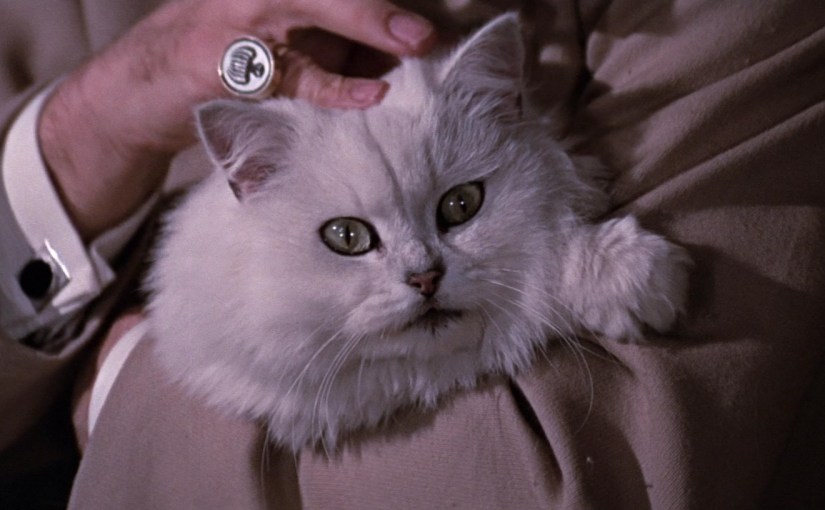
Still, Bond continues to hold up as does the curiosity of SPECTRE. Just who is the man with the white cat? We’ll just have to wait and see I guess.

FROM RUSSIA WITH LOVE

By Marc S. Sanders

Terence Young returns to direct the second installment in the James Bond franchise, From Russia With Love.

Sean Connery is back as 007 and he is assigned to escort the beautiful Russian Tatiana Romonava with the Lektor, a secret Soviet computer.

Tatiana (Daniela Bianchi, one of the most beautifully charming Bond girls) claims to be wanting to defect, but she is under duress from the terrorist organization SPECTRE to trap Bond (revenge for the demise of Dr. No) and cause a conflict between England and Russia.

Ian Fleming’s story is deeply rooted in the Cold War climate of the mid 1960s. It only makes sense that SPECTRE, with leadership from the mysterious Blofeld, would become a formidable opponent to Bond. Moments like the Cuban Missile Crisis and other events of the time were on everyone’s mind. I imagine it was easy to relate to in this film.

The story primarily takes place in one of Fleming’s most favorite known locales, Istanbul, Turkey. Young has great shots within enormous cathedrals and museums and even underground in 16th century tunnels, as well as outdoors on the ferry. It’s a fascinating, scenic tour.

Connery is at his best here. He looks great in his fitted suits, letting the suave and dry humor of Bond come naturally. 007 even disapproves of one ordering red wine with fish. Yet he’s also a great player, as his chemistry with gadgets like his quick assemble sniper rifle and trick briefcase (complete with explosives, gold coins, and dagger) really works well. A great fight scene aboard a train against Red Grant (Robert Shaw, in a great toughie role, nowhere recognizable compared to his later portrayal as the shark fisherman Quint in Jaws) is brutal and bare knuckled; well choreographed within the close quarters of a small train compartment.

Another killer comes in the form of Rosa Kleb (the miserly Lotte Lenya) with the shoe knife that’ll kill you in 12 seconds. She’s a lot of fun.

From Russia With Love is the most unusual of the Connery/Moore films. There’s no giant fortress for a villain, or global domination plot that is speechified to Bond over dinner.

The film is more like a Hitchcock interpretation as a pursuit is the driving force. People turn up dead just feet away from Bond and he doesn’t confront or acknowledge the villains himself. He knows they are there, but he doesn’t pick them out of the crowd. Young’s film relies on the suspense that Hitchcock introduced time and again as in North By Northwest, for example. A great scene pits Bond against an aggressive helicopter dropping grenades.

The gadgety playfully exists however, as does Bond’s chauvinism for great puns and tongue in cheek material.

The future of the franchise was looking even more promising here thanks to Connery and EON productions upping the stakes in action and more forthright innuendo.

Bond was going to be here to stay for quite a long time.

DR. NO

By Marc S. Sanders

Sean Connery introduced the iconic James Bond, Agent 007, with a license to kill the way he should be (sorry Woody Allen); handsome, highly intelligent and perceptive, quick with fighting techniques and even faster with a beautiful woman.

However, one hero who gets overlooked is director Terence Young who must receive credit for changing the movie landscape. In 1962, sets like Dr. No’s Crab Key fortress were not often conceived in movies. Dr. No is a mysterious villain with limitless resources who serves a Dom Perignon ‘55 while revealing his sinister intent to Mr. Bond. To make him even more unnerving he is bestowed with a handicap of black steel hands to intimidate the hero. This is a scary villain.

Terence Young deserves much credit for a lot of this imagery. It would change how we see action/ adventure films for the latter half of the 20th century and thereafter. Bond’s first cinematic mission set a standard in adventure formula. Set up the threat or mystery, assign the hero to the job, cross him with an ally or two, give him a damsel in distress, interfere him with one bad guy after another. Indiana Jones, Luke Skywalker, Riggs & Murtaugh, Batman and even The Goonies follow this path time and again.

Dr. No doesn’t look so sophisticated a film these days in its cinematography and effects (a car chase consists of going around the same curve 3 times), but it’s storytelling still holds up and even managed to get my 10 year old daughter interested. That’s proof of its staying power.

LUCE

By Marc S. Sanders

In early 2022, the local theatre that I volunteer at, Carrollwood Players in Tampa, Florida, will be presenting Luce by playwright Julius Onah.  I’d never heard of this dramatic play before, and I learned that Onah wrote a screenplay adaptation with J.C. Lee.  Onah directed the film. 

Watching the film ahead of seeing the stage production left me quite surprised.  It was not what I expected.  Luce is a story that begins as what I anticipated would be an examination of social or racial injustice and evolves into a suspenseful thriller that questions those arguments.  There are four main characters to ponder what they stand for.  Luce (Kelvin Harrison Jr) is an adopted black boy from a war-torn country and now the star athlete and likely valedictorian of his high school.  Amy and Peter (Naomi Watts and Tim Roth) are his white well to do parents, and Mrs. Harriett Wilson (Octavia Spencer) is Luce’s African American history and government teacher with a fifteen-year tenure at the prestigious high school.  Over the course of the film, each character will be fleshed out with background and dimension.  Each character may also change his or her position on the main conflicts at hand, and each one of them will exercise an action of misgiving or betrayal.  So, in what seems like a perfect world of brilliant academics and success, who can we trust?

Harriet is introduced as “stern” and later confirmed by Luce and Peter as a “bitch,” but spoken humorously within the private confines of their car ride home from an evening speech event that Luce conducted at school.  Amy shames them for the characterization.  The men in her family are wrong to describe a hard-working woman in such a way, even if it is a little sarcasm among just themselves.  A day or so later, and Amy meets with Harriet because she’s disturbed by an essay that Luce wrote glorifying the philosophy of Frantz Fanon, who believed that elimination by violence is a sound societal solution to his country’s problems.  The assignment was to select a historical figure and write the paper from that figure’s perspective.  Following her review of the essay which left her uneasy, Harriet takes it upon herself to search Luce’s locker where she uncovers a bag of illegal fireworks.  Amy is shocked by Harriet’s actions and at first can not fathom Luce as a boy who would ever have a violent nature or want to cause harm.  Debates in the kitchen occur when she gives the run down to Peter.  Questioning confrontations with Luce and his parents occur as well.  It just doesn’t make sense.  Luce is such a model student.  He’s also a brilliant debater, and that makes it hard to get to the truth.  Is there any truth to get to at all however? Is there any justification to question him when no crime or damage has occurred and by all accounts, Luce did in fact meet the standards of the assignment?  Luce asks a good question as well. As a student, were his civil rights violated by Harriet when she took it upon herself to search his locker, under no one’s authority or approval?

All of these questions are presented early on in the film.  Afterwards, developing twists take place and the story adopts a thriller mentality to it.  Luce seems so kind and enviable.  Kelvin Harrison Jr. presents the character with a beautiful smile, who is well versed, polite and presentable.  Luce even steps in to calm down a fight among his peers.  He delivers gracious speeches.  He’s a brilliant model of the debate club and he’s a star on the track team.  He takes it upon himself to approach Harriet with a mea culpa to whatever misunderstanding may have occurred, but there’s also a disturbing subtext.  He volunteers to her that his favorite holiday is Independence Day because he appreciates its meaning when he considers the violent country he was rescued from…along with the celebratory fireworks that traditionally accompany the day.  Wilson never asked for this information, and yet Luce is telling her anyway.  Is he being sincere, or is he using this as a means to torment Harriet?

Amy becomes torn by these events.  Does she really know her son, that she eventually nurtured out of the fear of his original environment?  Does it make sense for Amy to hide the paper and fireworks that Harriet gave to her with trust that she’ll address these allegations with her son and husband?  Did Peter really want to adopt this boy, when he and his wife could have easily had a child on their own, thereby avoiding the challenges of raising a child of a different race, from a war-torn country?

As a white, middle class, Jewish American male, I don’t think I’m any wiser on the plights that people of other races have endured following my experience with Onah’s film and screenplay. I thought I might have been early on in the film, but then the film seems to divert to the wise mechanics of how any one of us can be sinister, either for our own satisfaction or to prove a point, or to protect a loved one, or to mask our own foolish blindness.  Onah deliberately leaves threads of his story ambiguous, and I appreciate that.  I always like to think and ponder a film or a play or book, with its characters, long after it’s over and Luce is a perfect opportunity. 

There are surprising moments in Luce.  Just when you think you have one of these four characters figured out, something happens that forces you to take two steps back and start over.  I’ll credit Onah’s story for that, but also the impeccable casting here.  Octavia Spencer is such a great actor.  She’s awarded a character here with much background that is challenging and lends to why the other players in the story have a right to question her actions.  Watts is given more material to play with than Roth.  Typically, I’d argue that mothers bear the weight of affection towards a child more than a father and so more opportunities present themselves here for Watts to turn Amy into an unsure, but loving mother. It’s ironic, but as I watching this film, I couldn’t help but parallel some of the themes with the play/film Doubt by John Patrick Shanley, which also ends with much uncertainty.  Amy certainly becomes more of a character plagued with internal doubt as the story progresses here.  Tim Roth is maybe given the least amount of dimension here, but he embodies the wishy-washy nature of not really knowing what’s true and what isn’t.  Roth portrays the guy like he doesn’t know whose side he’s on anymore, and he just wants to cut through the bullshit.  Harrison needs to become a more established actor in today’s mediums of streaming and cinema.  He’s brilliant at playing one face while keeping me guessing whether he’s playing another face as well.  By far, this was the most important role to cast in this film, and the production got the right guy for the part.  Side note: after watching the film it was interesting to see what his character’s name could potentially stand for.  Don’t read anything ahead of the film.  Check out the trivia notes on IMDb afterwards. 

You may expect to have a discussion on what Luce was trying to say.  I don’t think it bears overthinking from a societal perspective, really.  If Julius Onah were to hear me say this, or read this publication, he might be disappointed to know that.  Rather, I think it’s better to piece together how all of the surprises came to be.  Regardless, Luce is terrific dramatic entertainment with superb and nuanced performances, and heightened suspense from its toe the line direction and the entire cast.

WEST SIDE STORY (1961)

By Marc S. Sanders

The musical answer to Romeo & Juliet will always remain as one of my favorites.

West Side Story crackles with energy as soon as the 6 minute overture begins and segues into overhead shots of New York City accompanied by its frequent whistle calls. Then it zooms in for something new, fresh, and eye popping; precise choreography from Jerome Robbins to represent street fighting by means of heart racing ballet. You simply can’t take your eyes off the screen.

Young love and pride carry Robbins’ film with partnered direction from Robert Wise. It’s sadly amazing that the prejudices that shape the story are arguably more evident and profound nearly 60 years later. Tony & Maria must never be together. Change the names today, and the logic behind the societal law will often mirror the reasoning found in the film.

Am I focusing too much on that message though? There’s so much to cherish in West Side Story. A film that boasts numbers like “America,” “I Feel Pretty,” “Tonight,” “Stay Cool Boy,” “When You’re A Jet,” “Maria,” and my favorite “Officer Krupke.” It does not get much better than this.

The dancing lunges at the camera. The dialogue may be dated, yeah, but the cast is so genuine to the setting (even if Natalie Wood is lip syncing her songs).

Steven Spielberg has remade the film, to be released in December, 2021. I’ll go see it, sure. Yet I don’t believe it’ll compare to the original 1961 winner for Best Picture as well as the other 9 Oscars it was recognized for.

Go back and catch up with West Side Story. It should be seen by anyone who ever wanted to watch a great film.

SLEEPING BEAUTY

By Marc S. Sanders

When the Walt Disney Studios released Sleeping Beauty in 1959 it was not received as well as other classics like Snow White And The Seven Dwarfs or Cinderella. Financially it didn’t prove to be as close to a success to Disney’s prior films. I dunno. Maybe moviegoers were tiring of the semi fluid animation where the drawn characters freely move but the backdrops remain in place. The gimmick of animation might have been getting old and stale.

My opinion though is that Sleeping Beauty carries a perfect blend of charm, humor, beautiful colors (whether it’s pink or blue) and most certainly suspense.

Princess Aurora is born, but during her introductory ceremony the evil fairy Maleficent curses her to die on her sixteenth birthday when she pricks her finger on a spinning wheel. The delightful fairies, Flora, Fauna and Merryweather (the original Golden Girls) agree to hide her in the forest, thus avoiding Aurora’s impending doom. This trio is are terrific with their squabbling and intentions to avoid magic use. No magic will ever bode well in dress making or baking.

This is one of the best examples of Walt Disney’s knack for beautiful storytelling in imagination and fantasy. It’s a perfectly innocent film, rated G, but it consists of terrific personality from all of the main characters, even Aurora’s true love to be, Prince Phillip with his trusty steed, Samson, who will carelessly toss Phillip off his back and into a pond.

Moreover, Maleficent is one of the greatest tools of suspense in all of film. A hauntingly well executed scene puts Aurora in a trance forced to follow a floating neon green light. Maleficent’s spell has possessed her and forced her to meet her destiny. Yet as the scene is playing out and Aurora slowly climbs the castle’s stone staircases, you hope to god she doesn’t prick her finger. The scene plays out slowly building on fear and anxiety. A great bedtime story moment.

Another highlight is one the greatest achievements in the studio’s history involving Maleficent transforming into a hideous black dragon breathing bolts of green/yellow fire and smoldering the bridge beneath Phillip as he tries to defeat the beast. Phillip loses his footing, ready to fall into a bottomless void, the three good fairies shake their heads in terror and the music builds. It’s a great scene of bold adventure.

Aurora is adoring as she harmonizes about meeting a handsome prince “once upon a dream.” A beautiful sequence set in the forest where the lovable creatures allow our heroine to play within her fantasies.

Sleeping Beauty has everything. Adventure, romance, music, suspense, and one of the best cast of characters, most especially well delivered from the evil Maleficent. It’s an absolutely perfect accomplishment in storytelling and filmmaking. A film that continues to sustain the Mouse House’s awe inspiring legacy.

Every family and young child especially should watch Sleeping Beauty.

NORTH BY NORTHWEST

By Marc S. Sanders

A story of mistaken identity becomes one of the grandest adventures on film with Alfred Hitchcock’s North By Northwest. The movie plays at such a fast pace, moving from one locale to the next and it all feels convincingly possible.

Before James Bond, there was the dashing Cary Grant in his sharp, fitted light grey suit (the best suit to ever be shown on film) portraying advertising executive Roger Thornhill who simply raises his hand in the air while meeting some colleagues at The Plaza Hotel in New York and is suddenly mistaken for a man named George Kaplan. Soon he’s forced into a car by two men and driven to an estate property belonging to someone named Townsend (James Mason) who implores “Mr. Kaplan” to cooperate or else. Suddenly, Thornhill who continues to insist he’s not Kaplan is on a cross country journey while escaping the authorities who want him for murder while he tries to prove his true identity and exonerate himself.

Cary Grant is dashingly fun with Hitchcock’s camera. It’s refreshing for a change to watch an innocent protagonist not lay on the heavy drama and panic so much. Hitchcock with Grant were going for a sweeping story of cat and mouse play.

What Alfred Hitchcock does best is put the viewer right in position of Thornhill. For the most part (definitely through the first forty minutes) the viewer only knows what Thornhill knows. We know he’s been mistaken for someone else and we are only given the opportunity to put a few names with faces and get a hold of a crumpled photograph. That’s all we and Thornhill have to go on.

Later on, it’s only fortunate that Thornhill comes upon one of Hitchcock’s celebrated blond actresses he was always reputed to cast. This time it is the incredibly striking Eva Marie Saint as Eve Kendall who becomes a willingly helpful train companion for Thornhill. Cary Grant and Eva Marie Saint make for a spectacular on screen couple. Their chemistry is so natural together.

Not much else should be said about the story of North By Northwest. The entertainment comes from what each new scene reveals. Hitchcock incorporates all the expected twists and makes sure to use a MacGuffin, of course. This time it involves a statue and microfilm. What’s on it? That does not so much matter really. It’s the need to pursue it that’s important. The pursuit is what drives the picture from New York City to the United Nations, all the way to a curious auction house for fine art and then on to the four famous faces of Mount Rushmore in South Dakota.

Naturally, Hitchcock is the master once again as he points his camera up close on Grant, Mason and Saint and then quickly will cut to one of their points of view to lengthen the suspense. Running after or away from something in the moment is where Hitchcock is very strong as a storyteller. It keeps you alert as a viewer. Very alert!!!

James Mason makes for a terrific villain as Townsend, or could he be someone else? He’s got that sneaky inflection in his voice and short build that makes for a great antagonist against Cary Grant’s tall stature. Mason’s sidekick, Leonard (a mysterious looking Martin Landau) is also a spooky guy to keep your distance from.

The most celebrated scene probably also contains one of the best captions caught in film. I speak of the very surprising crop duster chase. As Roger Thornhill finds himself in a quiet, Midwestern dirt road intersection, an airplane crop duster turns into a frightening menace. The best shot occurs as Grant runs quickly towards Hitchcock’s camera and the plane flies overhead rapidly getting closer in the upper left side of the screen. As Grant runs and runs, he fills more of the screen, but so does the crop duster. The editing alone is spectacular, as an oil rig eventually comes into play with Grant about to get run over. Story wise, I adore this scene as somehow the life of a man who routinely gets in taxicabs and hob nobs through New York City on a daily basis suddenly has found himself in a dusty field running for his life. What was never expected is suddenly all that matters to this ordinary man.

Hitchcock plays with what’s around to play with. Other than a quick gag in Superman II, l don’t recall many films incorporating Mount Rushmore as such an important element to its picture. Every crevice or ledge or finger hold is important to the edits of the climax in North By Northwest. When Eva Marie Saint is holding on for life, I truly believed she could actually fall. [SPOILER ALERT] Actually, Hitchcock wanted you to believe that as the very last scene doesn’t even truly reveal the solution to her predicament. I like his method of editing this way. Hitchcock seemingly offers no option for survival as Grant and Saint’s hands barely hold on to one another. The editing is just so damn good here.

I’d be remiss if I also didn’t recognize one of the greatest orchestral scores in film. Bernard Hermann’s stirring, fast paced rhythms keep the running man theme in play. The movie seems to play by the beats of Hermann’s conduction. Action films of the future seemed to adopt some measures from he did with this film.

North By Northwest will always remain as one Alfred Hitchcock’s best films. There is not one error in the picture. Every shot is done with deliberate intent to sustain the mystery of suspense. Humor is included even at times on a risqué and subtle measure. Alfred Hitchcock again invites the simplicity of storytelling to introduce the complexity of fear and mystery and outstanding suspense. Not many films compare to North By Northwest.

12 ANGRY MEN

By Marc S. Sanders

This film lives up to its reputation.

This was the great Sidney Lumet’s first theatrical film, and for a project limited mostly to only a claustrophobic and hot room, it boasts a lot of talent; Henry Fonda, Martin Balsam, Lee J Cobb, Jack Klugman, Jack Warden, EG Marshall.

For a black and white picture Lumet and his crew are effective at showing tiny details like sweat on brows and shirt stains, a broken ceiling fan, and the mental exhaustion of limited breathing space as twelve citizens debate over the guilt or innocence of a young man on trial for killing his father by stabbing. Lumet’s camera (just like when I watched The Verdict) is constantly traveling, even if it’s in a tiny confined space. He zooms in when he needs to and he changes angles to get the most of 12 different perspectives. Lumet keeps it interesting by changing up his use of lens. As the afternoon proceeds into early evening, the camera navigates more closely to the table they sit at. The men are uncomfortable, frustrated with each other, more impatient and more concerned with their consciences about sending a man to death. The actors do well with translating these factors, but Lumet sends the message home.

What I found most interesting is the different variations of how each juror eventually comes to changing his mind. Almost all of them arrive at that point in a new or different way. Credit goes to screenwriter Reginald Rose for that. Additional credit for the different variations of how the jurors repeatedly cast a vote; raising hands, notes, anonymously, not anonymously and so on. Rose changes it up each time to keep the viewers’ attention.

Rose’s script will only tell you so much. The attorneys don’t appear in the film, deliberations are done, we only get a close up of the defendant but there’s not enough material for a viewer to cast judgment. The film opens with the judge giving a boring routine instruction as to how the jury should proceed. He might as well be telling them how to complete an SAT exam.

Yet what we are treated to are the faults and overcomings of the human spirit. Ed Begley is a juror who gives a brilliant monologue that stereotypes the defendant’s ethnic background, though we never know what race or ethnicity he is. As he continues to rant, every other juror steps away from the table. Begley seems to get more ashamed of his thought process as he carries on, but he doesn’t stop until he’s ordered to by another juror. Amazing!!! In 1957, when Jim Crow and McCarthyism were on the horizon or rampant, this film was not having it. It’s the best scene in the film.

Henry Fonda is great as the one who only asks for sensibility. He adds weight to the case they are deliberating over that the others are sadly failing to recognize. A man’s life is in their hands.

I’d argue that the facts of the case and evidence presented carry very little complexity to what a real murder trial might offer. I’d also argue that what serves as a fulcrum to sway each vote is maybe a little too convenient (presuming the time it takes for one witness to walk or whether a witness wore glasses), but that doesn’t matter. What’s most important is whether each of these men can live up to the demand of recognizing reasonable doubt; the necessary requirement for a trial by jury. In that sense, 12 Angry Men succeeds.