MIDNIGHT RUN

By Marc S. Sanders

Martin Brest’s Midnight Run is a perfect blend of comedy, action and sweet tenderness. Different facets of what two guys could potentially experience together, especially if they are on an unexpected cross country road trip, pop up unexpectedly. It’s a well-acted film with great exchanges in dialogue that surge with broad comedy and high-octane car chases and shootouts. Yet, there’s even some special quiet moments to appreciate as well. It’s another favorite film of mine.

Robert DeNiro is Jack Walsh, a disgraced former Chicago cop now turned bounty hunter who spends his days wrangling up criminals who skip out on their bail. When Eddie the bondsman (a great Joe Pantoliano) asks Jack to bring back Jonathan “The Duke” Mardukas (Charles Grodin) who skipped out on a $450,000 bond, something as simple as a “midnight run” turns into an excruciating journey from New York to California. The Duke doesn’t make it easy for Jack. He never shuts up and right from the start it doesn’t help that he’s afraid to fly. Well, there’s always the train, right? Plus there’s plenty of time because Jack has five days to get The Duke back into custody.

Not so fast. The mob, led by a silky smooth and threatening Dennis Farina, wants The Duke dead as revenge for embezzling millions of dollars from them, plus avoiding the risk of him testifying against them. The Duke unknowingly served as their accountant. The Feds, led by a just as awesome Yaphet Kotto, want The Duke as their material witness against the mob. On top of all that, Jack has to compete with Marvin (John Ashton), another bounty hunter who wants to bring in the The Duke.

There’s great action in Midnight Run and you can’t get enough of it, but it’s the comedic layers of complications the cast of characters bring on to themselves that serve the film best. Danny Elfman’s music accompaniment primarily on horns with guitar and piano bring out the fun in the best way possible. Great chases with a helicopter and various stolen vehicles while Jack and The Duke outrun endless squad cars are magnificent. Martin Brest (Beverly Hills Cop) is just an entertaining director.

Still, the action is not even the highlight for me. First, the chemistry among all the actors is fantastic. They have such brilliant exchanges of cursing each other out, getting on each other’s nerves, and especially listening to one another as well. It doesn’t matter if it’s a screaming match phone call between DeNiro and Pantoliano, or a one on one with Kotto getting frustrated DeNiro. It all works.

Most especially is the pairing of DeNiro and Grodin. They hate each other and then seconds later they’re laughing with each other. Grodin as The Duke, as pesky as he is, plays an unwelcome therapist at times to DeNiro’s Jack as the history of his failed marriage resurfaces and his fall from grace with the Chicago police department comes back to bother him. Jack doesn’t give in so easy to The Duke’s desire to share his feelings. He’d rather endlessly smoke, eat unhealthy food and tell The Duke to “shut the fuck up!” Nevertheless, a bond between the two forms and continues to reshape itself during the course of the film. A great moment occurs when they need to scam a barkeep out of some twenty-dollar bills. You’ll never forget “the litmus configuration” after you see Midnight Run.

I also want to call attention to one of my favorite of so many DeNiro moments in his long career. Midway through the film, Jack reunites with his ex wife and teen daughter that he hasn’t seen in nine years. Like many divorced couples, an argument breaks out among the parents only to be quickly silenced by the quiet intrusion of Jack’s daughter Denise (Danielle DuClos). As Jack waits for his wife to bring him money to help, Brest allows DeNiro to do some of his best acting with this young actress. They can hardly speak to one another. DuClos simply stares in disbelief that her estranged father came home. DeNiro can’t, in good conscience, make eye contact, knowing he’s been the absent parent. It’s too difficult. It is such a humane moment that it grabs me every time. It reminds me that dialogue is not always necessary for a great acting piece. Martin Brest really trusts his actors in this moment. It’s likely my favorite scene of the film and of DeNiro’s career. You can take this scene out of the context of the entire film and still be just as moved by it.

The best action films succeed when the filmmakers care about the characters. When the characters are given depth, then we worry about them. We hope they don’t get killed or taken or arrested, and simply make it home. Midnight Run is that kind of action piece. Had we not cared for Jack and The Duke, movie lovers never would have cared for Martin Brest’s film, now going on 34 years later. It’s a perfect film.


THE ITALIAN JOB (2003)

By Marc S. Sanders

F Gary Gray’s 2003 remake of The Italian Job is crackling with cool and sleek film coverage. It is a blend of wit and fast paced action delivering a solid heist thriller. The cast is terrific as well.

Donald Sutherland plays John Bridger, a near retired master thief and safe cracker. He is ready for one last job with his protégé, Charlie, played by Mark Wahlberg. They assemble a team specializing in different skills like Left Ear, played by Mos Def, who overlooks explosives, Lyle or “Napster”, Seth Green, as a computer hacker, and “Handsome Rob,” Jason Statham, the getaway driver. With another member named Steve (yeah, he’s just called…ahem…Steve) played by Edward Norton, they successfully rip off a safe containing $35 million in gold bars from a home located off the straits of Venice, Italy. However, Steve betrays the team leaving them for dead.

Jump to a year later and the team ventures out to Los Angeles with Stella (Charlize Theron), another safe cracker and daughter to John. They have an opportunity to even the score with Steve while also collecting what’s left of the gold bars. Early on, an idea is conceived to use light weight, speedy MINI Coopers to get in and haul away the booty. However, soon they learn that it’s not so easy to just take it from Steve’s house. They will have to apprehend the gold while in transit.

There’s nothing overly special about The Italian Job. I don’t think Gray was looking to achieve an iconic classic. He just made a solid caper flick that’s pure fun. Sure, the thieves would likely get busted. No, the timing of everything from sabotaging the downtown traffic lights and exploding a precise hole in the street for an armored car to fall through would never occur so perfectly. Who cares? This film is a pitch perfect dance in car chase choreography where we get a kick out of watching sporty little red, white and blue MINIs careen through a subway system, down public staircases and through cylindrical tunnels. It’s all done to get your heart racing.

The players are fun but they aren’t putting in much dimension. I doubt they did much research on the specialized skills their respective characters possess. Maybe Theron researched how to crack a safe. She amps up some nail biting in those sequences as Gray edits between high speed motorcycles approaching while she’s quietly trying to concentrate on the lock’s combination.

There are some cute inside jokes. The best being that Lyle insists he is the inventor of Napster (a little dated by now), and the idea was stolen from him by Sean Parker. The real Sean Parker makes a quick cameo as that scene is told in flashback. Seth Green is quite funny in a nerdy kind of way.

I like the cast. Norton plays a good jerk for villain; a real “Frank Burns.” I appreciate the story behind his character. Early on before he betrays the team, each member shares what they are going to spend their money on. Later, it’s revealed that Steve just used what he ripped off to buy everything the other guys had in mind. He’s a killer and he’s a jerk, but he’s also a guy with no imagination or creativity. I like that angle for a bad guy. He’s only just so much of a genius.

The Italian Job is a fun film that is never too intense, and offers great surprises in the step-by-step process of how to pull off a cinematic heist. If anything, it’ll make you wanna buy a MINI Cooper. I came…THIS CLOSE one time!

MY WEEK WITH MARILYN

By Marc S. Sanders

Simon Curtis directs a glimpse into the life of Marilyn Monroe with an exquisitely cast Michelle Williams in the title role of My Week With Marilyn.

The film is told through the perspective of 23 year old Colin Clarke played under dream like naivety from Eddie Redmayne. Clarke embarks on joining the production crew of Sir Laurence Olivier’s (pompously over played by Kenneth Branagh) newest film that he is directing and starring in, opposite Monroe. When Marilyn’s new husband, playwright Arthur Miller, returns to the states, Colin is drawn into Marilyn’s seduction; protecting her from an intimidating Olivier and tolerating her drug and alcohol use.

This film features an outstanding cast of who’s who from Dame Judi Dench to Emma Watson to Dougray Scott, Julia Ormand (playing a past her prime Vivienne Leigh), Toby Jones and Dominic Cooper. An amazing cast and amazing performances all around.

Still, I just wasn’t wild about the film. With her life startlingly cut short, Marilyn Monroe is arguably one of the biggest enigmas to come out of Hollywood, and yet this tiny glimpse into her life just wasn’t interesting enough for me.

Fully aware of her impending doom to come, the sad foreshadowing of pills on her dresser, and her unfamiliar stupors didn’t drive anything for the character. It all becomes repetitious with nothing new to say. Colin’s virginal experience with this celebrity tryst never drives anywhere but back into Marilyn’s bed after he’s requested to appear at any given hour. This occurs again and again. The film just doesn’t progress past these moments. I found myself saying “I’ve seen this already!”

Did Marilyn learn anything from this fleeting moment in her lifetime? Did Colin? Maybe Colin got to witness the dichotomy of the privately ill Marilyn versus her ability to turn on the public charm with curvaceous ease and a wide lipstick smile. Yet, I have to wonder what came of it for Colin, thereafter.

Redmayne is quite good in his naive innocence. He inhabits nearly every scene since the story is told from Colin’s experience. Storywise though, what was the point of all this really?

Williams as Marilyn is astonishing. As good at playing a Hollywood legend as when Cate Blanchett deservedly won her Oscar for playing Katherine Hepburn in The Aviator. My one wish is that Williams accepted the role with a much more dimensional and nuanced script.

Perhaps because of the mystery that always seemed to surround Marilyn, Williams will never get the chance at playing the bombshell in something better. Marilyn’s life was so dubious and questionable. What filmmakers would be brave enough to truly make claim of how the starlet lived and how she died?

I can wish for another Marilyn portrayal to come one day, with Michelle Williams in the role, but alas I won’t hold my breath.

THE LAST EMPOROR

By Marc S. Sanders

Finally, I invested myself in watching Bernardo Bertolucci’s Oscar winning Best Picture The Last Emperor. Honestly, as breathtaking as the undertaking to make this sweeping epic is, it was the first and likely last time I will ever watch the film.

This three hour plus biographical picture focuses on a young child named Puyi, plucked from nowhere to become the next Emperor of China. He is destined to reside in Peking, The Forbidden City amid rich tapestries and deep Chinese culture at the start of the twentieth century. Oddly enough, the would be Emperor is a prisoner of his own surroundings for nearly his entire life. He is forbidden to go beyond the walls of Peking. Later in his adult life, he is a political prisoner and war criminal in the now regarded People’s Republic of China. Puyi was never granted an opportunity to think for himself or act upon his devices. He is forced to become an adaptable symbol to ongoing representations of the country that harbors him.

I watched this film with my wife. The next day we discussed it with my colleague Miguel who regards the picture as one of the best films he’s ever seen. I can not dismiss his viewpoint, but personally the depth of Betolucci’s efforts for maximum authenticity pushed my interest away from the film.

I embrace character arcs in films. It’s what keeps each passing moment of a movie refreshingly interesting. I do not deny the change in the Emperor’s story arc. Puyi changes as his country changes on both a political or militaristic platform. Yet, the film has vague segues in its changes as well.

Characters appear and disappear. Moments in history occur with no build up or explanation. It was challenging to follow who is who, and what has just happened.

Early on, we see how Puyi as a child interacts with his younger brother, Pujie. Much later in the film, Pujie reappears when they are adults. I am not going to pretend I’m a sophisticated enough moviegoer to realize this is the brother we saw as child over an hour earlier in the film. It took some time to realize who this guy was.

I’m also not going to pretend I know enough about Chinese history and culture to comprehend the traditional customs and ceremonies that occur, or China’s relationship that developed with Japan, or China’s significance during World War II.

That’s my problem with the film. Was I supposed to take a college course on Chinese history before watching The Last Emperor? The film is expository for sure, but it presumes the viewer will recollect at what point in history this moment or that moment occurs.

The film flashes forward and back to when Puyi was a prisoner of war in 1952. In prison, he eventually becomes reformed, but it became frustratingly complicated to understand exactly why he was even sentenced.

Following the film, I referenced Wikipedia to grasp the sequence of events. The historical change of this one man certainly merits a film to be made, much like Malcolm X or Born On The Fourth Of July. However, those films had a more comprehensive narration for me and the ongoing changes that the central figures experience are more well defined as the years pass and the people around them change.

The Last Emperor felt unclear to me in its storytelling while still immersing me in a land I’d imagine is unfamiliar to most viewers. For centuries “The Forbidden City” was not open for a public to encounter. If that’s the case, I believe Bertolucci needed to define what he captured much more clearly. Who’s to know what we are looking at, or what significance this setting has if most of the world population has yet to see what is here?

The Last Emperor requires a high threshold of patience and focus to grasp what it presents. It should be seen for the locales that are filmed, which were completely unseen by me personally. You’ll also get some tidbits of Chinese history, for sure.

All I can recommend is not to be so hard on yourself, when you find yourself lost at times in the film.

FLASH GORDON

By Marc S. Sanders

How can anyone not like Mike Hodges’ camp celebration of a savior hero vs a destructive villain?

Flash Gordon was penned by Lorenzo Semple Jr, writer on the 1960s Batman TV show. His first draft is the one and only draft which producer Dino DeLaurentis approved for shooting. A glossy, flashy and fetishistic approach was adopted for the film, and it became timelessly memorable.

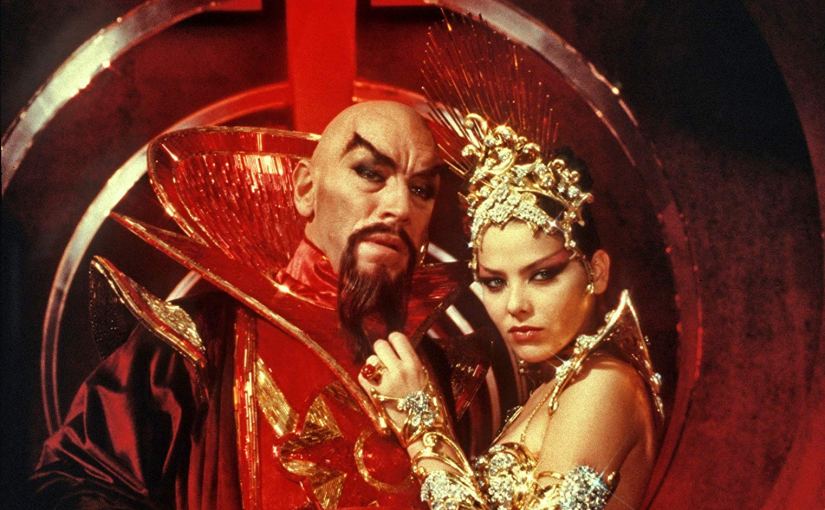
What thrills me about the film is its appreciation for the original, pioneering comic strips on which the film is based. Max Von Sydow’s Ming The Merciless is pulled right from the newspapers in his gloss pinks, reds, golds and blacks costume wear. The inflection of his voice is otherworldly from the start (“Klytus, I’m booooored. What do you have for me to play with today?”)

Sam Jones is a level down in the relatable hero of Christopher Reeve, but he’s enjoying every minute of his hero character schtick. He’s perfect for Semple’s playful writing and he looks like a champion.

Timothy Dalton and Brian Blessed are great side characters on opposite ends; one distinguished, the other gluttonous and proud.

The best flavor of the film is its soundtrack. Thank you Queen!!! Their musical touch is an early inspiration to some modern Marvel films like Guardians of the Galaxy, and Thor: Ragnarök, clearly showing direct influence from Flash Gordon. Freddy Mercury, Brian May and company relish in heavy pounding drums and special effect sounding guitars to deliver a cheerleading rock anthem. “Flash…aaaah!!! He’s a miracle!”

Dino DeLaurentis saw opportunity following the success of science fiction with Star Wars. He produced Flash Gordon with his own style, not as a copycat. The film became a fantasy with characters bleeding rainbow colors, pet midgets, cat fighting concubines, great hall football fighting with aluminum watermelons, weird lizard creatures, hawkmen, half egg-shaped planets, and even a thrilling fight to the death on a tilting platform with protruding spikes, the best scene amid all the camp craziness.

It’s all great. Flash Gordon is the savior of the universe. “He’s a miracle!!!!”

DEATH ON THE NILE (2022)

By Marc S. Sanders

It’s time for the murder mystery to maintain an ongoing trend in modern films.  They’re just fun to watch and play with and deduce.  Why do you think the board game Clue has lasted so long in so many households?  Films like Rian Johnson’s Knives Out and a recent retelling of Murder On The Orient Express have already whetted our appetites for the “who done it?” tales.  Endless variations of Sherlock Holmes continue to appear.  Even Steve Martin and Martin Short have gotten in on the mystery circuit.  Adam Sandler with Jennifer Aniston, too.  Kenneth Branagh’s second time as Hercule Poirot (following …Orient Express), in an adaptation of Agatha Christie’s Death On The Nile, is proof positive that the sleuth is the next super hero that movie goers should follow.

Branagh returns to direct his detective character in Egypt, aboard a privately rented boat occupied by the newly engaged couple, Lynette Ridgeway and Simon Doyle (Gal Gadot and Armie Hammer).  As the luxurious yacht makes its way down the majestic river Nile, the couple suspects that someone, particularly Simon’s recent ex-fiancée, Jacqueline (Emma Mackey), is determined to cause harm or even murder towards them.  They ask for the sleuth’s services in uncovering who is scheming against them.  Poirot is on vacation, however, and tells them his services cannot be made available as no crime has been committed.  Yet, he accepts their invitation to board the boat and attempt to relax and recline. 

Naturally, a murder will eventually occur.

Hercule Poirot was not even a character in Agatha Christie’s original novel.  Yet, Branagh seamlessly weaves the detective into an elegant page turner on screen, with a script from Michael Green.  Branagh is a skillful actor/director. 

As this is a murder mystery, there are a wealth of characters with possible motives and red herrings to keep the journey down the Nile tense and engaging.  There’s the doctor (Russell Brand), an aunt (Annette Benning), a nephew (Tom Bateman, returning from Orient Express), Lynette’s housemaid (Jennifer Saunders), a speakeasy blues singer and her niece (Sophie Okonedo, Letitia Wright), as well as Lynette, Simon and Jacqueline, and on and on.  Branagh wisely moves his camera repeatedly at times across the boat panning over the faces of the cast, as if to the remind the viewer of who are the suspects.  There’s a wealth of information to take in, but this is not going to feel like you are cramming for a final exam the next morning. 

Because everyone could have a motive and/or a background with the murder victim, each actor within the colorful cast has various moments to shine.  There are some great acting scenes going on here that the players share with Branagh, and they don’t come off with similar formulas from one moment to the next.  Each character actor is thankfully unique in both appearance and personality.  It’s not hard to keep up, and while I may have known the ending before seeing the film (having read the book and seen stage adaptations over the years), I don’t believe it’s easy to deduce and solve as a viewer.  Different characters and moments that never occurred in the source material turn up.  There might even be few unexpected deaths along the way.  Branagh also keeps the picture alive with outstanding blues numbers that begin in an underground speakeasy bar in Paris and then play over transitional moments throughout the film.  This picture has a great period soundtrack.

Beyond the well diversified mystery, Branagh treats the viewers to gorgeous scenery aboard the boat, but even beneath the surface of the river and within the pyramids and sphinxes of Egypt.  There are spectacular starry night skies and breathtaking sunrises and sunsets to take in with palm trees and wildlife in the desert frames.  Sure, I imagine most of it is CGI, but it’s well done and nothing looks artificial.  Costume work is also magnificent as they lend to the distinctiveness of the suspects.  Whether it is evening wear, or casual garb for post-World War I, each character looks so intriguingly lively and different.

Michael Green’s script even delves further into the Poirot character.  There’s a background to that infamous mustache and tiny goatee.  I recall how people responded to the outrageously grotesque facial hair that Branagh donned in his first film as Poirot.  I appreciated it, however.  His appearance was as unforgettable as the red and yellow “S” on Superman’s chest.  Yet, why go to such great lengths, even if this is the early 1900’s amid an exaggeratingly glamourous murder mystery, to grow a mustache like that? Thankfully, there’s reason given here that draws out a dimension to Hercule Poirot both within a ten-minute prologue, and then implied periodically during the course of the film and wrapping up in a bluesy epilogue before the credits roll.  All I’ll say is that absurd mustache delivers a humanity to the film’s protagonist.

Death On The Nile has already suffered from negative publicity involving controversy with some of its cast members.  Its release was also postponed a number of times due to the pandemic.  Finally, it has arrived in theatres and what a refreshing experience it is to see on a big screen.  It opened to a modest box office response in its first weekend, though it finished at number one.  Normally, I don’t care about rankings at the box office.  How much money a film makes does not lend to the merits or faults of a piece.  However, for this film, I think I do care a little.  I hope it becomes a profitable success only to allow more films of the mystery genre to appear on screen in the future.  I’d certainly welcome another gripping yarn from Agatha, out of service from Kenneth Branagh.  Could And Then There Were None… be next?  That’s the real mystery.

MURIEL’S WEDDING (1994, Australia)

by Miguel E. Rodriguez

Director: P.J. Hogan
Cast: Toni Collette, Bill Hunter, Rachel Griffiths
My Rating: 9/10
Rotten Tomatometer: 79% Certified Fresh

PLOT: A young social outcast in Australia steals money from her parents to finance a vacation where she hopes to find happiness, and perhaps love.


For years and years, I had always assumed Muriel’s Wedding was your stereotypical romantic comedy.  I mean, come on, it’s got Wedding right there in the title.  The story involves a quirky young woman, obsessed with weddings, who runs away from home to find a new life for herself.  Who knows…maybe she’ll get married herself?

But what am I saying, of COURSE she gets married…once again, it’s in the title.  So, based on that bit of logic, I never made any serious effort to watch this movie.  The rom-com has never been my absolute favorite genre.  For me to enjoy one, it has to really stand out in some way.  Either it must be REALLY different (Stranger Than Fiction), or it must be a shining example of the genre (The Philadelphia Story), or it must be so well written that it sneaks past my defenses (Jersey Girl – I know, I don’t get it either, I just responded to it, leave me alone).  I never imagined Muriel’s Wedding would meet any of those criteria.  On the surface, it didn’t look like much.

Welp…I was wrong.  Be warned because some story spoilers may follow, though I will do my best to be obtuse where necessary.

The plot: Muriel (Toni Collette, in the role that put her on the map) is a painfully awkward, overweight young woman who lives for weddings.  At the opening of the film, she is one of many women fighting for the tossed bouquet at a friend’s wedding, and the look on her face is of pure religious ecstasy.  She wears a hideous leopard print outfit completely out of place with…well, everyone.

Her home life is one of middle-class desperation.  She and her family live in a hopelessly hopeful seaside town called Porpoise Spit.  Her parents are in a loveless marriage, she and her oldest brother are on the dole (that’s “welfare” to us Yanks), and one of her sisters seems capable of greeting her only with the same phrase over and over again: “You’re terrible, Muriel.”  She has “friends”, but when they’re on their way to celebrate their newlywed friend’s discovery that her new husband is already cheating on her (long story), they tell Muriel point blank they don’t want her around anymore because she’s a drag on their image.  Muriel’s reaction to this news is as pitiful and heartbreaking as anything I’ve ever seen on film.

It was around this time that I started to wonder if the word Wedding in the film’s title was some kind of perverse code word for “suicide.”  What’s going on here?  There’s comedy here, but it’s comedy of awkwardness, the kind of comedy that can be painful to watch.

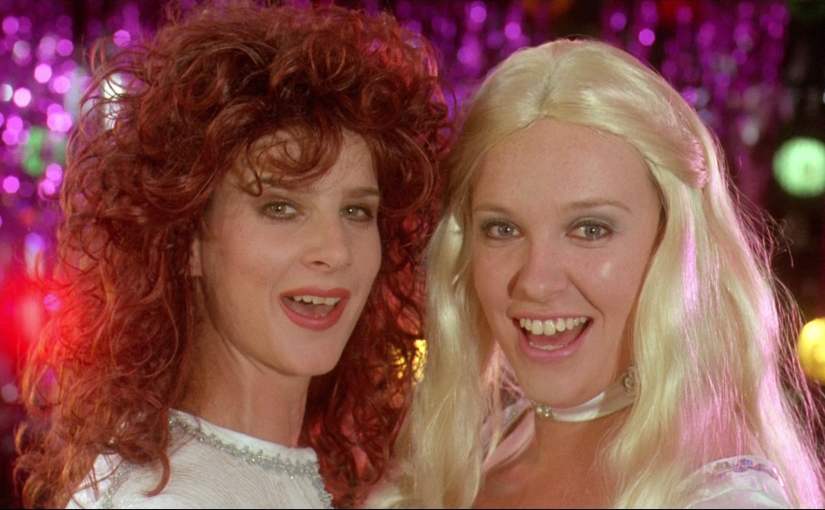
Through an improbable, but satisfying, chain of events, Muriel steals quite a bit of her father’s money, goes on an impromptu vacation, and meets an old schoolmate, Rhonda (Rachel Griffiths, in her film debut), who gets Muriel to open up a little.  For the vacation resort’s talent show, they lip-synch and dance to “Dancing Queen” by Abba in white stretch pants, a scene that must have at least partially inspired the makers of Mamma Mia!  Instead of returning home after her vacation, Muriel moves to Sydney and tries to reinvent herself.  At her low points during this time, she finds herself irresistibly drawn to the wedding gowns on display at the local bridal shops…

The rest I leave for you to discover.  One of the joys of this movie is how one thing leads to another in completely unexpected ways.  This was, without a doubt, one of the most unpredictable films of any kind that I have ever seen.  I can’t tell you how delightful it is whenever I find a movie that avoids cliches and narrative pitfalls and continually surprises me.

For example, there’s a scene involving – how can I say this without giving too much away – two people clumsily making out, a broken window, two naked men, and a malfunctioning beanbag cushion that had me laughing uproariously.  And then, just when I thought the scene was over, a curveball gets thrown that made me gasp audibly, as if I were watching footage of a dog getting run over.

The whole movie is like that.  For an hour and forty minutes, I was completely and utterly in the dark about what might be coming next.  The screenplay is bloody ingenious.  It starts with what looks like a generic rom-com premise, leads you down the garden path, then removes the path, and then removes the garden.  There are genuinely tender moments, and moments of delight (Muriel’s reactions during her first date are sheer perfection), and one or two shocking moments, and, and, and…  You get the idea.

Muriel’s Wedding gets high marks for its honest performances and its unfailing unpredictability.  The posters and especially the trailers paint the film as an “uproariously funny” comedy, and it is…at the funny parts.  There are also loads of dramatic surprises, and tender moments, and utterly unexpected plot twists.  It’s one of the most original movies I’ve ever seen.

NIGHTMARE ALLEY (2021)

By Marc S. Sanders

Guillermo del Toro’s Nightmare Alley is a visual feast of the macabre set in a Depression era western America.  Every caption caught on film is unbelievable to look at, and while I know del Toro released his picture in black and white to enhance its film noir theme, I was truly delighted with the color version of the film.  With del Toro’s direction and photography designed by Dan Lausten, every dimension and sparkle of color from a sunset to a dreary cloud in the sky to the lights on a Ferris wheel spinning in an open field from the distance is absolutely jaw dropping.  Nightmare Alley is a modern technical masterpiece.  It makes me want to go back and watch the original 1947 version, as well as explore other productions in the film noir category.

Bradley Cooper portrays Stanton Carlisle, a murderous drifter who ends up accompanying a traveling carnival of garish figures who entertain their quirky qualities for townsfolk to be marveled and amazed.  There’s the flexible snakeman, the world’s strongest man (del Toro regular, Ron Perlman), the smallest man alive, the electrical woman, the psychic and the terrorizing, caged “geek” who will eat the head off a live chicken in front of your very eyes.  At first Stanton serves as a heavy meant to carry loads and set up and strike the tents and stages as the show moves from town to town.  He connects though with the psychic (Toni Collette) and the architect behind her façade (David Strathairn).  Soon, Stanton is adopting their techniques of using code words and hand gestures to “read the minds” of the various audience participants. 

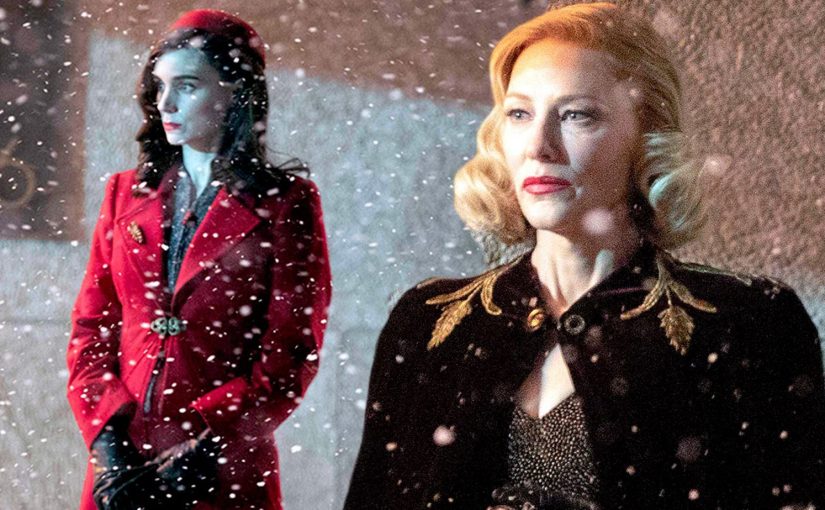
He goes even further by redesigning the electrical woman’s presentation. Before she was using teslas to demonstrate her will to generate electrical currents.  Now she can be zapped in an electric chair.  The woman is Molly (Rooney Mara), and a relationship begins that sends her and Stanton on a successful tour away from the carnival where they entertain more sophisticated and wealthier nightclub guests with his psychic abilities.  One attendee, however, is on to Stanton’s devices, a beautifully alluring psychiatrist named Lilith (Cate Blanchett).  She maneuvers Stanton into using his manipulative talents into conning her clients.  She has recorded her sessions and will share confidential information with Stanton. Then, he will use that towards his ongoing psychic advantage as a means to swindle them of their fortunes.  Lilith and Stanton will split the rewards.  The play seems convincing enough for the likes of a wealthy industrialist named Ezra, played by Richard Jenkins yearning to reconnect with his deceased wife at a cost of thousands of dollars for Stanton’s services.

The narrative of Nightmare Alley is so absorbing.  Everything is beautifully staged.  A fun house hall of mirrors has a décor of disturbing imagery.  Stanton enters this place symbolically at the beginning of the film in search of the runaway “geek.”  The surroundings display the seven deadly sins around a large skull and other haunted house imagery.  del Toro demonstrates what Stanton is about to enter, which occupies the remainder of the film.  Stanton performs on the motivations of greed and lust and vanity.  Maybe, pride as well.  At least those are the first couple of sins that come to my mind.  How will his actions reflect back on him later on, though?

The film is also performed by a magnificent cast.  Cooper is doing some of his best work here.  While I feel like I’ve seen Blanchett’s deceitful character before, I don’t mind.  I can’t think of anyone else to play the role.  Curiously, del Toro has Mara, with her snow-white complexion, dressed in red quite often amid a cast of characters and extras wearing blacks and dark greys.  She’s meant to stand out as the innocent.  Molly questions Stanton’s decisions while also trying to convince him to end his charades.  Yet, she only serves as a disturbing pawn in the shyster’s tricks.  Will Stanton corrupt Molly though?  It’s one thing to put on a magic show for a couple of hours each night.  It’s another when you are swindling the massive fortunes of others and toying with their despair. 

Other surprise performers that appear include Willem Dafoe as the showman for the “geek,” and a late appearance by Tim Blake Nelson to close out the film and deliver what’s to come of Stanton. 

Nightmare Alley deliberately moves at a slow pace, but that only allows you to take in its various environments.  From the carnival tents to the nightclubs to the alleyways, to Ezra’s snow covered never-ending garden, and even Lillith’s gold embossed office of cabinetry and furniture are so hypnotic and dark in its intended film noir way.  Again, while I’m sure there’s some striking qualities to the black and white interpretation of the film, I really fell in love with the colors provided by Lausten’s photography.

I won’t call this a favorite film of mine, but I loved the journey of it all.  I appreciated the script by del Toro and Kim Morgan, adapted from the novel by Lindsay Gresham, that depicts a sinful man like Stanton devolve into more sin, until he’s only undone by a smarter sinner than he; a sinner masked within beauty and wealth with a noble and educated profession.  Bradley Cooper and Cate Blanchett perform beautifully with one another.  They make a terrific pair.  I only hope they’ll do another film together.

MARVEL’S THE AVENGERS

By Marc S. Sanders

Phase One of the Marvel Cinematic Universe concludes with Marvel’s The Avengers. This is a real treat and a feast for the eyes. It’s not my favorite of all the Marvel films because it gets a little too Saturday morning cartoon like at times, but it’s enjoyable to watch for good escapist popcorn fun.

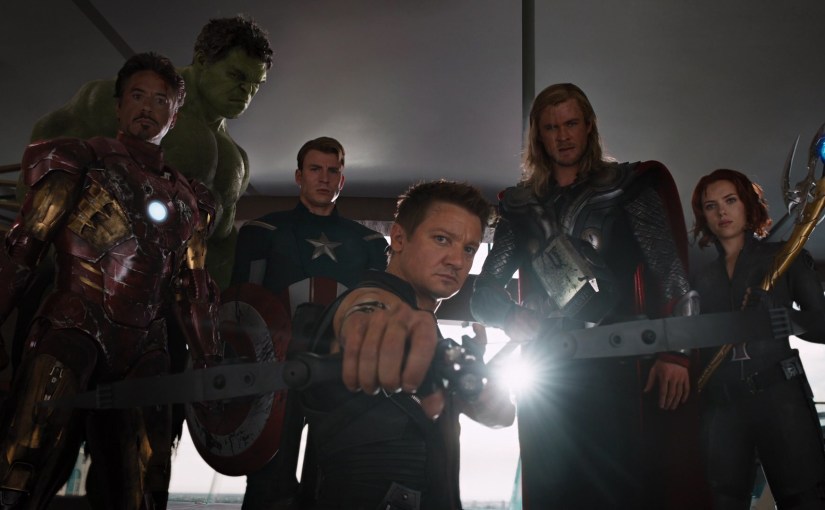
Movie goers were salivating for the year 2012 to arrive which would finally assemble Thor, Iron Man, Captain America and the Hulk on screen. Thanks to writer/director Joss Whedon that wish had finally come true and Whedon does not try to reinvent the wheel. When you assemble a team of heroes, you pit them against a large army and watch every variation imaginable of how the Hulk can smash, or what Iron Man’s armored suit can launch.

By now, you all know how I feel about the actors portraying their respective roles. Best to just say the chemistry works among them. They find reasons to squabble and Whedon provides moments for them to use their given talents against one another. So you get to see what happens when Thor smashes his hammer against Cap’s shield.

The actor who finally gets his moment in the sun is Samuel L. Jackson as Nick Fury, the orchestrator behind this team up. Jackson is more subdued than his other well known characters from the Tarentino films or Snakes On A (Mother effing) Plane. He does get to say “stupid ass idea” at one point and there’s the Samuel L. Jackson we all know and love! In comics, the Nick Fury character was reinvented before any of the films to harbor the appearance of Jackson. This film proves why the writers went that route. He’s great. He’s fun to watch. He makes for a great leader of the secret agency SHIELD. In tow with him is Clark Gregg as Agent Phil Coulson, a welcome cameo guy before this film, Gregg gets in a few scenes that show his endearment, and offer some dramatic weight as well. The guy could be waiting on hold while Black Widow takes out a couple of thugs, and you are cracking up at Gregg as Coulson, not necessarily Black Widow. He’s so likable that well…heck…he should get his own Marvel TV show….wait….nevermind….I digress.

Again, however, the women of the MCU are not drawn well for the screen. Scarlett Johansson makes her second appearance as Black Widow. She’s got a great, funny early fight scene while tied to a chair in a sleek black dress, but that’s all for show. She hints at a checkered past but this film does not offer much to expound on that. I understand. There’s a lot going on here. So there’s not much here for her to do. It’s time she got a film of her own, however. I’ll sign the petition. Wait! Nevermind! Colbie Smolders is a waste as Agent Maria Hill. She is nowhere convincing as a bad ass agent. Her line delivery seems forced. Her role seems unnecessary. Her scenes should have been on the deleted floor. It would have allowed more time for Johannson to play up her character. How is Maria Hill different from Black Widow in this film, anyway? She’s not. Therefore, cut out Maria Hill.

Jeremy Renner is given nothing to do but shoot arrows as Hawkeye, and work against the Avengers while under a spell from Loki.

Speaking of Loki, the great Tom Hiddleston is back. Hiddleston just elevates the Marvel films to more than just a comic book movie. His glee as the God of Mischief is different than say any version of the Joker’s. Pay attention Syndrome (from The Incredibles)!!! When Hiddleston monologues, you want to listen, unless you are the Hulk.

Whedon does an awesome job with the action scenes as he gradually destroys an aircraft carrier when chaos takes hold among the various heroes, and then later he destroys New York City in a fun amusement park like battle through the streets, subways and skyscrapers. It’s a little reminiscent of Richard Donner’s (or Richard Lester’s) Superman II, and Ivan Reitman’s Ghostbusters. It’s fun to watch the Hulk run through a building only to come out the other side and leap upon the head of a gigantic, flying centipede to bring it down on to the top of a building. Who cares how this all gets cleaned up? The greatest city in the world always figures out a way.

Whedon sealed the pop culture significance of superheroes in the early 21st Century. He’s done what guys like Michael Bay beg to do with other toy/comic book franchises. Marvel’s The Avengers stands out as an important impact in cinematic filmmaking. It’s not best picture worthy, but it is nonetheless important to how blockbuster films are conceived and created. Sadly, some people still don’t get it right, all these years later.

SPECTRE

By Marc S. Sanders

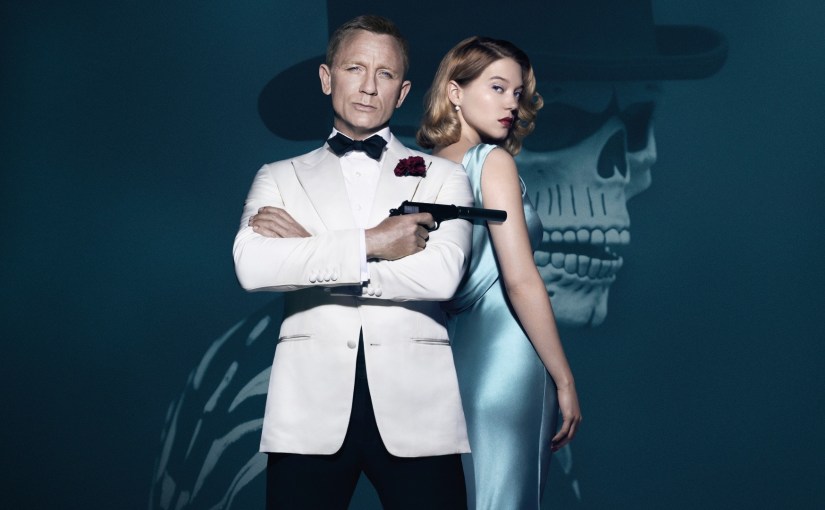
It’s fortunate that the success of Mike Myers’ Austin Powers franchise did not wash out the best features of the James Bond series. Had it done so, we wouldn’t have been treated to the outstanding production of Daniel Craig’s film, Spectre, with an opportunity to face off against a reinvented Ernst Stavro Blofeld played perfectly by Christoph Waltz. One of my few complaints however, is that we didn’t get enough material for the two-time Oscar winner.

Director Sam Mendes returns following Skyfall to reinvigorate the original traditions and blueprints that attracted audiences to 007 in 1962 with Dr. No. Blofeld lays in wait in his secret fortress of a lair housed within a desert crater (an upgrade from the volcano in You Only Live Twice), ready to offer exquisite hospitality to Bond and his love interest before providing an unrequested guided tour of his technology and hideous plots. No, he never had to show Bond anything. Yet Blofeld was never bashful, with or without his cat. Waltz is the right choice for this 21st century iteration of the staple villain. Gone is most of the camp presented in the character during the later Connery films. Most of the camp actually. He does still have the white cat after all.

Craig remains a great 007. The role is not a mimic of past Bonds. Craig is everything of the “blunt instrument” that author Ian Fleming described. Thanks to his physique and some great fight choreography, a marvelous fisticuffs scene occurs between him and brutish Dave Bautista aboard a moving train. Craig always looking great in the white dinner jacket tux, even while he’s getting pushed around.

Lea Seydoux is serviceable as the Bond girl, Madeline Swann, daughter of an old enemy of Bond with information necessary in the pursuit. Seydoux is not the best Bond girl. Others have offered more intellect beyond the beauty. Still, that might only be due to the limits of the script. She’s a good actor nonetheless.

Ben Whishaw and Naomie Harris are great as Q and Moneypenny. The roles have stepped up in frankness and skills that stretch out more than a traditional one scene cameo. Whishaw as Q is more of a know it all and Harris as Moneypenny reminds the audience that she has a life outside the office.

Ralph Fiennes is good too as M. Though I do wish his storyline was better here where he is dealing with an over abundant policy in complete government surveillance. The antagonist against Fiennes is nothing special and as quick as this storyline started, you knew how it was going to end. Still, I like watching Fiennes in the role.

Spectre has great scenes, most especially the signature opening taking place on the Day of the Dead in Mexico City that culminates in the destruction of a city block before Bond disables two bad guys aboard a spiraling helicopter. Steady cam and very clear edits make this a knockout.

I also appreciate the gag that not all things work accordingly for Bond. He orders his signature Vodka Martini, shaken not stirred, and is denied as he is at a bar located in an isolated strict health retreat. As well, his Aston Martin is not as reliable thanks to empty hidden machine guns hidden behind the logo in the trunk. Not everything comes as easy for Craig’s Bond, and that allows for some tongue in cheek humor.

I liked Spectre more on a repeat viewing. Mendes shot a gorgeous looking globetrotting picture of Mexico City, Rome, Austria, Tangiers and clear evening London.

Considering the next installment is likely to be Craig’s last film is disheartening. With Spectre, a summation of all the prior Craig films is assembled leading to what has been a great miniseries within the storied franchise. I’ve liked following this James Bond. There are revelations about the character including his orphan history, his faults and his coldness that only serves to protect the Queen’s country. The Daniel Craig Bond is the best following the very different albeit wry interpretation of Sean Connery.

Still, I’ll take what I can get, and once again happily look down the target scope aimed right for 007 before the blood comes pouring down.