
by Miguel E. Rodriguez
DIRECTOR: Robert Wise
CAST: Julie Harris, Claire Bloom, Richard Johnson, Russ Tamblyn, Lois Maxwell
MY RATING: 7/10
ROTTEN TOMATOMETER: 87% Certified Fresh
PLOT: A paranormal researcher assembles a motley crew of assistants to spend a night or two inside a gothic manor estate to prove whether it’s truly haunted or not.
If I had seen The Haunting when I was a bit younger, I might have told everyone I knew that this was the scariest movie I had ever seen…if I had not already seen The Shining, Alien, and Jaws, to name a few. As it is, the short version of my opinion is that, while director Robert Wise successfully creates a genuinely creepy atmosphere in and around Hill House, I was only rarely truly scared. (That first scene with the pounding noises outside the door was very effective.) I’m not saying The Haunting isn’t worth watching, though. It’s a giant step forward in the haunted house movie, bringing artistic and cerebral respectability to a cheesy sub-genre.
(It’s a credit to how effective it was in its day that Walt Disney’s imagineers cribbed several ideas from the film for the Haunted Mansion attractions in Orlando and California, most notably the bending or “breathing” doorway.)
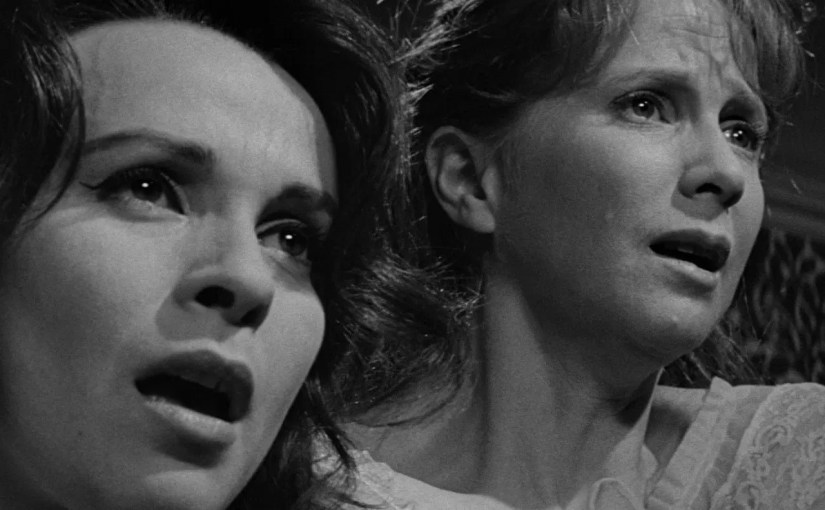
The Haunting is, like most horror films, an ensemble piece with one clear leading role. In this case, it’s Eleanor Lance (Julie Harris), a flighty, nervous woman with an unhappy home life. She received an invitation from a paranormal specialist, Dr. Markway (Richard Johnson), to spend the night in a famously creepy mansion, Hill House. Joining them will be Theodora (Claire Bloom), who can apparently read minds, although not much is done with that plot thread; and Luke Sannerson (Russ Tamblyn), an insouciant young man who possibly stands to inherit Hill House for his own.
Hill House itself, like the Overlook Hotel, becomes a character of its own, even more so. A quick prologue tells us all we need to know: every previous resident of Hill House has come to a sticky end one way or another, from runaway horse carriages to a disturbing suicide by hanging. Director Wise used a ton of stylistic choices for the interior of Hill House. Wide-angle lenses, images that are “stretched” too far, tilts, extreme close-ups…everything combines to give the house itself an identity beyond its name.
This is all well and good, extremely well-done. But the sinister mood of the place is occasionally derailed by the overacting on display, as well as some overly cheesy dialogue. I can see how a lot of these things would work on paper (in fact, the movie is based on a famous story by Shirley Jackson [The Lottery]), but when it comes to the execution, there are a lot of dialogue scenes that feel ripe for parody by those guys from Rifftrax.
For me, when I watched it, I adopted a kind of “take-the-bad-with-the-good” attitude. I marveled at the superb imagery and expert evocation of tension and terror, but when the characters opened their mouths to talk, I paid a little less attention. I was especially taken aback by Eleanor’s occasional fit of hysterics, which is all in character, but sometimes it felt like just a little too much.
Am I being too hard on a haunted house film from over sixty years ago? I’m willing to concede that possibility. But I want to make clear how much I admire the production design of Hill House itself, and how effective are the scares that do work. Much like some earlier horror films (and more than a few later ones), the chills are a direct result of what we don’t see. We hear the sounds and see doorknobs turning, but we never see who or what is doing it. Do it right, and it saves quite a lot of money in the budget while still delivering great fright value.
IMDb states that Robert Wise took quite a bit of inspiration from one of his heroes, Val Lewton, producer of low-budget horror classics like Cat People and I Walked with a Zombie, movies that cut corners, not for artistic reasons, but because they HAD to, and the results were more effective than they would have been with a bigger budget. Wise took that method and ran with it, creating a movie that may be cheesy at times, but its influence can be clearly felt in any modern horror movie in which things go bump in the night.
 2 UNPAID MOVIE CRITICS!!!!
I happy ‘The Haunting’ sits in my top ten list of best haunted house movies of all-time.
LikeLike
I can see why! As much as The Overlook Hotel in The Shining, Hill House just exudes evil, both on its own and with the help of Robert Wise’s eerie camerawork.
LikeLiked by 1 person