
by Miguel E. Rodriguez
DIRECTOR: Charles Vidor
CAST: Rita Hayworth, Glenn Ford, George Macready, Joseph Calleia
MY RATING: 8/10
ROTTEN TOMATOMETER: 90% Certified Fresh
PLOT: A small-time gambler hired to work in a Buenos Aires casino discovers his employer’s new wife is his former lover.
Admit it: we’ve all known a couple like these two: Johnny Farrell (Glenn Ford) and Gilda (Rita Hayworth). They’re the kind of couple that inspire lifelong celibacy. You see them together, and you think one of two things: “Why is SHE/HE with HIM/HER?” Or, “Well, at least they’re saving two other people.”
The irony of Gilda is that they’re not even a legitimate couple, at least not for very long. The fact that the movie sees fit to give them a semi-happy ending fits more with the period when it was made than with the characters themselves. Watching them go off together at the end feels…off. I know there are exceptions to this rule (see Bound [1996], spoiler alert), but this film noir fairly screams for a tragic ending of some kind, appropriate to the genre. Instead, the two leads get off the hook just a little too easily, for my money.
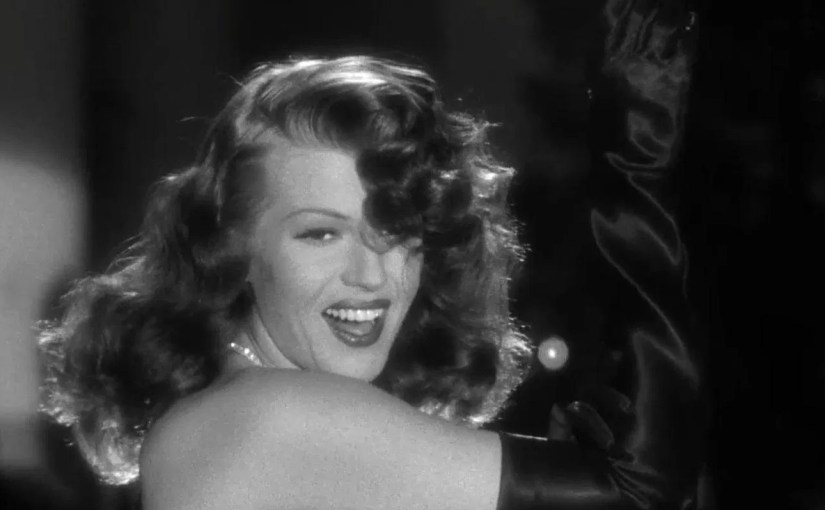
But I’m jumping ahead. In case you didn’t know, Gilda is the 1946 seamy/steamy film noir that forever turned Rita Hayworth into a Hollywood sex symbol. Humphrey Bogart turned down the lead role (that went to Glenn Ford instead) because he figured, with Hayworth on the screen, no one would be looking at anyone or anything else. He wasn’t kidding. From the moment of her iconic entrance to the film (hair flip…“Me?”), Hayworth dominates every moment she’s onscreen, as effortlessly as Monroe, Dandridge, or Loren, assisted by those legendary Jean Louis gowns and costumes. Especially the famous “Put the Blame on Mame” number, with the slinky black strapless “sleeve” dress, and those long black elbow-length gloves that she peels off ever so slowly…
The story! Right, the story…
Johnny Farrell is a low-rent gambler in Buenos Aires who is hired by casino owner Ballin Mundson – one of the weirdest character names ever – to watch over his operations while he tends to other business in and around post-war Argentina. One day Mundson returns from a business trip with a new wife: Gilda, whom he married after a whirlwind one-day romance. Gilda is as tempestuous as they come, brazenly flirting with Johnny in front of her new husband, who can’t help but wonder why Johnny seems so icy towards her…
It doesn’t take a rocket scientist to figure out Johnny and Gilda knew each other a lifetime ago. Their chance meeting in a foreign country ranks right up there with Ilsa wandering into Rick’s Café Américain in North Africa: unlikely, but it makes for a helluva story.
Glenn Ford holds his own in the film as the scruffy, no-nonsense enforcer who can more than hold his own in a fistfight, but whose physical prowess can’t compete with the psychic hold Gilda still has on him. Of course, the fact that Gilda mercilessly pokes and teases Johnny indicates she’s just as fixated on him. It’s easy to see how this material could almost become a standard-issue rom-com, but Gilda is made of darker stuff. Look at it from a certain angle, and there are hints that Johnny and his boss, Mundson, might share a relationship that goes beyond employer/employee, that Gilda knows this, and is using that knowledge to stick the knife even deeper into Johnny’s stomach, just to watch him squirm.
So, Gilda becomes a psychological battle of the sexes, evoking The War of the Roses at times. Gilda tosses off some zingers that would have made Mae West blush. (“If I’d been a ranch, they would’ve named me the Bar Nothing.”) Johnny gets off a couple of his own. (“Pardon me, but your husband is showing.” …and, “Statistics show that there are more women in the world than anything else. Except insects.”) In between zingers, the plot moves on in the background, but it’s only a clothesline on which to hang the arguments between Gilda and Johnny. In that respect, it’s like a John Wick film: you’re not there for the plot, you’re there for the action. It’s entertaining as hell, don’t get me wrong, but they are so good at being despicable to each other that I found myself hoping they DIDN’T wind up together. Talk about a match made in hell. Do they deserve each other? Discuss.
Gilda robustly lives up to the film noir tradition, in style, substance, and story, RIGHT up until the last two or three minutes, when the darkness gives way to the major-chord strings of “happily ever after.” For that, I personally can’t call it perfect. But holy black strapless gown, Batman…as they say at Passover, for that alone we should be grateful.
 2 UNPAID MOVIE CRITICS!!!!