
By Marc S. Sanders
The worst thing that could have happened to Paul Sheldon is that Annie Wilkes saved his life.
Rob Reiner breaks away from innocent romantic comedy to deliver a violently cruel kind of intimacy. He directs his second Stephen King adaptation, Misery. (His first was based off King’s novella The Body, which became Stand By Me.) With next to no prior record with horror or disturbing psychosis, Reiner achieves greatness with this film. Much like Martin Scorsese, he focuses quite a bit on props that offer no dialogue but say so much. A cigarette, a match, a champagne flute, a bottle, a beat-up briefcase, a clunky Ford Mustang, along with a gun, a two by four block of wood, a portable grill, a knife, a syringe, a sledgehammer, and a porcelain penguin. Barry Sonnenfeld is the cinematographer offering brilliant clarities of color for mundane and endless discomfort.
Before leaving his mountainous Colorado cabin, Paul has smoked his cigarette and savored his glass of 1982 Dom Perignon. He has just completed a new manuscript; a big departure from his best-selling series of novels focusing on his beloved heroine Misery Chastain. Lady Misery is not how Paul wants to be entirely defined as an author.
Unfortunately, on his way back down the snowy mountain, he veers off the road and lands upside down in his Mustang, buried within a blizzard. A hulking figure carries him back to a peaceful, isolated cabin in the woods. When he awakens two days later, he meets Annie who has already begun to nurse him back to health following two very damaged legs and a popped shoulder blade. By his grogginess, he might have had a concussion too. Lucky for Paul because apparently, he cannot reach a hospital or get a call out to his family or literary agent (Lauren Bacall) due to the harsh weather conditions.
It’s also convenient that Annie is quite the fan of Paul’s work, particularly his series of Misery novels. She has a maternal bedside manner, but oddly enough she becomes irascible at any given moment. After honoring Annie’s request to read his untitled manuscript, Paul realizes that might have been a mistake. Annie can easily get unhinged to say the least, and that temper…
Paul Sheldon is portrayed by James Caan, and he was one name on a long list of leading actors considered for the role including Warren Beatty, Robert Redford, Harrison Ford, Robert DeNiro, and Jack Nicholson. Any one of these guys could have done the part. However, I can now only see James Caan. He beautifully plays stationary vulnerability as he’s anchored to a bed for most of the film. Ironically, for a writing master of words, Caan’s dialogue is not even half of the script that belongs to his counterpart.
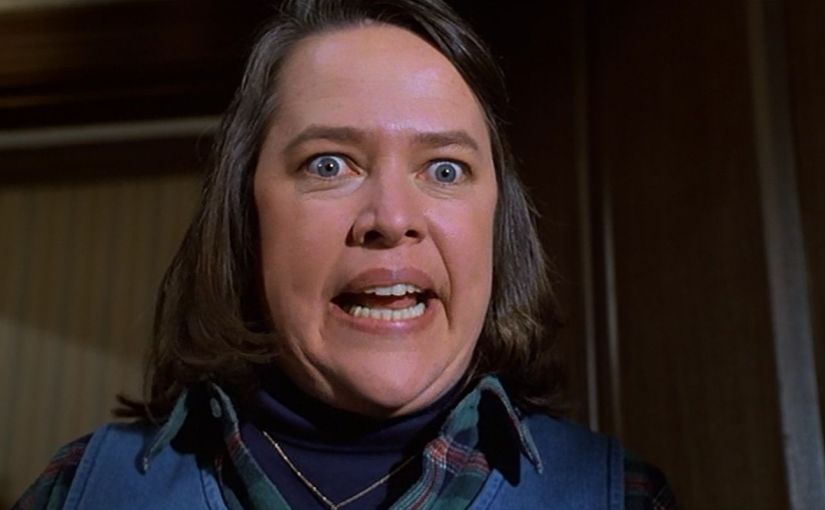
Kathy Bates was deservedly awarded the Oscar and a slew of accolades for her role as Annie Wilkes. This role put Bates on the map. Her portrayal is timed so authentically with changes in tempo from childlike enthusiasm to demented rage that she only makes Stephen King seem like that much better of an author than he already was at the time. Actually, I’d argue that before Misery hit theaters, the Stephen King factory of film adaptations was churning out subpar products like Cujo, Firestarter, Christine, and his own film that he directed Maximum Overdrive. Misery elevated the author’s brand back to when it was celebrated with Brian DePalma’s Carrie and Stanley Kubrick’s unforgettable interpretation of The Shining.
I believe what helps is that of all the varieties of horror the author was delivering, Misery did not hinge on the supernatural. Annie Wilkes is a very real embodiment of capable terror and disturbing psychological handicap. Kathy Bates effectively demonstrates byproducts of schizophrenia and obsessive, compulsive disorders. Living alone in the woods with the subconsciousness of an author speaking to her through the pages of his fictional hardcover novels only feeds the beast that she’s become.
I’m not a big fan of Stephen King’s works. Often, I find his material of gore stretches too hard for shock value, and hardly ever achieving insightful originality. To the best of my recollection, I’ve only read Misery, The Stand and It. That’s enough for me. I read that as he was writing Misery, he was emoting his alcoholic demons that left him obsessively challenged. Annie Wilkes developed into that tangible, physical fiend. This story takes a far step away from the macabre world that built his literary empire.
Rob Reiner does not go for any kind of novel inventions with his film. He’s simply telling a story with the tools provided by celebrated screenwriter William Goldman (The Princess Bride, Butch Cassidy & The Sundance Kid, All The President’s Men) and his wise adjustments from King’s piece. Goldman and Reiner wisely cut out a lot of King’s gory schlock. (That foot scene, for example. Either way? YEESH!!!) Smart move, because Annie Wilkes is such force of power personified by the hulking physicality (by choice of Reiner’s lens) and range of Annie Wilkes. Even though Kathy Bates is short, she is a hulking menace here. Kathy Bates is doing stage work in front of a camera. I’d argue her performance inspired the idea of eventually converting Misery into a Broadway play that featured Laurie Metcalf and Bruce Willis in the roles. I wish I could have seen that.
Goldman wisely allows the picture to move on with another perspective in the form of two characters that were not part of King’s story. A perfect casting of Richard Farnsworth and Frances Sternhagen as the local sheriff and wife advance the curiosity of Paul’s absence from the world. They speak for the surrounding areas that don’t reveal what is beneath the blankets of snow where few clues remain, and not even a missing 1965 Ford Mustang can show itself. They’re funny, quirky, and unusual, almost like a combination of Jessica Fletcher or Miss Marple seeking to resolve the mystery.
Props like a gun and a knife along with visuals like uncontrollable fires and fight scenes are nothing new. However, it’s when these scenarios are paired with Kathy Bates to victimize a small, weakened James Caan that these items become well filmed properties of Rob Reiner. So again, I focus on the inanimate objects of Misery because Reiner lends a lot of footage to all of these working pieces. This revolver suddenly has dialogue of its own through one of Annie’s personalities. The knife works like a guard dog for Paul. The aluminum can of lighter fluid sadistically squirts itself to tickle or tease an extreme point for Annie.
The cigarette and champagne flute emote those small, cheating, harmless vice escapes from commitment that awards Paul.
The sledgehammer puts its foot down.
The match plays both sides of the duality during different points of the film.
Misery is that film that works with a small cast, but with a wide population of environment, in a snug, confined space. I describe the picture this way because like Annie Wilkes, this exploration in psychological terror operates without fair balance. When an animal cannot control and subdue its instincts, there’s no telling what to expect, and an unpredictable Annie Wilkes might be one of the scariest personifications any one of us could ever encounter.
 2 UNPAID MOVIE CRITICS!!!!
I’ve never read the book nor have I seen the movie. I have read a lot of King’s work and most all of it has remained with me so completely I understood what Gerald meant; he said if I ever read it or saw it I would never write another word, and he has always been my best supporter in every way when it comes to my writing. (And, of course, there’s King’s own ON WRITING, which is the gold standard for every writer I know and which I continually recommend; I pick up used copies to give away.)
I like the way you wrote this.
LikeLike
Thank you so much Beth. I still encourage you to watch the film.
LikeLike