
by Miguel E. Rodriguez
DIRECTOR: Lloyd Bacon (with choreo by Busby Berkeley)
CAST: Warner Baxter, Bebe Daniels, George Brent, Ruby Keeler, Una Merkel, Ginger Rogers, Dick Powell
MY RATING: 9/10
ROTTEN TOMATOMETER: 92% Fresh
PLOT: The unglamorous side of life on Broadway is laid bare in this unexpectedly enthralling musical from Hollywood’s golden years.
I’ll admit it: I was a victim of my own expectations.
For decades, I assumed that Lloyd Bacon and Busby Berkeley’s 42nd Street was your standard Hollywood fluff musical from an era when the genre had been beaten nearly to death, filled with wall-to-wall corny songs and even cornier story lines. I was aware of the famous line from the film: “Sawyer, you’re going out a youngster, but you’ve got to come back a star!” I was certain I knew everything I needed to know about the movie right there. Unknown chorus girl gets a lucky break, becomes a star, a little song, a little dance, happy endings for everyone.
I’ve said it before and I’ll say it again: I love it when I’m wrong. 42nd Street defied all of my expectations, and even when it felt like it was caving to the genre, it did it so exuberantly that I caved into it myself.
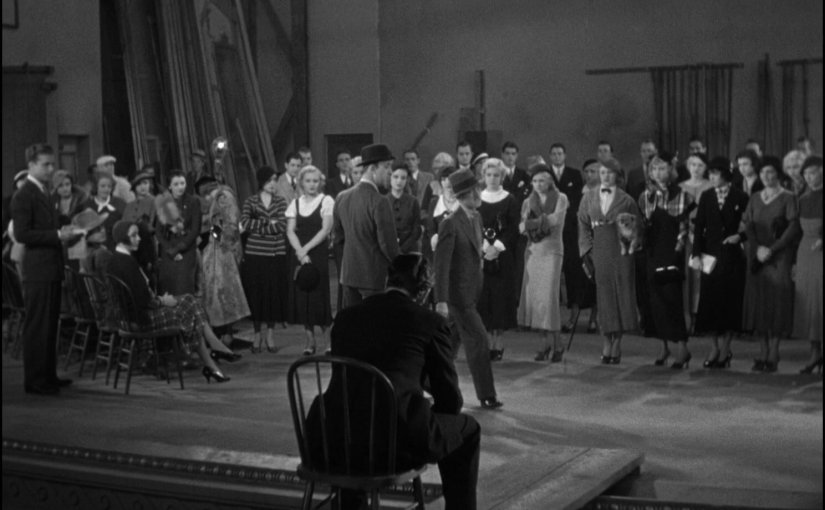
The story is ancient: A Broadway show is holding auditions at an unnamed theater on New York’s famed 42nd Street. A rookie actress, Peggy Sawyer (Ruby Keeler), is one of scores of hopefuls at the cattle call, among them seasoned veterans Lorraine Fleming (Una Merkel) and Ann Lowell, played by Ginger Rogers the same year she was first paired with Fred Astaire in Flying Down to Rio…a legend in the making. The show’s director, Julian Marsh (Warner Baxter), is a taskmaster who wants this show, “Pretty Lady”, to be his final masterpiece before he retires on advice from his doctors. Then there’s Dorothy Brock (Bebe Daniels), the diva whose sugar daddy ensures she will get the plum role; Pat Denning (George Brent), Dorothy’s penniless paramour; and Billy Lawler (Dick Powell), the show’s “juvenile”, aka “mangenue”, who takes a shine to Peggy Sawyer when she interrupts him in his underwear in the dressing room. Long story.
So, all the stock characters are here for a plot that was probably old even before the introduction of sound. But 42nd Street subverted my assumptions by doing several things.
First, it is definitely NOT wall-to-wall with song and dance. In fact, before we hit the final tune-filled 15 minutes, only one full number is performed. Everything else is rehearsals, endless rehearsals with masses of dancers in their practice clothes or solo singers at the piano. The backgrounds of the main characters are fleshed out in several scenes outside the theater, but the filmmakers were smart enough to keep those scenes to a minimum. The real drama is on the stage, where it belongs.
(I loved those rehearsal scenes. As an amateur actor in community theater myself, I had all sorts of flashbacks to my first shows as an ensemble member of big shows like The Music Man and Camelot, going through endless repetitions of musical numbers or just SEGMENTS of musical numbers until the director was satisfied. I particularly loved one number being rehearsed on stage while the camera showed most of the cast and crew watching from the wings. Pitch perfect.)
Second, the screenplay was not as cornball as the plot summary makes it sound. I expected kitsch, but instead I got unexpected drama and grittiness, interspersed with comic relief and some outstanding zingers. (“It must have been tough on your mother, not having any children.”) Peggy Sawyer, the rookie, faints during rehearsal; Julian, after first making sure she’s not dead, yells at the stagehands to remove her from the stage so rehearsals can continue. And they do. When Julian learns of Dorothy Brock’s affair with Pat Denning, an affair which could jeopardize her participation in the show, he reaches out to an unsavory connection who agrees to rough Pat up as a warning. Granted, this is all handled with a light touch, but this is serious business. Putting a “hit” on someone? Would a Broadway director ever actually do such a thing? (Spoiler alert: probably.)
Third, by easing off the musical numbers until the last reel, 42nd Street positively had me eager for a full-blown song and dance. And, brother, does it deliver. The mythical Busby Berkeley pulls out all the stops for three sensational numbers that begin within the confines of a Broadway stage, and then magically “open up” into a cinematic tour de force. I especially enjoyed the number where Ruby Keeler is clearly doing a complicated tap dance for real, but the best of the three is the film’s namesake, “42nd Street”, which is basically a travelogue of NYC, and which contains wild mood swings and some show-stopping choreography. Watch for the moment when a young woman escapes a bad situation in her tenement apartment by running to the 3rd floor fire escape and then leaping to the street below. I’m sure there were safety measures in place just out of camera range, like Harold Lloyd dangling from that clock, but in the moment, it genuinely looks like the cameras captured an actress leaping to her death. Not to mention the sequence where the chorus transforms into the NYC skyline. (In fact, I’d say the movie’s worth watching just for that final dance sequence…it’s astonishing.)
Fourth, the very end of the film took me totally by surprise. At the risk of spoiling it, I’ll say that it takes place after I thought the movie WOULD end, and that it perfectly captures the combination of emotions that go through a stage director’s mind and soul after a show goes up and is an apparent success. It’s another moment that felt absolutely real, with no overcooked dialogue or mugging.
It’s said that, before the release of 42nd Street, the movie musical was dead in the water. Too many musicals had come before it, musicals that overdid the song and dance or had a half-baked story, etc. Not only did 42nd Street singlehandedly revive the genre for decades to come, it also apparently saved Warner Bros. Studios from bankruptcy. As someone who is not a particularly huge fan of older movie musicals, I wholeheartedly recommend this movie to anyone who is like me and has put off watching it because you think you already know everything about it you need to know. I’m here to tell you: you probably don’t. (And I especially recommend it to theatre aficionados who are familiar with the stage musical “42nd Street”, which pads the running time with dozens of additional songs, most of which were taken from Gold Diggers of 1933 [1933].)
 2 UNPAID MOVIE CRITICS!!!!