
By Marc S. Sanders
In the decade following the Vietnam War a common denial (or ignorance, maybe) went towards American soldiers who were missing in action. Many men were theorized to be prisoners of war long after the armed forces left the country, ending a losing battle with record numbers of casualties. A handful of films of the 1980s brought focus to this topic, as a means for adventurous entertainment. Chuck Norris had a series of Missing In Action films. Even light action fare TV shows like The A-Team and Magnum PI brought attention to this issue. Most predominantly, the possibilities of POWs were ingrained within Sylvester Stallone’s box office bonanza of Rambo pictures. In 1982, Ted Kotcheff directed the initial entry of that series, First Blood, and he zeroed in much more precisely the following year, with Uncommon Valor.
Gene Hackman is retired Marine Colonel Jason Rhodes who begins a decade long campaign convincing the U.S. government to seek out those who were left behind and are likely being held as prisoners of war. His motivation stems from his belief that his son Frank is likely being held captive in a camp located in northern Laos.
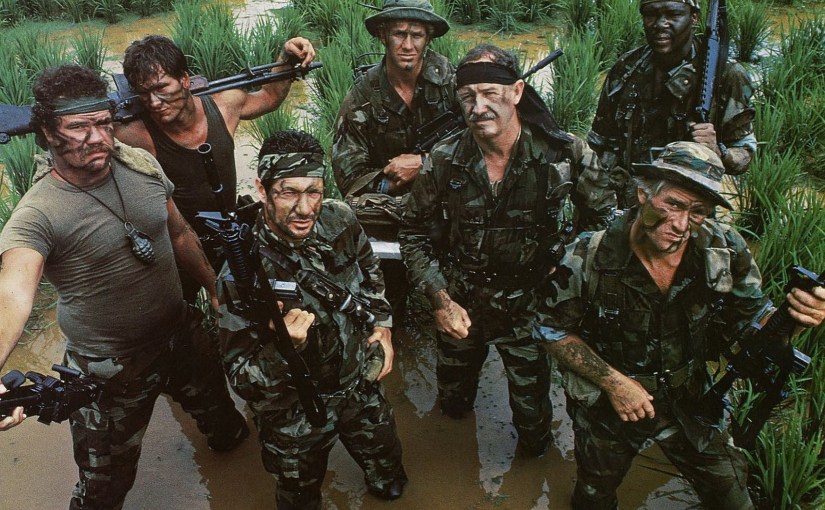
By the time 1983 arrives no action of recovery or rescue is taken. The Colonel is committed to bearing the responsibility. He appreciatively accepts financing of his own mission from an oil tycoon (Robert Stack) whose son might be with Frank. The Colonel also recruits members of Frank’s unit who made it home (Fred Ward, Reb Brown, Randall “Tex” Cobb, Harold Sylvester, and Tim Thomerson). Patrick Swayze is a young guy named Scott who never served in the conflict but is an expert combat and weapons specialist who will get these men retrained for the upcoming rescue. He also has his own reasons for partaking of this mission.
Uncommon Valor is sporadic on humor and focused on the adventure and resourcefulness. The first half provides footage of how the squad gets reacquainted with each other and the jungle elements they left behind in Vietnam. They practice routines outlined by the Colonel with ground patrols, detonators, hand to hand combat, artillery, sabotage, and chopper rescue. The second half follows them back into the Asian country where they have to obtain weapons and supplies, while making connections with locals who will escort them through the dense jungle area towards the camp.
This is a rare occasion where Gene Hackman is not applying much of his acting craft. He is primarily going through motions of Kotcheff’s film direction with a script rumored to be co-written by Wings Hauser (also a producer on the film). The trauma of the war is primarily carried by Fred Ward who struggles with PTSD long before it became so widely attributed to service men and women after returning from combat. In First Blood, Stallone offered a much more substantial and convincing demonstration. Yet, Ward does a serviceable job with a script that never goes terribly deep.
Uncommon Valor is better described as a present-day adventure picture. It’s never boring. There are fireball explosions and machine gun shootouts. The action set pieces still hold up with good art designs staged off the Hawaiian Islands in place of a sweltering Vietnam. The prisoners who are recovered, supposedly held for over a decade, are chilling to look at with obvious malnourishment and dead-blank expressions.
Randall “Tex” Cobb and Reb Brown (the TV movie Captain America) are mostly doing wacky A-Team material here. Gene Hackman, Fred Ward and Harold Sylvester are the straight characters.
It’s not as grand as a Rambo film, but Uncommon Valor never lampoons or minimizes what was a horrifying experience for those enlisted soldiers who never came home, while their next of kin never obtained closure.
For the 1980s, which feels like it had just passed yesterday, it’s fair to say that all those missing in action during that terrible and bloody war are no longer alive over fifty years later. The opportunity to search and negotiate for their freedom has long expired by now. While movies like Missing In Action, Rambo and Uncommon Valor focused on fictional triumphs that were never factually replicated, at least these films can serve as reminders for the sacrifices these people served at the behest of their country. I’m not writing to ease lifelong pains. All I can do is recognize, remind and be forever grateful. These movies still serve a purpose beyond the pulpy Saturday afternoon adventures.
 2 UNPAID MOVIE CRITICS!!!!