
By Marc S. Sanders
I propose you try an experiment. Watch one of Alfred Hitchcock’s earliest, British produced films, The 39 Steps, and then have a look at Andrew Davis’ The Fugitive with Harrison Ford and Tommy Lee Jones. You’re likely to recognize how inspiring Hitchcock’s film is towards modern thrillers almost sixty years later. In particular, Hitch explored the thrill of the chase. All he needed was the simplest of reasons for the pursuit to begin. Then, he had the framework for his entire motion picture.
The 39 Steps is a loose adaptation of John Buchan’s novel. Hitchcock’s film invented so much more than the book offered. When the film was previewed for Buchan, midway through, the author reportedly told the filmmaker how he was wondering how it was going to end. I took a film studies course in college and one of my assignments was to read the book and then document how it compares with the movie. The nationality of the hero is different, a potential love interest appears in the film that is nonexistent in the novel, and even the actual 39 steps is entirely something else in the film. Some books are challenging to deliver on a visual medium. Alfred Hitchcock knew what needed to be altered to make for an adventuresome thriller.
The film opens in a European theater where one of the most astonishing people has taken the stage. He is Mr. Memory (Wylie Watson) and he claims that his mind contains an infinite number of facts. So much so, that any reasonable question pertaining to math, science, geography, sports or history can be answered by him instantly. He won’t be able to tell a lady where her husband is spending his nights, and while he knows how old Mae West is, because he’s a gentleman, he will never reveal a woman’s age.
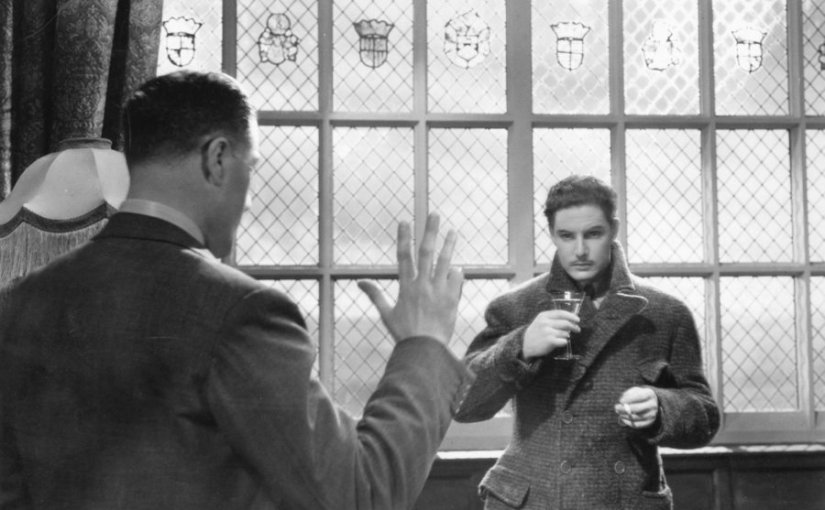
A Canadian gentleman named Hannay (Robert Donat) is in the audience and after a riot breaks out within the crowd and some gunshots go off, he’s escorting a mysterious woman back to his flat. She hides from the windows, away from the light and is fearing for her life because of what she knows about The 39 Steps. She also accurately points out two men down below on the street who have been following them. When she awakens Hannay in the middle of the night with a knife in her back, he is suddenly on the run, trying to make it to Scotland with what few clues she has shared with him. However, he’s also become a prime suspect in her murder. The police are after him. These two men are following him and who knows who else is on his tail relation to the 39 steps. This foreigner is now up against an entire country that offers no friends and only suspicions. Alfred Hitchcock relishes in drowning his characters within whatever can be sinister.
Though I have not seen the picture in decades, I’ve never forgotten the secret of The 39 Steps. This recent viewing (on a superb Criterion print) offers moments that are near copies of films that had yet to come.
Ian Fleming declared that without the invention of the suave, well dressed and sarcastic Mr. Hannay there would be no James Bond. A woman’s scream upon discovering a murder victim is reminiscent of a scene transition from Spielberg’s The Lost World: Jurassic Park. Black Widow and Captain America evade secret agents the same way Hannay does with a woman named Pamela (Madeleine Carroll) who he inadvertently encounters on a train. How many times have you seen two characters handcuffed together while on the run? Plenty, right? (The Defiant Ones and I’m sure there’s an episode or two from Moonlighting or Starsky & Hutch). Here’s where the idea of such an inconvenience first took place. Of course, there’s Davis’ thriller with so many near identical scenarios like a foot chase through a chilly countryside to blending within the crowd of a town’s marching parade. The one-armed man from The Fugitive franchise of TV and film is seen here as a character with a deformity on one of his fingers. Both films even boast nail biting train scenarios, and pursuits that take to the air while the escapee flees down below on the ground.
Alfred Hitchcock tricks his viewer time and again. He will make you believe that the focus of his pictures carries an overwhelming weight. Often, they do. However, it’s of no consequence to reveal what must remain secret or concealed. Instead, his themes are to make sure his protagonists survive and evade. The 39 Steps is one of his first efforts he thematically became known for about an ordinary man getting entangled in undeserving threats of danger.
I directed a stage adaptation of The 39 Steps and the script, published in 2005, pays deliberate tributes to some of the most famous films from Hitchcock such as North By Northwest, Rear Window and The Man Who Knew Too Much. (Liberally, I incorporated my crew into the play and called them The Backstage Psychos.) The play is notable for its broad spoof treatments and the fact that only four actors are intended to play every character, and some props and pieces, within the story. It may teeter on satire, but it’s also a salute to Hitchcock’s career. Before any of his most famous films were conceived, The 39 Steps created some of the director’s most well-known set ups. While Hitch is a direct, or indirect, inspiration to modern filmmakers, he was also laying groundwork for what audiences would accept as shocking and eye-opening beginning with something as simple as a knife in someone’s back.
I was also impressed with the director’s use of the camera. The audience’s questions for Mr. Memory come at him fast, and Hitchcock moves his camera from row to row in a zig zag trajectory with a new extra ready with a demanding query as soon as the camera arrives on every face. You’d think this was Steadicam work, but this is nearly fifty years before that option was available. Alfred Hitchcock was daring enough to work beyond simplicity.
Wide shots of a small Hannay silhouette stumbling across the mountainous Scottish terrain allow for the pursuit to appear overbearing. The police close in, while a flying machine above is ready to bear down on the hero. Close ups during a dinner sequence at a farmer’s home are provided with alarming looks and eyes widening to spell doom and fear. Hannay’s need for caution while containing his paranoia uphold the suspence.
The 39 Steps is a picture that any film enthusiast should watch. When you see a Marvel movie or an Indiana Jones adventure or even an episode of Murder, She Wrote, you are apt to uncover staples and tropes you have become all too familiar with. Yet, what about when these ideas were fresh and new?
The 39 Steps is nail biting entertainment from the early twentieth century, ninety years ago. Despite its grainy black and white footage, its pursuit moves at a brisk pace with new encounters to overcome while a man tries to hide in plain sight. Again, it seems of utmost importance to discover the answers to a conspiracy wrapped in murder and secrecy. Actually, it’s the struggle to stay ahead and alive that hold you until the end.
You have watched movies like this before, but have you watched one of the first of this kind?
 2 UNPAID MOVIE CRITICS!!!!