
By Marc S. Sanders
As soon as composer Michael Small’s easy listening disco themes kick in and you see Gene Hackman make a u-turn in his green Ford Mustang convertible, I had vibes that Night Moves was going to operate like an episode of The Rockford Files. I was alert and energized. I liked where this was going. A new, undiscovered gritty 70s movie to sink my teeth in.
Gene Hackman is Harry Moseby, a perfect name for a private detective. Arthur Penn is the director in his second of three collaborations with the actor. The film starts off well for Harry. He’s giddily promiscuous and happily married to Ellen (Susan Clark), and he’s ready to take on a new case.
A Hollywood has been actress needs Harry to find and bring back her sixteen year old, runaway daughter named Delly (Melanie Griffith, in her debut role). Through a lead in the form of a young, punk kid (James Woods, in an early role), Harry flies out to the Florida Keys where Delly might have taken up with her step father.
Seems easy enough, but before he departs Harry does some personal investigating on the side and discovers that Ellen is having an affair with a guy named Marty (Harris Yulin). Harry’s carefree exterior is shattered. Quickly, he becomes bitter towards all he cared about, from his wife and his profession which serves a purpose of lifting the veil on sins and secrets.
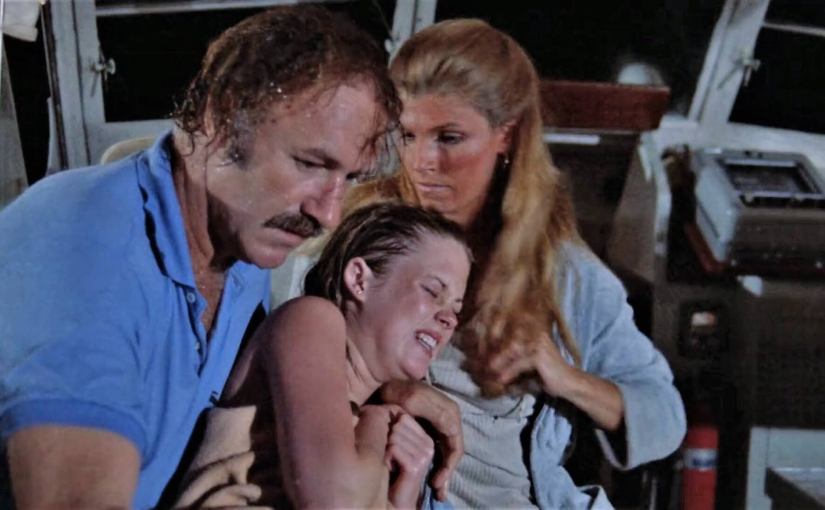
Night Moves performs with unpredictable directions and tempos. When Harry finds Delly with her step father Tom (John Crawford) and his younger girlfriend Paula (Jennifer Warren), the rundown boat dock where they reside seems relaxing and tranquil. Paula tends to a dolphin pen. There’s a plane that Tom uses for shipment trips. Drugs? Harry is not all that concerned. He’s only here to pick up Delly. A boat is there for fishing and swimming off of too. Delly feels welcome and independent here. Though as a teen she’s resistant to Harry’s obligation to return her to her mother in Los Angeles.
It’s only after he wraps up the case that unexpected twists occur and now he’s got to backtrack to find out what is really going among the ranks of these folks. In parallel succession, Harry and Ellen have to wade through their own sordid conflicts.
Watching the Criterion issue of Night Moves was really interesting. After seeing the film, I watched two different interviews with director Arthur Penn. There are lots of discoveries to find in the film all the way down the very last frame of the picture. However, the revelations of the mysteries are not told but rather shown. Dialogue hardly spells out this story. It’s what Arthur Penn allows you to see. He described it as explaining through a lens or view from a window, for example. As Penn speaks, Criterion edits in quick moments where mirrors and windows that were woven into the final cut of the film provide new information and answers. It’s a very clever strategy.
The sinister happenings of Night Moves are undetectable until Harry gets wise. It made me think of what Jake Gittes experiences in Chinatown. The new assignment seems so easy. An open and shut case until the complexities surface from under water or even high above.
What separates Night Moves from the Mickey Spillane gumshoe stories or Chinatown and The Maltese Falcon for example, is that Harry Moseby’s personal hell interferes with an occupation where he’s meant to serve from outside of all of the sordidness. Harry won’t slack on his case, but he still has to grapple with a sudden broken marriage that he is so capable of uncovering from his wife and her bumbling lover. He’s not a loner like Sam Spade, Jake Gittes or Mike Hammer. He’s opted to open his own private practice and dig into others personal conflicts and misgivings. On the side, he wants a happy home life. Problem is he is just too damn good at what he does. So, he’ll get hurt. It’s the cost of his talents.
This is a great performance from Gene Hackman. He seems like a put together Jim Rockford in the form of James Garner. Yet, when the film steers into the tsunami of its conflicts, this character splinters apart. Hackman has always been good at evoking strength and confidence in the romances and adventures his characters get into as well as with their various occupations. He’s also a dynamo at showing how his characters crack and become undone (Crimson Tide, The Conversation, The French Connection).
The supporting cast of lesser known but familiar character actors are collectively stellar as well. Sharing scenes with Hackman only makes them look more engaging and natural in either their privileged Hollywood, California habitats or the earthy locales of Florida islands. Arthur Penn assembles this whole cast in great footage and sequences.
Whether it’s a trip to Florida or back to California, a late night personal stake out and break-in at an ocean beach house, a visit to a film set, or a moonlit boating venture in the Keys, Alan Sharp’s script never foreshadows what’s too come. Thus, Night Moves offers a verity of the sinister and complex. Just when you think you don’t need to carry much thought with the picture, it suddenly begins to challenge you.
Night Moves will have you believe it gets its title from how Harry plays the strategies of two celebrated chess champions against one another. He explains to Paula, that while it may seem that the players are three moves ahead of each other, they’re really not. Instead, there’s play going on beyond a standard trap of check or checkmate. When everything is laid out to the very last second, it all makes sense even if Harry never had the instinct to think of any likely scenario before.
Was I a little vague with you just now?
Good.
That’s how Night Moves serves its audience best. A stunning, unpredictable thriller.
 2 UNPAID MOVIE CRITICS!!!!