
By Marc S. Sanders
September 5 is a sweeping account of how breaking news used to be assembled. You had to be in the right place at the right time. If you weren’t, then perhaps the sports department of your media conglomerate is, and they will get the story.
The very first televised terrorist attack was broadcast at a sadly appropriate time. The 1972 Olympics were being covered by the ABC television network. For the first time, homes all across the world would be able to watch the games in color, from a satellite feed shared among the big three networks. ABC had the broadcasting rights to the games though. The setting is especially interesting to this story. The Olympics are being hosted by Germany, primarily out of Munich. This is an opportunity for the country to finally redeem itself, only twenty-seven years after World War II had come to an end and their country’s Nazi regime had been overthrown. Germany had a lot to make up for.
The Sports Division of ABC news turn over in the wee hours of the morning of September 5. Geoffrey Mason (John Magaro) slumps into the studio and relieves Roone Arlege (Peter Sarsgaard) following long hours of editing and covering competitions in swimming, volleyball, boxing, track and so on. There’s minimal staff on shift as the athletes and coaches are asleep for the night, but then Geoffrey and crew believe they hear machine gun fire out of the direction of Olympic Park, and suddenly everyone is awakened and scrambling to put together the story fast.
No other broadcasts are reporting on this alarming incident. This is a story that comes at ABC Sports in their own time. Had this happened today, amid an age of worldwide shrinkage with the existence of the internet, these guys would have been way behind. In 1972 however, they can rely on Mariane Gebhardt (Leonie Benesch) a female German flunky of the sports division to translate the various radio communications between the terrorists and the German negotiators, and what plans are being put in place. Nine Israeli athletes have been taken hostage in their hotel rooms with two believed to have already been killed. The terrorists (believed to be a Palestinian militia group called Black September) demand that Israel release two hundred of their prisoners or they will kill a hostage every hour beginning at noon.
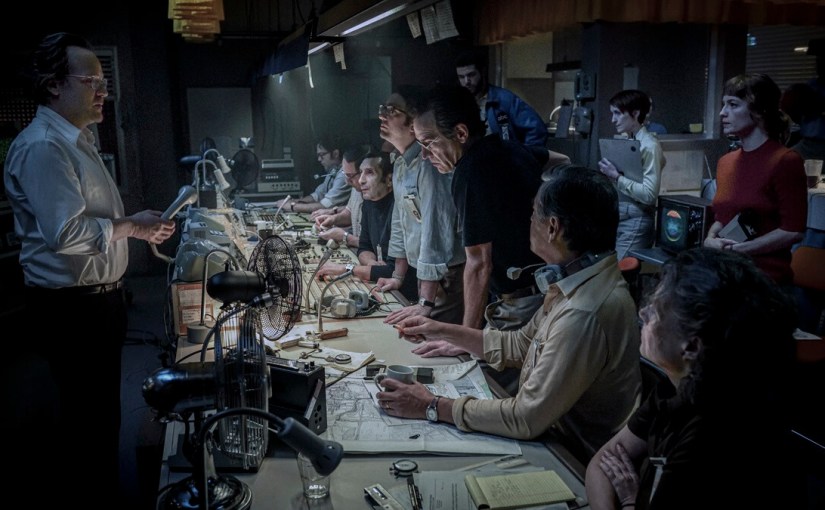
Forgive the cliché terminology, but September 5 is a taut, nail biting, documentary style thriller told only through the perspective of the ABC Sports division. While the developments of the hostage situation feel urgent, for these unshaven guys in glasses and wrinkled shirts who are operating on little sleep and a lot of coffee, it is about getting the news out quickly and accurately, and just as importantly, first. Geoffrey and Roone are constantly on the phones trying to learn whatever they can from Peter Jennings, the eventual famed ABC reporter, who is nearby the incident and at times hiding from the German police who are desperately trying to clear the area of the press. The guys even send in a staff member with a smuggled camera and reels of film taped to his belly while he poses as an Olympic weightlifter. The Germans forbid the press from trespassing but insist the games carry on. So, the athletes and coaches are the only ones who can enter the area to prepare for competitions of the day. Even Howard Cosell happens to be in a hotel staircase nearby and can provide feedback.
In the news control room, the guys are literally putting walkie talkies next to microphones that broadcast live on air with Jim McKay who is behind the desk, talking to the world. This is bare bones news broadcasting with unsophisticated technology to aid them in this short window of time. The director of this film, Tim Fehlbaum, brilliantly captures the desperate inconveniences of reporting this way.
Roone and Geoffrey also have to contend within their own ranks. This is not a sports story. This is a news story and so Roone must insist on keeping the story. They are the only ones there. How much more effective would a news division located on the other side of the world fare? Therefore, Roone’s team are the only ones qualified to cover this developing story. ABC News will not have access to this.
Roone also has to improvise how the satellite feed is shared with their competitor, CBS Sports. It’s a pain in the ass inconvenience and yet the resourcefulness and quick thinking of the control room staff find a way to uphold their claim on this story.
While watching this account, it matters little if we know the outcome of the September 5, 1972, Munich attack. This film’s purpose is covering how the first few who knew about the situation responded. By the time the ninety-five-minute film is over a lot has been shared. Tim Fehlbaum, with an Oscar nominated screenplay written by him along with Moritz Binder cover quite a bit. The pace moves as fast as these people in the control had to move on that terrible day. So, the information comes quick. With real life archived ABC footage spliced within the film, you feel as if you are standing in the corner of this dark room with various tv screens, microphones, and telephones.
You watch John Magaro feed information to Jim McKay, and then the picture cuts to real life footage of McKay at the desk. It’s quite inventive how the script is accommodated to work in line with what Jennings, Cosell, McKay and others literally said as the crisis was being reported.
Having seen all ten Best Picture nominees for 2024, it is disappointing that September 5 did not make the cut. Tim Fehlbaum’s picture certainly deserves more recognition and a slot over other contenders this year. Still, the screenplay is a well-deserved accolade. To interweave a fresh script that hinges on what was literally said on television screens around the world at that time is a marvelous strategy.
September 5 is a crackling thriller of a terribly sad day.
 2 UNPAID MOVIE CRITICS!!!!