
By Marc S. Sanders
Wolfgang Peterson demonstrated how much suspense he can squeeze out of the tightest of movies when he embarked on filming one of the most realistic and famous submarine movies of all time, Das Boot (translated as The Boat).
During World War II, a German U-Boat is assigned to carry out missions of war within the deep Atlantic. The purpose is simply for attack and never to question motivations or reasons. Because these Nazi sailors have no concept of the politics or the totalitarianism behind the Führer, it is not hard to empathize with their plights at sea. Life on a submarine is no party.
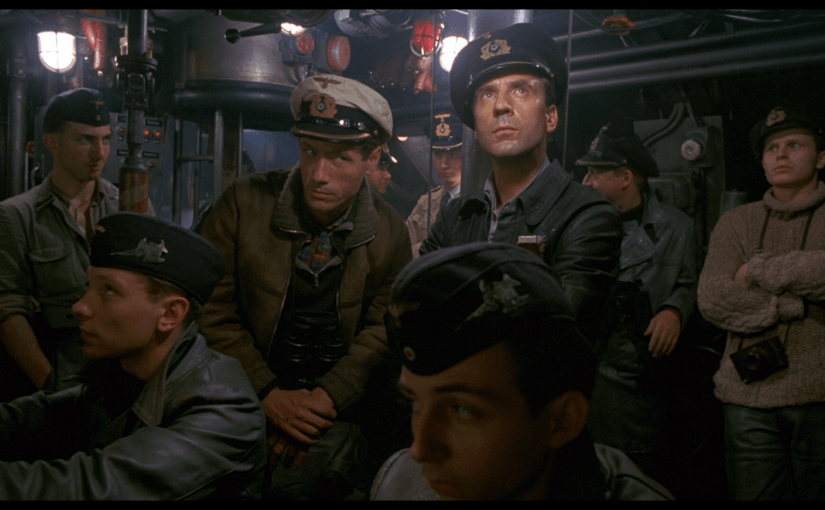
The Captain of the vessel is played by Jürgen Prochnow, the only recognizable actor in the whole cast. However, all of these men are working just to get by one more day within the very narrow confines of the sub. In fact, the main character is the submarine. Rarely has a setting been so evident. I was told that Peterson used miniature cameras, rare for use in the late 1970s when the film was shot. He would tightly hold the projector and pursue his cast of shipmates down one galley way after another. He’d put the camera right up against their face and profiles. The concentration of these actors to ignore the filming is astounding. Wolfgang Peterson provides a very clear documentary style to the piece. Herbert Grönemeyer portrays a war correspondent, easily used within the context of the story to accept Peterson’s approach of simply witnessing the activities and claustrophobia aboard a boat that is primarily under hundreds of feet of ocean water.
To my knowledge, Das Boot is a fictional story loosely based off of accounts from an actual military journalist who was aboard a similar cruiser during the war. I suppose the film could have been told from an Allies perspective rather than the Axis German superpower. However, the film works and as a viewer, as you become more engrossed in the picture, you become blinded to the fact that these men served Adolph Hitler. There’s hardly a swastika in the film. So, I’m seeing men like any other cadets and officers serving a military branch, working to survive while completing the assignments bestowed upon them.
The torment comes in all forms. The controls are old and clunky. It gets very dark at times. The vessel does not move at a comfortably smooth pace. They have no choice but to eat rotten food. It is so bad that the bread turns blue or green. The men are unbathed and you can practically smell the stench of their body odor and the raw sewage that remains behind. Sleeping quarters are cramped and are never efficient.
There is such miniscule space available for these people to carry on. The top officers get their exclusive table, but they must get up and move out of the way during dinner, while seamen pass them by on their way to different stations. Luxury is not afforded for anyone. The beards of the men become longer. Wolfgang Peterson shot the film in sequence to accurately show the progression of their beards. It maintained proper continuity as their sojourn of the boat carried on.
Most agonizing is when the submarine attacks back at the crew. A long sequence of suspense occurs following a surprise attack from the air. The boat has dive into the depths of the ocean, but their controls are malfunctioning and they just continue to sink and sink. Nuts and bolts pop out of nowhere like ricocheting bullets as the water pressure gets heavier. My car or my smart phone is more technologically developed and capable than this sub, and I question how this clunker can even withstand the compression. To maintain balance and direction, the men have to race to the front or back of the ship applying their body weight to work like a scale.
Imagine the boat coming to a rest on a rocky perch hundreds of feet deep underwater. There is no propulsion or engine power. No communications either and the crew has less than a few hours left to survive among the carbon monoxide flooding the ship. It’s a helpless scenario and at multiple points during the movie, I was convinced this is how it will all end. Often, I was prepared not to be surprised how this all wrapped up at any given period of time. Das Boot is a long film. The special edition is over three and a half hours. So, you get a vibe of how stretched out this crew has been away, cramped in these quarters. Because Peterson stages these challenging scenarios to be extensive, you easily relate to the stress of these men.
War is hell, even for the Nazis. The Captain agonizes over a successful attack he’s accomplished when he takes out an American naval destroyer. He’s done his job well, but he’s angered as he witnesses the aftermath through his binoculars. Crewmen are set ablaze as they fall off the ship and into water below, and he wonders where the rest of their convoy has gone. Shouldn’t they be rescuing their men? This Captain is not a Nazi. He’s a pawn on a chess board, not assigned to think of the fallen, but rather to do what he is told, absent of questions or emotions.
I do not want to spoil the ending but I cannot recall feeling so much anguish for a collection of Nazi officers before. Another submarine movie was bold enough to say that the only true enemy in war is war itself and having watched Das Boot, I can clearly see the meaning behind that perspective. This is not a war picture where one side torments and personally tortures individuals before brutally killing them with gunshots to the head. In a submarine, the crew is somewhat blind to what they must attack. They are only aware of the environment that troubles them. The men of Das Boot don’t curse the Americans or the British, or the Jews. They show no prejudice. That’s not their mentality.
When I see them overcome one daunting challenge after another, I’m relieved for these Germans. They survived. They made it.
However, after watching for over three and a half hours, the final sequence and frame send me a cold, all to real reminder of what occurred during that terrible world war less than eighty years ago and it the film’s ending is the only way this picture could have ended.
Das Boot is a masterpiece of filmmaking.
 2 UNPAID MOVIE CRITICS!!!!
We saw the theatrical version in the theater, then bought the director’s cut which, as you say, is over three hours long. But the original TV edition is five hours long and is well worth watching. Unfortunately, it is only on DVD for Region 1/USA DVD players. But if you have a region free player, you can get the German or European Blu-ray of the 5-hour Das Boot. The more time you spend with these characters, which is what the 5-hour version gives you, the more you sympathize with the hell of their lives.
LikeLike